
Crawl Space Electrical Wiring Damage Repair in Minnesota
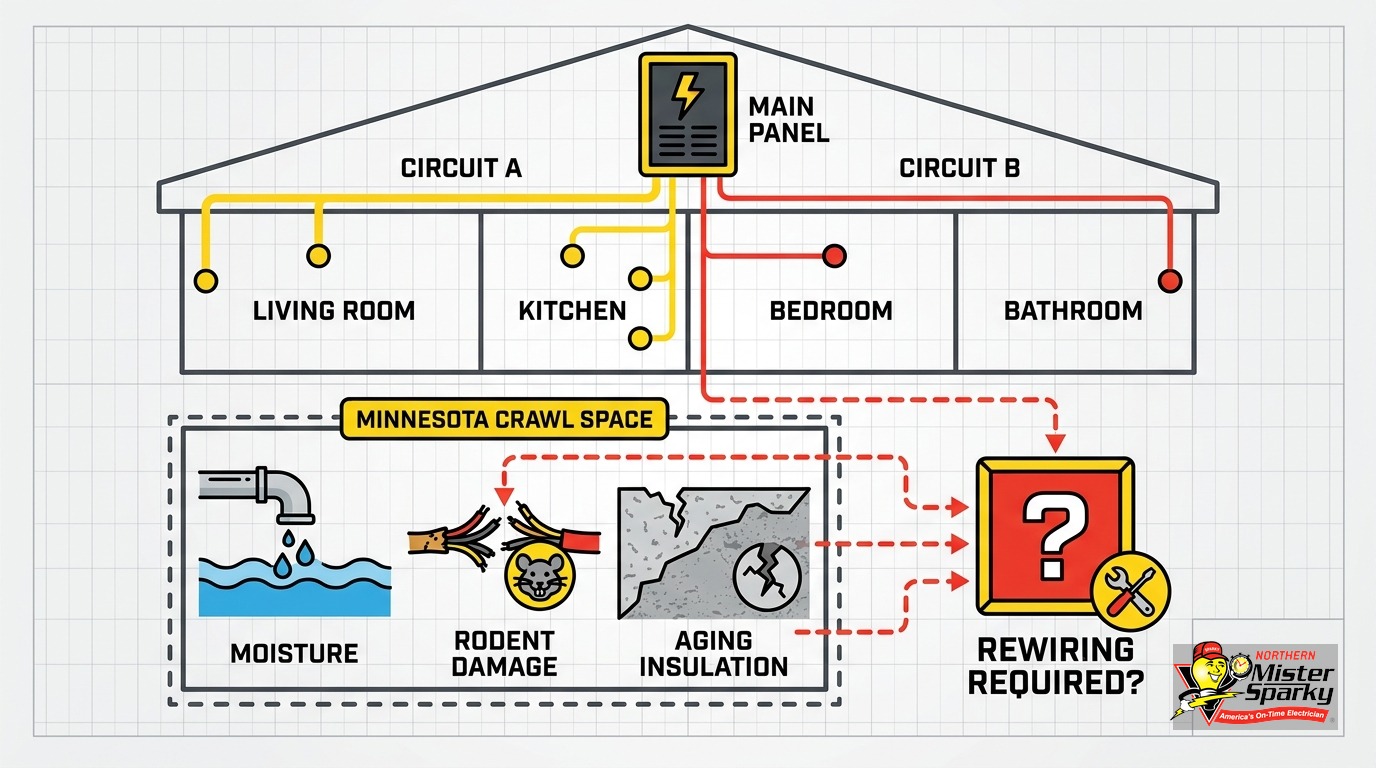
Key Takeaways
- Crawl space electrical wiring damage repair in Minnesota homes is driven by three forces: moisture from freeze-thaw cycling, rodent gnawing, and aging wiring that may never have been compliant for damp conditions.
- NEC 334.12(B)(4) prohibits standard NM (Romex) cable in wet or damp locations. Many Twin Cities crawl spaces qualify as damp locations. The compliance problem often predates any rodent or moisture damage.
- Minnesota experiences frequent freeze-thaw cycles per winter. That cycling keeps crawl spaces chronically damp and breaks down wiring insulation over time.
- GFCI protection is required for all receptacles and all lighting outlets in crawl spaces under NEC 210.8(A). Many older installations lack it.
- Knob-and-tube and aluminum branch circuit wiring each carry their own risks. Moisture or rodent damage layered on top changes the risk profile significantly.
- All crawl space electrical work requires a permit before work begins in Minnesota. Minneapolis and St. Paul each run their own permit offices.
- Call 763-200-5956 or book online to schedule your inspection.
Why Are Minnesota Crawl Spaces Especially Hard on Electrical Wiring?
Short answer: Minnesota averages roughly 86 freeze-thaw cycles per winter. Humid air enters crawl spaces each summer, then condenses repeatedly on cold surfaces through the heating season. That cycling keeps crawl spaces chronically damp, degrading wiring insulation, compressing fiberglass batts, and creating ideal nesting habitat for rodents.
Most content about crawl space wiring damage treats it as a rodent problem. In Minnesota, the bigger driver is moisture - and moisture that most homeowners never see.
Minnesota experiences frequent freeze-thaw cycles per winter season, measured one inch below grade from October through April. Here is what that cycle does to your crawl space. Humid summer air seeps in through foundation vents or gaps. When temperatures drop, that moisture condenses on cold surfaces - joists, pipes, and wiring. It dries out. Then it condenses again. Eighty-six times.
Over years, that cycling saturates fiberglass insulation batts. A wet R-19 batt can perform like an R-10 after repeated moisture absorption and drying in a Minnesota crawl space. Sagging, displaced insulation also creates nesting habitat for mice and squirrels. That connects the moisture problem directly to the rodent problem.
The result is a space that stays chronically damp. That changes what wiring is legal there, and it changes the risk level already present in your home.
Is Standard Romex Cable Legal in a Crawl Space?
Short answer: Often no. NEC 334.12(B)(4) prohibits standard NM cable (Romex) in wet or damp locations. Many Minnesota crawl spaces - especially those with dirt floors or persistent humidity - qualify as damp locations. That means many Twin Cities homes already have a code violation before any rodent damage ever occurs.
This is the gap that most online content about crawl space electrical wiring misses entirely. The compliance problem does not start with rodents. It often starts with the cable type itself.
Compliant alternatives for damp crawl spaces include Type UF-B (underground feeder), NMC (corrosion-resistant NM), or MC (metal-clad) cable. These are rated for damp environments. Standard NM is not.
Assume your crawl space qualifies as a damp location if it has any of the following:
- A dirt floor without a full vapor barrier
- Standing water after rain or snowmelt
- Visible condensation on pipes, joists, or wiring
- Fiberglass insulation that appears dark, sagging, or compressed
- A persistent musty smell in the basement or first floor
A licensed electrician can confirm the location classification and identify whether the installed cable type is compliant under Minnesota’s current adopted code.
What Does Moisture Do to Crawl Space Wiring?
Short answer: Moisture degrades plastic insulation jackets over time, leaves exposed conductors to corrode, and increases electrical resistance at damaged points. Higher resistance generates heat. In an enclosed space with wood framing nearby, that heat has nowhere to go safely.
Here is the sequence in a typical Twin Cities crawl space:
- Repeated moisture cycling degrades the outer plastic jacket on NM cable. It becomes brittle and cracks.
- Once the jacket cracks, inner conductors are exposed to damp air.
- Exposed copper corrodes. Corrosion increases electrical resistance at that point on the conductor.
- Increased resistance means more heat when current flows. A loose or corroded connection acts like a small resistor.
- If that heat point is near wood framing, dry insulation, or rodent nesting material, fire risk rises.
This process unfolds over years, not days. By the time a breaker trips or you notice a warm outlet, the damage is often extensive. Crawl space electrical wiring assessment requires a physical inspection of the space - not just a panel check from the utility room.
How Do Rodents Damage Electrical Wiring?
Short answer: Rodents gnaw on wiring because their incisors grow continuously - gnawing is biological necessity, not preference. Once insulation is stripped, you have bare conductors in a damp space. That combination is among the worst an electrician can find.
Research suggests rodent-damaged wiring contributes to a meaningful share of U.S. residential electrical fires. In a crawl space, that risk compounds because the damage often goes undetected for years.
What rodent damage looks like during a crawl space inspection:
- Outer jacket chewed through, with inner wires exposed
- Bite marks at multiple points along a single cable run
- Droppings concentrated near junction boxes or wiring runs
- Insulation gathered into nests against or around cables
- Circuits that trip repeatedly with no obvious overload
- Flickering lights tied to a specific circuit
Rodents do not discriminate by cable type. They will chew aluminum, copper, NM, and armored cable alike. Once the jacket is breached, the repair is not tape - it is cutting out the damaged section and splicing in new, code-compliant conductor. In Minnesota, that splice requires a permit and inspection.
If you are also dealing with an active pest problem, the right order is: pest removal first, then electrical assessment. We handle the wiring repair. A pest company handles the rodents. Both steps matter.
Knob-and-Tube and Aluminum Wiring: A Compounding Risk
Homes built before 1945 in Minneapolis, St. Paul, and the inner-ring suburbs frequently have active knob-and-tube (K&T) wiring. Homes built between the mid-1960s and late 1970s often have aluminum branch circuits. Both wiring types are common in Twin Cities housing stock. Either one, combined with crawl space moisture or rodent damage, is a substantially different risk profile than a modern copper-wired home.
Knob-and-tube wiring
The NEC prohibits K&T wiring from being surrounded by insulation, including loose fill batts and foam-in-place. K&T depends on open air circulation for cooling. Pack insulation against it, or let sagging damp batts press down on the conductors, and you remove that cooling path. In a crawl space where insulation is already failing from moisture, the two problems feed each other.
Most standard insurance carriers will not write policies for homes with active K&T wiring. Full rewiring costs vary significantly depending on home size and accessibility. Crawl space access is a significant cost variable - tight, wet spaces require more labor hours than open basements.
Our post on knob-and-tube wiring replacement covers what the full process involves and how to evaluate your options.
Aluminum branch circuit wiring
CPSC research found that homes with aluminum branch circuit wiring are 55 times more likely to have fire-hazard conditions at connections than copper-wired homes. Aluminum expands and contracts more than copper with temperature changes. Connections loosen over time.
In a Minnesota crawl space, that thermal cycling is accelerated. Cold winters and warm summers mean more expansion and contraction cycles per year than most other climates. Add corrosion from moisture, and loose connections become hot connections. Our post on aluminum wiring dangers and fixes covers the full picture, including approved remediation methods.
When Does Crawl Space Electrical Work Require a Permit in Minnesota?
Short answer: Always. All electrical repair, replacement, or new work requires a permit before work begins in Minnesota. There is no exception for crawl space access, minor repairs, or replacing a single damaged cable section.
Authority having jurisdiction (AHJ) varies across the Twin Cities metro:
- Minneapolis homeowners: permit through the City of Minneapolis electrical permit office - not the state DLI system
- St. Paul homeowners: permit through DSI (Department of Safety and Inspections)
- Suburban homeowners (Bloomington, Maple Grove, Woodbury, Blaine, Brooklyn Park, Edina, Plymouth, and most other suburbs): permit through MN DLI
Code transition note: Minnesota adopted the 2026 NEC effective August 17, 2026. Permits filed before that date must comply with 2023 NEC. Permits filed on or after that date must comply with 2026 NEC. If your repair was recently quoted, confirm which code cycle governs the work.
A rough-in inspection is required before any wiring is concealed under Minnesota Administrative Rules. If work is covered before inspection, the homeowner or contractor bears the full cost of uncovering it.
Unpermitted crawl space electrical work creates three downstream problems: insurance exposure, sale complications (unpermitted work surfaces on pre-sale inspections and can kill deals), and personal liability if a fire starts at the unpermitted repair. We pull the permit on every job. Our post on electrical permits in Minnesota explains what the process looks like before we talk.
What Does a Crawl Space Electrical Inspection Include?
Short answer: A licensed electrician checks cable type and location classification, physical condition of insulation jackets, GFCI coverage, junction box accessibility, wiring era, and evidence of rodent activity. The goal is a complete picture - not just the damaged section you already know about.
A thorough inspection covers these areas:
Cable type and damp-location compliance. Is the installed cable rated for the moisture level present? Standard NM in a confirmed damp crawl space is a code violation on its own, independent of any damage.
Physical jacket condition. Cracked, brittle, or chewed outer jackets. Bare conductors. Splices made outside of accessible junction boxes.
GFCI coverage. Under NEC 210.8(A), GFCI protection is required for all receptacles and all lighting outlets in crawl spaces. This coverage expanded with the 2020 NEC. Many older installations lack it.
Junction box accessibility. All connections must be in accessible, covered boxes. Buried splices under insulation are a code violation regardless of moisture or damage.
Wiring era. If K&T or aluminum branch circuits are present, the inspection scope expands. K&T covered by insulation and aluminum connections showing heat discoloration both need immediate attention.
Pest evidence. Droppings, nesting material, gnaw marks. This determines whether full cable sections need replacement or whether targeted repairs at specific damage points are sufficient.
After the inspection, you receive a written scope of work with the permit requirement attached. No surprises after the fact.
Signs You Need Crawl Space Electrical Wiring Damage Repair Now
Do not wait for a dead circuit to prompt an inspection. These warning signs mean call this week, not next spring:
- Breakers tripping with no clear overload. A circuit running through the crawl space trips repeatedly with nothing unusual drawing power. That points to a fault in the run, not an overloaded panel.
- Flickering lights on one circuit. Flickering usually means a loose or corroded connection. In a crawl space context, that is often a damaged splice or junction.
- A burning smell near an outlet or the panel. A burning smell from an outlet or breaker is urgent. Stop using that circuit and call the same day.
- Visible moisture or standing water in the crawl space. Even if wiring looks intact, wet conditions mean the clock is running on your insulation jackets and any NM cable in the space.
- You know you have K&T or aluminum wiring. If either system is present and the crawl space has seen moisture, schedule a current-condition inspection.
- Rodent evidence anywhere in the house. Mice do not stay in one room. If they have been in the kitchen or attic, they have almost certainly been in the crawl space.
- You are buying a home built before 1980. Pre-purchase electrical inspections routinely surface crawl space problems the general inspector flagged but did not scope. Knowing what you are buying before you close is far cheaper than discovering it after.
Two or more of these apply? Schedule the inspection before anything else.
What Crawl Space Electrical Wiring Damage Repair Typically Involves
Once an inspection defines the scope, here is what the repair process looks like for most Twin Cities homes:
Damaged section replacement. We cut out chewed or deteriorated cable, splice in new conductor of the correct type (UF-B or MC cable for damp-location compliance), and house all splices in accessible, covered junction boxes. Each replaced section goes through permit and inspection before it is closed in.
Cable type upgrade. If existing NM cable runs through a confirmed damp location, we replace it with a compliant alternative. This is not optional once a permit is pulled. The inspector will flag non-compliant cable types at the rough-in stage.
GFCI upgrade. If crawl space receptacles or lighting circuits lack GFCI protection, we add it as part of the repair scope. This brings the installation into compliance with current NEC requirements.
Aluminum connection remediation. If aluminum branch circuits are found, the standard repair is COPALUM crimp connectors or AlumiConn connectors at every device and splice - not just in the crawl space, but throughout the affected circuits.
K&T assessment and rewiring plan. If active K&T is found in the crawl space, we discuss the full rewiring scope together. Partial K&T repairs are possible but limited in what they can resolve long-term. Insurance carriers and buyers at resale increasingly require full replacement. We will be straight with you about what your specific home needs - no malarky.
For larger scopes like full K&T rewiring, financing is available. Ask when you call.
Schedule Crawl Space Electrical Wiring Damage Repair Today
Moisture and rodents work year-round in Twin Cities crawl spaces. Minnesota winters accelerate both. Waiting until spring does not reduce the risk - it extends the time your wiring goes unprotected.
We are locally owned and operated in the Twin Cities. As America’s On-Time Electrician(R), we show up on time, pull the permit, and back every job with the UWIN(R) 100% satisfaction guarantee.
Call 763-200-5956 or book online to schedule your inspection today.
Frequently Asked Questions
Is Romex cable legal in a Minnesota crawl space? +
Do I need a permit for crawl space electrical repair in Minnesota? +
What are the warning signs of damaged crawl space wiring? +
Need an electrician now?