
Crawl Space Dehumidifier Outlet Installation: MN Guide
Key Takeaways
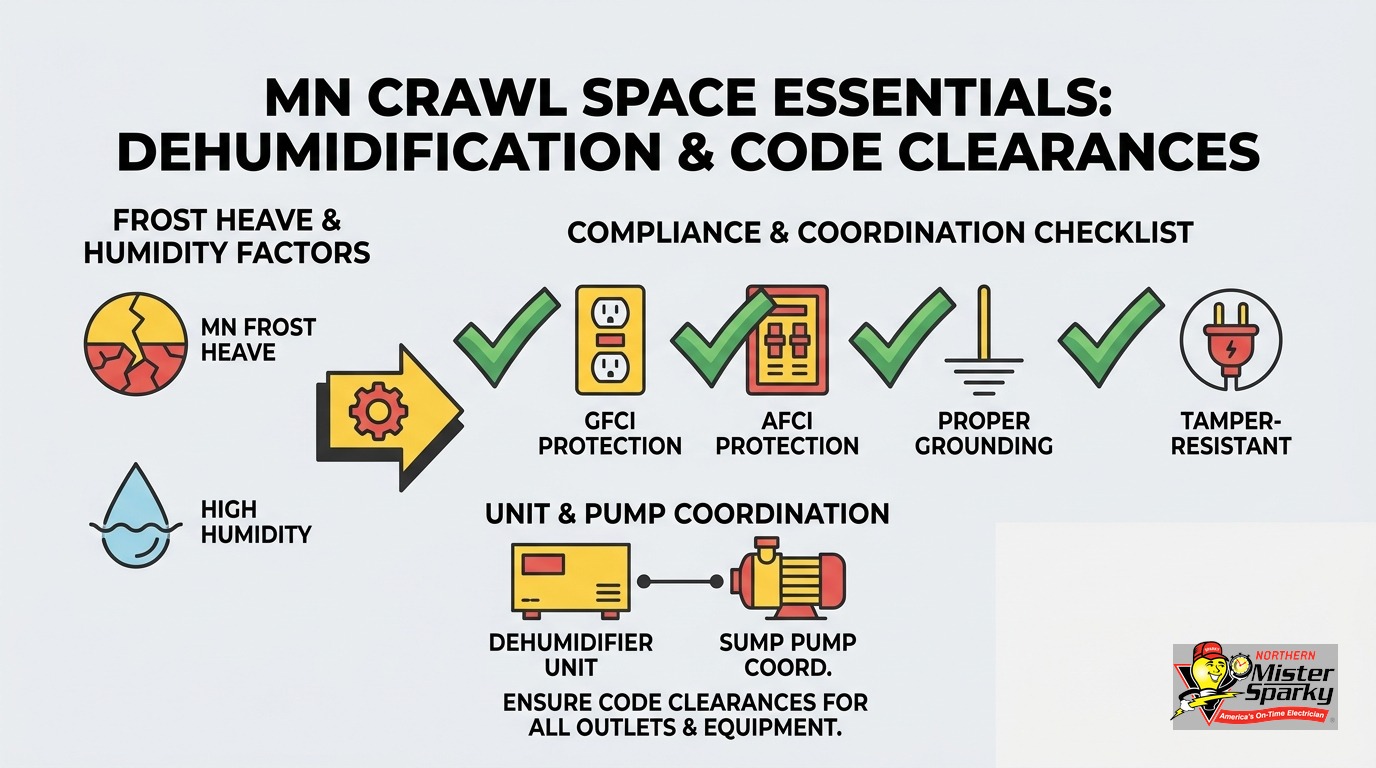
- Minnesota’s NEC adoption requires GFCI protection on all crawl space receptacles. There are no exceptions for dedicated circuits.
- A permanently installed crawl space dehumidifier in a closed or unvented crawl space requires a dedicated electrical outlet by code, not just by recommendation.
- The dehumidifier and sump pump must run on separate circuits. Sharing one creates nuisance tripping and load conflict - exactly when both are working hardest.
- A GFCI breaker at the panel beats a GFCI receptacle buried in the crawl space. You want the reset point somewhere you can reach.
- Any new crawl space outlet requires a permit under Minn. Stat. § 326B. Filing with the wrong Authority Having Jurisdiction can trigger reinspection fees.
- Trade practice is to mount the outlet at least 18 inches above the crawl space floor to stay above condensation and standing-water lines.
Why Minnesota Crawl Spaces Stay Wet Year-Round
Minnesota’s frost depth tells the whole story. The Twin Cities metro sits in a deep frost depth zone, and northern counties reach even greater depths. That frozen ground acts like a lid from December through March. Snowmelt and spring rain cannot drain down through frozen soil. The moisture has nowhere to go except up - through the crawl space floor and foundation walls.
The soil type compounds the problem. Twin Cities clay-heavy soil holds moisture far longer than sandy soil after snowmelt and rain. Clay creates sustained vapor pressure against foundation walls from roughly March through June. Summer rain events keep that pressure going. A Minnesota crawl space never fully dries out on its own.
That sustained moisture load is why a dehumidifier in a closed or unvented Minnesota crawl space is a year-round appliance. It is not a device you plug in during August and unplug in September. It runs continuously, it draws significant power, and it needs electrical infrastructure that matches that job.
The product guides from dehumidifier manufacturers cover placement and drainage routing. None of them explain the permit requirements, the GFCI rule with no exception, or the sump pump circuit conflict. That gap is exactly what this post covers.
Does a Crawl Space Dehumidifier Need Its Own Dedicated Circuit?
Yes. In a closed or unvented crawl space, Minnesota building code requires a permanently installed dehumidifier rated at minimum 15 pints per day. Code also requires a dedicated electrical outlet for that unit. The Minnesota Commerce Department crawl space guidance makes the dedicated outlet a mandate for closed-crawl-space construction - not an upgrade, not a recommendation.
A dedicated circuit means the circuit serves only the dehumidifier. Nothing else shares the breaker - no light fixtures, no convenience outlets, no other appliances. Dehumidifiers cycle their compressors on and off throughout the day. Each startup draws a surge of current well above the running draw. A shared circuit is not sized for that surge alongside other loads.
The standard for a crawl space dehumidifier circuit is a 20A dedicated breaker feeding a 20A outlet. A 15A circuit is undersized for most units rated at the code-minimum 15 pints per day or above. Size up from the start.
If you are also running conditioned air into a closed crawl space, the electrical rough-in for both systems should be planned together. Running back into a finished crawl space to add a circuit costs more than doing it in one visit.
What Does the 2023 NEC Say About GFCI in Crawl Spaces?
All 15A and 20A 125V receptacles in crawl spaces at or below grade require GFCI protection. No exceptions exist for dedicated circuits. This requirement comes from the NEC, and Minnesota has adopted the current NEC standards. Every permit filed on or after that date must meet 2023 code.
This is the section that catches homeowners and, occasionally, contractors still working from memory of older code. The common assumption runs like this: a dedicated circuit is a safer, cleaner circuit, so it does not need GFCI. That assumption is wrong under current Minnesota code. The 2023 NEC applied the crawl space GFCI requirement across the board - dedicated circuits included.
The 2023 NEC also went further than previous editions. NEC 210.8(D), new in the 2023 edition, extends GFCI protection to hardwired appliances as well, including sump pumps. The same requirement appears at 422.5(A)(6). The old workaround of hardwiring an appliance to skip the GFCI requirement is gone.
If a contractor quotes you a crawl space installation and does not mention GFCI, ask directly. If they reference the 2020 NEC, ask why. Minnesota adopted the 2023 edition. Any permit pulled after July 1, 2023, must comply with it.
One practical note: Minnesota has about 66 cities that operate as their own Authority Having Jurisdiction rather than deferring to the state DLI. Some of those cities have adopted local amendments. A few have added sump pump exceptions; others have not. Your licensed electrician verifies local amendments before the rough-in, so nothing surprises the inspector.
Can You Put the Dehumidifier on the Same Circuit as the Sump Pump?
No. This is one of the most common crawl space electrical mistakes we see, and it creates a real problem during exactly the conditions when both appliances need to work. A dehumidifier and a sump pump on the same circuit risk nuisance tripping - and a sump pump that fails to restart is a flooded basement.
Both appliances draw heavy starting current when their motors kick on. During a heavy spring snowmelt, both may start within seconds of each other. That combined surge can trip the shared breaker. In a cold Minnesota spring, the sump pit can fill faster than you expect if the pump is not running.
The field solution is separate dedicated circuits for each appliance. The sump pump gets its own 20A circuit with a GFCI breaker at the panel - not a GFCI receptacle at the pump, for reasons covered in the next section. The dehumidifier gets its own 20A circuit with a GFCI breaker at the panel. Two breakers, two circuits, two appliances that will never fight each other for amperage.
For a full look at sump pump circuit requirements, see our post on sump pump dedicated circuit installation.
Crawl Space Dehumidifier Outlet Installation: Where Should the Outlet Go?
Mount the outlet near the dehumidifier, at least 18 inches above the crawl space floor. No NEC section specifies a minimum height for crawl space receptacles, but trade practice and inspection guidance consistently land at 18 inches to keep the outlet above typical condensation and standing-water lines.
In a wet Minnesota crawl space before the dehumidifier is running, moisture collects on the floor and lower walls. Mounting an outlet lower than 18 inches invites GFCI nuisance trips from water intrusion before the system even gets to do its job. Mounting higher also makes the outlet easier to see and reach during maintenance checks.
A few other placement factors matter during a crawl space dehumidifier outlet installation:
- Cord reach. The dehumidifier’s power cord should reach the outlet without extension cords. Extension cords are not a code-compliant permanent solution for an always-on appliance.
- Drain routing. Most crawl space dehumidifiers drain to the sump pit by gravity or pump. Plan the electrical run and the drain hose route at the same time. Neither should interfere with the other or with access through the space.
- Wire gauge and run length. A 20A circuit on a short run from the panel uses 12 AWG wire. A long run may require 10 AWG to keep voltage drop within acceptable limits. Your electrician calculates this based on the actual distance.
- Wire protection. Exposed NM-B cable lying on a crawl space floor or stapled low on joists can be damaged during maintenance access. Many installers run conduit in crawl spaces to protect the cable. Check local code on whether conduit is required in your jurisdiction.
Getting the outlet location right at rough-in saves rework. A dehumidifier that cannot drain freely, or a cord that barely reaches the outlet, creates problems the homeowner notices immediately.
GFCI Breaker vs. GFCI Receptacle: Which One Belongs in Your Crawl Space?
For a crawl space dehumidifier circuit, a GFCI breaker at the panel is almost always the better choice. The reason comes down to one word: access.
A GFCI receptacle resets at the outlet. In a crawl space, that means belly-crawling into a cold, damp space to press a small button every time the GFCI trips. If the GFCI trips overnight or while you are traveling, the dehumidifier is off until someone physically resets it. Moisture continues to build. That defeats the purpose of having the appliance.
A GFCI breaker resets at the panel. The panel is in a utility room, basement hallway, or garage. You push the breaker reset, the circuit comes back up. No crawling required.
The cost difference between a GFCI breaker and a standard breaker is real but modest. For a crawl space circuit where access is genuinely difficult, paying for a GFCI breaker is the right call. We recommend GFCI breakers at the panel for both the dehumidifier circuit and the sump pump circuit in crawl space installations.
For more on where GFCI protection is required throughout the home, see our post on GFCI outlet requirements.
What Does the Installation Look Like?
A crawl space dehumidifier outlet installation is one visit for a licensed electrician. Here is the typical sequence:
- Site assessment. The electrician checks panel capacity, identifies the best route for the new circuit, and confirms local AHJ requirements.
- Permit filing. The permit gets filed with the correct authority - state DLI or the local city, depending on your municipality - before work begins.
- Circuit rough-in. The electrician runs the circuit from the panel through the floor system and into the crawl space. Wire gauge and conduit requirements are determined by the run length and local code.
- Outlet installation. The outlet is mounted at least 18 inches above the floor, near the dehumidifier location. The GFCI breaker is installed at the panel.
- Inspection. The inspector verifies the circuit sizing, GFCI protection, outlet placement, and wire protection. This step is required; skipping it means unpermitted work.
- Connection. Once the inspection passes, the dehumidifier is plugged in and tested.
Most installations are complete in a half-day. Homes with older panels that are already near capacity may need a panel assessment before the new circuit can be added.
Do You Need a Permit for Crawl Space Electrical Work in Minnesota?
Yes. Any new circuit or outlet installation in Minnesota requires a permit under Minn. Stat. § 326B. Crawl space work is not exempt. This applies whether the job is a single outlet or multiple new circuits.
The permit and inspection process exists for good reason. An inspector verifies GFCI protection, circuit sizing, wire gauge, and outlet placement. A crawl space that floods and damages uninspected wiring is an insurance problem. Unpermitted electrical work also surfaces at home sale - inspectors find it, buyers use it as leverage, and price reductions follow.
Minnesota’s permit landscape has a detail worth knowing. About 66 cities in the state serve as their own Authority Having Jurisdiction rather than filing with the state DLI. Minneapolis, St. Paul, and many suburbs have their own inspection departments. Filing a permit application with the wrong body does not stop the clock. It costs time and can trigger reinspection fees when the correct authority eventually gets involved.
A licensed electrician knows which body governs your address. They file the permit as part of the job, schedule the inspection, and are present when the inspector comes. That is the clean path.
Homeowners can pull their own permits in Minnesota for a single-family home they own and occupy. The electrical work still must meet code, and the inspector still comes out. Most homeowners find that letting the electrician handle both the work and the permit is the more straightforward option.
For a full walkthrough of Minnesota’s electrical permit process, see our post on electrical permits in Minnesota.
Signs Your Crawl Space Wiring Already Has Problems
A crawl space dehumidifier outlet installation is also a good time to have the rest of the space’s existing wiring looked at. Crawl spaces are hard to access and easy to ignore - which means problems often go unnoticed for years.
Watch for these during any crawl space visit:
- Outlets without GFCI protection. If your crawl space already has receptacles and they are not GFCI-protected, they do not meet current code. Any electrician doing new work should flag unprotected outlets.
- Corrosion on junction boxes or wire connections. Moisture and metal connections do not mix. Corroded splices create resistance, which creates heat.
- Chewed or damaged cable insulation. Rodents access crawl spaces. Damaged insulation is a fire and shock hazard.
- Wire run without conduit or protection. Exposed cable lying on the floor or stapled low on joists can be damaged during routine maintenance access.
- Unfamiliar panel connections or DIY wiring. A previous owner’s unlicensed work sometimes shows up for the first time during a crawl space visit.
Our post on crawl space electrical wiring damage covers the full inspection checklist.
Ready to Schedule the Work?
We are locally owned and operated in the Twin Cities. We pull permits, we know the 2023 NEC requirements, and we know which Minnesota cities are their own AHJ. Our team has done crawl space electrical work from Minneapolis and St. Paul to Maple Grove, Woodbury, Bloomington, and Blaine.
A crawl space dehumidifier outlet installation is a one-visit job: dedicated 20A circuit, GFCI breaker at the panel, outlet at the right height, permit filed, work inspected. We do it right the first time. No malarky.
For larger crawl space projects - running multiple circuits, combining this work with a panel upgrade, or addressing existing wiring damage - financing is available. Ask when you call.
Call us at 763-200-5956 or book online to schedule. We are America’s On-Time Electrician(R), and every job is backed by the UWIN(R) 100% satisfaction guarantee.
Frequently Asked Questions
Does a crawl space dehumidifier outlet need GFCI protection in Minnesota? +
Can a crawl space dehumidifier share a circuit with the sump pump? +
Do I need a permit to add a crawl space outlet in Minnesota? +
Need an electrician now?