
Window Air Conditioner Dedicated Circuit: Twin Cities Guide
Key Takeaways
- A window air conditioner dedicated circuit is required when the unit draws more than 50% of its circuit’s rated capacity under NEC rules.
- A 10,000 BTU window unit pulls 12A running and surges above 20A at compressor startup. A shared 15A bedroom circuit was never designed for that load.
- Minnesota adopted the 2026 NEC effective August 17, 2026. Permits filed after that date are governed by the updated code, including current GFCI and AFCI requirements.
- Bedroom dedicated circuits in Minnesota require AFCI protection at the breaker. A standard breaker does not meet code.
- A new dedicated 20A circuit typically costs $400 to $800 in the Twin Cities, permit and both inspections included.
- Xcel Energy does not offer rebates for window AC units. A ductless mini-split qualifies for up to $1,500 in Xcel rebates plus a 30% federal tax credit.
- If your panel has no open slots, making room is a prerequisite. Options include tandem breakers, a subpanel, or a panel upgrade.
Why Does My Breaker Keep Tripping When the Window AC Runs?
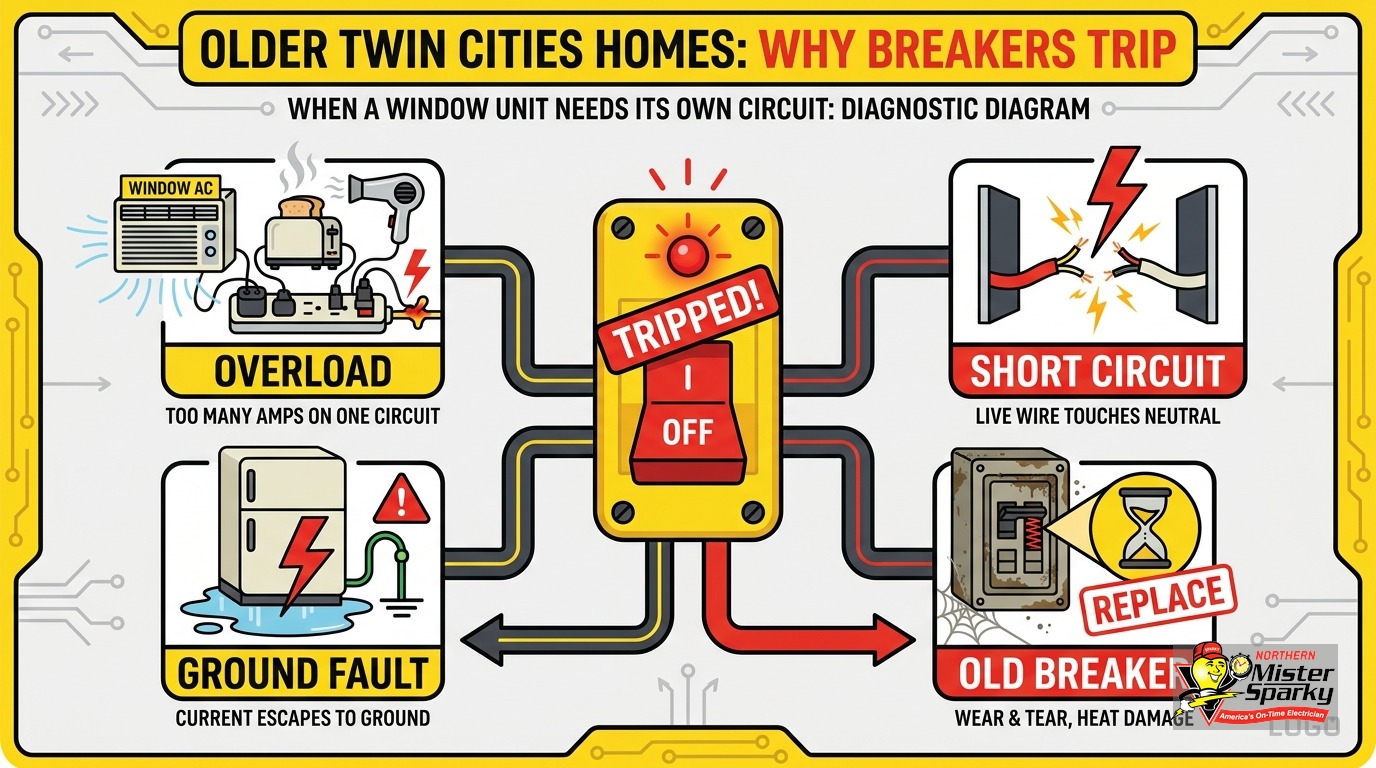
Short answer: Your window unit is drawing more current than the shared circuit can safely deliver. The compressor’s startup surge spikes far above the circuit’s rated capacity, and the breaker trips to protect your wiring from overheating. It is doing its job correctly.
Your bedroom circuit is almost certainly a 15A branch. In a Minneapolis or St. Paul bungalow or Cape Cod built in the 1940s through the 1960s, that circuit typically feeds the overhead light, every outlet in the room, and sometimes the hallway too. These homes were wired before residential air conditioning was common. Bedroom circuits were sized for incandescent bulbs, a clock radio, and a table lamp. That was the full load. The wiring had plenty of room.
Then came window AC units with compressor motors drawing 10, 12, or 14 amps. The circuit was never updated to match.
When the compressor kicks on, it does not ramp up gradually. Inrush current at compressor startup spikes 2 to 3 times the rated running load for the first half-second. A 10,000 BTU window unit pulls about 12A at steady state and can surge above 20A at startup. Before the AC even starts, a lamp and a phone charger are already on the line. A 15A breaker does exactly what it was built to do: it interrupts the circuit before the wire overheats.
The wiring in your walls is not failing. The breaker is not failing. The mismatch is between the circuit’s capacity and what the appliance actually needs.
What Is a Window Air Conditioner Dedicated Circuit?
Short answer: A dedicated circuit runs from your main panel directly to one outlet, with nothing else on that branch. The AC gets the full rated capacity of the circuit, and there is no competing load to push it over the edge at startup.
A standard bedroom outlet shares a general-purpose 15A circuit with other outlets and the room’s lighting. A dedicated circuit is a separate 20A branch: one breaker, one wire run, one outlet. That is the complete list.
When the AC is the only load on that circuit, the full 20A is available. The compressor’s startup surge has room to work. The breaker stays reset.
The phrase “dedicated” matters here. It does not mean a higher-quality outlet or a different plug shape. It means that circuit serves one purpose, and no other device can accidentally overload it later.
Does a Window Air Conditioner Need a Dedicated Circuit? What the NEC Says
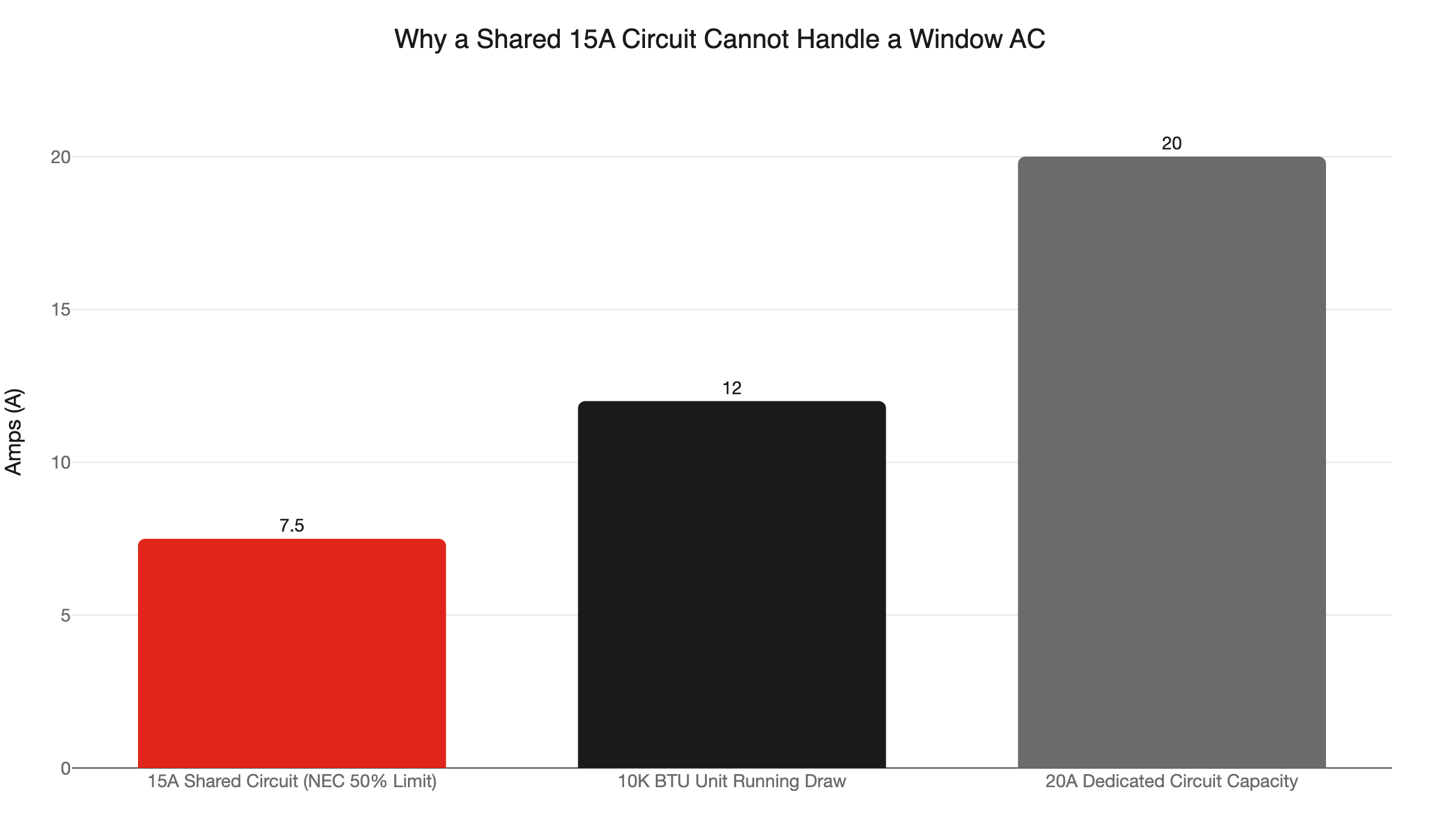
Short answer: NEC 210.23(A)(2) limits any fastened-in-place load to 50% of the branch-circuit rating when other loads share the circuit. A window AC on a 15A shared circuit cannot legally draw more than 7.5A. Most units above 8,000 BTU exceed that limit, and many units have a label that says so explicitly.
NEC Article 440 governs air-conditioning and refrigerating equipment specifically. NEC 440.62 sets the branch-circuit requirements for cord-connected room AC units. The code has been consistent on this for decades. The problem is that older Twin Cities homes were wired long before residential AC loads were expected, and the bedroom circuits reflect that era.
Here is the math across common window unit sizes:
- 8,000 BTU (approx. 7.5A running): Right at the 15A shared-circuit limit. Any additional load on that circuit pushes the unit over the edge.
- 10,000 BTU (approx. 12A running): Exceeds the 7.5A shared-circuit limit by 60%. A dedicated circuit is required.
- 12,000 BTU (approx. 14A running): Exceeds both the 15A shared limit (7.5A) and the 20A shared limit (10A). A dedicated 20A circuit is the only compliant option.
Check your unit’s nameplate before you call. Look for the amperage draw and for any text that reads “individual branch circuit required.” That phrase is the manufacturer’s NEC compliance declaration. If it is on the label and the unit is on a shared circuit, the installation is out of code today, regardless of whether the breaker happens to hold.
What Does Minnesota’s Electrical Code Require Now?
Short answer: Minnesota adopted the 2026 NEC effective August 17, 2026. Permits filed on or after that date are governed by the updated code. Minnesota’s electrical requirements are codified in Chapter 1315 of the Minnesota State Building Code under MN Statute 326B.35.
The 2026 NEC expanded GFCI requirements in ways that directly affect window AC installations. Units installed in openings that face the exterior may require GFCI protection at the outlet. An enforcement delay on those GFCI requirements for outdoor-facing HVAC equipment at dwellings ran through September 1, 2026, and has now expired. Any new circuit installed for a window AC today must account for the current code cycle. A licensed electrician will know which specific provisions apply to your installation and your unit’s placement.
Bedroom circuits carry a second requirement: AFCI protection. Minnesota code requires arc-fault circuit interrupter protection for bedroom branch circuits. A new dedicated circuit to a bedroom uses an AFCI or combination AFCI/GFCI breaker, not a standard thermal-magnetic breaker. This is not an optional upgrade and it is not a line item to negotiate away. It is code. Our post on AFCI breaker requirements explains what arc-fault protection does, why bedrooms require it, and what a combination breaker covers.
What Happens If My Panel Has No Open Slots?
Short answer: No open slots means no new circuit without first making room. Options are a tandem breaker where the panel allows it, a subpanel, or a main panel upgrade. The right answer depends on the panel’s age, condition, and what else is planned for the home.
This is not a rare situation in the Twin Cities. A 1950s rambler in Bloomington, a 1960s split-level in Brooklyn Park, or a postwar Cape Cod in south Minneapolis may have a 60A or 100A panel sized for its era. Lights, a refrigerator, a furnace blower, and a television. Not central AC, not a 240V electric dryer, not a home office full of equipment, and not an EV charger. Decades of incremental additions fill the available slots, and eventually the count reaches zero.
When the panel is full, the window AC dedicated circuit starts with a panel conversation:
- Tandem breakers fit two circuits into one slot. Not every panel supports tandems in every slot. The panel’s bus listing and the breaker manufacturer’s listing determine where they are allowed. A licensed electrician checks this before recommending it.
- Subpanel addition runs a feeder from the main panel to a new subpanel with fresh breaker slots. This is a common solution when the capacity need is concentrated in one area, like a bedroom wing, a finished basement, or an addition.
- Service upgrade replaces the main panel entirely, typically moving from 100A to 200A service. If the panel is aging, full, and showing other concerns, this is often the right long-term answer rather than a workaround.
Our post on what to do when your panel is out of breaker slots walks through all three paths with cost context. If the panel is the real problem, we will say so and give you the options clearly.
Do I Need a Permit to Add a Dedicated Circuit in Minnesota?
Short answer: Yes. A new branch circuit is permitted electrical work in Minnesota. Two inspections are required: a rough-in inspection before walls close, and a final inspection after the panel is energized and devices are installed.
Minnesota homeowners can apply for their own electrical permit through the DLI online portal at ims.dli.mn.gov for work on their own occupied residence. Homeowner permits are a distinct category from contractor permits, with their own scope limitations. Whether a new branch circuit specifically falls within the homeowner permit scope is worth verifying with DLI directly before you start any work.
For most homeowners, the cleaner path is hiring a licensed electrician and letting them pull the permit. The permit cost folds into the project quote. You get a licensed contractor’s warranty on the work and a smooth path through both required inspections. At the final inspection, the inspector verifies GFCI and AFCI function. This is not a formality. Inspectors find field wiring errors that create problems months or years later, and catching them at the final walkthrough is exactly the point.
Skipping the permit is not a free savings. Unpermitted electrical work surfaces during home sale inspections. It can affect your homeowner’s insurance coverage if a claim involves electrical equipment. The permit costs far less than either of those outcomes.
What Does a Window Air Conditioner Dedicated Circuit Cost in the Twin Cities?
Short answer: A new dedicated 20A circuit runs $400 to $800 installed in the Twin Cities. That covers the breaker, wire, outlet, permit, and labor. Distance from the panel and access through finished walls drive most of the variation.
Labor accounts for the largest share of the quote. Running wire through finished walls requires cutting access holes, fishing wire through framing, and either patching the drywall afterward or accepting a surface-mounted conduit run. A bedroom directly above an unfinished basement with a clear path to the panel is the simplest scenario. A room at the far end of a second floor, separated from the panel by plaster walls and a finished ceiling, is a more involved job.
Wire gauge matters too. A 20A circuit requires 12-gauge wire. A 15A circuit uses 14-gauge. The material cost difference is modest. The routing and access time are what make quotes vary.
If the panel also needs attention, such as a tandem breaker to free a slot or a subpanel for a finished area of the home, those scopes add to the total. Any quote we give includes all of that up front, along with the permit and both required inspections. If a competing bid leaves those out, ask why before you sign.
Should I Upgrade to a Mini-Split Instead?
Short answer: A mini-split costs more upfront but qualifies for Xcel Energy rebates and a federal tax credit. If your window units are aging or you want to cool more than one room, the numbers can shift clearly in favor of the upgrade.
Many Twin Cities homeowners assume Xcel Energy covers window AC in its cooling rebates. They do not. Xcel’s Minnesota residential cooling rebates apply to central AC and cold-climate heat pumps. Heat pump rebates run up to $1,500. Window units are not in the program.
A ductless mini-split does qualify for those rebates. It also qualifies for the federal 25C tax credit: 30% of the project cost, up to $2,000 for qualifying heat pumps. A dedicated circuit is a prerequisite for a mini-split regardless, so that circuit cost is part of both paths.
Here is how the two options compare side by side:
Path A: Dedicated circuit, keep the window unit
- Circuit cost: $400 to $800
- Rebates: none
- Result: no more tripped breakers, no equipment change required
Path B: Dedicated circuit and ductless mini-split
- Cost: higher upfront
- Rebates: up to $1,500 Xcel Energy, plus 30% federal tax credit
- Result: quieter, more efficient, rebate-eligible, qualifies for the federal credit
If the window unit is five or more years old and you were already thinking about replacing it, the mini-split path deserves a real look. No malarky: for older equipment in a house that struggles to cool, the long-term savings and rebate stack often close most of the gap.
A mini-split installation involves two separate permits: an electrical permit and an HVAC permit pulled by separate licensed contractors. Our team pulls the electrical permit and installs the dedicated circuit. Northern One Hour, our locally owned sister brand, handles the HVAC scope. We can coordinate both sides so you are not managing two separate contractor relationships on your own.
Our post on mini-split electrical circuit requirements covers the electrical side in detail, including why the circuit for a mini-split differs from a standard window AC outlet.
What to Check Before You Call
A few items worth noting before you schedule:
- Find the breaker label. Know whether the tripping breaker is 15A or 20A. If your panel is unlabeled, mention that when you call. It is another item on the list.
- Read the AC unit’s nameplate. Look for the amperage draw and for the phrase “individual branch circuit required.” That tells us the unit’s code status before we arrive.
- Note other loads on the same circuit. A television, desktop computer, or space heater plugged into the same outlet cluster all contribute to the load the AC is competing against.
- Know your panel’s location. A panel in the basement directly below the problem room means a short wire run and lower labor. A panel in the garage or on the opposite end of the house adds time and cost.
- Note the panel’s current condition. Double-tapped breakers, a missing or illegible directory, or any visible scorching around the breakers are worth mentioning on the call. They may change the scope.
If breakers are tripping on other circuits beyond the AC, our post on why your circuit breaker keeps tripping covers a broader range of causes and what each pattern points to.
Ready to stop resetting that breaker? Call Northern Mister Sparky at 763-200-5956 or book online to schedule a dedicated circuit assessment. We are locally owned and operated in the Twin Cities, backed by the Mister Sparky national network and the UWIN(R) 100% satisfaction guarantee. We serve Minneapolis, St. Paul, Bloomington, Brooklyn Park, Woodbury, Blaine, Maple Grove, Plymouth, and the surrounding metro.
Frequently Asked Questions
Does a window air conditioner need a dedicated circuit? +
Can I pull my own electrical permit in Minnesota? +
How much does a dedicated circuit for a window AC cost in the Twin Cities? +
Does Xcel Energy offer rebates for window air conditioners? +
Need an electrician now?