
Outdoor Outlet In-Use Weatherproof Cover Requirements
Key Takeaways
- Before 2014, extra-duty in-use cover requirements applied only to commercial buildings. Any home that had outdoor outlets installed before 2014 may have covers that passed inspection then but do not meet current code.
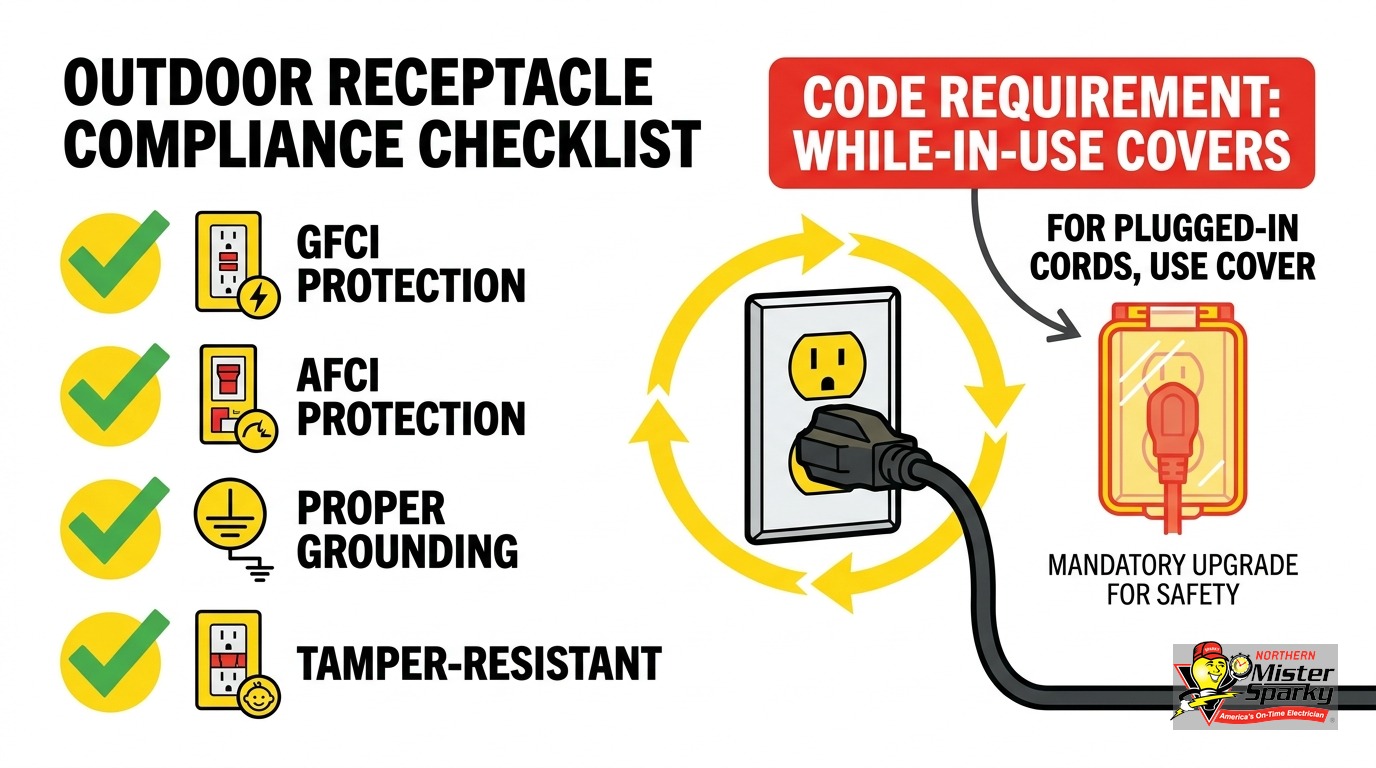
- Any outdoor outlet in a wet location must have an in-use cover that protects the outlet with or without a cord plugged in.
- In-use covers at wet locations must be listed and marked “extra-duty” per NEC 406.9(B)(1).
- All outdoor outlets must also use a weather-resistant (WR) receptacle and have GFCI protection.
- Minnesota adopted the 2026 NEC effective August 17, 2026. The code version governing your project depends on when the permit is filed.
- Swapping a cover plate requires no permit. Adding a new outlet or running a new circuit requires a licensed electrician and a permit.
What Are Outdoor Outlet In-Use Weatherproof Cover Requirements?
Quick answer: An in-use weatherproof cover is a hinged hood that closes around a plugged-in cord, keeping rain and moisture away from the outlet face at all times. For any outlet in a wet location, code requires this protection whether the cord is in or out. Extra-duty models are the required standard for all residential installations.
Every time you plug landscape lights, a phone charger, or a power tool into an outdoor outlet and walk away, code expects that outlet to stay protected. A flat snap-cap cover solves half the problem. It protects the outlet when nothing is plugged in. The moment a cord goes in, the cap flips open and the receptacle face is exposed to rain, snow, and humidity.
In-use covers solve this with a bubble-shaped hinged hood. The hood opens wide enough to accept a standard plug and cord, then closes back around it. The outlet face stays protected regardless of whether a connection is in place.
The governing rule is the NEC code, which requires any 15-amp or 20-amp receptacle in a wet location to be weatherproof whether or not a plug is inserted. That “whether or not” language is the key distinction between the wet-location standard and the less demanding damp-location standard described below.
Why Does Your Home’s Build Year Matter?
Quick answer: Before 2014, the extra-duty in-use cover requirement applied only to commercial buildings. Homes did not need them. The 2014 NEC extended the rule to all one- and two-family dwellings. Any outdoor outlet installed before that change may have a cover that passed inspection at the time but no longer meets code today.
This gap affects a large portion of Twin Cities homes, and it is a detail no national article about weatherproof covers names directly.
If your house was built in the 1990s or early 2000s, or if outdoor outlets were added or updated during a pre-2014 renovation, you likely have a flat snap-cap cover on at least one of them. That cover was completely code-compliant when installed. An inspector signed off on it. The permit closed.
The NEC code change is what separates a cover that was fine then from one that meets current standards. The extra-duty designation requires the cover to be listed under ANSI/UL 514D and marked accordingly on the housing. Generic flip-cap covers sold before 2014 typically carry no such listing for residential use.
Code revisions work prospectively. That means the 2014 change did not require every homeowner to retrofit existing outlets immediately. But it does mean that any new outdoor electrical work permitted today must meet the current standard. And it means that a home inspection or insurance review may flag those older flat-cap covers as below current code.
Knowing where your house sits relative to 2014 is the fastest way to understand your exposure.
What Is the Difference Between a Damp Location and a Wet Location?
Quick answer: A damp location is a covered outdoor space that sees some moisture but is not directly hit by rain, such as a deeply recessed covered porch. A wet location is any outdoor surface exposed to rain, sprinklers, or standing water. The cover requirements differ significantly, and misidentifying your location type is a common mistake.
The NEC draws a firm line between the two categories.
For a damp location, the NEC code requires only that the outlet be weatherproof when a plug is not inserted. A basic flip-cap cover satisfies this standard. The classic example is a porch with a solid roof and walls on three sides, where rain almost never reaches the outlet directly.
For a wet location, the NEC code requires the outlet to be weatherproof at all times, with or without a plug inserted. That means an in-use cover with a hinged hood. This applies to the side of a house, an open deck, a patio, a front stoop, and anywhere rain can reach the outlet from a direct or angled path.
The nuance is that damp and wet are not always obvious on sight. A covered porch with an open front receives wind-driven rain. A pergola provides shade but exposes any outlets below it to sky and precipitation. If there is any reasonable path for rain to reach the outlet, treat it as a wet location. An extra-duty in-use cover satisfies both standards and eliminates the classification question entirely.
What Does “Extra-Duty” Mean, and Why Does It Matter?
Quick answer: An extra-duty in-use cover is listed under ANSI/UL 514D and labeled “extra-duty” on the housing itself. It is the only cover type that satisfies code for a wet-location outdoor outlet at a residential property. A standard in-use cover without the extra-duty marking does not meet the requirement, even if it physically encloses the cord.
Not every bubble cover on the hardware store shelf is the same. Some carry listings only for commercial installations. Some carry no listing at all. If the packaging or the cover housing does not say “extra-duty,” it does not meet the current standard for a one- or two-family dwelling in a wet location.
The hinge is also part of the specification. Per NEC 406.9(B)(1), the hinged lid must open freely after installation. That clearance lets the cord hang freely without being forced into a bend at the plug blades. A restricted hinge arc puts mechanical stress on the connection over time, which can lead to arcing.
When you shop for a replacement, confirm both: the “extra-duty” label on the housing and a UL 514D listing. If the packaging is unclear, pull up the spec sheet before you buy.
Do Minnesota Homes Need GFCI Protection on All Outdoor Outlets?
Quick answer: Yes. NEC 210.8(A)(3) requires GFCI protection on all 15-amp and 20-amp, 125V outdoor receptacles at dwellings. No exceptions apply for rarely used outlets, covered porches, or deck installations. The in-use cover requirement and the GFCI requirement are separate rules, and both must be met.
This is a common point of confusion. Homeowners replace the cover and assume the job is complete. But the in-use cover addresses NEC 406.9, while GFCI addresses NEC 210.8. Both rules apply to the same outlet, and satisfying one does not satisfy the other.
For a fully code-compliant outdoor outlet today, three things must be in place:
- A weather-resistant (WR) receptacle, marked “WR” on the face, with UV-stabilized thermoplastic and corrosion-resistant contacts
- GFCI protection at the device or upstream at a GFCI breaker
- An extra-duty in-use cover at any wet-location outlet
See our guide on outdoor GFCI outlet installation for how GFCI protection is typically set up on outdoor circuits. If your outdoor GFCI has been tripping repeatedly through winter, that is a separate pattern common in Minnesota. Our post on outdoor GFCI nuisance tripping in cold weather explains why it happens and what to do about it.
It is also worth knowing: NEC 210.52(E) requires at least one outdoor receptacle at the front and rear of every single-family home. Any attached deck that provides interior access also requires at least one outlet, per the Minnesota 2026 NEC FAQ. If your home or deck is missing those receptacles, they should be added when any outdoor electrical work is permitted.
What Did Minnesota’s 2026 NEC Adoption Change?
Quick answer: Minnesota adopted the 2026 NEC effective August 17, 2026. Permits filed on or after that date must comply with the 2026 NEC. Permits filed before August 17, 2026, fall under the 2023 NEC. The permit date is the definitive line, not the date the work is performed.
Per the Minnesota DLI electrical codes and standards page, August 17, 2026, is the official adoption date. If you started a project before that date under a permit already filed, your inspector references the 2023 NEC. Start a project today with a new permit, and the 2026 NEC governs.
For outdoor outlet cover requirements specifically, the core language in NEC 406.9 has been consistent across recent code cycles. The extra-duty in-use cover rule, the WR receptacle requirement, and the GFCI mandate all predate both the 2023 and 2026 editions.
The more consequential variable for most Twin Cities homeowners is still the 2014 line: whether existing outdoor outlets were installed before or after the extra-duty requirement was extended to homes in the first place. That is the gap most likely to surface on an inspection today.
How Do Permits Work for Outdoor Outlet Upgrades in Minnesota?
Quick answer: Replacing a cover plate requires no permit. Adding a new outdoor outlet, relocating a receptacle, or adding a circuit requires a permit and typically a licensed electrical contractor. Minneapolis and St. Paul each operate their own permit departments. All other Twin Cities suburbs file through the DLI portal at ims.dli.mn.gov.
The permit rules in Minnesota are more nuanced than a blanket yes or no, and the location of the property determines where the permit goes.
Per the Minnesota NEC FAQ, homeowners may self-permit certain device-level work on their primary residence. That covers replacing a receptacle or a cover on an existing outlet box. It does not cover running new wire, adding a circuit, or installing a new outlet box where none existed before.
Here is a practical breakdown:
No permit required:
- Replacing an outdoor cover plate
- Swapping a non-WR receptacle for a WR-rated device in the same existing box (homeowner, primary residence)
Permit required, licensed electrician typically needed:
- Installing a new outdoor outlet box
- Running a new circuit from the panel to an outdoor location
- Adding the required front, rear, or deck receptacle that is currently missing
- Relocating an existing outlet box to a new position
Where to file in the Twin Cities:
- Minneapolis: Minneapolis Inspections Services Department
- St. Paul: City of Saint Paul Department of Safety and Inspections
- Bloomington, Brooklyn Park, Maple Grove, Plymouth, Woodbury, Blaine, and all other suburbs: DLI portal at ims.dli.mn.gov
For the full breakdown of what requires a permit in Minnesota, see our post on electrical permits in Minnesota.
When Can You Swap the Cover Yourself?
Quick answer: If your outdoor outlet already has a GFCI-protected WR receptacle and you only need to replace the cover with an extra-duty model, that is a homeowner job with no permit required. The swap does not touch wiring or circuits. The job takes about 15 minutes and costs under $20 in materials.
Here is how to do it. Remove the old cover (typically two screws through the cover frame into the outlet box). Check whether your box is flush-mounted or raised, since covers are not always interchangeable between configurations. Buy an extra-duty in-use cover that matches your box type. Mount it, confirm it seats flush against the wall, and plug in a cord to verify the lid closes around it fully.
If the receptacle is not marked WR, replace it while you have the cover off. WR devices cost a few dollars more than standard receptacles and the swap is the same process. Pull the outlet from the box, disconnect the wires, connect the same wires to the WR device, and push it back in.
If there is no GFCI protection anywhere on the circuit, that is the one step that deserves extra care. A GFCI receptacle can replace a standard device in the same box without new wiring. It protects itself and all downstream outlets on the circuit. No permit required for the device swap on your primary residence.
Any work that involves wiring inside the wall, a new circuit, or the panel is a different category entirely. No malarky on that point: pulling permits for circuit-level work protects you at resale and keeps your homeowner’s insurance intact.
Why Minnesota Winters Are Especially Hard on Weatherproof Covers
This is the detail national code articles miss, and it matters here more than most places.
An extra-duty cover in January in the Twin Cities faces conditions a cover in a warmer climate never encounters. Polycarbonate and thermoplastic housings, the most common materials for bubble covers, become brittle in sustained sub-zero temperatures. A cover that flexes easily in October can crack in February when you try to force the lid open in the cold.
The gasket is the other failure point. The rubber or foam seal between the cover and the outlet box compresses over time. Cold accelerates that compression and hardening. A gasket that sealed well in year one may be hardened and gapped by year three after repeated freeze-thaw cycles. You can often see the gap by looking closely at the edge where the cover meets the box wall.
Every spring, check your outdoor covers for:
- Cracks in the hood or around the hinge
- Gaps between the cover edge and the box where the gasket has pulled away or compressed
- Lids that no longer close fully around a plugged-in cord
- Hinges that have stiffened to the point where the lid cannot open to 90 degrees
If you find any of these, replace the cover before winter. A cracked or gapped cover is not performing its rated function regardless of what the housing says. The “extra-duty” listing reflects the condition when new, not after three Minnesota winters.
This degradation also contributes to GFCI nuisance tripping in cold weather. Moisture enters through a failed cover or gasket, gets trapped in the outlet box, and trips the GFCI when temperatures drop. Our post on outdoor GFCI nuisance tripping in cold weather covers that pattern in detail.
How to Tell Which Type of Cover You Have
Walk the exterior of your home and check each outdoor outlet. You are looking for three things: the cover type, the WR marking on the receptacle face, and the presence of GFCI protection.
Flat snap-cap cover: Two small spring-loaded caps, one per slot, that flip up when a plug is inserted. Nothing encloses the cord or the outlet face when the outlet is in use. This cover satisfies code only at a damp location. At any wet-location outdoor outlet today, it does not meet the current outdoor outlet in-use weatherproof cover requirements.
Standard in-use bubble cover (not extra-duty): A hinged hood that opens over the full outlet face and closes around a cord. This satisfies the physical form of an in-use cover, but if it is not marked “extra-duty” on the housing, it may not meet the code standard for a residential wet-location installation.
Extra-duty in-use cover: A hinged hood with “extra-duty” marked on the housing or frame. This is the required standard for any wet-location outdoor outlet on a home permitted after the 2014 NEC.
For the WR receptacle check: look at the face of the outlet between the two vertical slots. The letters “WR” should be embossed in the plastic. If they are not there, the device may need replacement along with the cover. Our post on outdoor outlet wet vs. damp location code covers receptacle markings in more detail.
For GFCI: look for a receptacle with TEST and RESET buttons on the face, or check whether the relevant breaker in the panel has its own TEST and RESET buttons. Either location provides protection for the outdoor outlet. If you find neither, the circuit likely has no GFCI protection and should be addressed.
Checking Your Outdoor Outlet In-Use Weatherproof Cover Requirements
Start with a walk-around. Check each outdoor outlet cover, look for the WR marking on the receptacle face, and confirm whether GFCI protection is present. Most Twin Cities homeowners find at least one flat snap-cap cover at a wet-location outlet that should be upgraded.
If the cover is a flat snap-cap at a wet-location outlet, it needs an extra-duty in-use cover. If the receptacle is not marked WR, swap it for a WR-rated device. If there is no GFCI protection, add a GFCI receptacle to the box. All three of these device-level swaps are homeowner-eligible on your primary Minnesota residence, and none require a permit.
If you need a new outdoor outlet, an additional circuit for a deck, or a licensed electrician to bring an older home’s outdoor wiring fully up to current standards, that is where we come in. We are locally owned and operated in the Twin Cities, and we back every job with the UWIN(R) 100% satisfaction guarantee. As America’s On-Time Electrician(R), we show up when we say we will.
Call us at 763-200-5956 or book online to schedule a visit. If you want a licensed set of eyes on your outdoor outlets before winter hits, we can inspect the full circuit and handle any upgrades the same day.
Frequently Asked Questions
Do all outdoor outlets in Minnesota need an in-use weatherproof cover? +
Can I replace my outdoor outlet cover without a permit in Minnesota? +
What changed with the 2014 NEC for residential outdoor outlet covers? +
Need an electrician now?