Wet vs. Damp Location Outdoor Outlet: What the NEC Requires
Key Takeaways
- Understanding the wet location vs. damp location outdoor outlet distinction determines which code requirements apply to your project.
- A pergola, open deck, or exterior wall is a wet location. A fully roofed, enclosed porch may qualify as damp.
- A code-compliant wet-location outlet has three parts: a WR TR receptacle, an extra-duty in-use cover, and a box listed for wet service.
- “Extra-duty” is a required listing mark on the product itself, not a marketing phrase. A cover without that stamp fails inspection in a wet location.
- The box behind the outlet is the component most homeowners miss entirely.
- Minnesota is under the 2023 NEC and transitions to the 2026 NEC on August 3, 2026.
- Minneapolis and Saint Paul have their own permit departments. A permit is required for any new outdoor outlet.
What Is the Difference Between a Wet Location and a Damp Location Outdoor Outlet?
The short version: A damp location is a covered, protected spot where rain cannot reach the outlet - like a fully roofed porch. A wet location is any area subject to direct rain, runoff, or saturation. The NEC requires a more protective assembly for wet locations across all three outlet components.
The NEC recognizes three location types: dry, damp, and wet. Indoor locations are typically dry. For outdoor residential work, the relevant question is almost always whether a location is damp or wet. That distinction governs device ratings, cover requirements, and box specifications together - not just one piece of the assembly.
NEC Article 100 defines a wet location as any installation “subject to saturation with water or other liquids, or unprotected locations exposed to weather.” Open decks, exterior walls, and unprotected outdoor spots all qualify.
A damp location gets a narrower definition. NEC 406.9(A) says a receptacle is in a damp location when it sits under a “roofed open porch, canopy, or marquee and will not be subjected to a beating rain or water runoff.” Notice that second clause. The roof alone is not enough. The outlet must also be shielded from runoff.
In a damp location, the cover only has to be weatherproof when the outlet is not in use. That is a meaningfully lower bar. In a wet location, the enclosure must be weatherproof at all times - cord in or cord out.
The practical default: when classification is unclear, assume wet. Inspectors lean toward wet when there is any doubt. Upgrading from damp to wet hardware costs a few extra dollars. Building to damp specs on a wet location costs a failed inspection and a return visit.
Is a Pergola or Shade Sail a Wet or Damp Location?
The short version: Both are wet locations. The NEC test is not whether there is something overhead. It is whether the outlet will face beating rain or water runoff. Open pergola slats and mesh shade sails do not stop rain. Any outlet on or near those structures must meet full wet-location requirements.
This is the edge case that catches the most Twin Cities homeowners off guard. The pandemic building boom added thousands of pergolas and shade sails across Minneapolis, Woodbury, Maple Grove, Eden Prairie, and Plymouth. They look sheltered. They are not, by code.
BuildingCodeGeek’s NEC location guide states the test plainly: a covered porch qualifies as damp only when it is truly protected from rain and runoff. Open structures fail that test. A pergola with open slats is a wet location. A retractable awning that spends most of its time open is a wet location. A shade sail anchored to deck posts is also a wet location.
There is a Minnesota-specific wrinkle worth knowing: ice-dam runoff. A porch that stays dry all summer can see water sheeting along the soffit during a February thaw. An inspector evaluating a nominally “covered” structure near an ice-prone roofline may factor in that seasonal exposure and classify it as wet. If your home has had ice-dam issues, plan for wet-location hardware even on covered areas near the roofline.
When you are unsure, use the rain test: if you can feel rain at the outlet during a storm, it is a wet location. If a cardboard box placed on the cover would stay dry through a rainstorm, it might qualify as damp. When in doubt, build to wet.
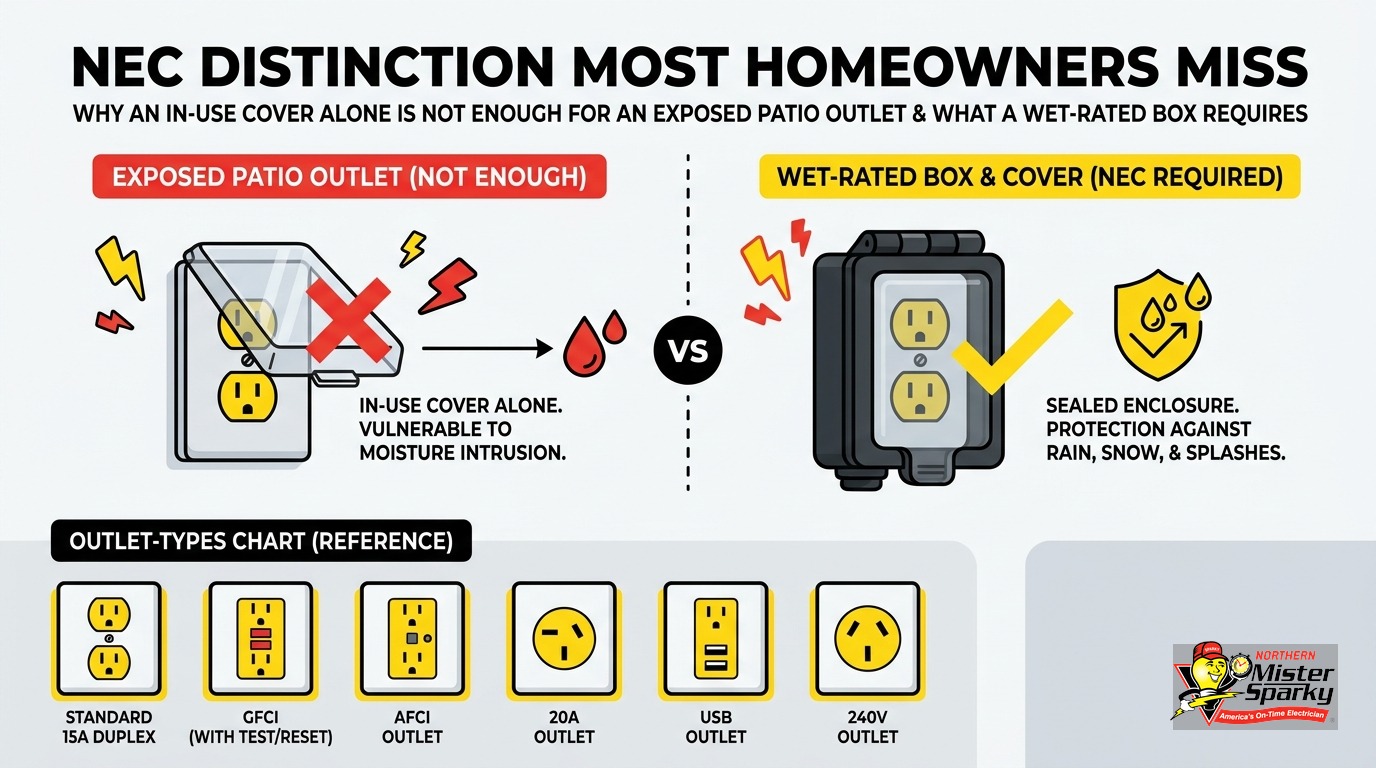
Why an In-Use Cover Alone Is Not Enough
No malarky: this is the gap most guides and some contractors never fill. Search outdoor outlet requirements and every top result will tell you to use an in-use bubble cover. That is correct. It is also one part of a three-part system.
NEC 406.9(B)(1) requires the enclosure at a wet location to be weatherproof “whether or not the attachment plug cap is inserted.” That language covers the entire assembly. The box, the cover, and the receptacle all have to meet the standard.
The three components are:
1. The receptacle. It must carry both “WR” and “TR” stamps on the device face. Weather-resistant and tamper-resistant are two separate listing requirements on one device. Either mark alone is not sufficient.
2. The cover. If you are using an outlet box hood, it must be listed and identified as “extra-duty.” That is a required mark on the product itself, not a marketing phrase. A flip-cap cover labeled only “weatherproof” does not qualify.
3. The box. It must be listed for wet service. A box sold as “outdoor” or “weatherproof” at most hardware stores is often rated only for damp locations. Damp-rated is not the same as wet-rated.
The typical scenario: a homeowner picks up a $6 in-use cover at the hardware store. They install it and consider the job done. The cover may lack the extra-duty mark. The existing box may be damp-rated only. The receptacle may be a standard device with no WR TR stamp. All three gaps are present, and all three have to be right.
A permit inspection will catch each one. Getting all three correct the first time avoids the cost of a re-inspection and a return trip from your electrician.
What Is an Extra-Duty In-Use Cover?
The short version: Extra-duty is a required listing mark printed on the cover itself. It means heavier housing construction, weather-rated gaskets, and a dome large enough to seal around a cord while the outlet is in use. Any cover without that mark does not meet the NEC wet-location requirement for outlet box hoods.
ExpertCE’s NEC 406.9 guide explains this clearly in its FAQ section: the extra-duty marking is a required listing, not a product description the manufacturer chose to add. A product with that mark has been tested and certified to the extra-duty standard. Generic phrases like “heavy-duty weatherproof” or “commercial grade” do not substitute.
One exception applies: if you are using a listed assembly - a product engineered as a single unit to achieve wet-location protection - the extra-duty mark on the hood alone may not be required. In practice, most homeowners buy a cover and a box separately at the hardware store. In that setup, the extra-duty mark on the cover is mandatory.
The NEC also requires that hinged covers on outlet box hoods be able to open at least 90 degrees after installation. If the cover cannot reach 90 degrees because siding or trim blocks it, the installation does not comply. This revision from earlier code cycles catches installations where the box was mounted too close to a corner or trim board.
In the hardware store aisle, extra-duty covers are slightly heavier and larger than standard in-use covers. The mark is usually molded into the housing or printed inside the dome. Look for it before you buy. If you only see “weatherproof” or “outdoor use,” keep looking.
Does the Box Behind the Outlet Have to Be Wet-Rated?
The short version: Yes. A standard weatherproof box sold for damp locations is not sufficient behind a wet-location outlet. NEMA 3R is the minimum for rain exposure. Where hose spray or irrigation contact is possible, NEMA 4 or 4X is the right choice.
This is the component most homeowners never think about. Once the cover is on, the box is invisible. But the box is the first barrier between weather and the wiring inside the wall.
NEMA weatherproof box ratings for common outdoor applications break down as follows:
- NEMA 3R: Protects against falling rain and sleet. The minimum for any rain-exposed outdoor installation.
- NEMA 4: Protects against windblown rain, splashing water, and hose-directed water. The right choice near hose bibs, irrigation heads, or anywhere a pressure washer might reach.
- NEMA 4X: Adds corrosion resistance on top of NEMA 4 protection. Useful in high-humidity environments.
A box labeled “outdoor” or “weatherproof” at the hardware store may only be NEMA 3R, or it may not carry a NEMA rating at all. Read the product label. A wet-service box will say so explicitly and will list its NEMA rating.
The cost difference between a damp-rated box and a NEMA 3R box is a few dollars. The labor cost of pulling an outlet apart after a failed inspection is not. Near an irrigation zone or a hose bib, go to NEMA 4. You will not regret it.
What Receptacle Does a Wet-Location Outlet Require?
The short version: The receptacle must carry both “WR” and “TR” stamped on the device face. These are two separate listing requirements. Weather-resistant alone is not enough. Tamper-resistant alone is not enough. Both marks must appear on the same device.
“WR” means UV-stabilized materials, stainless steel face components, and corrosion-resistant hardware rated for outdoor exposure. “TR” means internal shutters in the slots that block a single object from insertion - a child safety requirement now standard in most residential applications.
Both have been required for outdoor receptacles under recent NEC cycles. A standard residential receptacle behind the right cover and the right box still leaves the assembly non-compliant.
A related but separate requirement: most outdoor circuits also need GFCI protection. That is a circuit-level requirement, separate from the WR TR device rating. For the full picture on outdoor GFCI rules, see our guide on outdoor GFCI outlet installation. If you are planning a new outdoor outlet as part of a deck or patio project, our deck and patio outdoor electrical planning guide covers circuit sizing, GFCI requirements, and permits together in one place.
Does Minnesota Have Its Own Rules for Outdoor Outlets?
The short version: Minnesota follows the NEC on a state adoption cycle. The state is currently under the 2023 NEC and transitions to the 2026 NEC on August 3, 2026. The wet vs. damp classification, the extra-duty requirement, and the WR TR receptacle rule all come from the NEC and apply to all Minnesota residential work.
Minnesota’s 2023 NEC inspection checklist from the Department of Labor and Industry is the working document for permits filed before August 3, 2026. Permits filed on or after that date fall under 2026 NEC rules.
The outdoor outlet standards do not change significantly between the 2023 and 2026 NEC cycles. The wet/damp classification, extra-duty cover requirement, and WR TR receptacle rule have been in the code for several cycles. Properly permitted outdoor outlet work today should already comply with both.
Where the transition matters more: panel upgrades, new circuits, and expanded AFCI requirements. Our post on NEC 2023 code changes for Minnesota homeowners covers the full state adoption timeline.
One local note: Minneapolis and Saint Paul maintain independent electrical inspection departments. They do not use the state DLI system. If your home is in either city, your permit goes through the city. The rest of the Twin Cities metro routes through DLI.
Do You Need a Permit to Add an Outdoor Outlet?
The short version: Yes. Any new outdoor outlet or circuit extension requires an electrical permit in Minnesota. Minneapolis and Saint Paul run independent permit departments. The homeowner exemption does not waive the permit requirement - it only allows a homeowner to do the work themselves rather than hire a licensed contractor.
This surprises people. A single outlet feels like a small project. The permit requirement does not scale with project size. Any new wiring, new circuit, or new outlet location requires a permit and a passed inspection.
A permit matters beyond code compliance. Unpermitted outdoor electrical work surfaces during home inspections. If a buyer’s inspector finds a non-compliant outlet with no permit in the history, the lender may require a correction before closing. That is not a position any seller wants to be in.
One more point: the electrical permit for an outdoor outlet is separate from any deck or building permit. If you built a pergola last summer and pulled a building permit for the structure, that permit did not cover the electrical work. Those are two separate permits and two separate inspections.
Our outlet installation service page explains what a proper outdoor outlet installation includes and how we handle the permit process from the initial pull to inspection sign-off.
Getting the Assembly Right the First Time
The wet vs. damp distinction is not a formality. Water inside an electrical box causes ground faults, shock hazards, and nuisance GFCI trips. Over time, repeated moisture intrusion leads to wiring failures that can go undetected for years.
The fix is not expensive. The right receptacle, cover, and box are available at any electrical supply house. But all three have to be correct, and the cover is the only one most homeowners think to check.
Before any outdoor outlet project, ask three questions:
- Does the cover have the “extra-duty” mark on the housing itself?
- Does the receptacle face show both “WR” and “TR”?
- Is the box listed for wet service at NEMA 3R or higher?
If you are evaluating an existing outlet, here is what to check from the outside:
- Is the cover a dome-style in-use bubble, or a flat flip-cap? A flat flip-cap does not meet the in-use weatherproof standard for wet locations.
- Does the cover open fully without hitting the siding or trim?
- Are the letters “WR TR” visible on the receptacle face between the slots? Standard beige plastic with no stamps is almost certainly a non-WR TR device.
If any answer is a no - or you are not sure - that is where we help.
We are a locally owned and operated Twin Cities electrician and America’s On-Time Electrician(R). We pull the permit, install all three components to current NEC code, and schedule the inspection. The UWIN(R) 100% satisfaction guarantee covers every job.
Call 763-200-5956 or book online to get on the schedule.
Frequently Asked Questions
What is the difference between a wet location and a damp location outdoor outlet? +
Is a pergola a wet or damp location for electrical code? +
Do I need more than an in-use cover for an outdoor outlet? +
What does extra-duty mean on an outlet cover? +
Need an electrician now?