
Multi Wire Branch Circuit Shared Neutral: Twin Cities Homes
Key Takeaways
- A multi wire branch circuit shared neutral is a two-circuit wiring method common in Twin Cities homes built from the 1950s through the late 1980s. One cable carries two 120-volt circuits on a single neutral wire.
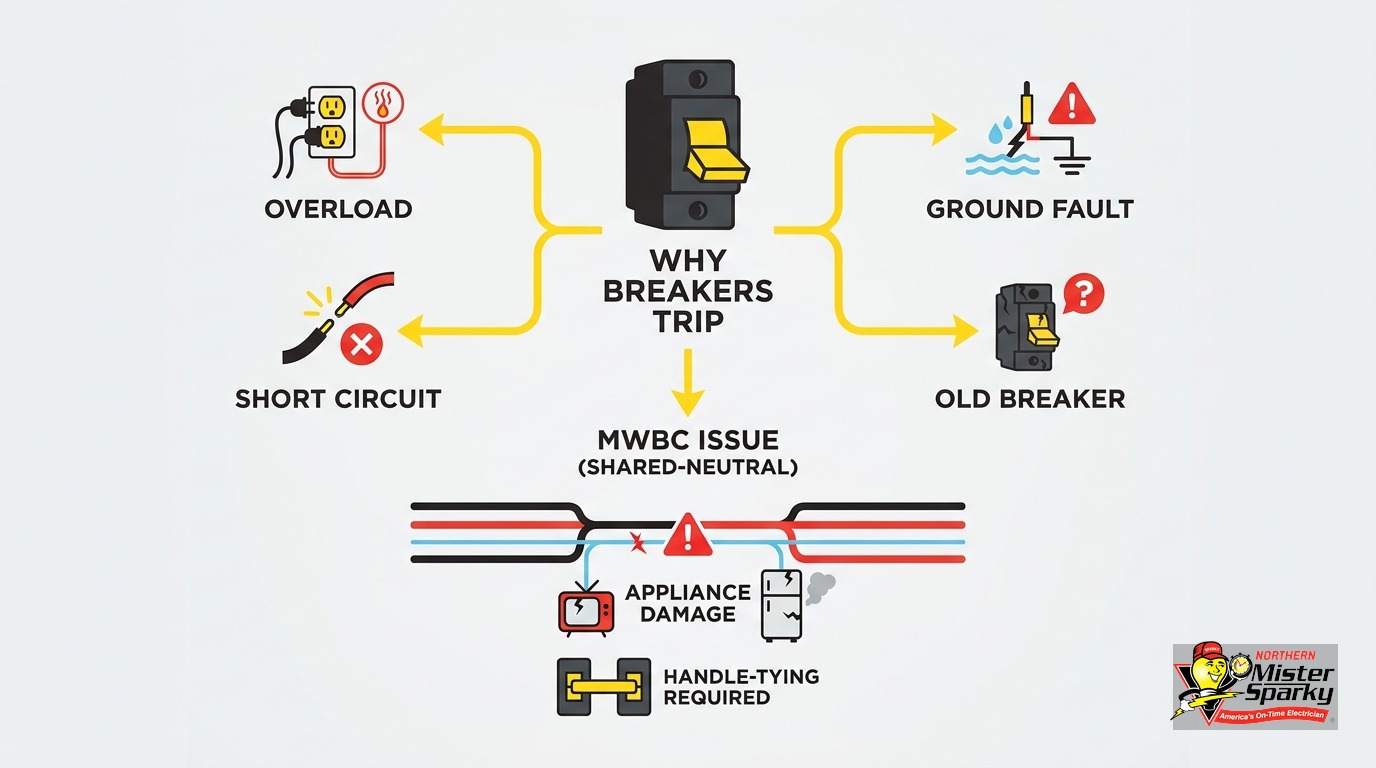
- The most common inspector deficiency is a missing handle tie. NEC 210.4(B) requires both hot conductors to disconnect simultaneously, satisfied by a 2-pole common-trip breaker or a listed handle tie.
- Same-phase miswiring puts the sum of both circuit loads on the neutral wire instead of the difference. The neutral overheats without tripping any breaker.
- An open shared neutral under load creates a voltage divider across 240 volts. Appliances on both circuits can be damaged or destroyed.
- The fix is nearly always a listed handle tie ($5-$20 part) plus a service call and permit. It is not a panel replacement or a rewire.
- Minnesota adopted the 2023 NEC effective July 1, 2023. These requirements are enforceable today on all permitted electrical work in the state.
- Call 763-200-5956 or book online if an inspection report flagged a multi wire branch circuit shared neutral in your Twin Cities home.
What Is a Multi Wire Branch Circuit With a Shared Neutral?
A multi wire branch circuit is a single cable carrying two 120-volt circuits that share one neutral wire. When the hots land on opposite phase legs, only the difference of the two load currents flows through the neutral. Less wire is used, and neither circuit loses capacity.
Picture a single 12/3 cable running from your electrical panel to the kitchen. Inside are three conductors: a black hot, a red hot, and a white neutral. The black wire feeds circuit A. The red wire feeds circuit B. Both circuits return current through the same white neutral.
This works because residential service in the Twin Cities is single-phase, 240-volt power split into two phase legs. When the two hot conductors land on opposite legs, their return currents partially cancel each other in the neutral. A 10-amp load on circuit A and a 12-amp load on circuit B return only 2 amps through the neutral. The wire stays cool, and nothing is overloaded.
Electricians used this configuration heavily from the 1950s through the late 1980s. The 12/3 NM cable was a routine, code-compliant way to supply two circuits on a single run. It saved wire and conduit on long pulls to kitchens, dining rooms, and bedrooms. Seeing an MWBC on an inspection report does not mean an amateur wired your house. It means the house was built when MWBCs were standard residential practice.
Why Did My Home Inspector Flag the Multi Wire Branch Circuit Shared Neutral?
Inspectors flag MWBCs when a required safety feature is missing. The most common defect is a missing handle tie on the two breakers. Without it, shutting off one breaker may leave the second half of the circuit live, which is a shock hazard for anyone working in the panel.
A handle tie is a listed plastic clip that mechanically links two adjacent single-pole breakers. Flip one off, and the other follows. NEC 210.4(B) requires that all hot conductors of an MWBC be disconnected simultaneously. A 2-pole common-trip breaker satisfies this inherently. Two single-pole breakers satisfy it only when a listed handle tie is installed per NEC 240.15(B)(1).
Many panels in pre-1990 Twin Cities homes have two separate single-pole breakers for an MWBC with no tie between them. The wiring itself may be perfectly good. The breaker arrangement is the violation. That is the most common finding, and it is also the simplest to fix. The handle tie part costs $5 to $20 at any electrical supply house. The work is a straightforward panel service call.
Inspectors may also flag MWBCs when the neutrals at outlets are looped through device screw terminals rather than pigtailed at a splice. This is a separate but related deficiency, and we will cover the consequence of that in the next section.
The inspector is doing their job when they flag this. They are not saying the house is unsafe or that it needs to be rewired. They are identifying a specific code item that a licensed electrician needs to verify and correct.
What Happens When the Neutral on an MWBC Opens?
An open shared neutral under load creates a voltage divider across 240 volts. Both circuits share that 240 volts in proportion to their load resistance. The high-resistance device sees far more than 120 volts and burns out. If it fails, the other device can be destroyed seconds later.
This is the scenario most worth understanding, because the physics are counterintuitive.
Imagine the shared neutral wire breaks at a splice, or imagine someone removes a receptacle where the neutral was looped through the device terminals instead of pigtailed. The two circuits are still connected to their hots, but the normal return path through the neutral is gone. The only path for current is through the loads on the opposite circuit.
The two circuits now sit in series across 240 volts. Voltage distributes across them in proportion to their resistance. A 60-watt lamp is high resistance. A television is lower resistance. Put them on opposite circuit legs with an open neutral. The lamp claims the majority of the 240 volts. It burns immediately, far brighter than intended. If the lamp fails and drops off the circuit, the TV is suddenly across the full 240 volts. It is destroyed in seconds.
NEC 300.13(B) was written specifically to prevent this. It prohibits neutral continuity on an MWBC from depending on device terminals. The neutral must be spliced at every junction box, with a short pigtail run to the device. That way, removing or replacing an outlet never interrupts neutral continuity for the downstream loads.
Older Twin Cities homes sometimes have the neutral looped through receptacle screw terminals rather than pigtailed. If a homeowner or a contractor replaces one of those outlets without restoring continuity at the splice, the open-neutral scenario above becomes real. This is one of several reasons DIY electrical work on pre-1990 homes carries risks that go beyond the obvious.
What Happens If Both Hots Land on the Same Phase?
Same-phase miswiring means the two circuit currents add in the neutral rather than canceling. A neutral rated for 20 amps can carry 25 or more amps continuously without any breaker tripping. The wire overheats silently inside the wall and can start a fire.
A correctly wired MWBC has the two hots on opposite phase legs. Their return currents partially cancel in the neutral, which stays well within its rated capacity.
When both hots accidentally land on the same phase leg, the currents add instead of canceling. A 15-amp load on circuit A and a 10-amp load on circuit B return 25 amps through the neutral. A 12 AWG wire is rated for 20 amps. Neither individual hot conductor is overcurrent, so neither breaker trips. The neutral carries 25 amps continuously, building heat inside the wall cavity. There is no protective device monitoring the neutral itself.
This type of miswiring can happen when a panel is modified later in the home’s life without tracing the original MWBC layout. It can also occur when a renovation added new circuits and the electrician did not realize an existing shared neutral was involved. The result is a fire hazard that looks normal on a surface inspection.
This is one reason a pre-purchase electrical evaluation by a licensed electrician, not only a general home inspector, is worth the cost in older Twin Cities homes. A licensed electrician can verify phase relationships at the panel rather than only flagging visible code items.
What Does the Code Require for a Multi Wire Branch Circuit Shared Neutral?
NEC 210.4 has four enforceable requirements: all conductors originate from the same panel; all hots disconnect simultaneously; only line-to-neutral loads on the shared neutral unless a common-trip OCPD covers the full cable; and conductors are grouped and labeled at the panel.
Here is what each requirement means in practice:
- Same panel of origin. All three conductors in the MWBC must come from the same service panel. You cannot split the two hots across two separate panels.
- Simultaneous disconnect. The two hot conductors must go off together when the circuit is de-energized. A 2-pole common-trip breaker does this automatically. Two single-pole breakers require a listed handle tie.
- Line-to-neutral loads only. The shared neutral is sized based on phase cancellation. Connecting a 240-volt appliance to a shared neutral defeats that math, unless a common-trip breaker protects all conductors in the cable.
- Grouping and labeling at the panel. Conductors belonging to the same MWBC must be physically grouped or identified at the panel. A future electrician needs to know they are related before touching them.
Failure on any one of these four points is a code deficiency. The simultaneous-disconnect and labeling requirements are the most commonly missed in older Twin Cities homes. Both are correctable with a panel service call and a permit.
Is a Multi Wire Branch Circuit in the Kitchen Code-Compliant?
Yes. The kitchen countertop MWBC is one of the most common and fully legal applications. NEC 210.52(B)(1) requires at least two small-appliance branch circuits for countertops. A 12/3 cable wired as an MWBC with a 2-pole 20-amp breaker and pigtailed neutrals at each receptacle satisfies both circuits cleanly.
The kitchen countertop circuit is the most common legitimate residential MWBC. Contractors used it for decades because a single 12/3 cable satisfies the two-circuit requirement in one pull. Current code still permits this configuration when all four NEC 210.4 requirements are met.
If your inspection report flags the kitchen MWBC, the deficiency is almost certainly the handle tie at the panel or looped-through neutrals at the receptacles, not the circuit concept itself. The fix is targeted. An electrician opens the panel, verifies the breaker pair, installs the handle tie, and checks each kitchen receptacle box for proper pigtailing. No new cable. No panel replacement.
We see this on inspection reports throughout the Twin Cities metro. The repair scope is predictable, the permit is routine, and the timeline from initial call to inspection sign-off is typically one to two weeks.
How Common Are MWBCs in Twin Cities Homes?
The 12/3 MWBC configuration was standard residential practice from the mid-1950s through the late 1980s. In the Twin Cities, that maps to a substantial share of the owner-occupied housing stock.
First- and second-ring suburban neighborhoods built during that era, including much of Bloomington, Roseville, Fridley, Mounds View, Brooklyn Park, and similar communities, were constructed during the peak MWBC period. MWBCs in kitchens and dining rooms of those homes are normal findings. They are not evidence of shoddy work. They reflect how electricians built houses at the time.
Home inspectors in this market flag MWBCs constantly on pre-sale reports. Buyers sometimes interpret the language as evidence of a dangerous house. Sellers sometimes call for quotes on a full rewire. Neither reaction is warranted. The finding almost always resolves with a handle tie, a permit, and a state inspection.
If the inspector also raised concerns about the panel’s age or capacity, that is a separate evaluation. The MWBC finding alone does not create a panel-replacement case.
What Does It Cost to Fix a Multi Wire Branch Circuit Problem in the Twin Cities?
The most common fix is a listed handle tie ($5-$20 part) plus the electrician’s service call. If wiring is disturbed, a permit is required. The total is a fraction of a panel replacement or rewire. Most MWBC repairs close as a targeted service call, not a major project.
Here is the typical breakdown:
- Handle tie at the panel. A licensed electrician opens the panel, identifies the correct breaker pair, and installs the listed handle tie for that breaker brand. No wiring is cut or moved. This is the most common resolution.
- Pigtailing at receptacles. If neutrals are looped through device terminals rather than spliced, an electrician opens each affected box, adds a short pigtail splice, and reinstalls the device. Each box adds time, but the work is accessible and predictable.
- Permit and inspection. Minnesota requires a permit any time wiring is disturbed. The state-track minimum is a $25 permit fee plus a $55 minimum inspection trip plus a $1 surcharge, per the Minnesota Department of Labor and Industry. Local AHJs have their own fee schedules. The licensed electrician pulls the permit; you do not manage that step.
- Phase correction. If both hots landed on the same phase leg, the fix is moving one hot to the opposite phase at the panel. This is panel work requiring more time, but it is still a panel-level correction and not a whole-house rewire.
No malarky: MWBC repair is one of the more predictable electrical service calls. The scope is defined, the parts are inexpensive, and the permit process is routine.
Minnesota Electrical Code and the 2023 NEC
Minnesota adopted the 2023 National Electrical Code effective July 1, 2023. All permits filed after that date are governed by NEC 2023, which means NEC 210.4(B) and the simultaneous-disconnect requirement are in force for any permitted MWBC work in Minnesota today.
About 66 Minnesota cities serve as their own authority having jurisdiction and issue electrical permits directly. All other work goes through the DLI state-track process. Either path requires a licensed electrician and a state inspection sign-off on completed work.
This detail matters when someone asks whether they can add the handle tie themselves without a permit. Legally, they cannot. A handle tie installed without a permit has no inspection record. That gap can surface at the next sale as an unpermitted modification, creating a new finding to resolve.
If you want to understand the electrical permit process in Minnesota before your service call, that post walks through what to expect from application to final sign-off.
When Should You Call a Licensed Electrician?
Call 763-200-5956 or book online if any of the following applies:
- A home inspection report flagged a multi wire branch circuit shared neutral and you need to understand the scope before responding to a buyer or seller.
- You are planning a kitchen renovation, bathroom update, or any remodel that will touch existing wiring in a pre-1990 Twin Cities home.
- Two breakers in your panel serve the same area of the house with no handle tie between them.
- Appliances or outlets on two separate circuits are behaving strangely at the same time, suggesting a shared neutral issue.
- You want an electrical inspection before buying or selling a home in the Twin Cities metro.
Northern Mister Sparky is locally owned and operated, serving Minneapolis, St. Paul, Bloomington, Maple Grove, Plymouth, Woodbury, Blaine, and the surrounding metro. We back every job with the UWIN(R) 100% satisfaction guarantee. As America’s On-Time Electrician(R), we show up when we say we will and give you a straight answer on what you are looking at.
Call 763-200-5956 or book online to schedule your evaluation.
Frequently Asked Questions
Is a multi wire branch circuit with a shared neutral dangerous? +
Do I need to replace my electrical panel if I have multi wire branch circuits? +
Why does an open neutral on a multi wire branch circuit damage appliances? +
Does Minnesota require a permit to add a handle tie on a multi wire branch circuit? +
Need an electrician now?