
30 Amp RV Hookup at Home: Minnesota Permit and Wiring Guide
Key Takeaways
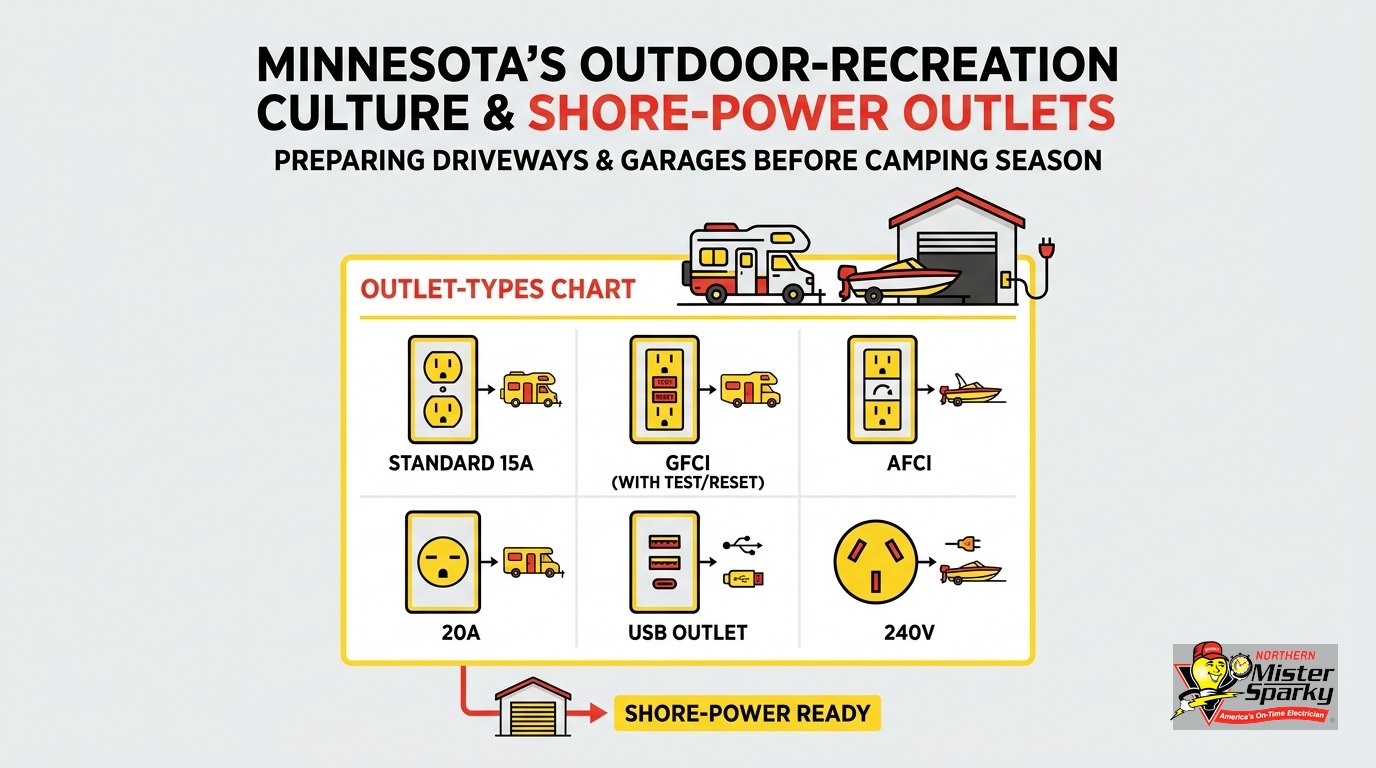
- A 30 amp RV hookup requires a TT-30R outlet, 10 AWG copper wire, and a 30-amp single-pole breaker. Never use a double-pole breaker - it delivers 240 volts and damages the RV.
- GFCI protection is required by NEC 210.8(A) for all outdoor receptacles. A 30-amp GFCI circuit breaker at the panel is the code-compliant solution.
- Minnesota requires a permit for any new electrical circuit. Minneapolis and St. Paul have separate permit offices. All other municipalities use the state DLI system.
- Homeowners may pull their own permit only on a homesteaded, owner-occupied single-family home, with a permit in their name, if they personally perform all the work.
- Underground runs require THHN/THWN-rated wire in PVC conduit, buried at least 18 inches deep. Standard Romex is not rated for underground use.
- Minnesota adopted the 2026 NEC effective August 17, 2026. Permits filed before that date fall under 2023 NEC.
- Twin Cities homes built between 1960 and 1985 often have 100-amp service. A load calculation is required before adding a new 30-amp circuit to a panel that may be near capacity.
- A 50/30/20-amp pedestal costs roughly 50% more than a 30-amp-only install but delivers three times the power capacity. Worth it if you might upgrade to a 50-amp RV.
Adding a 30 Amp RV Hookup at Home in Minnesota
Adding a 30 amp RV hookup at home is one of the smartest electrical upgrades a Minnesota homeowner can make. Minnesota ranks in the top five states for RV ownership per capita. Walk through any neighborhood in Maple Grove, Brooklyn Park, or Woodbury in early May and you can see why. Fifth wheels, travel trailers, and camper vans fill every other driveway. Most of them are running off a generator - or nothing at all.
A permanent shore power outlet changes that. It does two jobs: a driveway pad ready for camping season, and a garage outlet that keeps the RV healthy through a Minnesota winter. The camping opener in May is the forcing function most homeowners feel, but the winter storage case is just as compelling. Electricians get busy in spring. If you want the outlet ready before the season opens, now is the time to plan.
This guide covers the Minnesota permit process, NEC wiring requirements, and every decision point worth knowing before you call.
Do You Need a Permit for a 30 Amp RV Hookup at Home in Minnesota?
Yes, always. Any new electrical circuit in Minnesota requires a permit, and an inspector must approve the work before the outlet can be energized. Skipping the permit is not a shortcut that pays off. It surfaces at closing, creates insurance exposure, and leaves the work unverified.
Minneapolis and St. Paul run their own permit offices and do not use the state system. All other municipalities go through the Minnesota Department of Labor and Industry. The process is the same regardless of city: apply, pay the permit fee, do the work, and call for inspection. The inspector checks the outlet, the GFCI breaker, the wire gauge, and any conduit run before the circuit is energized.
Unpermitted electrical work is a real liability. A buyer’s home inspector will flag it during a sale. Homeowner’s insurance can deny a claim traced to unpermitted wiring. The permit fee is modest compared to either of those outcomes.
There is also a code transition to know about. Minnesota adopted the 2026 National Electrical Code, effective August 17, 2026. Permits filed before that date fall under the 2023 NEC. Permits filed on or after that date comply with the 2026 NEC. If your project falls close to that date, check with your permit office about which code applies before the work starts.
How Does a 30 Amp RV Hookup at Home Get Wired?
The outlet is a NEMA TT-30R, wired with 10 AWG copper to a 30-amp single-pole breaker at the panel. The circuit runs at 120 volts, single phase. A double-pole breaker delivers 240 volts and will damage your RV’s shore power systems. Single-pole is the only correct configuration for this outlet.
Here is every component of the circuit from panel to outlet:
- Breaker: 30-amp, single-pole, GFCI type (see the section below)
- Wire: 10 AWG copper; THHN/THWN-rated if any part of the run goes underground
- Outlet: NEMA TT-30R in a weatherproof enclosure with an in-use flip-lid cover
- Mounting height: Typically 18 to 24 inches above grade for a driveway pad, or at a convenient height on a garage wall
The run from the panel to the outlet is usually 30 to 60 feet in a typical Twin Cities home. At 10 AWG and 30 amps on a 120-volt circuit, voltage drop stays within the 3% branch-circuit threshold up to about 70 feet. Runs longer than that may require upsizing the wire to 8 AWG to stay within code.
The outlet box is rated for wet locations. The flip-lid in-use cover keeps rain and snow out when the shore power cord is plugged in and when the outlet is empty. This is not a standard outdoor duplex outlet - the TT-30R is a dedicated, single-purpose receptacle that only works with an RV shore power cord.
The exact mounting location depends on your driveway layout. For most travel trailers and fifth wheels, the shore power cord reaches roughly 25 to 30 feet. Place the outlet where the cord can reach the rig without strain.
Does a 30 Amp RV Outlet Need GFCI Protection?
Yes. NEC 210.8(A) requires GFCI protection on all outdoor receptacles at dwelling units. The TT-30R falls in the expanded outdoor GFCI category added in the 2020 and 2023 NEC cycles. A standard plug-in GFCI outlet does not come in a 30-amp TT-30R format. The code-compliant solution is a 30-amp GFCI circuit breaker at the panel.
A GFCI breaker protects the full circuit from the panel to the outlet. If a ground fault occurs - a short through water, a frayed cord, or moisture in the outlet box - the breaker trips in milliseconds. That is fast enough to prevent shock. A standard breaker trips on overcurrent, not ground faults. It would not protect you in those scenarios.
Some homeowners ask whether they can avoid the GFCI breaker if the outlet is under a covered patio or inside an open garage. The answer is no. NEC 210.8(A) applies to all outdoor receptacles at a dwelling, regardless of cover. The 2023 NEC expanded the requirement to include 30-amp outdoor receptacles explicitly. There is no exemption for covered locations.
The practical upside: a GFCI breaker at the panel covers the entire circuit in one device. There is nothing to reset at the outlet. If the breaker trips, you reset it at the panel, find the cause, and reconnect once it is safe.
For a broader look at outdoor receptacle requirements, see our guide on outdoor GFCI outlet installation.
What Wire and Conduit Does an Underground Run Require?
Underground runs require THHN/THWN-rated wire in PVC conduit, buried at least 18 inches deep per NEC Article 300.5. Standard NM-B cable (Romex) is not rated for wet locations and cannot be used underground. The house entry point needs a weatherproof seal to keep Minnesota ice and snowmelt out of the conduit.
Most driveway-pad installations require a trench. The panel is in the garage or basement. The outlet ends up at the edge of the driveway or on an exterior wall. That means underground wire.
PVC Schedule 40 or Schedule 80 conduit is the standard for residential underground circuits. The conduit sweeps up at both ends - into the panel area and up to the outlet location - with weatherproof LB conduit bodies and fittings at both terminations. The run is continuous inside the conduit with no splices below grade.
In Minnesota, frost penetrates 42 to 60 inches. The 18-inch NEC minimum is not a freeze-protection spec - it is a mechanical damage spec. Conduit at 18 inches handles the freeze-thaw cycle without any problem. The entry point at the house wall is where to pay attention. The conduit passes through the sill plate or foundation wall. That penetration needs to be sealed with weatherproof caulk or foam. Minnesota ice and snowmelt find every gap. A tight seal at the house keeps moisture out of the conduit and out of the outlet box.
For more on code-compliant underground electrical work in Minnesota, see our post on underground electrical wire depth in Minnesota.
Can You DIY a 30 Amp RV Hookup in Minnesota?
Only on a homesteaded, owner-occupied single-family home, with a permit in your name, if you personally perform all the work. Rentals, condos, townhomes, duplexes, and any property that is not your primary residence require a licensed electrician.
Minnesota statute allows homeowners to do electrical work on their own homesteaded single-family home under those specific conditions. You pull the permit in your name. You do the wiring yourself. The inspector expects the homeowner to have done the work - not a friend, not a handyman, not someone who is unlicensed. “Personally perform” means exactly that.
The homestead rule applies to the property where you live as your full-time primary residence. A lake cabin, a rental unit, a vacant investment property, or a condo does not qualify. Those require a licensed contractor, period.
Even on an eligible property, a DIY permit still requires an inspection. The inspector checks the outlet, the GFCI breaker, the wire gauge, the conduit type, and the burial depth if there is a trench. If something fails inspection, you correct it and reschedule. There is no skipping that step.
Here is the honest take: opening a main electrical panel carries real risk. Selecting the right breaker, sizing the wire, running conduit, and sealing an underground entry point all require some experience to do correctly. If any of those steps feel uncertain, it is worth the cost to have our team handle it. A 30-amp RV hookup is a half-day job. Call 763-200-5956 or book online and we will have it done before camping season opens.
Should You Upgrade to a 50-Amp Pedestal Instead?
If there is any chance you will own a 50-amp RV in the next decade, the 50/30/20-amp pedestal is worth the premium. It costs roughly 50% more than a 30-amp-only install but gives you three times the power capacity. That tradeoff is easy math when you consider the cost of a second trench and a second permit later.
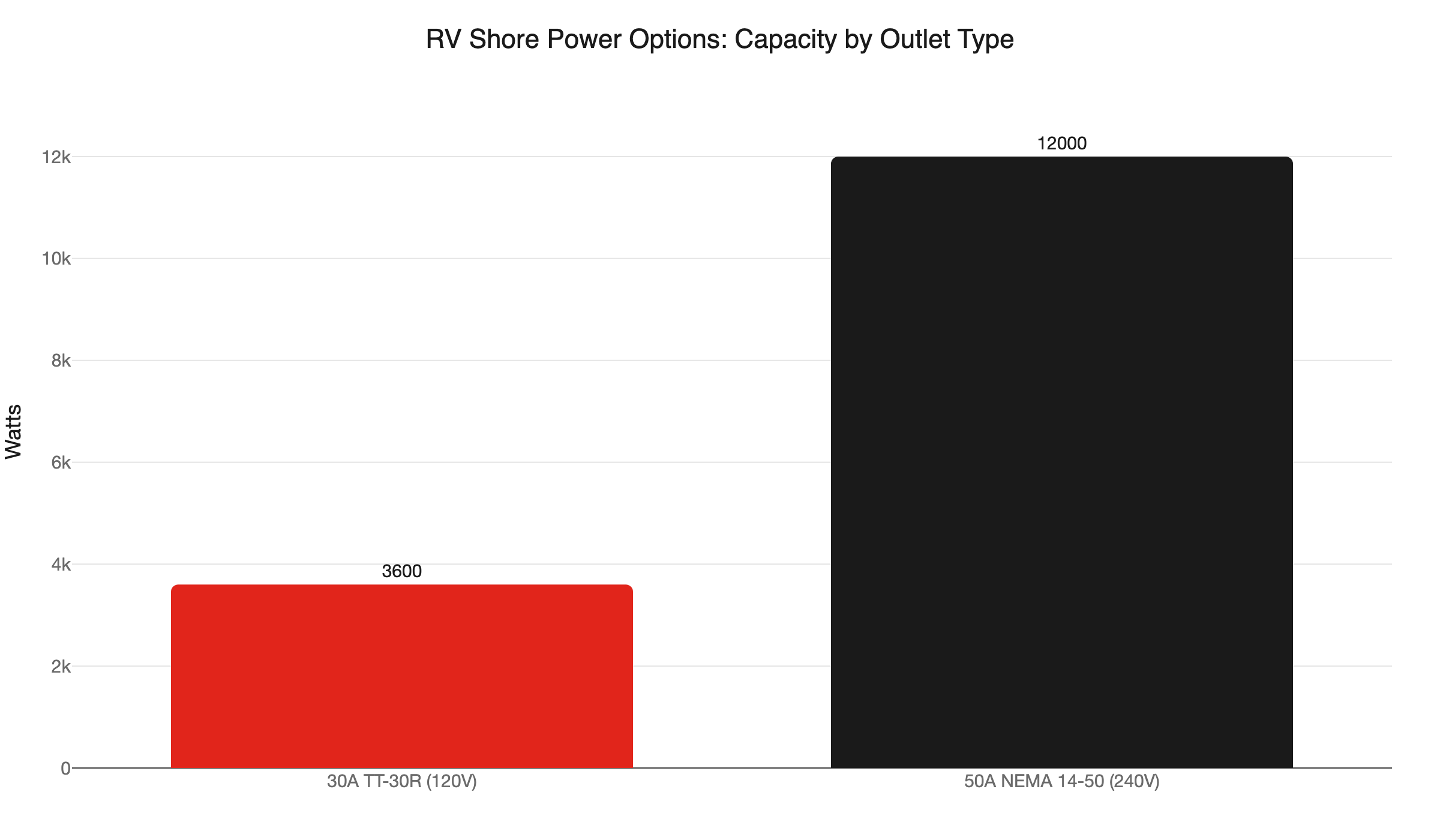
The capacity difference is significant. A 30-amp TT-30R delivers 3,600 watts at 120 volts. A 50-amp NEMA 14-50 outlet runs at 240 volts and delivers 12,000 watts. A 30-amp connection handles a travel trailer or small Class C comfortably. A 50-amp connection handles a large fifth wheel, a diesel pusher, or any newer rig with residential appliances - two air conditioners, a slide topper motor, a residential refrigerator, and a microwave running simultaneously.
A 50-amp installation is different hardware. The outlet is a NEMA 14-50, not a TT-30R. The breaker is a 50-amp double-pole. The wire is heavier, and the conduit must accommodate it. The panel load calculation changes too - a 50-amp, 240-volt circuit is a larger draw than the 30-amp, 120-volt version.
The decision comes down to what you own today and what you are likely to own in five to ten years. If you have a small travel trailer and no plans to change, the 30-amp installation is correct and complete. If you are watching for a larger rig, the pedestal is a one-time decision that avoids doubling back. We can include both outlets in a single installation: you use the 30-amp connection now and plug into the 50-amp when you upgrade.
What If Your Panel Is Already at Capacity?
A 30-amp circuit is real new load. If your home has a 100-amp main service, we run a load calculation before adding this circuit. A 100-amp panel was standard in Twin Cities homes built between 1960 and 1985. It may have headroom, or it may not. The calculation tells us which.
The load calculation adds up every circuit’s peak demand: the furnace, the central air, the electric range or cooktop, the dryer, the water heater, the dishwasher, and every dedicated circuit already on the panel. If the total pushes the panel close to its rated capacity, adding a 30-amp RV circuit is not safe without an upgrade first.
The solution is a service upgrade. A 200-amp main service gives you the headroom to add the RV circuit now and leaves room for an EV charger, a generator interlock, or any other future loads without a second upgrade. For a breakdown of what drives that decision, see our guide on 100-amp vs. 200-amp electrical service.
If your panel is already showing warning signs - breakers tripping under normal household load, lights dimming when the AC kicks on, a panel cover that feels warm to the touch - those are signals the upgrade conversation is already overdue. See our post on signs you need an electrical panel upgrade for the full list of what to look for.
The Winter Storage Case: Shore Power in the Garage
Most of this post has focused on the driveway pad for camping season. There is an equally strong case for an outlet inside the garage.
Minnesota winters hit -20°F or colder. An RV in an unheated garage is better than one sitting in the driveway, but it still suffers. Holding tanks can freeze at the low points. The 12-volt house battery drains and sulfates in sustained cold. Slide-out seals stiffen and crack. Propane regulators can fail in extreme cold. By April, you can be paying to fix problems that a winter’s worth of shore power would have prevented entirely.
Plugged into a 30-amp circuit in the garage, the RV can run its propane furnace fan continuously. The blower motor draws 12 volts - the shore connection keeps the battery charged to run it. The fan circulates warm air without active propane combustion, which matters in a garage with limited ventilation. The holding tanks stay warmer. The battery stays at a healthy charge through April.
The garage installation is often simpler than the driveway pad. The outlet mounts on a garage wall at a height that matches the RV’s shore power cord. If the main panel is in the garage, the run from the panel may be 20 feet or less. No trench. No underground conduit. Just a new circuit, a GFCI breaker at the panel, and a weatherproof outlet on the wall.
Many customers book both in a single visit: the garage outlet for winter storage and the driveway pad for the camping season. One permit, one mobilization, two outlets. The incremental cost of adding the second outlet when we are already on-site is much lower than a separate trip.
Ready to Schedule Your 30 Amp RV Hookup at Home?
A 30 amp RV hookup at home pays off across two full seasons. Every summer camping trip starts without fighting a generator. Every Minnesota winter, the RV comes out of storage with a charged battery, intact seals, and clear holding tanks.
The work requires a permit, a GFCI breaker, a weatherproof TT-30R outlet, and the right wire. An underground run adds PVC conduit and a proper seal at the house entry. A tight panel adds a load calculation first. No malarky - we cover all of it in the estimate and tell you exactly what the job involves before anything starts.
We handle the permit paperwork and coordinate the inspection. We tell you upfront if the panel needs a load calculation or an upgrade before we pull wire. We do not start work and then surface surprises. The job is done right, inspected, and backed by the UWIN(R) 100% satisfaction guarantee.
We serve the full Twin Cities metro: Minneapolis, St. Paul, Bloomington, Brooklyn Park, Woodbury, Blaine, Maple Grove, and Plymouth. As America’s On-Time Electrician(R), we show up when we say we will and get the work done correctly the first time.
Spring fills fast. If you want the outlet ready before the May opener, call 763-200-5956 or book online today.
Frequently Asked Questions
Do I need a permit for a 30 amp RV outlet in Minnesota? +
Can a homeowner wire a 30 amp RV outlet in Minnesota? +
What wire and breaker size does a 30 amp RV outlet require? +
Does a 30 amp RV outlet need GFCI protection? +
Need an electrician now?