
EV Charger Lake Cabin Minnesota: Seasonal Home Install Guide
Key Takeaways
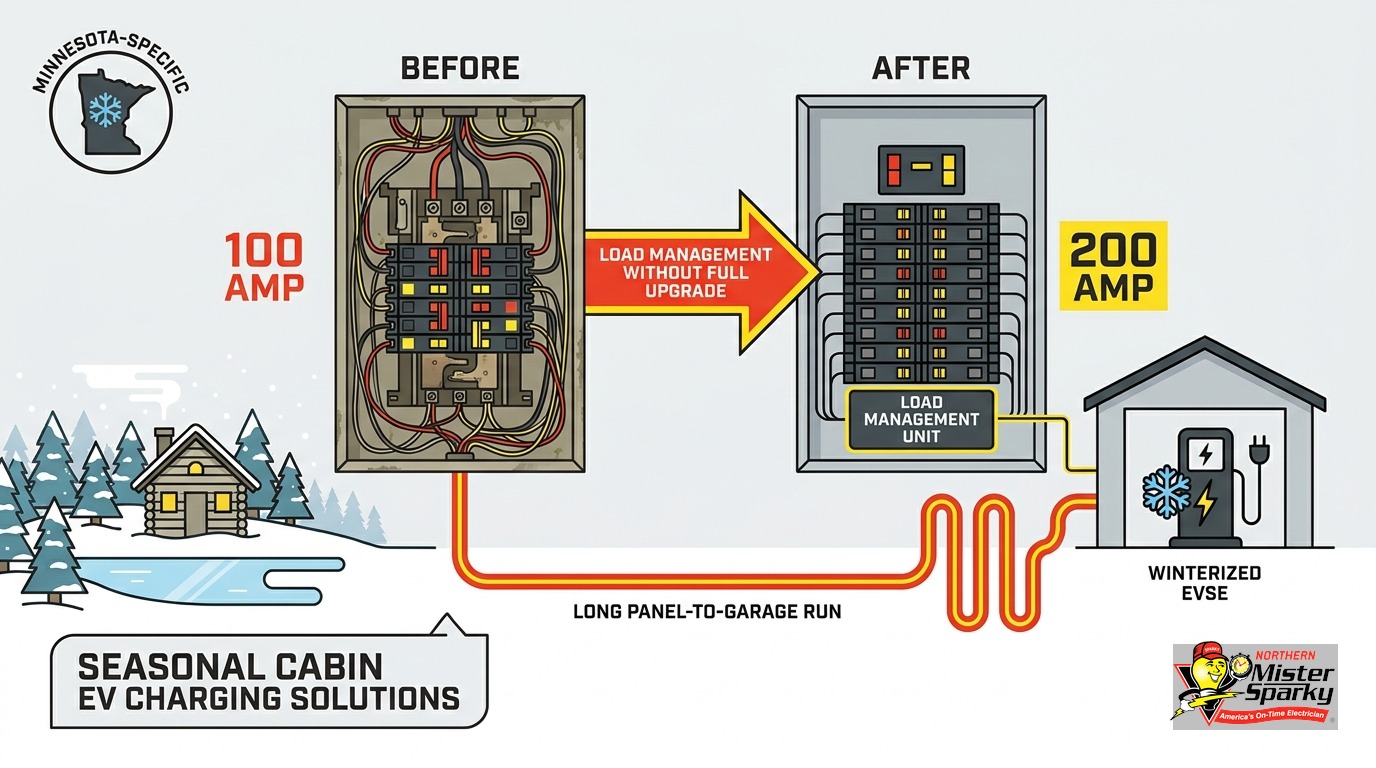
- An EV charger at a lake cabin or seasonal home in Minnesota presents three challenges a metro install rarely does: long panel-to-garage runs, limited service amperage, and a closed season that demands real winterization.
- Runs over roughly 100 feet require conductor upsizing. That is the primary cost difference compared to a standard in-garage wall install.
- A typical 100-amp cabin panel leaves only about 6,000VA of headroom after typical loads. A standard 40-amp EVSE circuit needs 9,600VA at the code-required 125% sizing. That math does not work without load management or a service upgrade.
- Smart chargers with built-in load management monitor home consumption in real time and throttle charge output automatically, often eliminating the need for a full service upgrade.
- Minnesota adopted the 2026 NEC for permits issued on or after August 17, 2026. The rules on which receptacles are legal for EVSE use changed in the new edition.
- Lake-country cabins are often served by Minnesota Power or a rural co-op, not Xcel Energy. Your utility territory determines which rebate programs apply.
- Before closing for winter: shut off the EVSE circuit at the breaker, store the cable indoors, and verify the charger is rated to at least -22F (-30C).
Why Cabin Installs Are Different From Metro Installs
Most coverage of EV charging at a lake home treats it like a standard residential install with a cold-weather note attached. They explain Level 1 vs. Level 2 and remind you that Minnesota winters are cold. Then they stop.
The real differences are more specific, and they are the ones that actually drive cost and complexity on a cabin job.
First: distance. A cabin garage often sits 100 to 200 feet from the main panel. That run forces conductor upsizing in a way that a 20-foot metro garage install never does. The longer the wire, the larger the gauge required to stay within code-acceptable voltage drop limits. Larger wire costs more to buy and takes more time to pull.
Second: service size. Older lake cabins commonly run on 100-amp service with electric baseboard heat. After existing loads, available panel headroom is limited. A standard 40-amp EVSE circuit would push past that headroom on most of these cabins. That means either sizing down the charger, using load-managing hardware, or upgrading the service.
Third: seasonal use. A cabin closes in October and reopens in May. A hardwired outdoor Level 2 charger needs specific winterization steps before the season ends. Without them, a cable left outside will crack. A charger without the right cold-temperature rating will fail. A live circuit on an unoccupied property is an unnecessary risk all winter.
This guide covers all three, along with the current permit landscape, the 2026 NEC update, and the rebate picture for Minnesota cabin owners specifically.
Does a Cabin Install Require a Permit in Minnesota?
Yes. Any new circuit to a separate structure requires a permit and inspection under Minnesota DLI rules, including secondary and seasonal properties. Feeder or branch circuits to a detached cabin garage carry their own permit and inspection fees. Pull the permit before any wire is run, and budget that cost upfront.
Minnesota’s Department of Labor and Industry administers electrical permits statewide. Skipping the permit creates real problems: an unpermitted install can void your homeowner’s insurance coverage after a fire, complicate or stop a future sale, and expose you to liability during a county inspection. Some lake counties add additional oversight for seasonal properties. Do not skip this step. Do not sign with any contractor who suggests you can.
If you are mid-project and a permit has not been pulled, call us. We can help you sort it out before the inspector does.
What Happens With a Long Panel-to-Garage Run?
Runs past roughly 100 feet require conductor upsizing to stay within code-recommended voltage drop limits. The longer the run, the heavier the wire needed. That upsizing is the primary cost driver separating a cabin garage install from a standard wall install.
NEC recommends keeping voltage drop under 3% on a branch circuit supplying an EV charger, with experienced installers targeting 2 to 2.5% on the feeder. A 60-amp circuit sized in #6 AWG copper may be adequate at 40 feet. At 150 feet, that same circuit may need #4 AWG copper or larger. The difference in wire material cost alone is significant. Larger wire also takes more time to pull.
Three routing options exist for getting power to a detached garage:
Direct burial conduit. Code sets minimum burial depths based on conduit type. Rigid metal conduit has a shallower requirement than direct-burial cable. On long Minnesota runs, plan for frost heave in clay soil. This is the cleanest approach when the trench path is clear of obstacles, footings, and utility crossings.
Overhead span. In some property layouts, an overhead run is actually shorter than a ground run. It requires proper clearances, drip loops, and weatherhead hardware at both ends. Have the span length and mounting heights measured before choosing this path.
Subpanel in the detached garage. For runs over 100 feet, installing a small subpanel in the detached garage is often the smarter decision. You run a single large feeder to the garage once, install a local service disconnect, and gain spare breaker capacity for future circuits: lighting, convenience outlets, a heated garage circuit, or a second EVSE if another EV joins the household. One feeder does the work of multiple long individual runs, and you stop paying the long-run penalty on every circuit you add later.
Have a licensed electrician calculate the actual voltage drop for your specific run distance before any materials are ordered. Guessing conductor size on a 150-foot run is how you end up with a charger that underperforms, or a main breaker that trips without obvious cause.
Can I Add an EV Charger to My Cabin Without a Service Upgrade?
Often yes, if you choose the right charger and approach. A standard 40-amp EVSE circuit exceeds available headroom on most 100-amp cabin panels. Two paths solve that without a full service upgrade: size down the charger, or use load-managing hardware that throttles charge output automatically.
A 100-amp panel delivers 24,000W total. After typical cabin demand, roughly 6,000VA of headroom remains. A standard 40-amp Level 2 charger, sized at 125% per code, draws 9,600VA. That is 3,600VA more than typical available headroom.
Option 1: Size down the charger. A 32-amp Level 2 charger on a 40-amp circuit requires about 5,000VA at 125% sizing. That fits within a 100-amp cabin panel’s typical headroom. The trade-off is speed. A 32-amp charger adds roughly 20 miles of range per hour of charging. For a weekend cabin, overnight charging at that rate tops off most EVs by morning with room to spare.
Option 2: Load-managing smart charger. Emporia’s Intelligent Load Sharing monitors total home consumption and adjusts charger output in real time to stay within service capacity. At midnight when the cabin is quiet, you might charge at full speed. When the baseboard heat kicks on, the charger throttles down to keep the main breaker from tripping. The charger handles those adjustments automatically. Other manufacturers offer comparable features under different names. Both options are significantly less expensive than a service upgrade.
A load study per NEC 220.87 on your cabin’s actual demand can also help. Real-world consumption is usually lower than the theoretical maximum, and a load study frequently reveals more headroom than the nameplate numbers suggest. Financing is available for larger jobs, including service upgrades, if that route makes the most sense for your situation.
What Outdoor Code Requirements Apply?
Four NEC requirements specifically govern outdoor EVSE installations at a dwelling. Missing any one of them causes a failed inspection. All four are easily satisfied with the right hardware and a licensed electrician working under current code.
Weatherproof enclosure. NEC 625.56 requires a weatherproof enclosure for any outdoor EVSE receptacle in a wet location, with the cover listed as “extra-duty.” For a Minnesota cabin, a NEMA 4X enclosure is the right spec. It is both weatherproof and corrosion-resistant. Standard weatherproof covers crack under repeated freeze-thaw cycling. NEMA 4X holds up.
Minimum mounting height. NEC 625.50 sets a minimum of 24 inches above grade for outdoor EVSE. In Minnesota, that clears average snowpack in most winters. High-snow years can exceed that, so mount higher if the wall location allows.
GFCI protection. NEC 210.8(F) requires GFCI protection on outdoor EVSE circuits of 50 amps or smaller at a dwelling unit. The 2023 NEC extended this requirement to accessory buildings and garages at or below grade. If the cabin garage floor sits at or below grade, this requirement applies.
125% continuous load sizing. EV charging is a continuous load under NEC 625.2. The branch circuit and overcurrent protection device must be rated at 125% of the charger’s rated draw. A 48-amp charger needs a 60-amp breaker and a 60-amp circuit. There are no exceptions to this sizing rule.
What Do the 2026 NEC Changes Mean for Cabin Installs?
Permits issued on or after August 17, 2026 in Minnesota are governed by the 2026 NEC. Permits before that date follow the 2023 NEC. If your project spans the cutover date, ask your electrician which code edition applies to each phase.
Minnesota DLI set August 17, 2026 as the official code adoption date. Two editions can govern different phases of the same project if work spans that date.
One change matters specifically for EV charger installs. Under 2026 NEC Article 625.44, 30-, 50-, and 60-amp receptacles used for EV charging must be specifically listed for EVSE use. A standard NEMA 14-50 or similarly rated receptacle is no longer code-compliant for new EVSE installations or replacement hardware under the new edition.
If your permit was issued before August 17, 2026, a standard receptacle was compliant at that time. If your permit is being pulled now, your installer needs an EVSE-listed receptacle. Confirm this in writing before materials are ordered. A swap at the supply house is minor. A swap after rough-in is not.
The 2026 NEC also added GFCI and arc-fault requirements in accessory structures. A licensed Minnesota electrician working under current code will address these automatically.
How Do I Winterize an Outdoor EV Charger in Minnesota?
Before closing the cabin for the season, shut off the EVSE circuit at the breaker or the service disconnect, then store the charging cable indoors. Cable insulation and connector rubber degrade in extreme cold. A cable left outdoors through a Minnesota winter is damaged cable.
The full seasonal shutdown checklist for an outdoor cabin EVSE:
Confirm a service disconnect is installed. NEC 625.43 requires a readily accessible service disconnect for outdoor EVSE where one is not integral to the unit itself. On a cabin install, this is both a code requirement and a practical tool. One switch shuts the charger down for the season. You do not need to locate and flip a breaker deep inside the panel.
Verify cold-temperature rating before purchase. Not all Level 2 chargers are rated for Minnesota cold. For a Minnesota cabin, the unit needs a cold-temperature operating rating of at least -22F (-30C). Check the manufacturer’s spec sheet before purchase. A charger rated to -4F will fail or shut down on a January morning at the cabin. That rating is not in the marketing copy. It is in the spec sheet.
Inspect before the first spring charge. Before plugging in for the new season, check the enclosure for cracks, moisture intrusion, pest damage, and loose hardware. Confirm the weatherproof cover seals cleanly. If anything looks off, call before charging.
For a broader look at preparing a cabin’s entire electrical system before a Minnesota winter, see our lake cabin electrical winterization guide.
Which Rebates Apply to a Cabin EV Charger in Minnesota?
The programs available to you depend on your utility, and lake-country cabins are frequently served by a company other than Xcel Energy. The rebate picture looks different depending on which utility serves your meter. Check your bill before shopping or applying for anything.
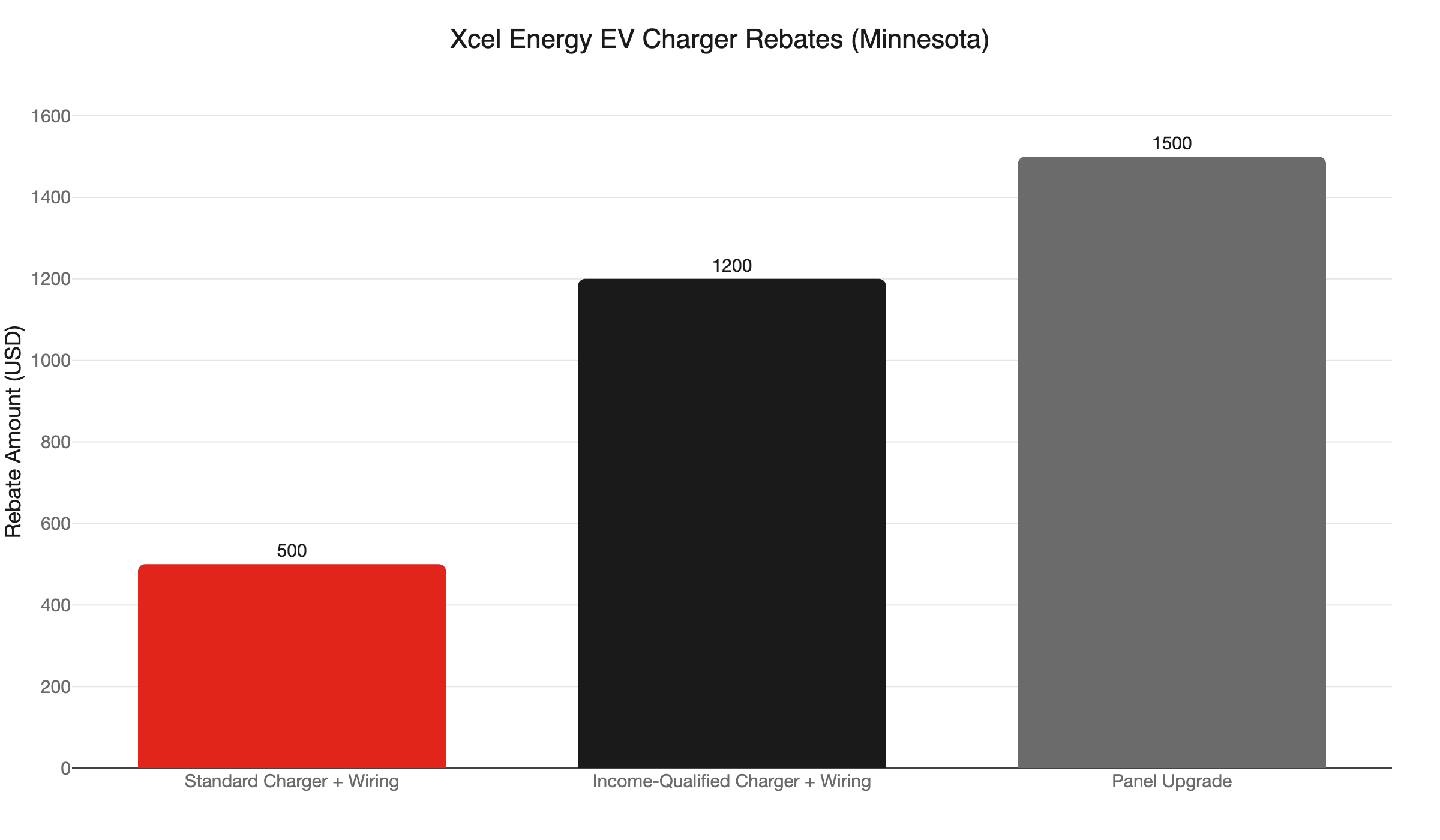
Xcel Energy. Xcel serves the Twin Cities metro and surrounding areas. Their EV charger program offers up to $500 for Level 2 charger and wiring costs. Income-qualified customers may qualify for up to $1,200. Qualifying panel upgrades can add up to $1,500. The critical rule: you must apply and be accepted into the program before purchase or installation. If you buy first and apply second, the rebate is voided. Xcel does not explicitly state whether seasonal or secondary properties qualify. Contact EVRebatesMN@xcelenergy.com to confirm eligibility before ordering anything.
Minnesota Power. A large portion of lake-country Minnesota, including the Duluth area, the Iron Range, and the lake regions north of the metro, is served by Minnesota Power, not Xcel. Minnesota Power runs its own EV equipment rebate program. Applicants must confirm the chosen charger supports OCPP or OpenADR protocols before purchase. The application process and rebate amounts differ from Xcel. If your bill says Minnesota Power, the Xcel application does not apply to you.
Rural electric co-ops. Parts of the Brainerd lakes area, the Mille Lacs corridor, and other lake regions are served by rural electric cooperatives. Co-op rebate programs vary significantly. Call your co-op directly.
Federal 30C tax credit. The Alternative Fuel Refueling Property Credit (30%, up to $1,000 for residential installs) expired June 30, 2026. Installations completed on or before that date in an eligible census tract can still be claimed on the 2026 tax return via IRS Form 8911. If your install was done before the cutoff, talk to your tax preparer before filing.
The short version: look at your utility bill first. Do not assume Xcel territory until you have confirmed it.
Schedule Your Cabin EV Charger Estimate
A cabin EV charger install is one of those jobs where the details drive both the cost and the outcome. Run length, service size, charger selection, code edition, and seasonal shutdown requirements all interact. Getting them right the first time is significantly cheaper than fixing them later.
As a locally owned and operated Twin Cities electrician, we install EV chargers throughout the metro and handle the permit process from start to finish. We know what a Minnesota cabin install actually looks like in the field: long runs in challenging terrain, limited-service panels under electric heat load, and outdoor hardware that has to hold up through real Minnesota winters. We size conductors for actual distances, not theoretical minimums, and we do not cut corners on outdoor enclosures or EVSE-listed receptacles.
For full details on what to expect from estimate to final inspection, visit our EV charger installation service page.
Call 763-200-5956 or book online to schedule your estimate. We are America’s On-Time Electrician(R), and every job we complete is backed by the UWIN(R) 100% satisfaction guarantee.
Frequently Asked Questions
Do I need a permit to add an EV charger at my Minnesota lake cabin? +
Can I add an EV charger to a cabin with 100-amp service? +
How do I winterize an outdoor EV charger at a Minnesota cabin? +
Does Xcel Energy offer rebates for cabin EV charger installs? +
Need an electrician now?