
Upgrade Your Electrical Panel Before Summer: A Twin Cities Guide
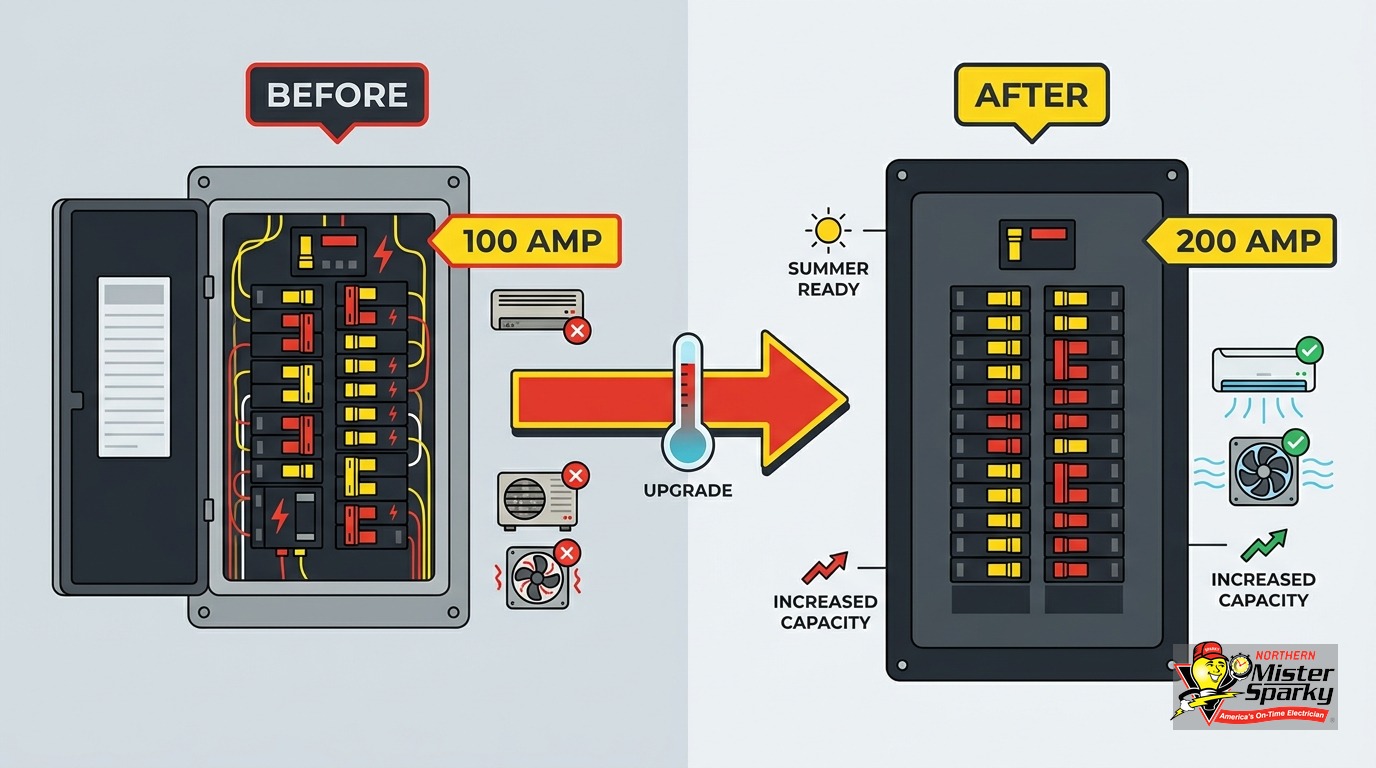
Key Takeaways
- Summer stacks your heaviest loads at once. Central air, outdoor lighting, and EV charging can push an older 100-amp panel past its safe limit.
- An electrical panel upgrade to 200 amps in the Twin Cities usually runs about $1,800 to $3,000, plus a $55 to $315 permit.
- Warning signs to act on: breakers that trip when the AC starts, a warm or buzzing panel, whole-home dimming, a fuse box, or any panel over 25 years old.
- Minnesota requires a permit and a state inspection. An unpermitted upgrade can void insurance and complicate a home sale.
- Minnesota offers a state panel-upgrade program plus Xcel rebates that can lower the cost, especially when the upgrade supports an EV charger or heat pump.
You do not think about your electrical panel until the day it cannot keep up. That day usually lands in summer. The first heat wave arrives, the air conditioner runs nonstop, someone plugs in the EV, and the breaker trips. An electrical panel upgrade before summer is how Twin Cities homeowners get ahead of that moment instead of sweating through it.
We install and upgrade panels across Minneapolis, St. Paul, and the metro suburbs. Spring is the smart time to do it, before the season’s loads pile on. This guide covers why summer is hard on your panel, the warning signs, what an upgrade costs here, and the Minnesota rebates that help pay for it.
Why Does Summer Strain Your Electrical Panel First?
Summer stacks your biggest loads at the same time. Central air, window units, pool or spa equipment, outdoor lighting, and EV charging all pull hard for hours on the hottest days. A panel that coped fine in winter can trip, overheat, or run near its limit all season.
Your panel is the heart of your home’s electrical system. It takes the power from the utility and splits it into the circuits that feed every room and appliance. Each circuit has a limit, and so does the panel as a whole. In winter, your heaviest draws are spread out. In summer, the air conditioner alone can pull as much as several rooms combined, and it runs for hours.
Now add the modern loads that did not exist when many Twin Cities homes were wired. A Level 2 EV charger, a heat pump, a hot tub, a home office full of gear. Each is a real draw, and they often run at the same time you are cooling the house. That is how a 100-amp service that felt fine for years suddenly starts tripping in July.
What Are the Signs You Need a Panel Upgrade?
Watch for breakers that trip when the AC or microwave starts, a panel that feels warm or buzzes, lights that dim across the house when a big appliance runs, a fuse box, or any panel over 25 years old. One of these on a 100-amp service means it is time for a professional look.
Here is what each sign is telling you.
- Frequent breaker trips. A breaker cuts power when a circuit draws more than the wire can safely carry. That is its job. But if you reset the same breaker every hot afternoon, your service is undersized for the load. Fighting overloaded circuits all summer is the panel asking for help.
- A warm or buzzing panel. Your panel should feel cool and stay quiet. Heat points to loose connections or failing breakers, and it can start a fire behind the wall. This one needs same-day attention. Do not open the panel yourself.
- Whole-home dimming. If lights across the house dip when the AC or dryer starts, the panel is struggling to spread the load, or a main connection is loose.
- A fuse box or an old panel. A 60-amp fuse box or a panel over 25 years old cannot add modern arc-fault and ground-fault protection, and it has no room to grow.
For a deeper walk through every symptom, read our full guide on the signs you need an electrical panel upgrade. If your panel shows any of these, do not wait for the first heat wave to force the issue.
How Much Does a Panel Upgrade Cost in the Twin Cities?
Most Twin Cities upgrades from 100 to 200 amps run about $1,800 to $3,000, with typical jobs landing near $2,000 to $3,000. A permit adds roughly $55 to $315. Service-entrance, meter, or mast work pushes the total higher. The final number depends on your home, so a firm quote comes after we see the panel.
Costs vary because homes vary. Here are the ranges we see across the metro, before any rebates.
- Straightforward 100-to-200-amp upgrade: roughly $1,800 to $2,500. A panel swap where the service entrance and meter are in good shape.
- Typical job: about $2,000 to $3,000. The common Twin Cities upgrade with modest service-entrance work.
- More involved: $3,500 and up. A new mast, meter relocation, buried service, or a subpanel add labor.
The charge comparison matters too. A modern 200-amp service does not just stop the trips. It gives you headroom for the EV charger, heat pump, or hot tub you may add next, so you are not paying for a second upgrade in two years. No malarky on the pricing. You get a clear quote before we start, and we offer financing on larger jobs.
Do You Need 200 Amps? A Simple Way to Tell
If you run central air plus any two of an electric dryer, an EV charger, a heat pump, an electric range, or a workshop, you likely need 200 amps. A licensed electrician confirms it with a load calculation before quoting the work.
The load calculation is the honest first step. It adds up your home’s square footage, fixed appliances, HVAC, and existing 240-volt circuits, then compares that demand to your service size. A 200-amp service usually has room to spare. A 100-amp service often does not once you add modern loads.
The math gets real fast with electrification. An EV charger draws 30 to 60 amps, a cold-climate heat pump 30 to 60 amps, an electric water heater about 30 amps, and an electric range 40 to 50 amps. Stack two of those on a 100-amp panel that already runs the AC, and you are over the line. That is why supporting an EV charger is one of the most common reasons homeowners upgrade to 200 amps in 2026.
If your panel is sound but a single circuit keeps failing, you may only need a circuit breaker replacement rather than a full upgrade. We tell you which one your home actually needs.
What Does a Panel Upgrade Involve, and How Long Does It Take?
A standard 200-amp upgrade takes most of a day, plus a short utility disconnect and reconnect. We pull the permit, install the new panel and breakers, coordinate the meter with your utility, and schedule the state inspection. Power is off for a few hours during the swap.
The work itself is methodical. We shut off and disconnect the old service, mount the new 200-amp panel, move each circuit to its new breaker, and land the service entrance and grounding to current code. Where the utility needs to disconnect and reconnect the meter, we coordinate the timing so your outage is as short as possible.
Then comes the part that protects you: the permit and inspection. Minnesota treats panel work as permitted electrical work, so a licensed electrician pulls the permit and a state inspector signs off before the job closes. That inspection is your proof the work was done to code, which matters for insurance and for resale.
Do You Need a Permit, and Are There Rebates in Minnesota?
Yes on the permit, and often yes on rebates. Minnesota requires a permit and a state inspection for a panel upgrade. On the savings side, the state runs a residential electrical panel-upgrade program, and Xcel Energy offers rebates that can apply when the upgrade supports an EV charger or heat pump.
Skipping the permit is a false savings. An unpermitted upgrade can void most homeowner insurance policies, and it becomes your problem when a buyer’s inspector finds it at closing. When we upgrade your panel, the permit and inspection are part of the job, not a line item you chase.
The rebate picture is worth a few minutes of your time. The Minnesota Department of Commerce panel-upgrade program is designed to help homeowners bring older services up to modern capacity, and Xcel rebates can stack with the state’s Conservation Improvement Program incentives. Because these programs change and depend on your address and utility, confirm the current offers before you schedule. We are happy to point you to the right application.
Why Spring Is the Right Time
Spring beats summer for a panel upgrade because you avoid the rush and the risk. Scheduling is easier before the first heat wave, and you replace an at-risk panel before it faces its hardest season, not after it has already tripped or overheated during it.
There is comfort in timing it right. A panel that upgrades in May faces its first July fully ready, with room for the AC, the outdoor lighting, and whatever you plug in next. Doing it in the middle of a heat wave, after a failure, means a hotter house and a rushed schedule. For the same reason many homeowners pair this with other warm-weather electrical work, our spring panel-upgrade guide covers what else to line up before the season turns.
Ready Before the Heat?
An electrical panel upgrade is one of the highest-value electrical projects a Twin Cities home can make. It stops the summer trips, it makes room for an EV charger or heat pump, and it removes a real fire risk from an aging service. The only way to know exactly what your home needs is a load calculation, and that takes one visit.
Call Northern Mister Sparky at 763-200-5956 or book online. We will evaluate your panel, quote the upgrade with no surprises, and get your home ready before summer arrives. Locally owned, on time, no malarky.
Costs, rebate amounts, and program availability change over time and vary by address and utility. Figures here are estimates for planning. Contact us for a quote specific to your home, and confirm current incentives with your utility and the Minnesota Department of Commerce.
Frequently Asked Questions
What are the signs I need an electrical panel upgrade before summer? +
How much does a 100-to-200-amp panel upgrade cost in the Twin Cities? +
Why does summer put more strain on my electrical panel? +
Can I add an EV charger without upgrading my panel? +
Do I need a permit to upgrade my panel in Minnesota? +
Need an electrician now?