Aluminum Wiring Hazards in 1960s-70s Twin Cities Homes
Key Takeaways
- Aluminum wiring hazards are most acute in homes built between 1965 and 1973. Those homes are 55 times more likely to have fire-hazard conditions at electrical connections than copper-wired homes.
- The root cause is a two-factor problem: AA-1350 alloy aluminum wire combined with brass-coated steel screws at device terminals. The expansion mismatch between aluminum and steel is what causes connections to loosen and arc over time.
- Purple “aluminum-safe” wire nuts are not a CPSC-approved permanent repair. Homes where a previous owner used purple wire nuts may still have an active hazard.
- Two permanent, CPSC-approved repairs exist: COPALUM crimping and AlumiConn connectors. Both require a licensed electrician, a Minnesota permit, and a final inspection.
- Most homes qualify for the pigtail method at a fraction of full rewire cost. Full rewire is triggered by specific conditions, not aluminum wiring alone.
- Minnesota adopted the 2023 NEC effective July 1, 2023. All aluminum wiring remediation requires a permit and inspection.
What Are Aluminum Wiring Hazards and Why Do They Matter?
Short answer: Aluminum expands and contracts more than copper with every heating cycle. Over years, connections at outlets and switches work loose, generate resistance, and create fire conditions. Homes from 1965 to 1973 carry the highest risk because of the specific alloy used and the hardware paired with it at device terminals.
The CPSC documented that homes with aluminum branch circuits from this era are 55 times more likely to have fire-hazard conditions at connections than copper-wired homes. An estimated 2 million homes and mobile homes in the US were wired with aluminum branch circuits since 1965. Many of them are still occupied and in daily use across the Twin Cities suburbs.
Aluminum wiring spread because copper prices spiked sharply in the mid-1960s. Builders substituted aluminum as a cheaper alternative, and the practice continued into the early 1970s before the hazard was well understood. By the time the CPSC published its guidance, millions of homes already had it installed.
The Two-Factor Problem: AA-1350 Alloy and Steel Screws
Most explanations of this hazard stop at “aluminum expands more than copper.” That is true, but incomplete. Two factors worked together to create the specific danger in 1965-1973 homes.
The wire used in those builds was AA-1350 alloy, a solid aluminum product originally designed for high-voltage utility transmission lines. When repurposed for residential branch circuits, it was the wrong material. AA-1350 has higher creep - permanent deformation under the sustained pressure of terminal screws - and higher thermal expansion than copper. A connection that starts tight gradually works loose as the wire deforms under load.
The second factor: the same copper-price spike that drove builders to aluminum wire also led device manufacturers to use brass-coated steel screws at outlet and switch terminals instead of solid brass. Steel and aluminum expand at significantly different rates. Every heat-and-cool cycle moves the connection slightly. Over thousands of cycles, aluminum creeps, resistance builds, heat rises, and loosening accelerates. That is the sequence that turns an outlet that appears fine into a fire hazard.
This two-factor convergence - AA-1350 alloy wire plus steel terminal screws - is the mechanical root cause. Aluminum wiring in general is not uniformly dangerous.
Around 1972-1975, the industry shifted to AA-8000 series alloys. These have better elongation, less creep, and better compatibility with modern termination hardware. Homes wired after that transition represent a meaningfully different risk profile. That boundary matters for Twin Cities homebuyers evaluating properties from the mid-1970s.
The scale of this danger became undeniable in 1977. The Beverly Hills Supper Club fire killed 165 people, and poorly installed aluminum wiring was a documented contributing factor. That event accelerated federal scrutiny and pushed the development of formal remediation standards.
Is Your Twin Cities Home at Risk for Aluminum Wiring Hazards?
Short answer: If your home was built between 1965 and 1973, assume aluminum wiring until an inspection confirms otherwise. The Twin Cities’ heaviest suburban buildout happened during exactly this period, and a large share of that housing stock has never had the wiring type confirmed.
Communities like Bloomington, Eden Prairie, Woodbury, Burnsville, and Brooklyn Park saw their primary residential growth during the 1960s-1970s housing boom. Split-levels, ramblers, and ranch homes from that era make up a significant share of the suburban single-family stock. If you purchased one of these homes without a dedicated electrical inspection, you may not know what wiring material is inside the walls.
A licensed electrician identifies aluminum wiring by opening the panel, junction boxes, and outlet boxes. Aluminum wire is silver-colored (not copper-colored), and older AA-1350 wire is often stamped or printed with “AL” on the jacket. Do not rely on a general home inspection for this. Home inspectors assess visible surface conditions; electricians open the boxes and inspect connections directly.
If you are purchasing a home from this era, request the electrical disclosure before closing. Some lenders flag aluminum wiring during appraisals, and many insurers ask about it at underwriting. Knowing before you close gives you negotiating leverage and a clear remediation path.
What Warning Signs Point to Aluminum Wiring Hazards?
Short answer: Warm outlet or switch cover plates, a burning smell near electrical devices, breakers that trip under light loads, and lights that flicker without explanation are the four symptoms that warrant immediate action. Any one of them in a home from this era is a reason to call an electrician the same day.
Watch for these specific signs in a 1965-1973 home:
- Outlet or switch cover plates that feel warm or hot to the touch
- A burning or plastic smell near outlets or switches
- Circuit breakers that keep tripping on circuits that are not heavily loaded
- Outlets that stop working intermittently
- Lights that flicker without a clear cause
- Discoloration or scorch marks around outlet or switch plates
By the time these symptoms appear, the connection has typically been degrading for months. For a broader look at residential electrical hazards, see our guide to the top 5 electrical hazards every homeowner should know.
Why Aren’t Purple Wire Nuts a Permanent Fix?
Short answer: Purple wire nuts are not CPSC-approved as a permanent repair for aluminum branch circuits. The aluminum-to-copper connection inside the nut still expands and contracts with every heat cycle, and purple wire nuts have been documented as failure points in fire investigations.
The common 1980s field repair was to connect a short copper pigtail to the aluminum wire using a purple “aluminum-safe” twist-on wire nut, then land the copper on the outlet or switch terminal. It was widely practiced, and a lot of Twin Cities homes from this era still have it.
The CPSC is unambiguous: purple wire nuts are not a CPSC-approved permanent repair for aluminum branch circuits. They have appeared as failure points in fire investigations. The connection between aluminum and copper inside a wire nut is still subject to the expansion mismatch. The nut conceals the joint but does not solve the underlying problem.
If your home has purple wire nuts on aluminum circuits, treat it as partially addressed, not fully resolved. An independent inspection by a licensed electrician is the appropriate next step.
What Are My Options for Aluminum Wiring Remediation?
Short answer: Two CPSC-approved permanent options exist. COPALUM crimping is the preferred method. AlumiConn connectors are the CPSC’s approved alternative. Both attach a copper pigtail at every connection so that copper, not aluminum, contacts device terminals. Both require a licensed electrician, a Minnesota permit, and a final inspection.
COPALUM Crimping
COPALUM is the CPSC’s first-choice permanent repair. A certified technician uses a proprietary hydraulic crimping tool to cold-weld the aluminum wire to a copper pigtail. The result is a gas-tight, permanent connection that eliminates the expansion mismatch at the terminal.
Availability limits this option. COPALUM requires a trained technician with proprietary equipment. When COPALUM is not available locally, the approved alternative is AlumiConn.
AlumiConn Connectors
AlumiConn connectors (King Innovation) are UL 486C listed and CPSC-approved when COPALUM is unavailable. Each connector has independent ports for the aluminum wire and the copper pigtail, with a setscrew holding each wire in its own channel. The ports come pre-filled with anti-oxidant compound to block the surface oxidation that degrades aluminum connections over time.
The critical field detail: independent testing found that AlumiConn’s long-term reliability depends on the setscrews being tightened to the manufacturer’s torque specification. Under-torquing and over-torquing are the primary causes of field failure. A technician who skips the torque step has not completed the repair correctly.
This is one reason aluminum wiring remediation is not a job for a capable DIYer. Getting the torque wrong by a small margin determines whether a connection holds for decades or fails in years.
CO/ALR-Rated Devices
Replacing outlets and switches with CO/ALR-rated devices (rated for copper-aluminum contact) addresses the device terminal only. It does nothing for splices in junction boxes, attic runs, or panel connections. CO/ALR devices alone are not a sufficient standalone repair.
For a complete assessment and permanent repair, see our home wiring repair service.
Should You Choose Pigtail Remediation or a Full Rewire?
Short answer: Most homes with aluminum branch circuits qualify for the less costly pigtail method, which achieves the same safety result as a full rewire. Full rewire is the right call when the wire itself is damaged, the panel needs replacement, or a lender or insurer specifically requires it.
Both methods achieve equal safety when done correctly. The decision turns on the condition of the existing wire, the panel, and any third-party requirements.
Choose pigtail (COPALUM or AlumiConn) when:
- The aluminum wire is undamaged with intact insulation
- The panel is adequate (200A service, modern breakers, no replacement needed)
- You want the permanent CPSC-approved fix at the most reasonable cost
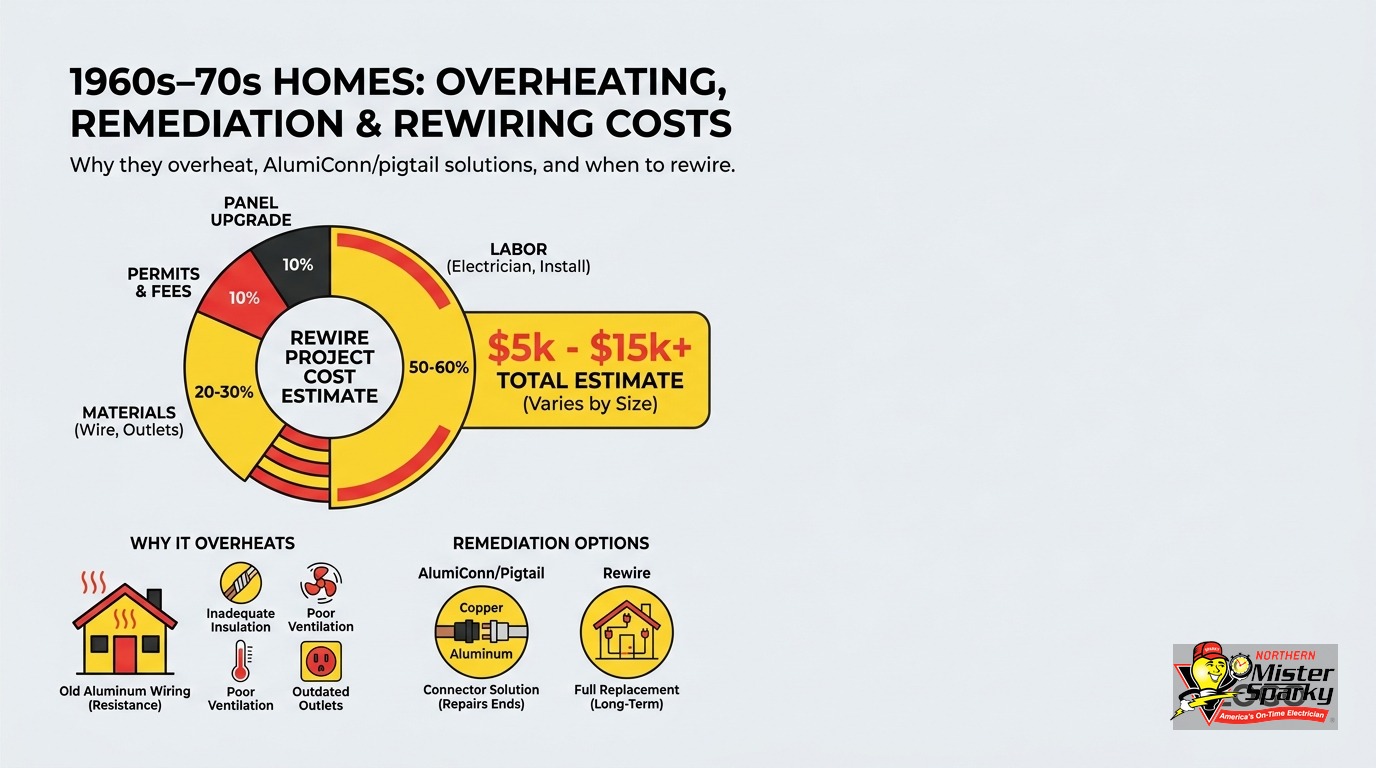
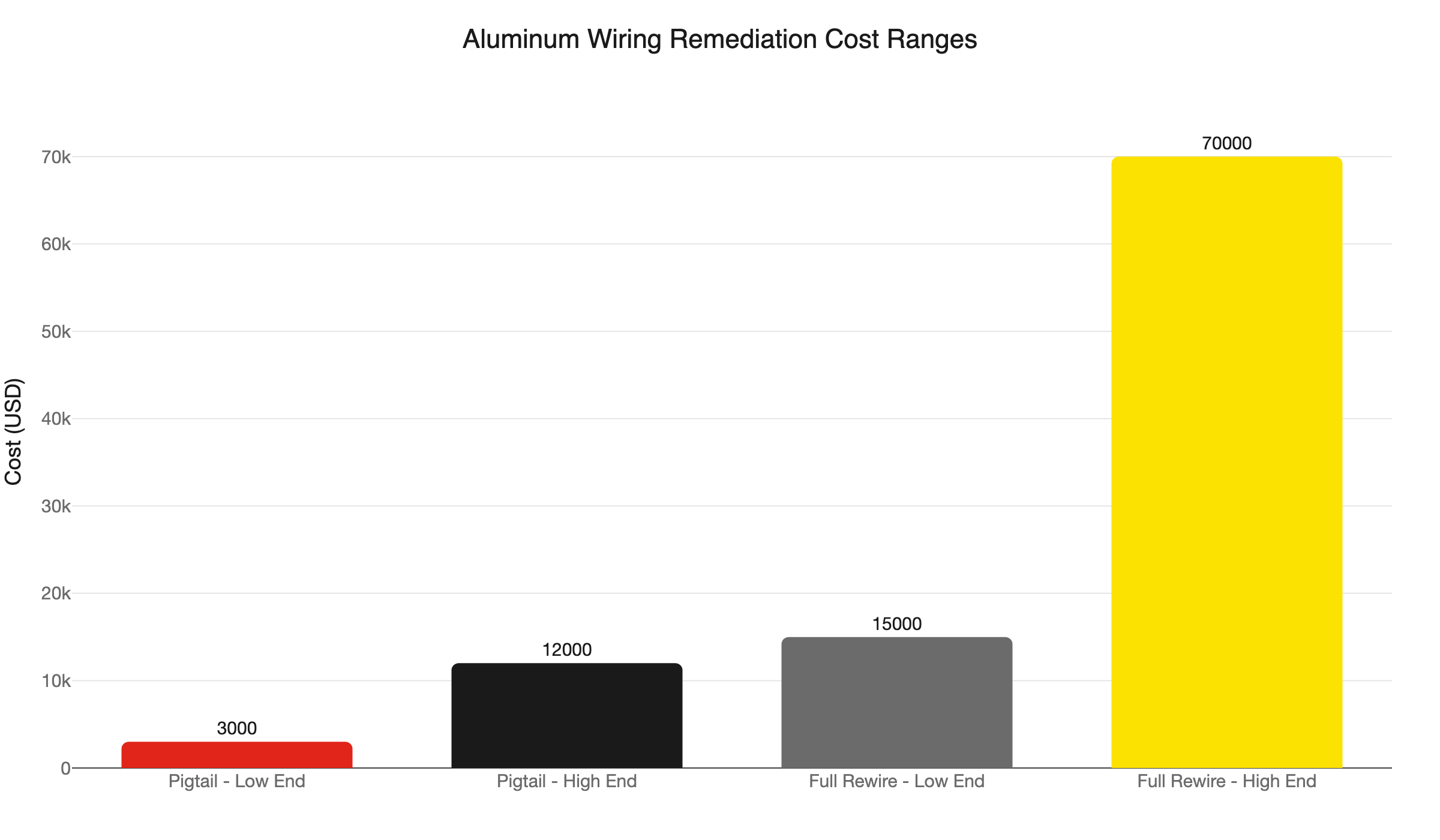
- Estimated cost: $3,000 to $12,000 depending on home size and circuit count
Choose full rewire when:
- The aluminum wire shows physical damage, melted or brittle insulation, or evidence of past overheating
- The panel needs replacement regardless (upgrading from 100A service, obsolete fuse box, outdated breakers)
- A buyer, lender, or real estate attorney requires full rewire as a condition of closing
- Your insurer requires it for coverage continuation
- Estimated cost: $15,000 to $70,000+ depending on home size and construction type
If your panel is already due for replacement, consider whether combining the panel upgrade with a rewire makes more sense than pigtailing a panel you will replace in two years. Our posts on signs you need a panel upgrade and the cost to rewire a house in the Twin Cities cover both decisions in detail.
Does Aluminum Wiring Affect My Homeowners Insurance in Minnesota?
Short answer: Yes. Some Minnesota insurers surcharge policies on homes with unremediated aluminum wiring. Others decline to renew. A completed, permit-pulled remediation with documented inspection sign-off is the most effective tool for protecting your coverage.
Insurance scrutiny of aluminum wiring has increased as underwriters price fire risk more precisely. Some major carriers now require proof of remediation before issuing or renewing a policy on a 1960s-1970s home with aluminum branch circuits. Others apply a surcharge.
Minnesota’s Fire Safety Surcharge increased from 0.5% to 0.65% on all property and casualty policies issued or renewed on or after July 1, 2023. This charge applies statewide - not specifically to aluminum wiring - but it reflects a broader environment in which fire risk is being priced more aggressively. Homes with known, unremediated hazards are drawing more insurer attention.
When remediation is complete, keep the permit, the final inspection sign-off, and any contractor documentation. That paperwork is what you present to your insurer to show the home is code-compliant. In some cases, it is the difference between a renewal and a non-renewal notice.
Do I Need a Permit for Aluminum Wiring Work in Minnesota?
Short answer: Yes. All residential electrical work in Minnesota, including pigtail remediation, requires a permit and inspection through the Minnesota Department of Labor and Industry. There are no exemptions for minor fixes.
Minnesota adopted the 2023 NEC effective July 1, 2023. Under NEC 110.14, connections that intermix dissimilar metals must use devices listed for the purpose. That is the code basis for why standard outlet screws cannot legally contact aluminum wire and why licensed, documented repairs are the only compliant path forward.
Minnesota homeowners can pull their own electrical permit for work on their homesteaded property only - not rentals, condos, or shared spaces. The work must meet the same code standard as a licensed contractor, and it still requires a final inspection.
For aluminum wiring remediation specifically, the inspection sign-off is your proof that the work was done correctly. It protects your insurance coverage, your resale value, and the safety of everyone in the home. Do not skip the permit to save a few days.
Schedule Your Inspection with Northern Mister Sparky
Aluminum wiring hazards in Twin Cities homes are real, documented, and solvable. If your home was built in the 1960s or 1970s and you have not had a licensed electrician verify the wiring type, that inspection is overdue.
As locally owned and operated Twin Cities electricians, our team works in these neighborhoods every day. We know what 1965-1973 homes look like on the inside, where the aluminum runs, and how to remediate it the right way - with CPSC-approved methods, correct torque, and a permit on record so the inspection sign-off is yours to keep.
Call us at 763-200-5956 or schedule your inspection online at northernmistersparky.com. America’s On-Time Electrician(R) shows up when we say - and the UWIN(R) 100% satisfaction guarantee backs every job.
Frequently Asked Questions
Is aluminum wiring dangerous right now in my home? +
Can I sell a home in Minnesota with aluminum wiring? +
How long does pigtail remediation take? +
Do I have to fully rewire if my home has aluminum wiring? +
Does my insurance company need to know about aluminum wiring? +
Need an electrician now?