
Attached Garage Electrical Wiring Requirements: MN Guide
Key Takeaways
- An attached garage needs both GFCI and AFCI protection. A detached garage needs only GFCI. Most national articles online miss this split entirely.
- Every receptacle in the garage needs GFCI protection, including the ceiling outlet for the garage door opener. No exceptions under NEC 210.8(A)(2).
- You need at least one dedicated 20A, 120V circuit for receptacles. A multi-bay garage needs a separate lighting circuit on top of that.
- Each vehicle bay needs one receptacle mounted no higher than 5.5 feet above the floor. The ceiling opener outlet does not count toward this requirement.
- Any EV charger drawing more than 16A must have its own dedicated circuit, sized at 125% of the continuous load.
- Permits filed before August 3, 2026 fall under the 2023 NEC. Permits filed on or after that date must comply with the 2026 NEC.
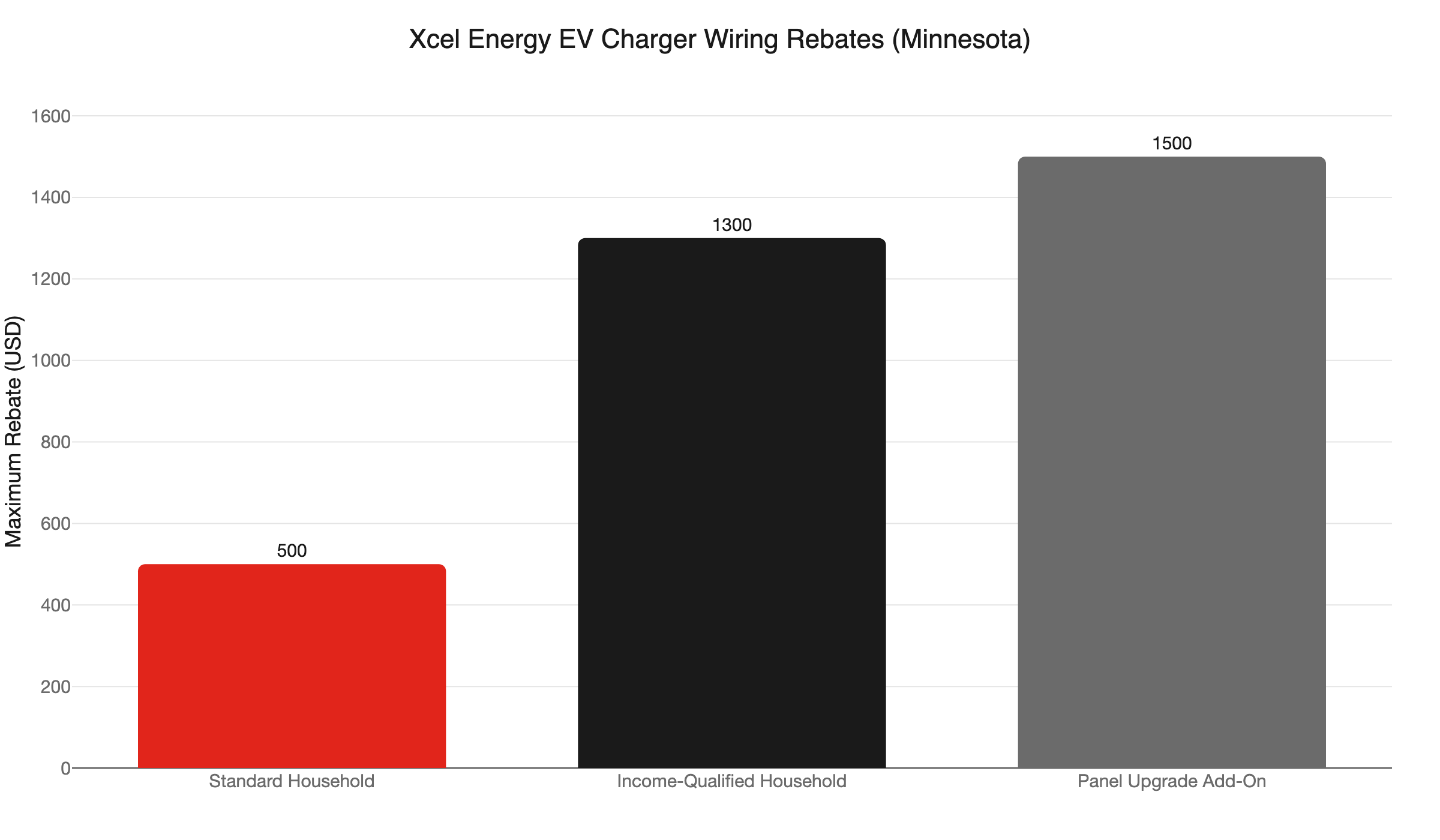
- Xcel Energy offers up to $500 toward Level 2 EV charger wiring, or up to $1,300 for income-qualified Twin Cities households.
Does an Attached Garage Need AFCI Protection?
Yes, and a surprising number of articles will tell you otherwise. Under NEC 210.12(A), all circuits in an attached garage require Arc Fault Circuit Interrupter (AFCI) protection. An attached garage is part of the dwelling structure. The requirement has been in effect since the 2017 NEC cycle. A detached garage is not covered by NEC 210.12.
This is the most common AFCI misconception in online garage wiring guides. One of the top-ranked national articles on this subject states explicitly that garages do not need AFCI. That is accurate only for a detached structure. Wire a new circuit in an attached garage without an AFCI breaker, and it will fail inspection.
Why does code care about arc faults specifically in a garage? Garages are high-risk environments for arcing faults. Extension cords get pinched under garage doors. Fasteners from nail guns or screws pierce wiring stapled along studs. Paint, sawdust, and solvents create ignition risk near a hot arc. A standard circuit breaker will not trip on a low-current arcing fault. An AFCI breaker detects the characteristic waveform of an arc and trips before the heat builds.
The practical fix is a dual-function AFCI/GFCI breaker at the panel. One device satisfies both NEC 210.8 (GFCI) and NEC 210.12 (AFCI) in a single breaker slot. These breakers typically run $35 to $50 and take about 10 minutes to swap on an existing circuit. It is the cleanest path to full code compliance for an attached-garage circuit.
For more on what breaker work involves and what it costs, see our post on circuit breaker replacement.
GFCI Protection in an Attached Garage: No Exceptions
Every receptacle in a garage must be GFCI-protected under NEC 210.8(A)(2). This covers 125V through 250V outlets rated at 50A or less. There are no exemptions, and no outlet location inside the garage is excluded.
The outlet that catches most homeowners and some contractors off guard: the ceiling receptacle for the garage door opener. According to electrical code resources, the most common garage inspection failure in residential work is a ceiling-mounted opener outlet installed without GFCI protection. The old “non-readily-accessible” exemption, which once allowed unprotected ceiling outlets, was removed from the NEC in 2008. If your garage door opener plugs into an unprotected ceiling outlet, your home does not meet current code.
You have two main options for providing GFCI protection on a garage circuit:
GFCI outlet (with TEST and RESET buttons). A GFCI outlet at the first position on the circuit protects all downstream outlets on the same circuit. The catch: if that outlet trips, everything downstream goes dead. If the tripped outlet is the ceiling opener, you need a ladder to reset it.
GFCI breaker at the panel. A panel-mounted GFCI breaker protects every outlet on the circuit. If you are already installing a dual-function AFCI/GFCI breaker for AFCI compliance, the GFCI side of that breaker covers the ceiling opener and all other garage outlets on the circuit. One breaker, both requirements met.
Our GFCI outlet requirements guide covers GFCI placement requirements throughout the home if you want to see the full picture.
What Circuits Does an Attached Garage Need?
At minimum, one dedicated 20A, 120V branch circuit for garage receptacles. NEC 210.11(C)(4) raised the minimum from 15A to 20A in the 2017 NEC revision. The reason is practical: modern garage loads, including battery chargers, power tools, and EV charging, routinely exceed what a 15A circuit can handle without tripping.
For a single-bay garage, the 20A circuit can supply both receptacles and lighting on the same circuit. For a multi-bay garage, the required 20A circuit is for receptacles only. Lighting must be on a separate circuit.
The minimum circuit list for a typical two-car attached garage in Minnesota:
- One 20A, 120V dedicated circuit for receptacles (required)
- One separate lighting circuit (required in a multi-bay garage; best practice in any garage)
- One dedicated 240V circuit for a Level 2 EV charger (required if installing one)
- Individual dedicated circuits for any 240V workshop tools, such as an air compressor or welder
If your garage currently runs on a single 15A circuit shared with the rest of the house, that is out of code for any new permitted work. When you pull a permit for a new outlet or EV charger, an inspector reviews the full wiring picture for the garage, not only the new circuit. Our post on dedicated circuits for appliances explains why shared circuits create inspection problems and nuisance tripping beyond the code violation itself.
Where Do Receptacles Need to Go?
One receptacle per vehicle bay, mounted no higher than 5.5 feet above the floor. NEC 210.52(G) has carried this placement requirement since 2017, and the 2020 NEC tied the required count explicitly to the number of vehicle bays.
Two details homeowners commonly miss:
- The ceiling outlet for the garage door opener does not satisfy the per-bay receptacle requirement. It is a separate, dedicated outlet for a fixed appliance.
- The 5.5-foot height limit keeps receptacles accessible from a standing position while keeping them clear of where a car door or bumper could make contact. The goal is a usable outlet at every bay, not a box checked on a drawing.
In a two-car garage, you need at least two bay-area receptacles, one per bay, in addition to the opener outlet and any workbench outlets you want. The right time to rough in all of these is before drywall, when routing wire costs almost nothing in extra labor. Adding an outlet after the walls are closed means patching, painting, and paying for significantly more electrician time.
Does Your Attached Garage Need an EV-Ready Circuit?
Current code does not require an EV circuit unless you are installing a charger now. But running the 240V stub while the walls are open is one of the smarter investments you can make.
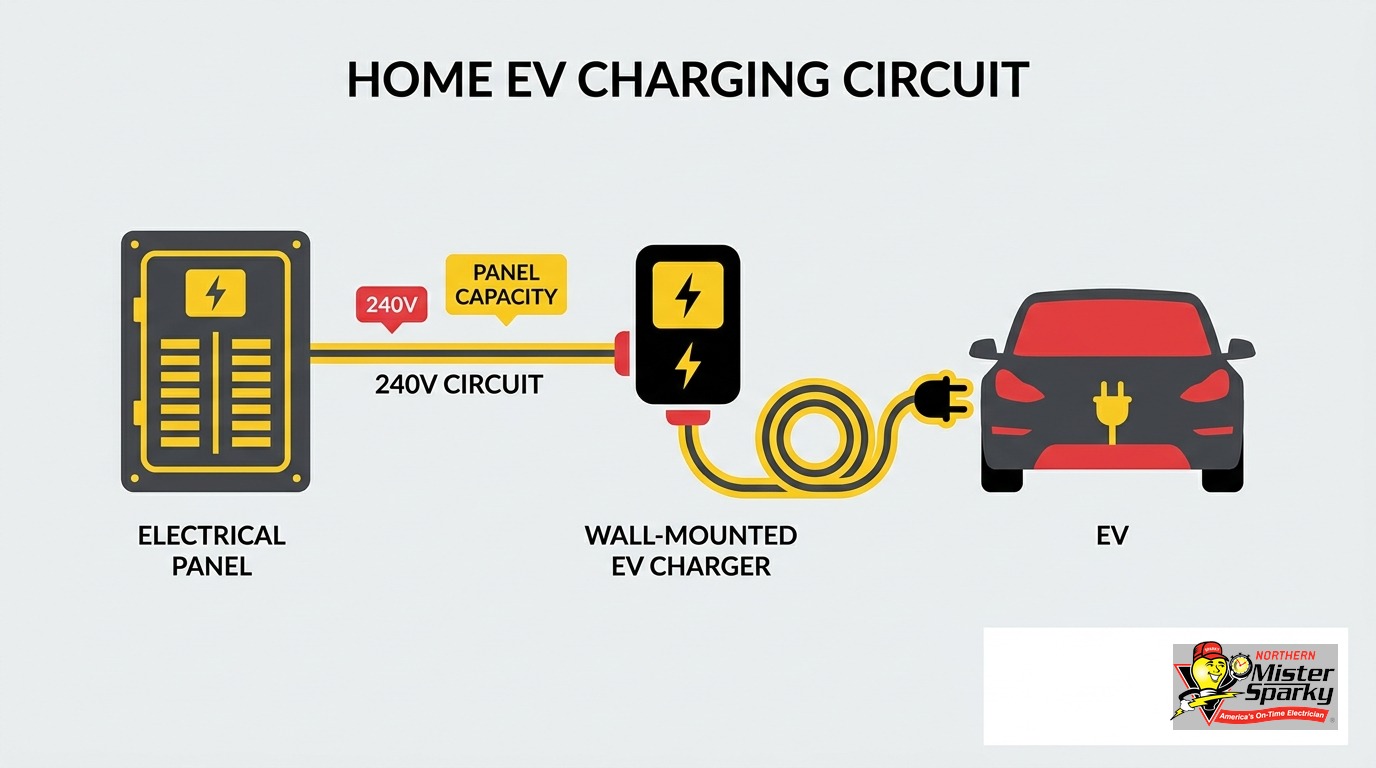
NEC 625.40 requires any outlet installed for EV charging to be on a dedicated branch circuit with no other outlets on it. This applies whether you are installing a 120V NEMA 5-15 outlet (Level 1, a standard 15A wall plug) or a 240V NEMA 14-50 or a hardwired Level 2 EVSE.
Level 1 charging, on a standard 120V outlet, adds only a few miles of range per hour for most EVs. Level 2 charging, on 240V, adds enough range per hour to fully charge most vehicles overnight. For Twin Cities drivers putting on typical daily mileage, Level 1 can barely keep up. Level 2 is the practical standard for home EV charging.
NEC 625.42 sizes the EV circuit at 125% of the continuous load. A 48A continuous load charger, a common 11.5kW Level 2 unit, needs a 60A dedicated circuit. The standard pre-run EV-ready stub is a 50A/240V outlet on a 60A breaker, which covers most Level 2 chargers available today and leaves headroom for the next vehicle.
Any EV charger drawing more than 16A must be on a dedicated individual branch circuit. It cannot share the general 20A garage receptacle circuit.
For the full scope and cost breakdown of an EV install in the Twin Cities, see our EV charger installation guide.
What Is the Xcel Energy Rebate for EV Charger Wiring?
Up to $500 for most Twin Cities households, up to $1,300 for income-qualified households, and up to $1,500 more for a panel upgrade. Xcel Energy is the dominant utility in the Minneapolis and St. Paul metro, and their EV charger wiring rebate covers Level 2 charger installation and the 240V circuit that feeds it.
The income-qualified tier applies to households at 80% or below the area median income. If a panel upgrade is also required to accommodate the EV circuit, that portion can stack with the charger rebate.
The rebate requires licensed electrician installation. We handle the work and the documentation trail that supports your rebate application. Between the rebate and the fuel cost savings compared to gasoline, the payback window on a Level 2 install for most Twin Cities EV owners is well under two years.
See our EV charger installation service for what a full Twin Cities install covers.
Which NEC Version Applies to My Minnesota Garage?
The version depends on when you file the permit. Permits filed before August 3, 2026 fall under the 2023 NEC. Permits filed on or after August 3, 2026 must comply with the 2026 NEC. Licensing exams for electricians shift to the 2026 NEC on September 8, 2026.
For most attached-garage projects, the practical difference between 2023 and 2026 NEC is small. The AFCI, GFCI, 20A circuit, and EV requirements in this post are in the 2023 NEC and carry forward into 2026. If you are planning garage work in the next 12 months, filing before August 3, 2026 puts you on the more familiar 2023 NEC path.
If you are in St. Paul, the Department of Safety and Inspections publishes an official 2023 NEC garage electrical checklist that inspectors carry during rough-in. Reviewing it before your inspection is worth 10 minutes.
One more variable worth checking: where to file. In the Twin Cities metro, electrical permits go either to the state (DLI) or to the local city, depending on the municipality. Some cities are state-jurisdiction, some are local. Our Minnesota electrical permit guide explains how to confirm your jurisdiction before you file.
Can a Minnesota Homeowner Pull Their Own Electrical Permit?
Yes, with conditions. Minnesota allows homeowners to pull their own electrical permit for work on the home they own and occupy. You are not required to hire a licensed electrician for your own home.
A few practical notes before you decide to go that route:
- The work still has to pass an inspection. An inspector will check every circuit, outlet, and breaker against code.
- Panel work, AFCI breaker installation, and 240V EV circuit wiring are not beginner projects. A wiring mistake in a panel costs more to diagnose and fix than paying a licensed electrician upfront would have cost.
- Our DIY electrical dangers post covers the most common homeowner wiring mistakes. Read it before picking up a wire stripper.
Do not skip the permit regardless of who does the work. An unpermitted wiring job surfaces in any home inspection when you sell. It can also complicate a homeowner’s insurance claim if a fire traces back to the garage.
Attached Garage Electrical Wiring Requirements: Full Checklist
Before rough-in work starts on a two-car attached garage in Minnesota, here is everything that has to be on the plan:
Circuits
- One 20A, 120V dedicated circuit for receptacles (required)
- One separate lighting circuit (required for multi-bay; best practice in any garage)
- One 50A/240V dedicated circuit on a 60A breaker for a Level 2 EV charger (if installing)
- Individual dedicated 240V circuits for any high-draw workshop tools
Protection
- Dual-function AFCI/GFCI breaker at the panel for all attached-garage circuits
- GFCI protection on every receptacle not already covered by a panel-level GFCI breaker
- Ceiling opener outlet on a GFCI-protected circuit, no exceptions
Receptacle placement
- At least one receptacle per vehicle bay, at 5.5 feet above the floor or lower
- Ceiling opener outlet in addition to the per-bay receptacles (not a substitute for them)
- Workbench outlets as needed, all GFCI-protected
Permit and inspection
- Permit filed with DLI or local city before any work starts
- Rough-in inspection scheduled before walls close
- Final inspection after drywall is up and cover plates are installed
If your panel does not have room for the new breakers, a panel upgrade may need to happen first. Our signs you need an electrical panel upgrade post covers what to look for before you start pulling permits. If you are adding a standby generator alongside the garage project, our whole-house generator installation guide covers how transfer switch wiring interacts with the panel and what has to happen in what order.
When to Call Northern Mister Sparky
Call us any time the work touches the panel, runs a 240V circuit, requires an AFCI breaker, or you just want to know what your garage actually needs before committing to a plan.
Northern Mister Sparky is locally owned and operated in the Twin Cities. We are not a national dispatch center. As America’s On-Time Electrician(R), we show up in the window we commit to, every time. The UWIN(R) 100% satisfaction guarantee covers every job we do.
Attached garage electrical work is one of the more common projects we handle for Twin Cities homeowners: a new EV circuit with Xcel rebate paperwork, a dual-function breaker swap to bring an older garage up to current code, or a full rough-in for a garage-to-workshop conversion. We handle the permit pull, the inspection scheduling, and the documentation that supports any rebate applications.
Call 763-200-5956 or book online. We will walk through your existing garage wiring before we quote anything.
Frequently Asked Questions
Does an attached garage need AFCI protection? +
Does a garage door opener outlet need GFCI protection? +
How many circuits does a two-car attached garage need? +
What is the Xcel Energy rebate for EV charger wiring in Minnesota? +
Need an electrician now?