
Electrical Bonding and Grounding: Twin Cities Home Guide
Key Takeaways
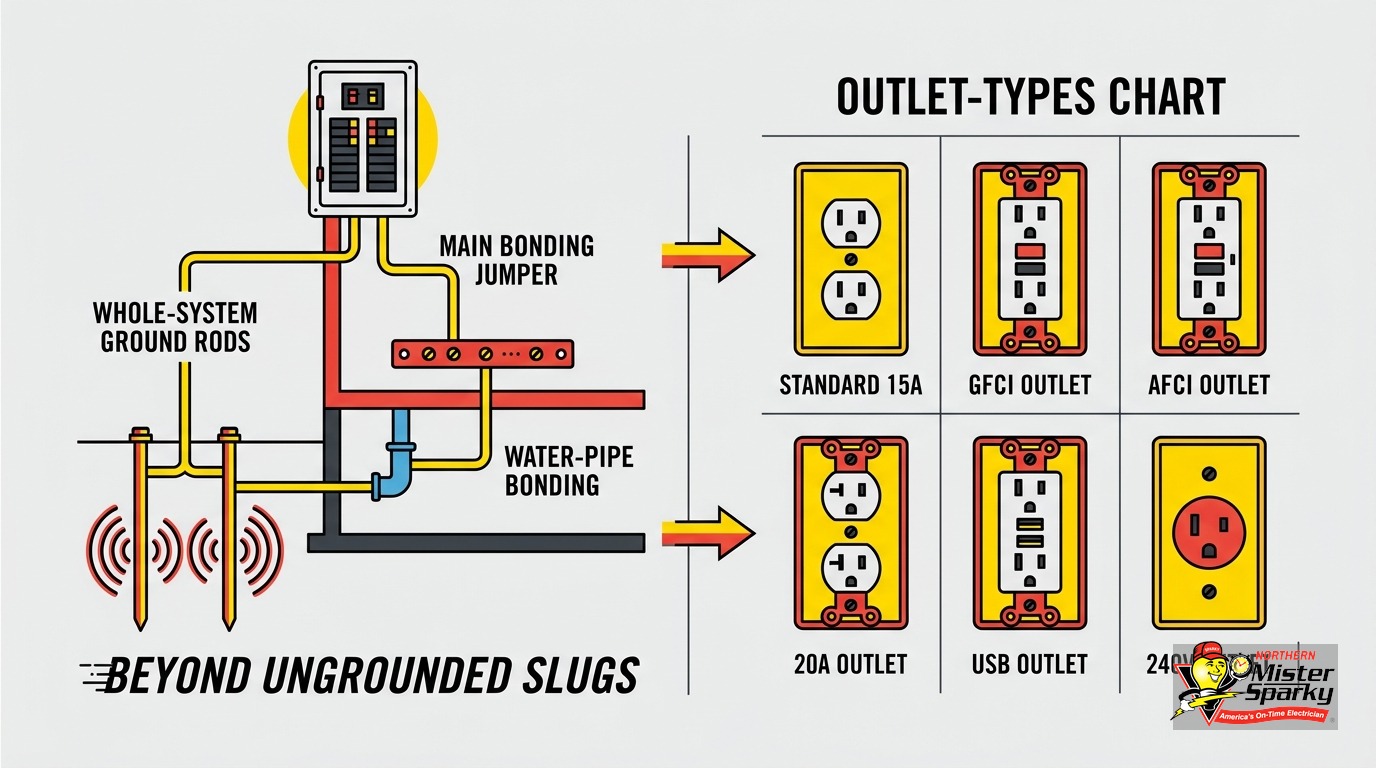
- Grounding ties your electrical system to earth. It stabilizes voltage and provides a path for lightning. Bonding connects metal parts so fault current trips a breaker instead of passing through you.
- The main bonding jumper inside your main panel is the single most critical connection in the system.
- Ground rods must be copper-clad steel, at least 5/8 inch in diameter, and driven 8 feet into the earth.
- Interior metal water pipes require bonding under NEC 250.104 even if the underground service lateral has been replaced with plastic (PEX).
- A bonding jumper must bridge the water meter. Utility crews routinely install plastic-bodied meters that break the electrode path.
- Minnesota moves to the 2026 NEC for any permit filed on or after August 17, 2026.
- Call us at 763-200-5956 or book online if your home has not had a grounding inspection.
What Is Electrical Bonding and Grounding?
The short answer: Grounding ties your electrical system to earth. It stabilizes voltage and provides a path for lightning surge energy. Bonding connects metal parts together so fault current has a low-resistance path back to the panel and trips the breaker. Both are NEC requirements. They protect against different hazards.
Most homeowners hear “grounded” and picture the round hole in a three-prong outlet. That hole matters. But it is only the visible end of a larger system. That system runs from the service entrance to the earth beneath your yard. The chain includes ground rods, a grounding electrode conductor, water pipe connections, and a critical bonding strap inside your main panel.
We work in Twin Cities homes every week: Minneapolis, St. Paul, Bloomington, Maple Grove, Woodbury, and the surrounding suburbs. Gaps in this system are common. A missing water meter jumper is one example. A ground rod that was never fully driven is another. Interior copper pipes that lost their bond after a PEX lateral replacement are a third. These are not cosmetic issues.
This post covers the complete chain from service entrance to earth. It explains what each NEC section requires. It also covers what our electricians typically find in older Minnesota homes.
What Does the Grounding Electrode System Actually Do?
The short answer: The Grounding Electrode System (GES) ties your electrical system to earth. Its primary jobs are stabilizing voltage and routing lightning surge energy safely away. Fine Homebuilding states the GES “has virtually nothing to do with reducing hazards from problems in the wiring inside the house.” Your equipment grounding conductors handle internal faults.
This is one of the most misunderstood points in residential electrical work. The GES and the equipment grounding conductors do separate jobs.
When a fault happens inside your home, the equipment grounding conductors carry fault current back to the panel. Those are the bare copper wires running through your cables. The main bonding jumper then routes that current to the panel enclosure. The breaker trips. Earth ground is not involved in that sequence.
Earth ground handles three things:
- Lightning strikes and utility line surges
- Keeping the neutral conductor at a stable reference voltage
- NEC 250.50 compliance: all electrodes present at the structure must be bonded into one system
A typical Twin Cities home’s GES has three components. The first is a metal underground water pipe, when at least 10 feet of it is in direct earth contact. The second is one or more driven ground rods. The third is the grounding electrode conductor (GEC) that ties them all back to the main panel.
What Is the Main Bonding Jumper?
The short answer: The main bonding jumper is a conductor inside your main panel. It connects the neutral/ground bus bar to the metal panel housing. Fault current uses this path to flow back to the utility transformer and trip the breaker. Fine Homebuilding calls it “probably the single most important connection in the entire electrical system.”
Without this jumper, the panel enclosure floats. A fault to the cabinet would energize the metal housing. There would be no path to clear the breaker. It would simply stay energized.
This jumper belongs only in the main panel. In any subpanel you add later, the neutral and ground must be kept separate. A detached garage panel, a basement feeder panel: both require an isolated neutral bar. Installing the main bonding jumper in a subpanel is a code violation. It is also a hazard.
When our electricians open an older panel during a service call in the Twin Cities, checking this connection is one of the first things on the list.
Ground Rods: Specs, Depth, and the Supplemental Electrode Rule
A ground rod creates a low-resistance path between the GEC and the earth. The NEC has precise requirements for how this is done.
Rod specifications. Ground rods must be copper-clad steel, at least 5/8 inch in diameter, and 8 feet long. The grounding electrode conductor connecting the rod to the panel is typically #6 AWG copper for most residential services. A properly installed copper-clad rod can last more than 40 years in the ground, which matters since the rod is not easy to access after installation.
The freeze-thaw problem. Minnesota’s frost depth in the Twin Cities metro is typically 42 to 48 inches. Ground rods still require 8 feet of depth. Frost depth does not change that. What does change is the clamp where the GEC attaches near the top of the rod. Clay-heavy Twin Cities soils and decades of freeze-thaw cycling can work that clamp loose. In homes built before 1980, this connection deserves a close look.
The supplemental electrode rule. Under NEC 250.53(A)(2), if a single rod is the only grounding electrode, a supplemental electrode is required unless the single electrode measures 25 ohms or less resistance to earth. When a metal underground water pipe serves as the primary electrode, the code also mandates a supplemental rod. In practice, most homes have both.
Does a Plastic Water Line Change the Bonding Rules?
The short answer: Yes for one requirement, no for another. Replacing the underground service lateral with plastic removes that pipe from the Grounding Electrode System. The NEC requires 10 feet of direct earth contact to qualify as an electrode. But interior copper pipes still require bonding under NEC 250.104 regardless of what the underground lateral is made of.
This distinction matters in the Twin Cities. The Metropolitan Council and many area utilities have been replacing aging iron service laterals with plastic for decades. A large share of pre-1980s homes in Minneapolis, St. Paul, Bloomington, Brooklyn Park, and the first-ring suburbs now have a plastic underground entry and original copper interior plumbing.
In code terms, that combination means:
- The plastic underground pipe cannot serve as a GES electrode (NEC 250.52(A)(1) requires 10 feet of direct earth contact).
- Interior copper pipes must still be bonded to the electrical system under NEC 250.104.
- If the underground lateral is plastic, the home’s GES depends entirely on driven ground rods.
If someone told you years ago that your water pipe was grounded, and the underground lateral has since been replaced with PEX, have the system checked. A grounding and bonding inspection gives you a clear picture of what is actually there.
Interior Water Pipe Bonding: NEC 250.104
NEC 250.104(A) requires interior metal water piping to be bonded to the electrical system. This applies regardless of whether the underground service lateral qualifies as a grounding electrode. It is a separate, stand-alone requirement.
Here is the hazard the rule prevents. An interior metal water pipe can become energized from an appliance fault. A failing water heater element is a common example. If the pipe is not bonded, there is no low-impedance path for fault current to return to the panel. The breaker does not trip. The pipe sits energized. Anyone touching it while in contact with a grounded surface completes the circuit.
This requirement exists because unbonded interior piping creates a shock hazard with no visible warning and no automatic protection. It is one of the most common gaps our electricians find in older Twin Cities homes.
The hot-and-cold jumper. A single bonding jumper connecting the hot and cold supply lines is sufficient. Hot and cold are already electrically connected through the water heater tank. The conductor is typically #8 copper or #6 aluminum. Many electricians install this jumper at the water heater so it is easy for an inspector to find and verify.
Why Does the Water Meter Need a Bonding Jumper?
The short answer: Utility crews swap water meters regularly. Many replacement meters are plastic-bodied or use non-conductive couplings. Without a jumper bridging the meter, one routine swap breaks the electrode path and the interior bonding continuity. NEC 250.68(C) requires this jumper, and it must be in place regardless of what type of meter the utility installs.
The jumper itself is simple: a copper conductor with a clamp on each side of the meter. It maintains electrical continuity across the gap no matter what meter the utility installs. It is inexpensive and takes a few minutes to install correctly.
The problem is that no one notifies the homeowner when the utility swaps the meter. The jumper may be missing even if it was present when the home was built. We treat this as a standard inspection item for any Twin Cities home built before 1990.
Two Conductor Sizing Tables, Two Different Jobs
Not all bonding conductors are sized the same way. The NEC uses two different tables for two different functions. Using the wrong one produces the wrong wire gauge.
NEC Table 250.66 governs the grounding electrode conductor and any jumper that forms part of the GEC path. These conductors carry electrode continuity between the grounding electrode and the panel. The table keys off the service entrance conductor size.
NEC Table 250.102(C)(1) governs conductors that bond interior piping for equipotential purposes only. These conductors tie metal pipes to the electrical system to prevent voltage differences. They do not carry GEC current. The two tables can produce different required gauges for the same service size.
The practical result: a water meter jumper that also carries the electrode path is sized from Table 250.66. A jumper that only bonds interior piping without serving as an electrode path is sized from Table 250.102(C)(1). Applying the wrong table is a code violation even when the wire physically fits the clamp.
What Is the Intersystem Bonding Termination?
The short answer: The Intersystem Bonding Termination (IBT) is a listed device mounted at the service location. It gives cable TV, telephone, and satellite coax a single connection point back to the electrical GES. During a lightning event, it prevents voltage differences from developing between utility entries. Without it, that voltage difference arcs through connected equipment or through a person.
NEC 250.94 requires the IBT at the service location. In older homes, the cable or satellite installer may have run their own ground wire to a cold water pipe. Or they may have left the entry ungrounded entirely. Neither satisfies the code.
If your home has cable, satellite, or a telephone landline, verify that the IBT is in place and properly connected. Our electricians check this during full safety inspections.
Common Violations Our Electricians Find in the Field
Years of service calls across the Twin Cities metro have shown us the same grounding and bonding problems in older homes again and again.
Ground rod not fully driven. The rod must be entirely below grade. A rod sticking up 6 inches above the soil may not meet the 8-foot depth requirement. The same is true of a rod driven at a sharp angle because the soil was rocky or hard.
Loose or corroded clamp at the rod. Minnesota’s freeze-thaw cycles are hard on connections. A clamp installed over paint or rust makes poor contact even when it looks tight.
Missing water meter bonding jumper. The utility swapped the meter and no one reinstalled the jumper. This is a well-documented gap in older residential installs and one of the items on our standard inspection checklist.
Cut or missing GEC. A previous owner ran the GEC through a finished space and cut it during a remodel. The entire electrode path is severed.
Interior pipes unbonded after a PEX lateral replacement. Widespread in pre-1980s homes throughout the metro. The pipe change happens at the utility level; no one tells the homeowner the electrical system needs to be updated.
No IBT for cable and satellite utility entries.
If your home was built before 1985 and has not had a grounding and bonding inspection, the odds of finding at least one item on this list are high. The inspection cost is low. An undetected fault is not.
Minnesota’s NEC Transition: What Changes in August 2026
Minnesota requires compliance with the 2023 NEC for any permit filed before August 17, 2026. Permits filed on or after that date must comply with the 2026 NEC. Electrician licensing exams switch to the 2026 code on September 8, 2026.
For grounding and bonding specifically, the 2023 and 2026 editions are substantially similar. The transition matters most for panel upgrades, service entrance replacements, and other permitted work. If you are planning any of those projects, the permit timing is worth discussing with your electrician before you schedule.
AHJ jurisdiction adds another layer. Minneapolis, St. Paul, and most first-ring suburbs are local AHJs. Permits and inspections go through the city, not the state DLI. Local adoption timelines can differ from the state deadline. A licensed Minnesota electrician will know which AHJ governs your address.
The DLI electrical codes page has the current AHJ lookup. It also links to free 2026 NEC access. A free NFPA account is required to read it.
When Should You Call an Electrician About Grounding and Bonding?
The short answer: Call if your home was built before 1985 and has not had an inspection. Call if you have two-prong outlets throughout the house, if the underground water lateral was replaced with plastic, or if you are planning a panel upgrade. Any of these situations warrants a grounding and bonding check.
You do not need to understand every NEC table to know when to pick up the phone. These are the situations we see most often in Twin Cities homes:
- The house was built before 1985 and has never had a grounding inspection.
- Two-prong outlets are present throughout the home. This is a strong sign the grounding system is incomplete or absent.
- The underground water lateral has been replaced with plastic since the home was built.
- You are buying or selling and want to know what would show up in a professional electrical inspection.
- You are planning a panel upgrade, service entrance replacement, or new subpanel. All of these are good opportunities to verify the GES at the same time.
- You noticed a ground rod clamp sticking above grade or a wire that used to be there and is no longer.
We are locally owned and operated in the Twin Cities. We show you what we find before we start any work. No malarky, no pressure: just a straight answer about what your home’s system looks like and what it needs.
Call us at 763-200-5956 or book online. We serve Minneapolis, St. Paul, Bloomington, Woodbury, Brooklyn Park, Blaine, Maple Grove, Plymouth, and the surrounding metro.
Frequently Asked Questions
What is the difference between electrical grounding and bonding? +
Do I still need to bond interior copper pipes if the city replaced my water lateral with plastic? +
How do I know if my home's grounding and bonding system is up to code? +
Need an electrician now?