
How Much Does an Electrician Cost in Minneapolis in 2026?
Key Takeaways
- How much does an electrician cost in Minneapolis? The answer depends on the quote structure, not one average.
- A flat-rate quote bundles labor, materials, and often the permit into a single price.
- An hourly quote charges a set labor rate plus a trip or service-call fee.
- Permit fees vary by city. Minneapolis inspects its own electrical work.
- The federal panel tax credit is gone. The only live panel incentive here is Xcel’s rebate of up to $1,500.
- Compare quotes by structure and line items, never by the headline number alone.
How Much Does an Electrician Cost in Minneapolis?
How much does an electrician cost in Minneapolis? A typical service call pairs a trip fee with labor and parts. Flat-rate shops fold those costs into one price. Hourly shops bill a set rate plus a visit fee. No single average can predict your bill. The total depends on the quote structure and the work your home needs.
That is the part most cost guides leave out. You may have seen figures like $395. Or an hourly rate of $45 to $150. Or a minimum service call of $100 to $200. Those numbers tell you little about your actual job. They mix flat-rate and hourly pricing. They skip the trip fee. They ignore your local permit. They almost never mention that the federal panel tax credit that once lowered your cost has expired.
We are Northern Mister Sparky, a locally owned and operated Twin Cities electrician backed by the national Mister Sparky franchise. We think homeowners should read a quote and understand every line. So this guide skips the averages. Instead, it shows how a Minneapolis electrician quote is actually built, line by line.
The goal is simple. When you finish, you can hold two quotes side by side and tell which one is fair. That beats chasing a single number every time.
What Is the Difference Between Flat-Rate and Hourly Pricing?
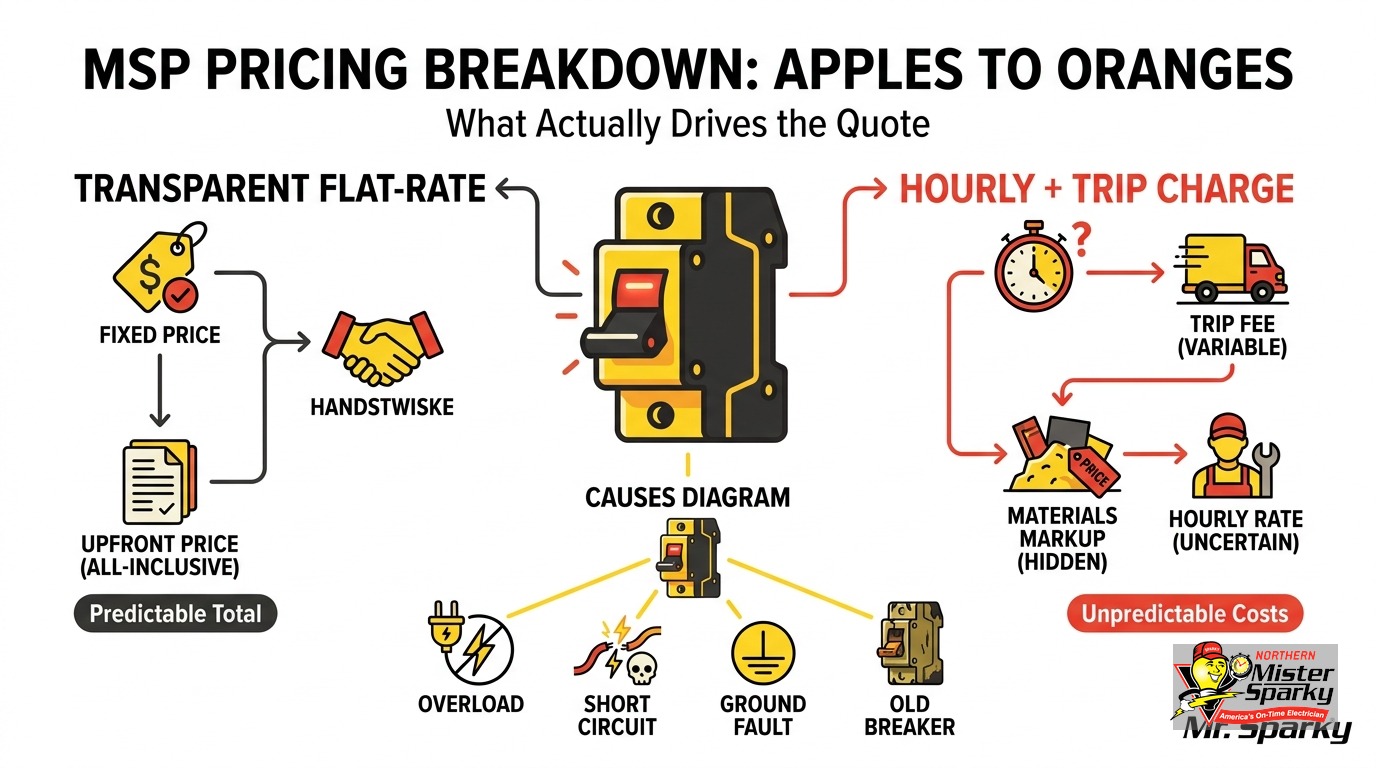
Flat-rate pricing gives you one total price for the whole job before work begins. Hourly pricing charges a set labor rate for each hour worked, plus a trip fee to reach your home. Flat-rate caps your cost. Hourly leaves the total open until the job ends.
Flat-rate pricing works well when the scope is clear. Replacing an outlet, swapping a breaker, or upgrading a panel has a predictable path. The shop prices the job up front. You approve the total, and the price holds even if the work runs longer than expected. That protects you from surprises.
Hourly pricing fits jobs where the fix is unknown. A flickering light or a tripping breaker may take 20 minutes to diagnose. Or it may take hours. An hourly rate charges you for the actual time spent. The risk is that a slow job costs more.
Neither structure is a bargain by default. A low flat rate can hide a thin scope that skips the permit or the inspection. A low hourly rate can balloon when a job runs long. The number that matters is the full, written quote, not the rate on its own.
This is why comparing a flat-rate price to an hourly rate feels confusing. They are not the same kind of number. Convert both into the same shape before you choose. Add the trip fee, labor, materials, permit, and inspection to each quote. Then the real cost appears.
What Is a Trip Charge, and Do You Always Pay It?
A trip charge, also called a service-call fee, pays for the technician and truck to reach your home. Most shops charge it whether or not you approve repairs. Many shops waive it when you book a larger job. Always ask about it before the visit.
The trip charge is the line item that surprises homeowners most. You call for a small repair. A technician arrives, looks at the problem, and gives you a price. If you decline, you may still owe the trip fee. That is standard, not a trick. The visit itself costs the shop time and fuel.
The fee ranges widely. National guides list a minimum service call around $100 to $200. Local rates vary. The key is to learn the amount before the truck rolls out, not after.
Here is the part that matters for your wallet. Some shops apply the trip fee as a credit toward your repair if you approve the work. Others treat it as a separate, nonrefundable cost. Ask one direct question when you book: “Is the trip fee waived or credited if I go ahead with the repair?” The answer changes your real cost by $100 or more.
A flat-rate quote often absorbs the trip fee into the total. An hourly quote usually lists it as a separate line. When you compare quotes, add the trip fee to the hourly side so both numbers include it. Otherwise the hourly quote looks cheaper than it is.
What Goes Into an Electrician Quote?
A clear quote lists five parts: the diagnostic or trip fee, labor, materials and their markup, the permit, and the inspection. Reading each line shows you what you pay for and what the shop left out. A quote that skips lines is a warning sign.
Let us walk through the anatomy.
The diagnostic fee pays for the technician to find the problem. In a flat-rate quote, this is often rolled into the total. In an hourly quote, it shows up as the first hour or as a trip charge.
Labor is the human work. Flat-rate quotes fold labor into one price. Hourly quotes list a rate, such as a dollar amount per hour, multiplied by the time on site.
Materials include wire, breakers, boxes, conduit, and the panel itself. Shops buy these at wholesale and sell them at retail. That markup is normal. It covers inventory, warranties, and the cost of stocking the truck. A good quote lists materials as a line item, even when the total is bundled.
The permit is the legal permission to do the work. In Minnesota, most electrical jobs require one. The permit fee is a real cost paid to your city or the state. We will cover that next.
The inspection confirms the work meets code. A quote that omits the inspection may leave you with work no one verified. That is a risk, not a savings.
When you read a quote, look for all five lines. If two are missing, ask why. The cheapest quote often leaves out the permit or the inspection to look lean. You pay for those later, in rework or in a failed inspection.
How Do Permit Fees Change the Price in the Twin Cities?
A permit is a real fee paid to your city or the state, not a markup. Minneapolis sets its own fees and inspects its own electrical work. Some suburbs use state inspectors instead. The cost and the inspector both change by city.
Permit jurisdiction is split in the Twin Cities, and that fact changes your quote. Minneapolis is a local authority having jurisdiction. The city sets its own construction and electrical permit fees, and city inspectors review the work. Many suburbs follow the same local model. Others fall under state jurisdiction through the Department of Labor and Industry.
That split matters in two ways. First, the fee itself varies by city and by job type. A panel replacement, a sub-panel, and a new service each carry different fees. Suburb schedules show the range. The City of Ramsey lists a residential panel replacement at $125 and a sub-panel at $75. Larger services tier up by amperage.
Second, the inspector changes. A local job gets a city inspector. A state-jurisdiction job gets a DLI inspector. The standard stays the same. Minnesota inspects to the 2023 NEC. But the office that signs off differs, and so does the fee schedule.
There is one more wrinkle. Homeowners can pull a permit for their own home in some cases. But service equipment and panel work is often restricted to a licensed contractor by the local authority. If a very low quote implies you will pull the permit yourself, treat that as a red flag. The work may not be legal for an unlicensed homeowner. The inspection may not happen at all.
A flat-rate quote should list the permit as a real line item. It is not padding. It is a fee your contractor pays on your behalf to the city or state. When a quote skips it, ask where the permit went.
How Much Does an Electrician Cost in Minneapolis After Permits and Rebates?
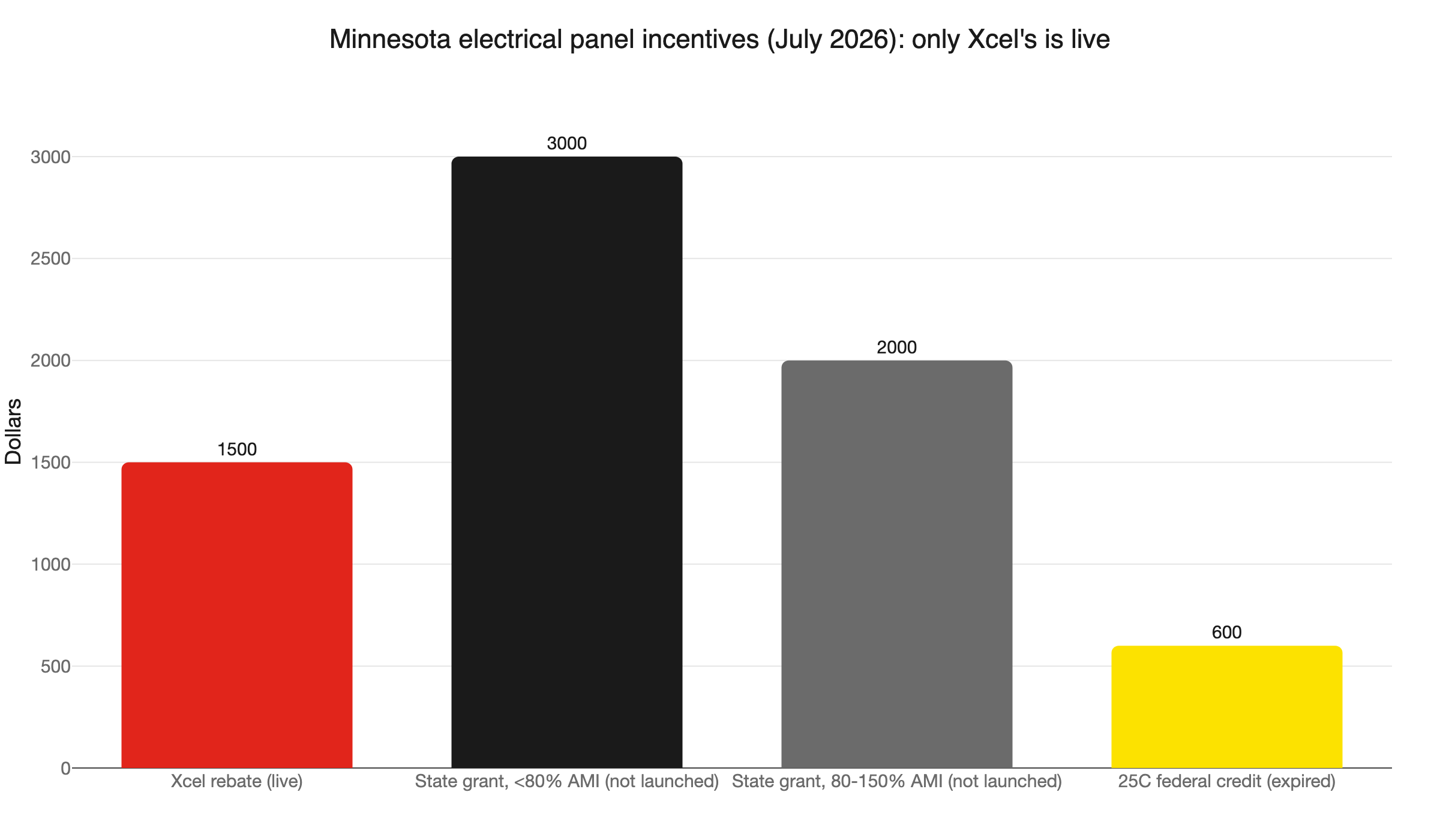
The rebate landscape shifted in 2026. The federal panel tax credit is gone. Minnesota’s state panel grant is not launched yet. The only live panel incentive in our area is Xcel Energy’s rebate of up to $1,500 through an approved contractor.
This is where most online cost guides go wrong, and where an honest local electrician earns trust. For years, the federal 25C tax credit cut the cost of a panel upgrade. You could claim up to $600 per item on a 200-amp or larger panel. That credit is now expired. Rewiring America’s page on the 25C panel credit states plainly that the deadline to make a credit-eligible upgrade has passed. The IRS confirms the credit ran through 2025. Federal tax legislation ended it for property placed in service after December 31, 2025.
So if you read an older article that promises a federal panel credit, that article is out of date. Do not budget for money you cannot claim.
What is live? Xcel Energy offers a panel-upgrade rebate of up to $1,500. It is income-agnostic, which means most homeowners can qualify. It runs through an approved contractor, so the rebate folds into your project rather than your tax return later. If your panel upgrade touches a 200-amp service, ask whether your contractor can apply it.
What about the state grant? Minnesota has a panel grant on paper. It would offer $3,000 for households below 80 percent of area median income. Households between 80 and 150 percent could get $2,000. But the state’s own update, dated June 12, 2026, tells a different story. The program has not launched, and it has no start date. Grants will not be issued retroactively. Plan as if it does not exist today.
The lesson is the same one running through this whole guide. The number you see online is not always the number you can use. A live $1,500 rebate is real money. A dead federal credit and a dormant state grant are not. Factor in only what you can actually claim.
What Drives the Cost in Older Twin Cities Homes?
In Minneapolis and St. Paul, the biggest cost drivers are the housing stock and the climate. Pre-1950 homes often run 60 to 100 amps on outdated wiring. Cold winters push heat-pump and EV loads upward. Damaged masts and weatherheads add repairs. These real conditions set the price.
The Twin Cities has a lot of older housing. Many Minneapolis and St. Paul homes built before 1950 still run 60 to 100 amps of service. Some still have knob-and-tube wiring. Those homes are not just behind on capacity. They are behind on safety. Bringing them up to a modern 200-amp standard takes real labor and materials. That shows up in the quote.
Then there is the climate. Minnesota winters push more homeowners toward heat pumps, EV chargers, and backup power. Each of those adds load. A 100-amp panel can serve a family fine for decades. Then a heat pump and a charger run together, and it trips. The fix is a 200-amp upgrade, and that is a bigger job than a simple repair.
Weather also damages the parts above your roof. Ice and snow stress masts, weatherheads, and service drops. A quote that includes a mast repair is not padding the bill. It is fixing real storm damage that a cheaper quote may ignore until the next winter.
Finally, some older homes still hold recalled panel brands like Federal Pacific and Zinsco. Those panels carry a known fire risk. If your inspector or technician flags one, replacement is not optional upselling. It is safety work, and it changes the scope of the job.
These drivers are why a national average means nothing for your house. The condition of your panel, your wiring, and your service entrance sets the real cost. A local electrician who has seen Twin Cities homes for years reads those conditions accurately. A flat number pulled from a website does not.
How Can You Compare Two Quotes Fairly?
Line them up side by side and convert both to the same shape. Add the trip fee, labor, materials, permit, and inspection to each one. Then compare the full totals and the scope. The cheapest headline number is rarely the cheapest real job.
Start by listing every line. If one quote shows five lines and the other shows two, the short quote is hiding something. Ask the short shop to break out the permit and the inspection. If they will not, treat the missing lines as a cost you will pay later.
Next, normalize the trip fee. Add it to the hourly quote so both quotes include the visit cost. An hourly rate of $90 looks cheap next to a $400 flat rate. But $90 for four hours plus a $150 trip fee is $510. Now the flat rate may be the better deal.
Check the scope. Does each quote cover the same work? One may include wall repair. The other may leave the drywall open. One may include the inspection. The other may list it as extra. Matching scope matters more than matching price.
Verify the warranty and guarantee. Ask whether the work is backed by a satisfaction guarantee. Ask how long the parts and labor are covered. A higher quote with a strong guarantee can cost less over time. A rock-bottom quote with no backup may cost more later.
Finally, confirm the contractor pulls the permit and arranges the inspection. A licensed shop handles that for you. A cut-rate operator may hand you the risk. Price is one factor. Protection is the other.
When to Stop Comparing and Call
Reading quotes is a skill, but some problems will not wait for shopping. If you smell burning from an outlet or breaker, see scorch marks, or your panel is hot to the touch, stop comparing and call now. Those are safety emergencies.
The same goes for a panel that trips repeatedly, lights that flicker across the whole house, or any recalled brand still in service. These are not cost questions. They are safety questions, and delay raises your risk.
For everything else, take the time to read the quote. Convert the numbers. Check the scope. Confirm the permit and the inspection. Then decide.
We are Northern Mister Sparky, and we are America’s On-Time Electrician(R). We back our work with the UWIN(R) 100 percent satisfaction guarantee. No malarky, just a clear quote and honest work. When you are ready, call 763-200-5956 or book online. We will show up on time and walk you through every line before we start.
Frequently Asked Questions
How much does an electrician cost in Minneapolis? +
Is the federal electrical panel tax credit still available? +
Do I need a permit for electrical work in Minnesota? +
Should I choose a flat-rate or an hourly electrician? +
Need an electrician now?