
February Spring Project Prep: Twin Cities Electrical
Key Takeaways
- February is the quiet window to book an electrical check before licensed electricians get slammed with spring work.
- Minnesota homeowners can do electrical work on their own home, but a permit and affidavit are required first.
- A state electrical permit costs $25, and the minimum inspection fee is $55 per inspector trip.
- Minnesota now follows the 2023 National Electrical Code, so older online checklists may be out of date.
- The federal 25C tax credit for electrical panels expired after Dec. 31, 2025, and does not apply to 2026 projects.
- Xcel Energy still offers real rebate dollars, including up to $1,500 to upgrade an undersized panel.
- Call Northern Mister Sparky at 763-200-5956 or book online to schedule your check.
Why Does February Spring Project Prep Matter for Twin Cities Homes?
February spring project prep matters because spring renovations rely on a panel that can keep up. Booking your electrical check in February means permits, inspections, and any panel work finish before the spring rush. You plan the power first, then demo the wall.
We are Northern Mister Sparky, locally owned and operated and serving homeowners across Minneapolis, St. Paul, Bloomington, and the wider Twin Cities. Winter puts real strain on your home. Heating loads run high all season. Freeze-thaw cycles wear on exterior outlets and your service entrance.
That makes late winter the natural time to audit your system. A new kitchen, a finished basement, an EV charger, a hot tub, and a heat pump all stack amperage on one existing panel. Check the panel now, before you add that load. It is the difference between a smooth spring project and a stalled one.
What Should Be on Your February Electrical Check?
A February electrical check should cover safety devices, outlets, and panel capacity in one visit. Our team tests GFCI and AFCI protection, inspects the panel for open space and heat, checks exterior outlets after winter, and runs a load calculation. That last step tells you whether your panel can support this year’s projects.
Start with the safety basics. We test every ground-fault circuit interrupter, or GFCI, and every arc-fault breaker, or AFCI. We look at outlets and cords for wear. We check smoke and carbon monoxide detectors, since they share a schedule with any panel work.
Then we look at capacity. Many older Twin Cities homes still run 100-amp service. That was plenty in 1975. It is tight in 2026 once you add an induction range, a heat pump, and a car charger. A load calculation shows the real headroom you have, so you are not guessing.
If the check turns up worn wiring or a crowded panel, you learn it in February. You have time to fix it. You are not calling for an emergency repair the week the drywall crew arrives. For a deeper look at what pushes a home past its limit, read our guide on the signs you need an electrical panel upgrade.
Do You Need a Permit to Do Your Own Electrical Work in Minnesota?
Yes, in most cases. Minnesota homeowners may perform electrical work on their own owner-occupied home without an electrical license. First, though, you must file a permit and sign an affidavit that you own and occupy the home and will personally do the work, per the Minnesota Department of Labor and Industry.
That affidavit is not a formality. It means you, the homeowner, do the labor yourself. You cannot pull a homeowner permit and then have a friend or an unlicensed handyman do the wiring. The permit and the inspection exist to keep the work safe.
There is a second step many homeowners miss. About 66 Minnesota cities run their own local electrical inspection authority, with their own forms and fees. You must verify whether the state or your city inspects your project before you file, again per the Department of Labor and Industry. File with the wrong authority, and your project stalls.
For most panel upgrades, service changes, and new circuits, hiring a licensed electrician is the faster and safer path. We pull the permit, do the work to code, and meet the inspector. You skip the paperwork and the risk. See what that covers on our panel upgrade service page.
How Much Do Minnesota Electrical Permits and Inspections Cost?
A Minnesota state electrical permit costs $25 per permit filed. The inspection fee is separate. There is a minimum inspection fee per inspector trip, and the total is the calculated work value or the per-trip minimum times the number of required trips, whichever is greater, per the state’s permit instructions.
Those numbers matter for budgeting. A simple job may need one trip. A larger project, like a panel swap followed by finished-basement circuits, may need more than one inspection. Each trip carries that per-trip minimum, per the same state instructions.
Local-authority cities set their own fees, which can differ from the state schedule. This is one more reason to confirm your inspecting authority before you file. When Northern Mister Sparky handles the job, we build the permit and inspection costs into a clear quote. No malarky, no surprise line items at the end.
What Changed in the 2023 Minnesota Electrical Code?
Minnesota’s electrical code is based on a current edition of the National Electrical Code, so guidance written for older code cycles may no longer apply, per the Department of Labor and Industry. Two changes hit spring projects directly: broader kitchen GFCI protection and wider arc-fault protection. Both can add cost when you add circuits.
The kitchen GFCI change is significant. The 2023 code removed the phrase about receptacles that “serve the countertop surfaces” in section 210.8(A)(6). In practice, essentially all standard kitchen receptacles now need GFCI protection, not just the ones on the counter, per the state code FAQ.
Arc-fault rules widened too. Section 210.12(B) of the 2023 code requires combination-type AFCI protection for 120-volt, 15- and 20-amp circuits in kitchens, bedrooms, living rooms, laundry areas, hallways, and most other living spaces, per the City of St. Paul’s guidance. That is a real cost driver when you finish a basement or add circuits.
Here is the takeaway for February. If you are planning a remodel, the new code may require protection your old panel does not have. Knowing that now lets us plan the breakers and budget before you open a wall, not after.
Is the Federal Tax Credit Still Available for Panel Upgrades?
No. The federal 25C Energy Efficient Home Improvement Credit for electrical panels expired after Dec. 31, 2025. It does not apply to current projects, per Energy Star. If a checklist tells you to claim it this year, that page is out of date. Do not plan your budget around it.
This is the single biggest error in most spring electrical guides online. Many still tell readers the 30% credit, capped at $600, is there for the taking. It is not, for work placed in service in 2026.
For context, that credit was always narrow. It applied only when the panel enabled a qualified heat pump or heat pump water heater, and the equipment had to be placed in service by Dec. 31, 2025. Homeowners claimed it on IRS Form 5695, per the IRS. The window has closed.
The good news is that local rebate money is still on the table. You do not need a federal credit to make a panel upgrade pencil out. You need to know which programs are live right now, which is exactly what we cover next.
What Xcel Energy Rebates Can Twin Cities Homeowners Still Claim?
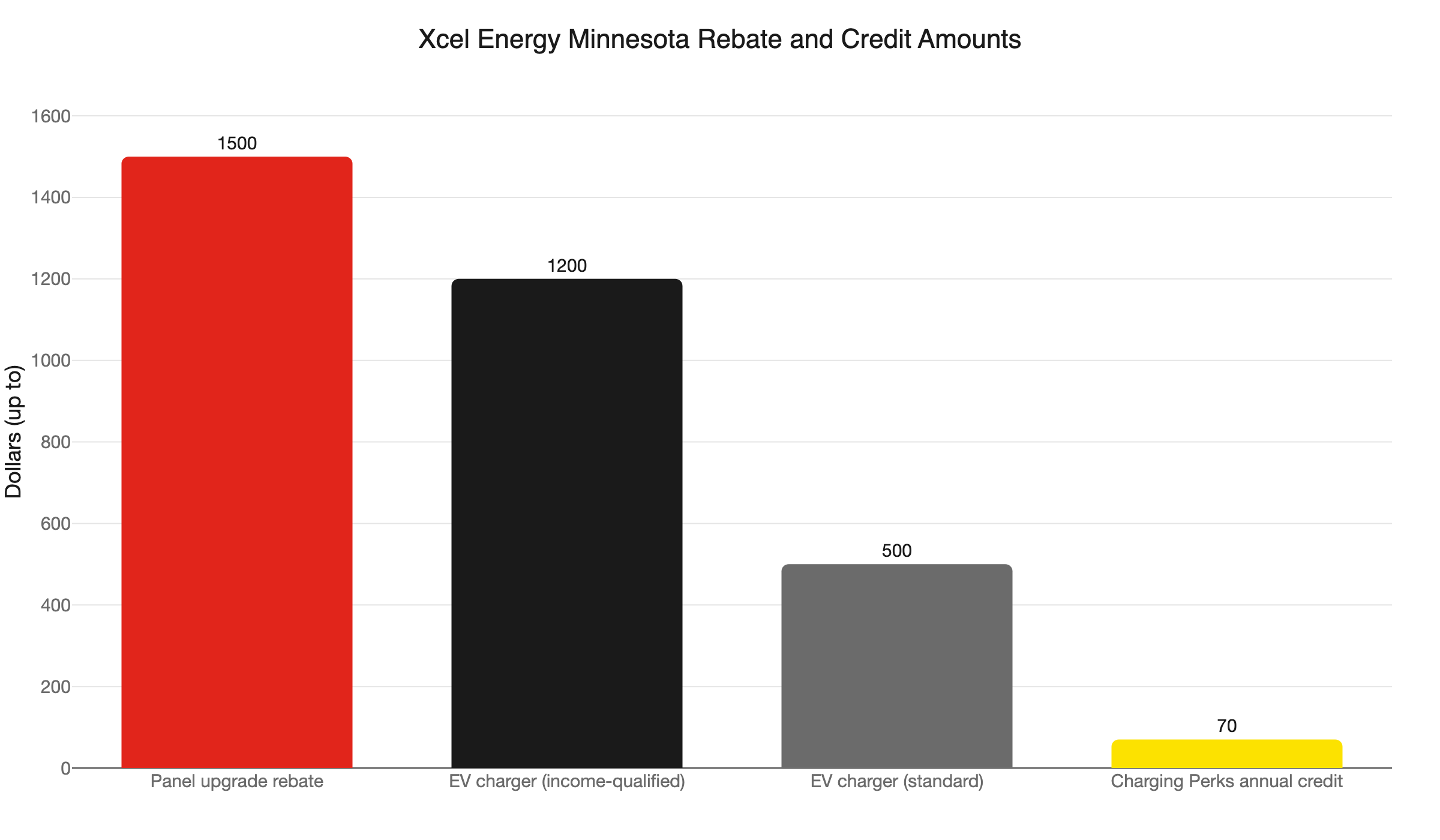
Xcel Energy Minnesota still offers real rebates for 2026 electrical work. The headline program is up to $1,500 to upgrade an outdated or undersized panel that cannot safely support added load, such as EV charging, per Xcel Energy. That rebate can cover a large share of a panel swap.
If your spring project includes a car charger, more money is available. Xcel offers up to $500 for a Level 2 charger install for standard customers, and up to $1,200 for income-qualified households, per Xcel Energy. That rebate covers the charger and the wiring.
There is also an ongoing credit. The Xcel Charging Perks program gives an annual bill credit for charging your EV during off-peak hours, per Xcel Energy. Stack the panel rebate, the charger rebate, and the annual credit, and the math on going electric changes fast.
Here is how those Xcel dollars compare at a glance.
Rebate amounts are set by Xcel and can change, so confirm the current terms when you apply. Our team can point you to the right program for your project and size the panel to qualify. When you are ready to add a charger, start with our EV charger installation service.
Does Your Panel Have Room for Spring Electrification?
Maybe not, and February is the time to find out. Older Twin Cities homes often run 100-amp service. Spring electrification, adding an EV charger, a heat pump, and an induction range, frequently pushes a home to a 200-amp upgrade. A load calculation tells you whether your panel has headroom or needs to grow.
Think of your panel as a parking lot. Every large appliance takes a space. A 100-amp lot handled a 1980s home fine. Today’s electric loads fill it and then some. When the microwave and toaster trip the breaker together, the panel is telling you it is out of room.
Freeze-thaw and winter heating make the point sharper. Your system already works hard in a Minnesota February. Adding summer loads on top of a full panel is how you end up with nuisance trips or an overloaded circuit. We check for that before it becomes a problem, and we can repair an overloaded circuit if the check finds one.
If the numbers say you need more capacity, spring is the season to do it. A 200-amp service opens room for years of projects. Pair it with the Xcel panel rebate, and the upgrade pays part of its own way. For a fuller walk-through, read our post on planning a spring panel upgrade.
How Does February Prep Prevent Mid-Project Surprises?
February prep prevents surprises by putting the electrical decisions before the construction. You learn the permit path, the code requirements, and the panel’s real capacity while walls are still closed. That order kills change orders. You are not tearing out fresh drywall to add an arc-fault circuit you did not plan for.
Most spring project pain comes from sequencing. Homeowners demo first and design the power second. Then the electrician finds a full panel or a code gap, and the timeline slips. Do the check in February, and the electrical scope is locked before the crew shows up.
There is a scheduling reason too. Licensed electricians get booked solid once spring hits. A February check gets you on the calendar early. Any panel work, permit, or inspection has time to happen at a normal pace, not a rushed one.
One scope note. Northern Mister Sparky handles electrical only. For heating, cooling, or plumbing tied to your remodel, we point you to our sister Northern brands. On the electrical side, we own the whole path, from the check to the permit to the final inspection.
Book Your February Spring Project Prep Check Today
The best spring projects start in February, with a system that can keep up. An electrical check now gives you the permit facts, the current code, the real rebate dollars, and a load number you can trust. You plan with facts instead of an outdated checklist.
Northern Mister Sparky is locally owned and operated, and we back every visit with the UWIN(R) 100% satisfaction guarantee. As America’s On-Time Electrician(R), we show up when we say we will. That reliability is the whole point of prepping early.
Call us at 763-200-5956 or book online to schedule your February spring project prep check. Do it before the spring rush, and your renovation starts on solid footing.
Frequently Asked Questions
Do I need a permit to replace my own outlet in Minnesota? +
How much does a Minnesota electrical permit cost? +
Can I still claim the federal tax credit for a panel upgrade in 2026? +
What Xcel rebate can I get for a panel upgrade in the Twin Cities? +
Need an electrician now?