
Electrical Safety After a Basement Flood in Minnesota
Key Takeaways
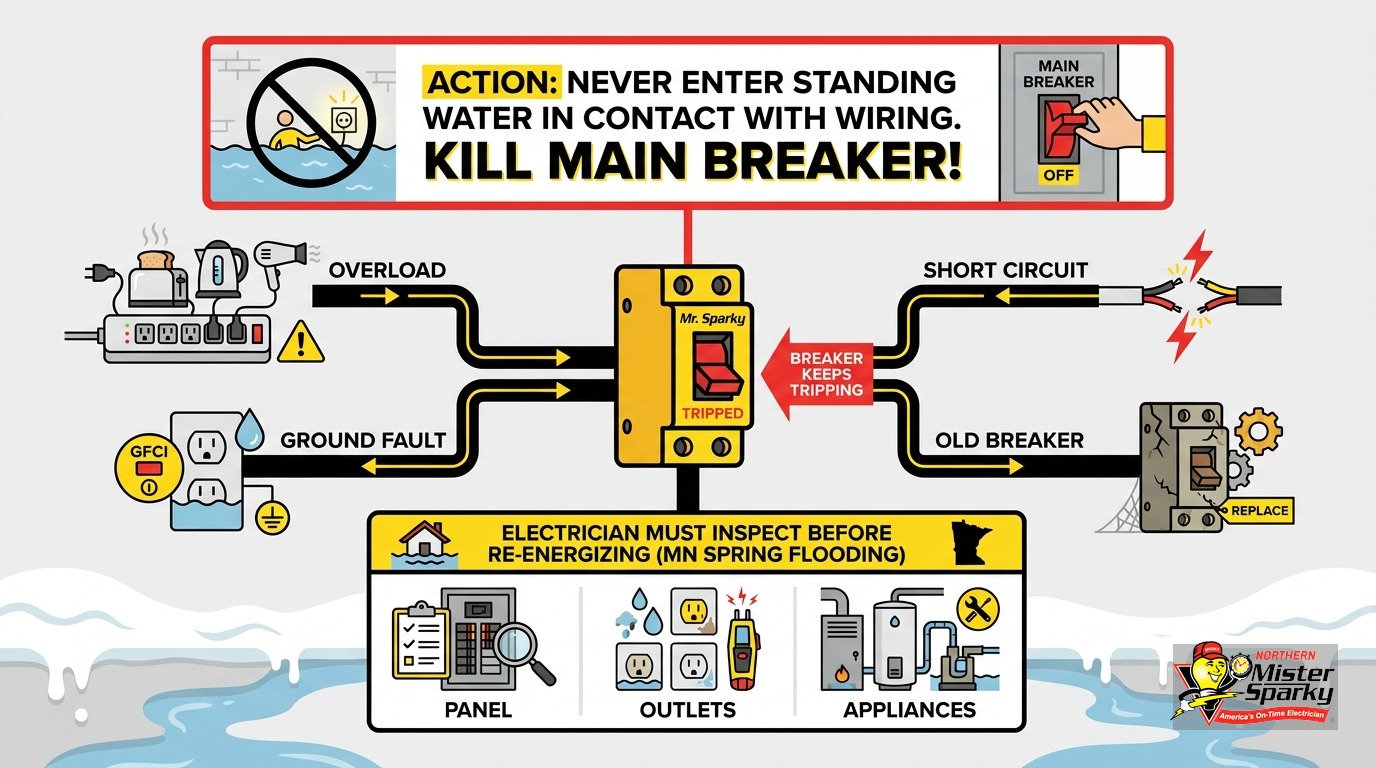
- Never enter a flooded basement until the power is disconnected. The water may be energized.
- Kill the main breaker from a dry spot. If water may reach the panel or meter, call Xcel to cut service.
- Minnesota DLI says flood-damaged electrical gear cannot be cleaned, restored, and reused. Replace it.
- A licensed electrician must inspect, and an inspection must pass, before Xcel restores power.
- Spring snowmelt on frozen ground is a top cause of Twin Cities basement floods.
- If the panel is replaced, current 2026 rebates and grants can offset the cost.
What Comes First for Electrical Safety After a Basement Flood?
Short answer: Stay out until the power is off. Electrical safety after a basement flood starts by treating the water as live. Even a shallow puddle can electrocute you if it touches wiring, an outlet, or an appliance. Disconnect power from a dry spot first, or have the utility cut service before you step in.
A flooded basement is one of the most dangerous rooms in your house. The hazard is invisible. You cannot tell by looking whether the water is live. Outlets, cords, and appliance motors below the waterline keep pushing current into the puddle you would walk through.
Treat the whole flooded area as energized until a licensed electrician proves it is not. Do not wade in to grab belongings. Do not plug things in to see if they still work. The few minutes you save are not worth the risk.
Once the power is off, the danger is not over. Take photos of the waterline on the walls and on the panel before anything dries. That record helps your electrician scope the job and helps with insurance. Then call a licensed electrician before you restore a single breaker.
We are Northern Mister Sparky, a locally owned and operated Twin Cities electrician. We re-energize flooded homes to Minnesota code, with the on-time reliability of America’s On-Time Electrician(R) and our UWIN(R) satisfaction guarantee. This guide covers what to do, what we inspect, and the one state rule most homeowners never hear.
Why Does Minnesota Spring Flooding Hit Basements So Hard?
Short answer: March and April thaws dump snowmelt onto frozen ground that cannot absorb it. The water runs toward foundations and overwhelms sump pumps, and spring storms often knock out power at the same time. The result is a fast, cold flood that catches Twin Cities homeowners off guard.
In the Twin Cities, the worst basement floods rarely come from summer storms. They come from the spring thaw. A deep snowpack melts fast during a warm March or April week. The ground beneath it is still frozen, so the water has nowhere to soak in. It sheets across yards and pools against foundations.
Minneapolis, St. Paul, and the closer suburbs see this pattern repeat every year. Older homes with foundations settled decades ago take the worst of it, and so do homes with driveways sloped toward the house. A sump pit that handled summer rain just fine can run nonstop for days during the thaw.
That is also when sump pumps fail under load. A spring storm can knock out power and take the pump offline at the worst moment. Minnesota home-prep guidance notes that rapid warm-ups after heavy snow overwhelm sump pumps and gutters in exactly this window.
The financial sting is real, too. Standard homeowner’s insurance typically excludes snowmelt and surface flooding, so you usually need a separate flood policy to be covered. That makes a safe recovery even more important.
Should I Turn Off the Main Breaker Before Entering?
Short answer: Yes, if you can do it from a dry location. Shut off the main breaker before you enter if water may reach any outlet, switch, or appliance. If water may reach the main panel or meter, do not touch it. Call Xcel to disconnect service at the meter instead.
The order of operations matters. You want to remove the energy source before your body becomes a path to ground. We Energies puts it plainly: assume basement flood water is energized. Never enter until power is disconnected, because even a little water on the floor can electrocute you.
The main breaker is usually at the top of your service panel, marked “main” or “service disconnect.” It shuts off power to every circuit at once. If your panel sits in the flooded area, or you cannot reach the breaker without standing in water, do not try. That is the moment to call Xcel and have the service cut at the meter.
A few hard rules from Xcel Energy apply to every Twin Cities basement flood:
- Do not touch or unplug any appliance if you must stand in water to reach it, not even on a damp floor.
- If water may reach outlets, shut off breakers at the main box before you enter.
- If water may reach the main box or the meter, call Xcel to cut service at the meter.
There is a second hazard next to the electrical one. Submerged gas-appliance controls corrode and can fail, which can cause a gas leak. The controls sit low, so the appliance does not need to be fully underwater to be dangerous. If you smell gas, leave the house and call the utility from outside.
What Must an Electrician Inspect Before Power Comes Back On?
Short answer: Every component the water touched. That includes the panel interior, breakers, fuse blocks, disconnects, every submerged receptacle and switch, GFCI and AFCI devices, the furnace, boiler, water heater, baseboard heaters, pump controls, and major appliances. Submerged branch wiring must be replaced, too.
This is the part homeowners underestimate. The waterline is not the finish line. Anything conductive that sat below it is suspect, even if it looks fine. Minnesota DLI lists the equipment a licensed electrician must check and replace after a flood. We inspect all of it:
- Panelboard interiors, breakers, fuse blocks, disconnect switches, and controllers.
- Every submerged switch and receptacle.
- Any GFCI receptacle required by code, replaced to NEC Article 210.
- Fixed equipment: furnaces, boilers, baseboard and space heaters, water heaters, pumps and pump controls, washers, dryers, ovens, ranges, cooktops, and dishwashers.
- Any partially or fully submerged branch, feeder, or service conductor.
Water does damage you cannot see. Corrosion creeps onto contact surfaces and raises resistance, which means heat. Arc-fault and ground-fault electronics are sensitive, and a soaked device may test fine today and fail to trip next month. That is why Minnesota treats a soak as permanent for these components.
One small exception: direct-burial and wet-location cable can sometimes survive if its terminations stayed dry. Standard interior wiring cannot. When in doubt, we pull and replace.
We handle the electrical side and coordinate with the right HVAC or plumbing pros for gas-fired gear. If your panel took on water, this is also the moment to check the signs you need an electrical panel upgrade. A flooded panel is almost always a replace, not a repair.
Electrical Safety After a Basement Flood: Why Minnesota Says Replace, Not Recondition
This is the detail almost no one explains, and it is the biggest reason to use a local electrician who knows Minnesota code.
National guides and Minnesota code disagree on one key point. The Electrical Safety Foundation International and NEMA publish a list of equipment that may be reconditioned after water contact. It includes some panelboards, switchboards, and motors. Read alone, that list sounds like good news.
Minnesota’s code officials disagree. The Minnesota Department of Labor and Industry states that flood-damaged equipment fails to an unsafe and potentially hazardous condition. Re-energized flood-damaged wiring will, in DLI’s words, forever pose a serious fire and life safety hazard. The agency explicitly notes that this contradicts otherwise credible sources.
“Reconditioned” means a factory-authorized process of cleaning, drying, and re-testing a device so it can go back into service. Minnesota’s stance is that flood contamination is not reversible for the gear in your home. Floodwater carries sewage, metals, petroleum, and chemicals. It is highly conductive and corrosive, and that damage does not wash off.
In practice, several items are replace-only here. The list includes AFCI and GFCI devices, molded-case breakers, receptacles, switches and dimmers, surge protectors, and outlet and junction boxes. So are submerged panels and wiring.
Skipping the replacement to save money now tends to cost more later. A re-energized flooded circuit can arc inside a wall, trip unpredictably, or fail to protect you when a fault happens. The inspection exists to catch exactly this before power flows again.
If a contractor offers to clean and reuse your flooded panel to save you money, treat it as a red flag in Minnesota. The cheap fix can become a permanent fire hazard behind your walls.
Do I Need a Permit and Inspection to Reconnect?
Short answer: Yes. Minnesota requires an electrical permit on file and a passed inspection before power is restored after a flood. Xcel also needs verification that the system was inspected and cleared before it reconnects service. A licensed electrician files the permit and does the work.
A common myth is that a homeowner can skip the paperwork on their own house. Minnesota lets a homeowner do limited electrical work license-free on their own home. They are still not exempt from inspection. The permit must be on file at or before the start of work, per Minnesota DLI’s homeowner permit rules.
After a flood, the path back to power is a chain, not one step:
- A licensed electrician inspects the damaged system.
- Required replacements are made and an electrical permit is filed.
- The work passes an electrical inspection.
- Xcel verifies the clearance and restores service.
We file the permit, do the work to code, and coordinate the inspection and the Xcel reconnect. You do not have to chase the paperwork. Read more in our guide to getting an electrical permit in Minnesota.
How Much Does It Cost to Make a Flooded System Safe?
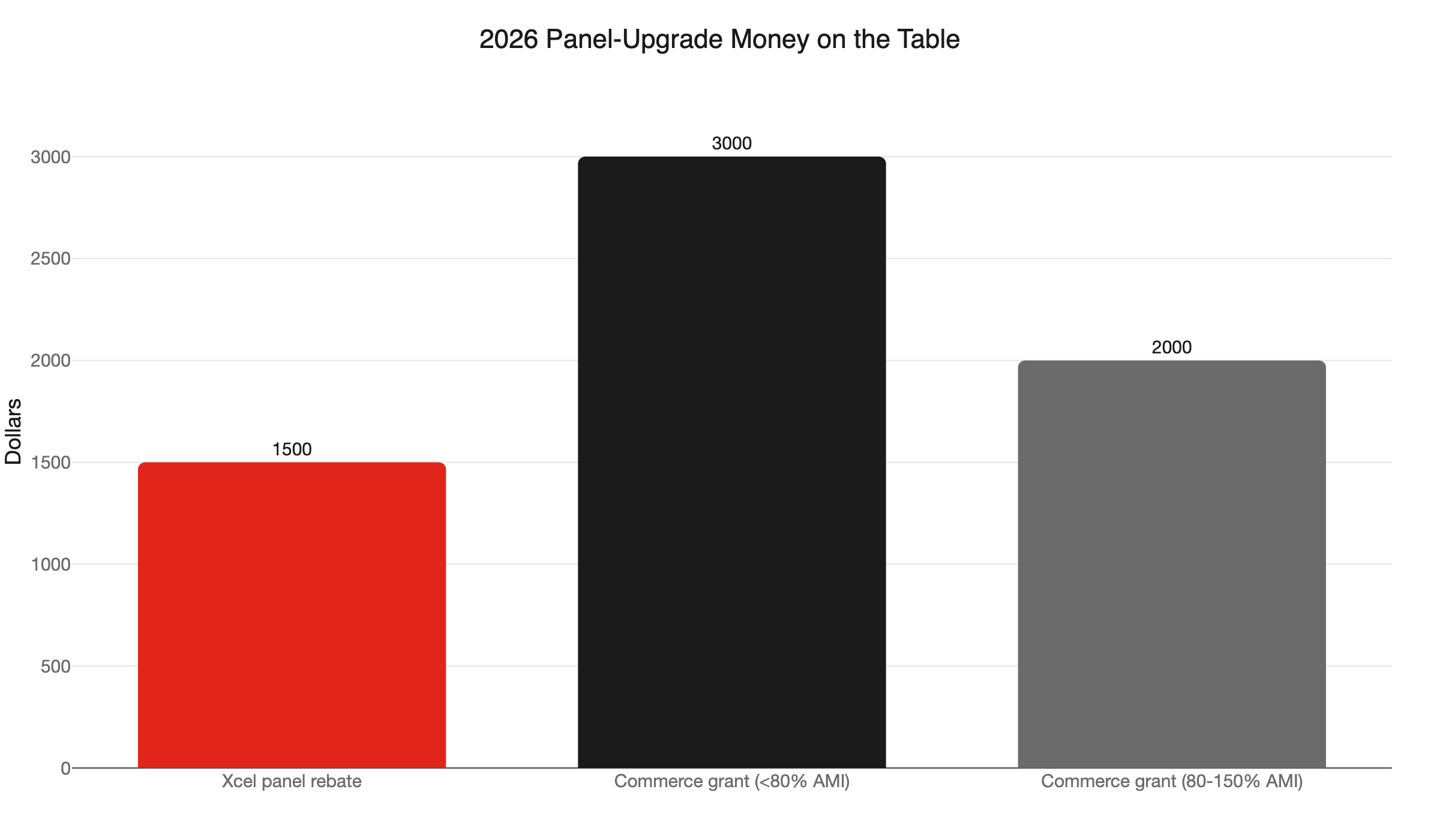
Short answer: It depends on how far the water reached. Replacing a few submerged outlets and a breaker is far cheaper than replacing a flooded panel and branch wiring. If the panel must be replaced, current 2026 rebates and grants can offset a meaningful share of the cost.
Costs scale with the waterline. A flood that soaked a few basement outlets and one circuit is a manageable repair. A flood that submerged the panel, the furnace, and the laundry circuits is a major project. We give you a clear, itemized scope before any work starts.
A small flood might mean two or three replaced outlets, a new GFCI, and one reworked circuit. A deep flood can mean a new panel, new service conductors, and a full basement circuit rebuild. Either way, you get a written scope and a clear price before we start.
If your panel is replaced, money is on the table right now:
- Xcel Energy offers up to a $1,500 residential panel-upgrade rebate for the 2026 program year.
- The Minnesota Commerce Panel Upgrade Grant pays up to $3,000 for households under 80% of area median income.
- Households between 80% and 150% of area median income can get up to $2,000.
- It covers a panel upgrade to 200 amps or more, full electrification, or a smart panel. The grant is not issued retroactively.
One dated figure to ignore: the federal 25C tax credit for panel upgrades expired at the end of 2025. Do not let an outdated article tell you it still applies. We file the permit and handle the Xcel and Commerce paperwork so you can actually claim what is available. Our panel upgrade service covers the full job.
How Do I Lower the Risk Before the Next Thaw?
Short answer: Move water away from the foundation and keep the sump pump running when the power fails. Clear gutters and downspouts, slope soil away from the house, service the sump pump, and add a battery backup. Add whole-home surge protection so a failing appliance cannot fry the panel.
Prevention is cheaper than a flooded electrical system. Most of it is plain home maintenance, tuned to a Minnesota spring.
- Clean gutters and extend downspouts well away from the foundation before the thaw.
- Slope soil away from the house so snowmelt runs off, not in.
- Test the sump pump and install a battery backup for spring storm outages.
- Keep the sump pump on a dedicated circuit so it does not trip shared loads.
- Add whole-home surge protection to shield the panel from a failing appliance.
Spring is also a good time to walk the exterior. Look for cracks in the foundation, clear window wells of debris, and make sure the ground slopes away from the walls. Small grading fixes cost little and keep snowmelt moving away from your electrical system.
A sump pump that shares a circuit with the basement freezer will trip when you need it most. We see it every spring. A dedicated circuit and a battery backup are small upgrades. They can prevent the flood that triggers everything else in this guide.
When to Call Northern Mister Sparky
Call us the moment the water recedes and before you flip anything back on. We are locally owned and operated in the Twin Cities. Our team inspects the panel, breakers, outlets, devices, and wiring. We replace what the state requires, file the permit, and coordinate the inspection and the Xcel reconnect.
If the panel took on water, we will tell you straight what it needs. Sometimes a breaker swap is enough. Often a full panel replacement is the safe call. Then we handle the Xcel rebate and Minnesota Commerce paperwork on the larger jobs.
Book online or call 763-200-5956. We show up on time, diagnose the system, and give you a clear path back to safe power, no malarky.
Frequently Asked Questions
Can I go into my flooded basement to grab things? +
Can flooded electrical equipment be cleaned and reused in Minnesota? +
Do I need a permit and inspection after a flooded basement? +
Need an electrician now?