
Hardwired Smoke Detector Chirping After Power Outage
Key Takeaways
- A chirp every 30 to 60 seconds almost always points to a weak backup battery, not a fire.
- On an interconnected system, only the triggering unit holds a red-light memory pattern.
- A steady green LED means AC power is present. No green light points to a wiring fault.
- Minnesota code requires hardwired, interconnected detectors, which is why one bad unit wakes the house.
- Replace any detector more than 10 years past its manufacture date.
- Swapping a hardwired detector is a permit job. Call us at 763-200-5956 or book online.
The power returns after a storm, and then it starts: a hardwired smoke detector chirping after a power outage. The sound is sharp, repetitive, and almost always begins around 2 a.m. We get this call across Minneapolis, St. Paul, and the surrounding suburbs all year long.
Here is the good news. Most of the time the fix is simple. The chirp is your detector telling you its backup battery is weak, dead, or confused by the outage. Once you learn to read the signals, you can quiet the house in minutes.
We are Northern Mister Sparky, a locally owned and operated Twin Cities electrician. This guide covers the diagnostic steps most advice skips. You will learn to find the one unit that started the cascade. You will tell a dead battery from a wiring fault. And you will know when the detector needs full replacement.
Why Does a Hardwired Smoke Detector Chirp After a Power Outage?
A power outage drains the backup battery inside a hardwired detector. When the current returns, the weak battery signals trouble with a single chirp roughly every 30 to 60 seconds. The detector runs on house current, but the battery keeps chirping until you replace or reset it.
Hardwired detectors do two jobs at once. They run on your home’s 120-volt circuits, and they carry a backup battery for outages. When the grid drops, the battery takes over so the alarm still protects you. Every minute on battery power draws the cell down a little more.
A short blip rarely drains a fresh battery. A long outage can drain a battery that was already weak. We see this often during Twin Cities ice storms and high-wind events. When the power returns, the detector runs a self-test. A low cell fails that test, and the chirping begins.
The chirp follows a pattern. One beep, a pause, then another beep. That cadence is your first clue, and it matters more than the noise. Read the pattern before you reach for a screwdriver.
Minnesota’s State Fire Code requires these alarms to be hard-wired at 120 volts with battery backup and interconnected wiring. That backup battery is the whole reason a dead cell can make so much noise. The detector is doing exactly what it was built to do.
Is It the Backup Battery or a Real Wiring Fault?
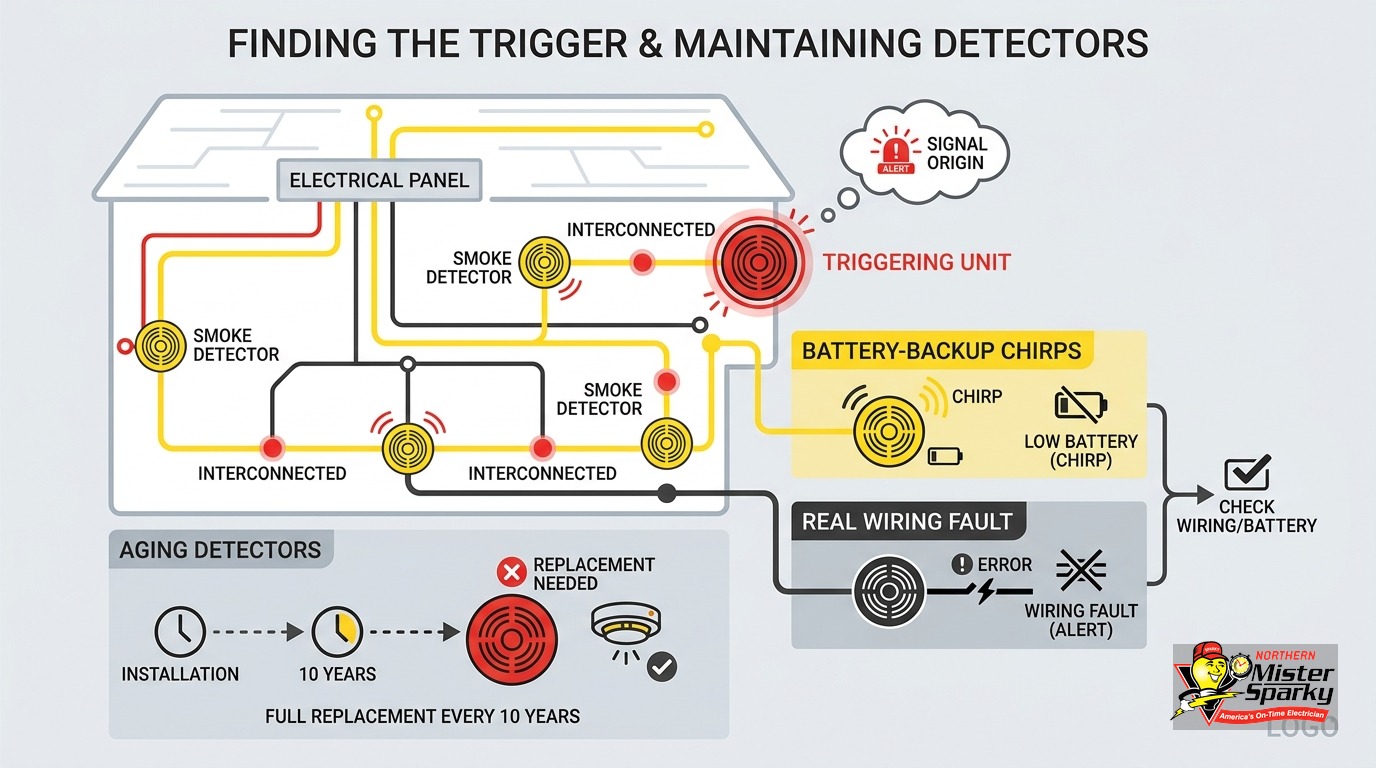
Match the sound to the cause. A chirp every 30 to 60 seconds means a low backup battery. A steady alarm across every unit with no smoke points to a wiring or interconnect fault. A unit that lost its green light is not getting AC power.
This is where most guides stop helping. They tell you to change the battery and move on. But a hardwired system can fail in three distinct ways, and each sounds different. Learning the difference keeps you safe and saves you money.
A low-battery chirp. One beep every 30 to 60 seconds is the classic dead-battery signal. The alarm still has AC power. The backup cell has simply dropped below its threshold. A fresh battery and a reset usually solve it.
A lost-power condition. Check the green LED. A steady green light means the unit receives AC power. If the green light is off, the detector is running on battery alone. That points to a lost hot or neutral on the circuit, a tripped breaker, or a loose wire upstream. The unit will keep chirping because it thinks the power is out.
An interconnect fault. This one is louder and more confusing. If every detector alarms at once and there is no smoke, the interconnect wire is the likely culprit. A loose wire nut, a failed back-stab connection, or a single dying unit holding the interconnect line low can loop the whole chain. Resetting one detector will not fix it.
The pattern of the sound is the cause. Train your ear before you call anyone, because the right diagnosis cuts the repair in half. If you hear the lost-power or interconnect patterns, that is electrical work. Stop there and reach out.
How Do You Find Which Detector Started the Cascade?
Walk the house and watch the LEDs. On an interconnected system, only the unit that triggered holds a distinct red-light memory pattern. The rest return to standby. That one unit is your starting point for a new battery or a full replacement.
This step is the single most useful trick, and almost no one teaches it. When detectors are tied together on one interconnect wire, they all sound. But only the initiating unit remembers the event. The others ring along and then forget.
First Alert documents this clearly. On their smoke alarms, the initiating unit shows a red light on for two seconds and off for two seconds. Every other alarm on the line returns to its normal state. That blink pattern is your fingerprint for the bad unit.
Here is the method:
- Silence the alarm with the hush button, or wait for it to reset.
- Walk every detector in the house, basement included.
- Watch each LED for about 10 seconds.
- The unit with the steady red-on, red-off pattern is your culprit.
- Start there with a fresh battery.
This saves you from changing every battery in the house. It also tells you whether the problem is one tired detector or something bigger. If two or three units hold the memory pattern at once, suspect an aging batch or an interconnect fault.
Note that the exact pattern varies by brand. Kidde units use a quick flash every 30 to 45 seconds in standby, and their test routine proves the interconnect. Hold the test button for five seconds, and every linked unit should sound. If one stays silent, the interconnect wire to that unit is broken.
What Do the Green and Red Lights Mean?
A steady green light means the unit receives AC power. A quick red flash every 30 to 45 seconds is normal standby. After an event, a red light on for two seconds and off for two seconds marks the detector that initiated the alarm.
Think of the lights as a dashboard. The green light answers one question: is this unit getting house current? The red light answers another: did this unit just trigger, or is it healthy?
If the green light is solid, your wiring to that unit is fine. If the green light is dark, the unit is on battery power and thinks the grid is down. That is a wiring problem, not a battery problem, and no fresh cell will quiet it for long.
A normal standby blink is a quick red flash, not a steady one. Do not confuse the two. The steady red-on, red-off memory pattern only shows on the unit that started the alarm. Once you can read the lights, the diagnosis gets fast.
Why Does the Whole House Sound at Once?
Minnesota code requires hardwired, interconnected detectors. One wire links them, so when one senses trouble they all sound. That interconnect is why a single dead battery can wake the entire house in the middle of the night.
This is the part most homeowners find baffling. One small battery should not set off every alarm on the second floor. But the interconnect wire is designed so that any detector in danger pulls the whole chain. Fire in the basement means you hear it in the bedroom, instantly.
The trade-off is sensitivity. A weak battery in one unit can mimic an alarm signal on the interconnect line. Every linked detector responds as if there were real smoke. The result is a house-wide chorus from a single tired cell.
This wiring is not optional. The State Fire Code calls for one alarm per level and one in the basement. It also wants one in the hallway outside sleeping rooms, all interconnected. The same logic extends to placement. For the full picture, review the smoke and CO detector placement code for Minnesota homes.
When Should You Replace the Detector Instead of Resetting It?
Replace any smoke detector 10 years past its manufacture date, printed on the back. A unit that chirps with a fresh battery, or one that keeps tripping the whole chain, has reached the end of its service life and should come out.
Detectors do not last forever. The sensing element slowly loses sensitivity, even if the electronics still work. The State Fire Marshal and NFPA 72 both set the limit at 10 years from the date of manufacture. After that, the unit is unreliable whether it chirps or not.
Find the date stamped on the back of the unit. It is usually molded into the plastic or printed on a label. If that date is older than 10 years, replace the detector. Do not trust it to wake you.
There are a few clear signs it is time, beyond the date:
- The unit chirps even after a brand-new battery.
- It triggers false alarms in the same spot, week after week.
- It fails the monthly test button check.
- The yellowing plastic suggests heat damage near an attic or garage.
- It is a different brand from the rest of the chain.
That last point matters more than people realize. Mismatched brands and ages on one interconnect line cause cascade false alarms. One aging unit can hold the line low and loop every other detector. When you replace, swap the whole batch on that circuit at once. They should age together.
The same 10-year rule covers the units near your heating equipment. Pair the smoke check with a working carbon monoxide detector, since Minnesota heating season is exactly when both matter most.
How to Reset a Hardwired Detector Step by Step
If you have a low-battery chirp, start with a reset. This works when the unit is under 10 years old. Follow these steps in order, and work safely. If anything feels off, stop and call.
- Identify the triggering unit using the LED method above.
- Cut power at the breaker that feeds the detector circuit.
- Twist the detector off its mounting bracket counterclockwise.
- Disconnect the wiring harness or unplug the connector.
- Remove the old backup battery and install a fresh one.
- Press and hold the test button for 5 seconds to drain residual charge.
- Reconnect the harness, reseat the detector, and restore power at the breaker.
- Press test again. On an interconnected system, every unit should sound.
If the chirp returns within a day with a fresh battery, the unit is failing. If the green light stays off after power is restored, the circuit has a fault. Either way, the detector needs attention from someone who works on this every day.
Never ignore a detector that keeps chirping after a clean reset. A silenced alarm is not a fixed alarm. The sound exists for a reason, and bypassing it trades a small annoyance for real risk.
Is Replacing a Detector a Permit Job in Minnesota?
Yes. Swapping or installing a hardwired smoke detector is electrical work that needs a permit. Minnesota law allows only the owner of a homesteaded primary residence or a licensed electrical contractor to do the work. Everyone else must hire a pro.
This surprises a lot of homeowners. A smoke detector looks simple, but it ties into a 120-volt circuit and an interconnect line. That makes it regulated electrical work under Minnesota law. The permit exists to confirm the wiring is safe and the unit is code-compliant.
St. Paul’s hard-wired smoke alarm fact sheet is clear on this point. Installing or replacing a hardwired detector requires an electrical permit. Only a homesteaded homeowner on their own primary residence, or a licensed electrical contractor, may do the work. St. Paul lists a minimum smoke-detector electrical permit fee around $85.
The rules carry real weight. Minnesota Statute 299F.362 requires every dwelling unit to have a smoke alarm that meets the State Fire Code. In rentals, the owner is responsible for maintenance, and the occupant must report a non-functioning alarm within 24 hours.
There is a timing detail worth knowing, too. Permits filed on or after August 17, 2026 must comply with the 2026 NEC. If you are replacing detectors this year, the new code applies. We track these changes so your install passes inspection the first time. For the broader rules, see our guide to the electrical permit in Minnesota.
When to Call a Licensed Electrician
Some chirps are a five-minute battery swap. Others point to wiring that needs a professional. Knowing the difference protects your home and your family.
Call us when:
- The green light stays off after a reset, meaning the unit lost AC power.
- Every detector alarms together with no smoke, pointing to an interconnect fault.
- The detector is over 10 years old and due for full replacement.
- You are unsure which breaker feeds the circuit.
- You want a whole-home batch replacement done to current code.
We are Northern Mister Sparky, a locally owned and operated Twin Cities electrician. We pull the permit, match the units, and wire the interconnect so your system works as one. There is no malarky, no upsell, just detectors that do their job.
That is the promise behind America’s On-Time Electrician(R), backed by the UWIN(R) 100% satisfaction guarantee. When your detectors fail at the worst hour, you want a team that shows up on time. You want it fixed right.
Whether you need one unit swapped or a full home upgrade, our smoke detector installation team handles it. Call 763-200-5956 or book online, and we will quiet the house for good.
Frequently Asked Questions
Why is my hardwired smoke detector chirping after the power came back on? +
How do I find which smoke detector is chirping when they are interconnected? +
Can I replace a hardwired smoke detector myself in Minnesota? +
How often should I replace hardwired smoke detectors? +
Need an electrician now?