
Ice Dam Electrical Damage: What to Inspect This Spring
Key Takeaways
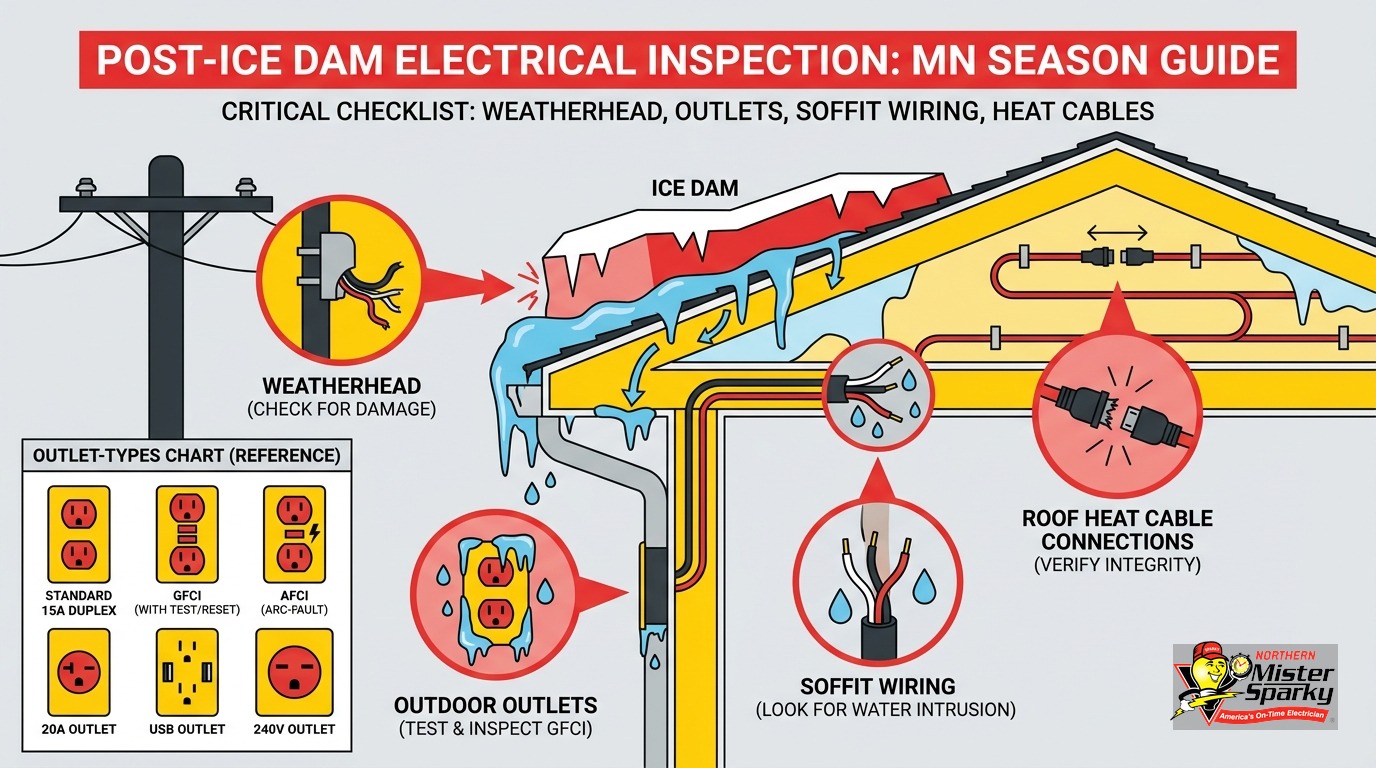
- Ice dam electrical damage is not limited to visible water in a junction box. Insulation degradation, corroded connections, and saturated GFCI outlets are common and often invisible.
- The homeowner owns the weatherhead, riser conduit, meter base, and service entrance conductors. Xcel Energy owns the service drop from the pole to the weatherhead only.
- Weatherhead damage requires a licensed electrician, a permit, and a passing inspection. Xcel will not reconnect power until the inspection passes.
- Outdoor GFCI outlets that absorbed moisture during an ice dam season may have lost trip sensitivity. Drying them out is not a fix. Replacement is.
- Roof heat cable requires GFPE protection at 30mA per NEC 426.28. A standard GFCI outlet trips at 4-6mA. Using the wrong protection type causes nuisance tripping and does not meet code.
- Any heat cable permit filed in Minnesota after August 17, 2026 must comply with the 2026 NEC.
- Call 763-200-5956 or book online to schedule a post-ice-dam electrical inspection.
What Does Ice Dam Electrical Damage Actually Look Like?
In short: Ice dam electrical damage ranges from nuisance-level corrosion on outdoor outlets to serious degradation of your weatherhead, service entrance conductors, and roof heat cable connections. Water and wiring do not mix. The risk is real, and some of it stays hidden until the next storm or cold snap.
Twin Cities winters are not gentle. The freeze-thaw cycle that creates ice dams also stresses every electrical component along your roofline. Meltwater backs up behind ice, finds the lowest point, and moves. It travels along rafters, drips into junction boxes mounted under the soffit, soaks wiring insulation, and leaves mineral deposits that accelerate corrosion over time.
Most homeowners know that ice dams cause water damage. Fewer know that the same water can reach a junction box behind an exterior wall and sit there until the next freeze cycle. By the time a fault appears, the wiring may have absorbed moisture through two or three wet seasons.
Roofing and restoration companies dominate search results for ice dam repair. They do mention electrical damage - usually in one sentence: water can reach wiring and panels. Then they pivot to insurance claims and steam removal pricing. They do not explain the weatherhead responsibility split, the difference between GFPE and GFCI protection for heat cables, or the NEC code version that governs every permit filed in Minnesota right now.
This post covers the four electrical systems most likely to sustain ice dam damage and the specific facts a Twin Cities homeowner needs before calling a contractor.
Who Is Responsible When the Weatherhead Gets Damaged?
In short: Xcel Energy owns the service drop - the overhead cable from the pole to your weatherhead. You own everything from the weatherhead inward: the riser conduit, meter base, service entrance conductors, and panel. Damage to the drop is Xcel’s responsibility at no cost to you. Damage to the weatherhead and everything below it is yours to repair.
Ice buildup along the roofline puts real physical stress on the weatherhead and the conduit that supports it. Heavy ice can pull a riser away from the soffit or bend the conduit enough to crack the fitting where it meets the weatherhead. When that happens, water has a direct path into the service entrance conductors.
This is not a minor repair. The service entrance is among the highest-risk work in residential electrical because it stays energized from the utility side even with your main breaker off. The steps are non-negotiable:
- A licensed electrician makes the repair and pulls the required electrical permit.
- The work gets inspected and passes.
- Xcel reconnects the service drop at the weatherhead only after the inspection is complete.
If Xcel arrives and finds an unsafe service entrance, they will not reconnect. The homeowner pays for the electrician regardless. The order of operations matters.
For a full walkthrough of what service mast and weatherhead repair involves in Minnesota, see our post on weatherhead and service mast storm damage repair.
One Minnesota-specific detail worth noting: aluminum service entrance conductors are standard in Twin Cities residential homes. Aluminum oxidizes at connection points. In a wet freeze-thaw climate, those oxidation points develop higher resistance, which creates heat. A visual inspection of the service entrance every spring - looking for discoloration, cracking at the entrance cable, or corrosion at the meter base - is a reasonable precaution after any season with significant ice buildup.
Are Your Outdoor GFCI Outlets Still Safe After a Wet Ice Dam Season?
In short: Not necessarily. Every outdoor receptacle in a Minnesota dwelling must be GFCI-protected per NEC 210.8. After a wet ice dam season, a GFCI outlet that absorbed moisture may test normally but have lost trip sensitivity. Replacement is the only safe answer - not drying out, not resetting.
GFCI outlets protect against ground faults by monitoring the current balance between the hot and neutral conductors. When the internal components absorb moisture and corrode, that sensing circuitry degrades. The outlet may still power a device. It may even respond to the test button. But it will not trip at the right threshold when it matters.
Meltwater running down the exterior wall during an ice dam event often terminates right at the outlet mounted under the eave. The outlet body does not need to be submerged. Repeated cycles of moisture intrusion and drying are enough to compromise the components over a single season.
What makes this easy to miss: a degraded GFCI outlet looks completely normal. The only indicators that something is wrong appear in a measured test or when the outlet fails to protect in a real fault condition. By then, it is too late.
After a significant ice dam season, replace any outdoor GFCI outlet that sat directly under an active ice dam or took on eave runoff. The part is inexpensive. The labor is minimal. The risk of leaving a compromised outlet in place is not worth the trade.
For more on GFCI requirements and what a proper outdoor GFCI outlet installation looks like in Minnesota, see our installation guide.
Soffit and Exterior Wall Penetrations: A Hidden Path for Ice Dam Electrical Damage
Every wire that enters your exterior wall passes through a hole. Every penetration gets a sealant bead when it is installed. That sealant does not last forever. Over five to ten years in a Minnesota climate, the freeze-thaw cycle dries, cracks, and pulls caulk away from the wall surface. What was a tight seal becomes a gap wide enough to admit water under pressure.
Exterior wall penetrations are a primary moisture entry point for electrical systems. Annual inspection and re-sealing with exterior-grade caulk or expanding foam is the recommended practice - but most homeowners never do it until something fails.
Ice dam seasons accelerate that failure timeline. Meltwater backed up behind ice will find every small gap in the building envelope. A conduit entry point at the soffit with cracked sealant is an easy target. The water does not need to pour in. It just needs a path.
What to check after an ice dam season:
- Conduit where it enters the exterior wall near the soffit. Look for gaps, cracked caulk, or water staining on the wall below.
- Soffit-mounted junction box covers. Discoloration, rust on cover screws, or white mineral deposits around the edge indicate moisture has gotten inside.
- The service entrance cable where it penetrates the siding or soffit. Any gap between the cable and the wall surface is an open moisture entry point.
- Interior light fixtures and outlets on exterior walls in rooms directly below the ice dam line. Water staining on the wall plate or flickering in wet weather points to moisture inside the box.
A fresh bead of exterior-grade caulk around a conduit penetration is a quick fix. A saturated junction box with corroded connections inside is a more involved repair. But the time to find either is a dry afternoon in spring, not after the next hard freeze.
Ice dam meltwater reaching a junction box or running along wiring creates an immediate shock and fire risk. Wiring insulation degrades through repeated freeze-thaw cycles. A single wet season can accelerate failure in ways that are not visible from the outside until something goes wrong.
Why Does Heat Cable Need GFPE Protection, Not a Standard GFCI?
In short: Heat cable requires ground-fault protection for equipment (GFPE) at a 30mA trip threshold, per NEC 426.28. A standard GFCI outlet trips at 4-6mA. In cold, wet conditions, heat cable draws enough normal current variation to nuisance-trip a standard outlet constantly. The 4-6mA threshold is also wrong for this application regardless of tripping frequency.
This is the most common heat cable installation mistake in the Twin Cities. A homeowner or contractor installs a heat cable run and plugs it into the nearest outdoor GFCI outlet. The cable trips the outlet on the first cold night. They reset it, it trips again. Some tape the reset button down and forget about it. Neither outcome provides correct protection, and both create real hazards.
The fix is a dedicated heat cable circuit with a GFPE-rated breaker or receptacle at the 30mA threshold. That is not a plug-and-play solution. It requires a licensed electrician, an electrical permit, and a passing inspection. For the complete breakdown of what a proper heat cable circuit looks like, see our post on roof heat cable electrical circuits.
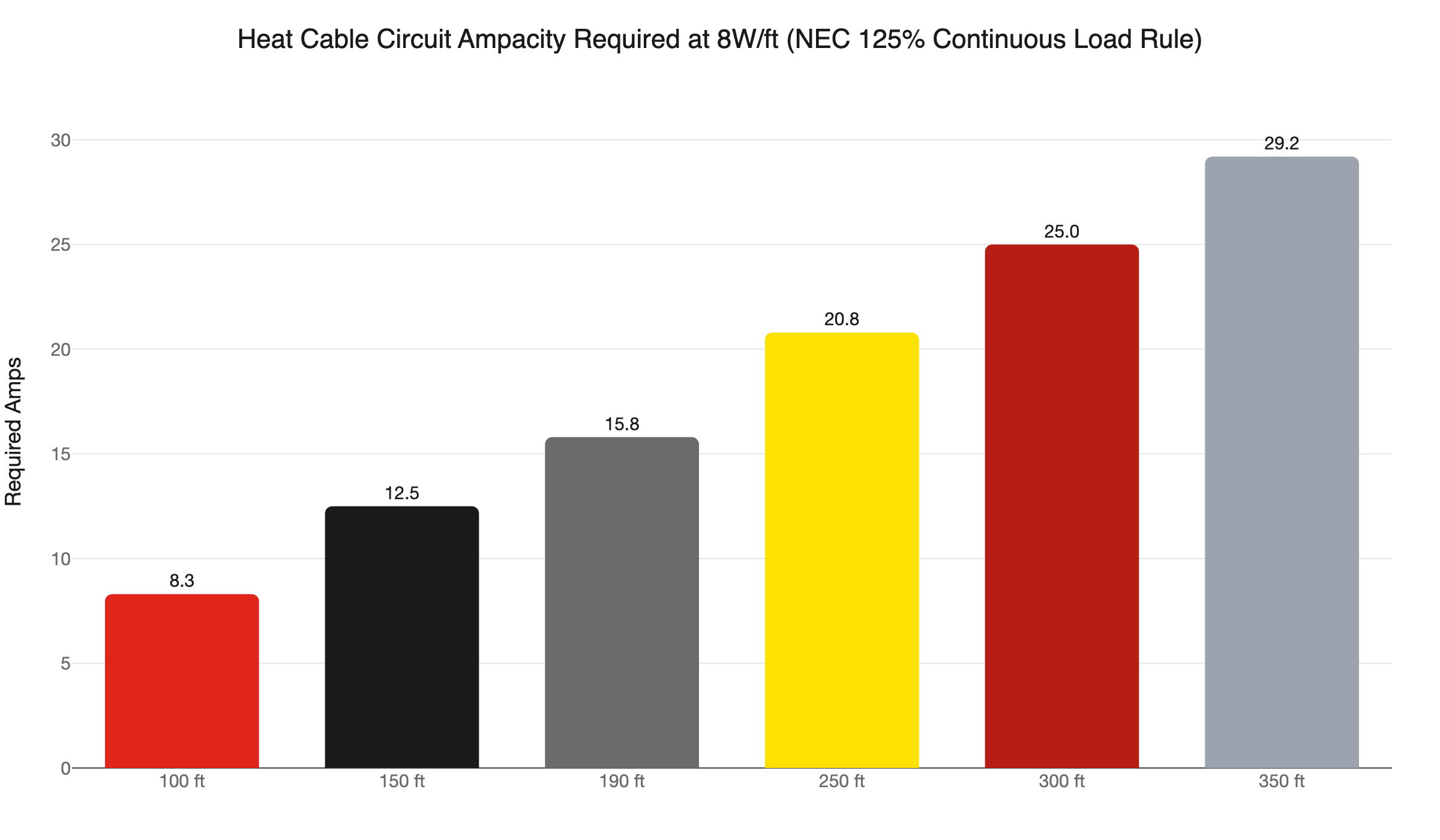
Circuit sizing is the second issue. NEC 210.20 requires conductors and breakers rated at 125% of the continuous load. At 8 watts per foot, here is what that math looks like for common Twin Cities installation lengths:
- 190-foot run: 1,520W divided by 120V equals 12.7 amps continuous. At 125%, you need at least 15.8 amps - meaning a dedicated 20A circuit.
- 250-foot run: 2,000W divided by 120V equals 16.7 amps continuous. At 125%, that is 20.8 amps. A single 20A circuit is already at its limit with this one cable run.
- 350-foot run: 2,800W divided by 120V equals 23.3 amps continuous. At 125%, that is 29.2 amps - requiring two dedicated 20A circuits.
Most Twin Cities homes need 250 to 350 feet of cable to protect eaves, valleys, and downspouts adequately. That range pushes past what a single 20A circuit can legally serve. Two dedicated 20A circuits are the code-compliant answer for a full installation.
Before adding any heat cable circuits, NEC 220.82 also requires a load calculation to verify the existing panel can absorb the new continuous load at 125%. A 100A panel with an electric range and dryer may have considerably less headroom than expected. This is why heat cable work belongs in front of a licensed electrician who pulls a permit, not on a DIY task list.
What Code Applies to Heat Cable Permits Filed After August 2026?
In short: Minnesota adopted the 2026 NEC effective August 17, 2026. Any permit filed on or after that date must comply with the 2026 NEC. Permits filed before that date fall under the 2023 NEC. If a contractor quotes heat cable work and cites only 2023 NEC requirements, they are behind on which code cycle governs the job.
The Minnesota Department of Labor and Industry officially adopted the 2026 NEC with an effective date of August 17, 2026. That date is past. If you are adding a heat cable circuit, upgrading the service entrance, or adding an outlet under the eave this fall, the work must comply with the 2026 NEC.
For most heat cable and service entrance work, the core requirements carry forward from the 2023 cycle without major changes. But the code version that governs the work matters when an inspector reviews it. An inspector signs off on the correct code cycle. A contractor who does not know which NEC applies in Minnesota right now is worth asking about before the job starts.
Do You Need a Permit to Add Heat Cable in Minnesota?
In short: Yes. Minnesota requires an electrical permit for heat cable installation. In Minneapolis and St. Paul specifically, the homeowner self-install exemption that exists statewide may be restricted. Always verify with the local AHJ before any DIY attempt. Unpermitted heat cable work will not pass inspection and creates real liability if something goes wrong.
This surprises many homeowners. Heat cable looks like an appliance - you plug it in and it heats the roof. But a permanently installed heat cable circuit is an electrical installation subject to the same permitting requirements as any other circuit work in the home.
The permit protects you. It ensures the circuit is sized correctly, the protection type matches the application, and an independent inspector verifies the work. If an unpermitted heat cable installation causes a fire or injures someone, the permit gap creates significant liability.
There is also the outlet access question. Heat cable with a plug-in cold lead requires an outlet within reach - typically 36 to 50 inches - under the eave. Extension cords void the manufacturer warranty. If no outlet exists at the termination point, a licensed electrician must install one, and that addition triggers a permit.
If your heat cable currently terminates in an extension cord running along the soffit to reach a distant outlet, that is a fire risk and a warranty violation. The electrical permit process in Minnesota is not complicated when a licensed contractor handles it. We pull the permit, complete the work, and schedule the inspection.
When to Call a Licensed Electrician After an Ice Dam Season
Ice dam electrical damage is not always visible from the outside. A bent or separated weatherhead is obvious from the driveway. Corroded connections inside a soffit junction box are not. The safest approach after a bad ice season is a point-by-point inspection by a licensed electrician who knows the four areas to check.
Watch for these signs before scheduling. Any one of them warrants a call:
- A weatherhead that has pulled away from the soffit, bent, or shows visible cracks at the conduit fitting
- Outdoor GFCI outlets that fail to reset or that have been tripping repeatedly in cold, wet weather
- Heat cable that trips the outlet every time the temperature drops
- Flickering lights or inconsistent behavior from circuits that run through exterior walls below the roofline
- Water staining around soffit junction box covers or at exterior conduit entry points
- A breaker that trips on a circuit feeding the eave area or outdoor receptacles
Northern Mister Sparky is locally owned and operated in the Twin Cities. As America’s On-Time Electrician(R), we arrive when we say we will, explain what we find in plain terms, and fix it right the first time. The UWIN(R) 100% satisfaction guarantee backs every job.
For HVAC or plumbing damage from ice dams, our sister brands handle those trades: Northern One Hour for heating and cooling, Northern Benjamin Franklin Plumbing for pipe-related damage.
Call 763-200-5956 or schedule online to book your post-ice-dam electrical inspection. We serve Minneapolis, St. Paul, Bloomington, Brooklyn Park, Woodbury, Blaine, Maple Grove, Plymouth, and the surrounding Twin Cities area.
Frequently Asked Questions
How do I know if my weatherhead was damaged by an ice dam? +
Can I plug roof heat cable into a regular outdoor outlet? +
Do ice dams damage wiring inside the walls? +
What is the difference between GFCI and GFPE protection? +
Need an electrician now?