
Outdoor Kitchen Electrical Requirements: Twin Cities Guide
Key Takeaways
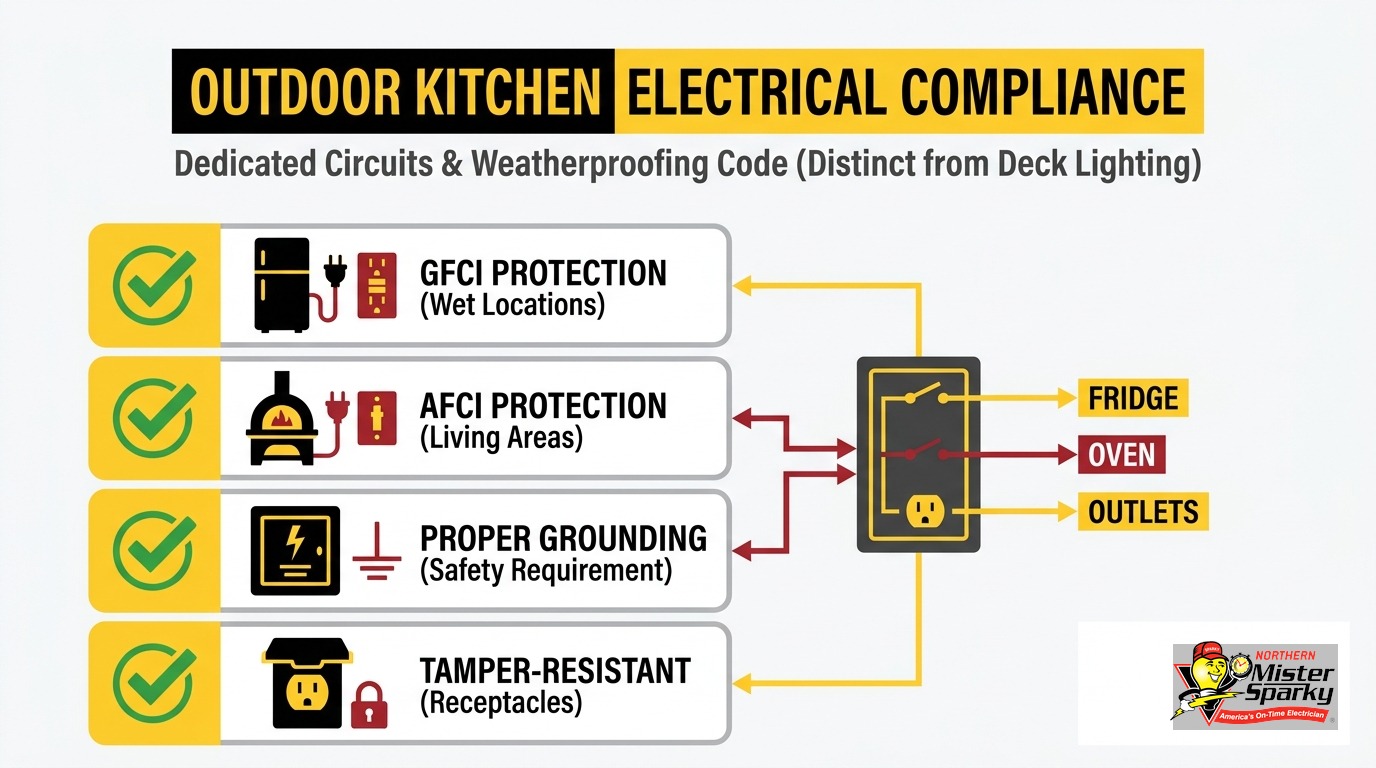
- Every outdoor outlet requires GFCI protection under NEC 210.8(F). No exceptions for appliance circuits rated 50A or less.
- 120V kitchen circuits also require AFCI protection under NEC 210.12(A). A dual-function breaker covers both at once.
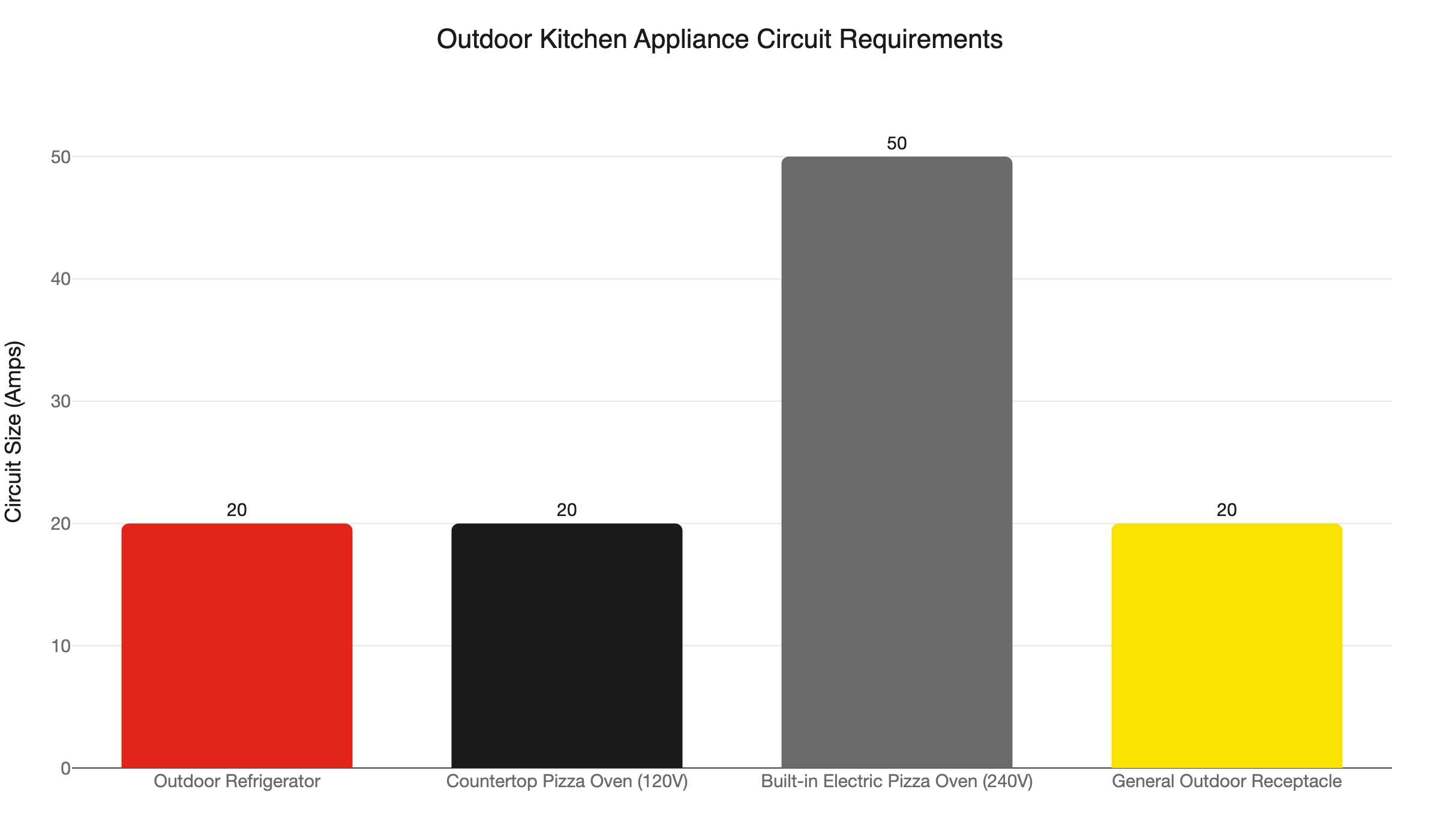
- Outdoor refrigerators need a dedicated 15A or 20A circuit. A 20A circuit is preferred for compressor startup surge.
- Built-in 240V electric pizza ovens need a dedicated 50A circuit, 6 AWG wire, and a NEMA 14-50R receptacle with GFCI protection at the breaker.
- Whether your space is a covered porch or an open patio changes your outlet weatherproofing requirement under NEC 406.9.
- Minnesota transitions to the 2026 NEC on August 3, 2026. File your permit before that date to lock in the current 2023 NEC rules.
- Homeowners may pull their own permit in Minnesota for their primary homestead. Underground work requires a trench inspection before backfill.
Planning an outdoor kitchen means settling the outdoor kitchen electrical requirements before any concrete is poured or countertop is set. The wiring is the hardest element to change after the structure is finished.
What Outdoor Kitchen Electrical Requirements Apply to Every Project?
Every outdoor kitchen needs GFCI protection on all circuits, weather-resistant outlets matched to your space type, and dedicated circuits for major appliances. These are code minimums, not optional upgrades. Plan the electrical before any countertop or concrete work begins.
Four requirements appear on every outdoor kitchen job:
- Dedicated circuits for the refrigerator, pizza oven, and any other high-draw appliances.
- GFCI protection on every outlet in the space.
- Weatherproof covers matched to a covered porch (damp location) or an open patio (wet location).
- Permits and inspections filed with the correct local or state authority.
The sections below go appliance by appliance and code section by code section. Start with the appliance list. That list drives the entire circuit plan.
Does an Outdoor Refrigerator Need Its Own Circuit?
Yes. An outdoor refrigerator requires a dedicated 15A or 20A circuit. A 20A circuit is strongly preferred because the compressor can draw 10-15A at startup. That surge trips a shared 15A circuit and can damage the compressor over time.
Under the 2023 NEC, Section 210.8(A)(6), outdoor refrigerator outlets count as kitchen receptacles and require GFCI protection. The 2023 update removed the old countertop limitation and the distance-from-sink trigger. GFCI is required regardless of where the outlet sits in the kitchen layout.
There is a local wrinkle that no national guide addresses. Most residential outdoor refrigerators are rated for an ambient temperature range of 55-90°F. A Twin Cities patio in May or October drops well below that band. When the ambient temperature falls outside the rated range, the compressor cycles incorrectly or stops running entirely. That is an appliance spec problem, not an electrical failure. But the circuit spec and the appliance spec need to match. When we size an outdoor kitchen circuit, we ask what refrigerator you plan to use before we finalize the design.
A 15A circuit is the code minimum. A 20A circuit is the right call. Budget that extra capacity at install time and you will not be back pulling wire a year later.
What Size Circuit Does an Outdoor Electric Pizza Oven Need?
A built-in 240V electric pizza oven needs a dedicated 50A double-pole breaker, 6 AWG copper wire, and a NEMA 14-50R receptacle with GFCI protection at the breaker. A countertop plug-in oven may only need 15-20A. Always check the nameplate first.
This is where outdoor kitchen electrical plans go sideways most often. A plug-in countertop pizza oven running on 120V typically draws 12-15A. A standard 20A kitchen circuit handles that. A built-in 240V electric pizza oven is a completely different product. It pulls like an electric range.
The nameplate is the starting point. If the nameplate shows 240V and 48A continuous, the breaker is sized at 125% of continuous load - which means a 60A breaker. If the nameplate shows 40A continuous, a 50A breaker is correct. Do not assume the circuit size; read the nameplate.
GFCI protection for 240V outdoor appliances is required under NEC 210.8(F). A GFCI breaker at the panel covers the entire circuit. That is a cleaner installation than sourcing a 50A GFCI receptacle, which is expensive and harder to find in stock.
If you have a countertop plug-in oven and a refrigerator sharing a circuit, that is not code-compliant. Each major appliance needs its own dedicated circuit. Each also needs its own GFCI protection path.
What Is the Difference Between a Wet Location and a Damp Location Outlet?
A damp location is a covered, protected space such as a porch or covered patio. A wet location is open and exposed to direct rain. Both require weather-resistant outlets. Wet locations also require an in-use “bubble” cover that protects the outlet even with a cord plugged in.
This distinction lives in NEC 406.9. It splits into two subsections.
NEC 406.9(A) - Damp locations (covered porch or patio):
- 15A or 20A receptacles must be listed weather-resistant (WR) type.
- The enclosure must be weatherproof when nothing is plugged in.
- A standard flip-lid cover satisfies this requirement.
NEC 406.9(B) - Wet locations (open or exposed patio):
- Same WR receptacle requirement as damp locations.
- Plus a weatherproof in-use cover, sometimes called a “bubble cover” or “while-in-use” cover.
- The cover must protect the outlet with a cord fully inserted and the lid unable to close.
Why does this split matter? If your outdoor kitchen sits under a permanent roof structure, you may be in damp-location territory. If the countertop is fully exposed to the sky, every outlet is a wet-location installation. Confuse the two categories and you will fail inspection.
For a full breakdown of receptacle types and cover options, see our post on outdoor GFCI outlet installation.
Do Outdoor Kitchen Circuits Need Both GFCI and AFCI Protection?
GFCI is required on all outdoor circuits under NEC 210.8(F). AFCI is required on 120V, 15/20A circuits supplying kitchen outlets under NEC 210.12(A). A dual-function AFCI/GFCI breaker satisfies both requirements on one device.
Here is why both protections matter in an outdoor installation.
GFCI (Ground Fault Circuit Interrupter) detects current leaking to ground. Wet surfaces, damaged cords, and water infiltration create exactly that kind of fault. GFCI trips in about 1/40 of a second. Every outdoor circuit rated 50A or less and 150V or less to ground needs GFCI protection.
AFCI (Arc Fault Circuit Interrupter) detects arcing faults. These are the faults that start fires inside walls and at loose connections. Outdoor kitchen wiring runs through conduit exposed to seasonal temperature swings. Freeze-thaw cycles loosen connections over time. AFCI catches that degradation before it becomes a fire risk.
The cleanest solution is a dual-function AFCI/GFCI breaker at the panel. One device satisfies both Section 210.8(F) and Section 210.12(A). One install, one inspection line item. These breakers cost more than a standard GFCI breaker, but the alternative is running a GFCI receptacle and an AFCI breaker in combination, which adds complexity without much benefit.
For a deeper explanation of AFCI requirements and which breaker types satisfy them, see AFCI breaker requirements explained.
Does Your Main Panel Have Room for an Outdoor Kitchen?
Adding a refrigerator, a 50A pizza oven circuit, and two outdoor receptacle circuits can add 90-110 amps of new circuit capacity to your panel. If your panel is near its limit, an upgrade may be required before any outdoor kitchen wiring begins.
A built-in 240V pizza oven runs on a 50A circuit. A refrigerator adds 20A. Two general outdoor receptacle circuits add 20A each. Total: 110A of new circuit capacity before any lighting circuits. Not all of that load runs simultaneously, but the panel still needs the physical breaker slots and service headroom to support those circuits.
Before finalizing the outdoor kitchen circuit plan, check three things:
- Total service size: Is the house on 100A, 200A, or 400A service?
- Open breaker slots: How many slots remain in the panel?
- Available headroom: Is the main breaker already under heavy load from existing circuits?
If the answers are unclear, our team can pull the panel cover and assess capacity before any outdoor work begins. Catching a panel capacity issue in the planning stage costs nothing to fix. Catching it mid-project after permits are filed costs time and money.
If your panel is already showing strain, read signs you need an electrical panel upgrade before finalizing the scope of the outdoor kitchen project.
What Happens When the Outdoor Kitchen Is Far From the House?
A remote outdoor kitchen needs a trenched underground feeder from the main panel or a subpanel. Minnesota frost depth in the Twin Cities metro area runs 42-60 inches. The DLI requires a trench inspection before backfill, so plan for at least two inspector visits on any underground wiring job.
NEC 300.5 sets minimum burial depths by wiring method:
- Direct-burial cable (UF-B): 24 inches minimum under a residential yard.
- PVC conduit: 18 inches minimum.
- Rigid metal conduit or IMC: 6 inches minimum.
None of those code minimums account for Minnesota frost. Our team runs conduit deeper to prevent frost heave from shifting the installation over repeated winters. That is not always a code requirement. It is the right way to build here.
If the outdoor kitchen sits far enough from the house to warrant its own subpanel, that approach simplifies the job considerably. All the kitchen circuits land at the subpanel. The feeder run from the house carries one large circuit instead of four or five individual circuits. Future additions are easier because the subpanel is already on-site.
Large feeder runs also tie back to the panel capacity question from the previous section. If you are adding 90-110 amps of outdoor kitchen load through an underground feeder, confirm the main panel can supply it before any trenching begins. A surprise panel upgrade mid-project adds cost and delays the inspection schedule.
Minnesota Outdoor Kitchen Electrical Requirements and the August 2026 Code Change
Minnesota is one of the first states to adopt the 2026 NEC. The transition date is August 3, 2026. Permits filed before that date follow the 2023 NEC. Permits filed on or after August 3 follow the 2026 NEC. This deadline is immediately relevant for any homeowner planning a summer or fall outdoor kitchen build.
Every requirement covered in this post reflects the 2023 NEC, which is currently in effect in Minnesota. The 2026 NEC continues the trend toward broader GFCI coverage and stricter AFCI requirements. Specific changes will be finalized as the adoption review completes, but the direction has not been toward fewer protections.
Two practical implications for your project:
- Filing before August 3, 2026: Your project locks in under the 2023 NEC. The requirements in this post apply.
- Filing on or after August 3, 2026: The 2026 NEC applies. Our team stays current on both code versions and will advise on what changes for your specific circuit plan.
Minnesota electrician licensing exams transition to the 2026 NEC on September 8, 2026. The state is moving fast. If you are pricing the project now and expect to break ground in late 2026, tell your electrician the expected permit date upfront.
What Permits Do You Need for an Outdoor Kitchen in the Twin Cities?
Yes, a permit is required for outdoor kitchen electrical work in almost every case. Minnesota homeowners may pull their own permit for their primary homestead. But underground wiring requires a trench inspection before backfill, and the final installation requires a separate inspection too.
Twin Cities permit jurisdiction is split between state DLI authority and local city AHJ. Which one you file with depends entirely on your municipality. A homeowner in Eden Prairie files with the DLI. A homeowner in Minneapolis files with the city. Getting it wrong means an invalid permit and required reinspection. Confirm your AHJ before filing anything.
Steps for a typical outdoor kitchen electrical permit in the Twin Cities:
- Identify your AHJ using the DLI inspector lookup directory.
- File the permit before any work begins.
- Schedule a trench inspection before backfilling any underground conduit.
- Schedule a final inspection after all wiring is complete and devices are installed.
If you hire a licensed electrician, they pull the permit and coordinate all inspections. That removes the logistics from your plate and puts code compliance responsibility on a licensed professional. For a complete walkthrough of the Minnesota permit process, see electrical permits in Minnesota.
Plan the Wiring Before the Concrete Goes In
Outdoor kitchen electrical requirements are straightforward when you have the appliance list in hand before any ground is broken. A refrigerator, a pizza oven, two or three receptacle circuits, and a lighting circuit cost far less to wire during construction than after the countertops are set and the structure is closed.
Our locally owned team serves Minneapolis, St. Paul, Bloomington, Brooklyn Park, Woodbury, Blaine, Maple Grove, Plymouth, and the surrounding Twin Cities area. We handle the permit filing, the trench inspection, the final inspection, and every circuit in between. America’s On-Time Electrician(R) shows up on schedule.
Call 763-200-5956 or book online to get started. If your outdoor kitchen adds significant load to your existing panel, ask about financing options when you call.
Frequently Asked Questions
Does an outdoor refrigerator need a dedicated circuit? +
What is the difference between a wet location and a damp location outlet? +
Do outdoor kitchen circuits need AFCI protection? +
Need an electrician now?