
Outdoor Pickleball Court Lighting: Electrical Requirements
Key Takeaways
- Minnesota moved to the 2026 NEC on August 17, 2026. Any permit filed on or after that date must comply with the new edition.
- Court lights are a continuous load under the NEC. Size the circuit at 125% of the connected load, not 100%.
- The NEC minimum for Schedule 40 PVC conduit is 18 inches. Twin Cities design frost depth runs 42-60 inches. Trench deeper or use expansion fittings at grade transitions.
- Every fixture must carry a “Suitable for Wet Locations” listing per NEC 410.10(A). A lumens spec and IP rating alone do not satisfy the code.
- Any outdoor receptacle added near the court requires GFCI protection under NEC 210.8(A)(3).
- A dedicated 20A circuit is the practical minimum for a four-pole system. For fixtures 250W and above at 240V, a 20A/240V circuit is standard.
- File with the correct authority having jurisdiction. Minneapolis and St. Paul have their own electrical inspectors. Many suburbs use DLI. Filing with the wrong office costs days.
Backyard pickleball courts are showing up all over the Twin Cities. The outdoor pickleball court lighting electrical requirements are the part almost nobody plans for. The conversation usually stops at surface material, net hardware, and boundary paint. Then the inspector shows up and writes a stop-work notice on a trench that was not deep enough. Or a $2,000 fixture order arrives without a wet-location listing. This post covers what the code actually requires: circuit sizing, conduit burial depth, fixture compliance, and the Minnesota permit process every homeowner should know before the first shovel goes in.
What Are the Outdoor Pickleball Court Lighting Electrical Requirements?
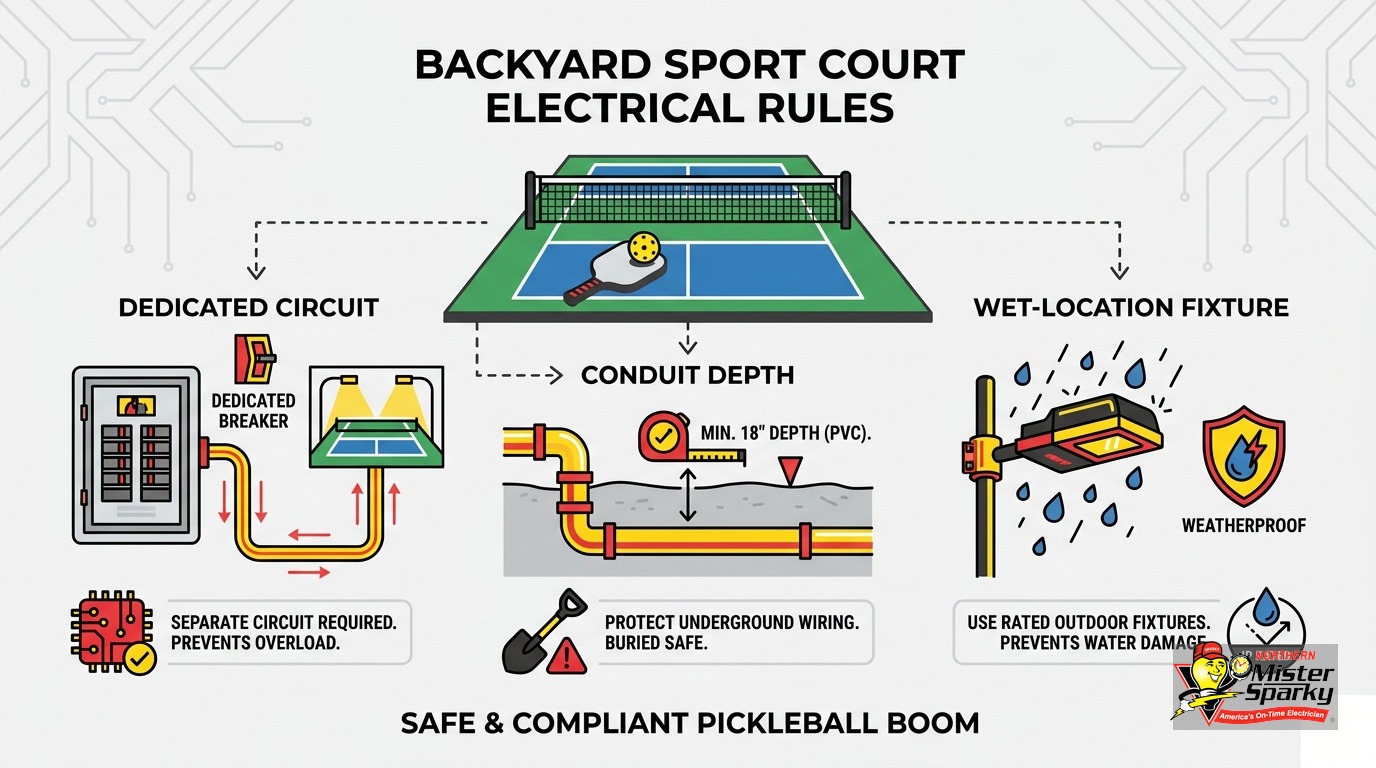
Four NEC sections govern every residential court lighting install. You need a properly sized dedicated circuit, conduit buried to code-legal depth, wet-location-listed fixtures, and a permit in hand before work begins.
The National Electrical Code is the statutory baseline for all electrical construction in Minnesota. Four articles drive the compliance checklist for a backyard court:
NEC 210.19 and Article 220: Circuit sizing. Court lights run for three or more hours at a stretch. That qualifies them as a continuous load under the NEC. Continuous loads require conductors sized at 125% of the connected load. The overcurrent device must not exceed 80% of its rating while running continuously.
NEC 300.5, Table 300.5: Conduit burial depth. The code sets minimum cover depths by wiring method. In Minnesota, frost depth pushes the practical number well above those minimums.
NEC 410.10(A): Wet-location listing. Any luminaire installed outdoors is in a wet location by definition. It must be listed and marked “Suitable for Wet Locations.” Rain exposure qualifies every pole light on a backyard court.
NEC 210.8(A)(3): GFCI protection. If the job includes any outdoor receptacle, GFCI protection is required on all 15A and 20A, 125V outlets.
Each rule gets its own section below.
Do You Need a Permit for This Project in Minnesota?
Yes, without exception. Minnesota requires an electrical permit for any new circuit or wiring at a residential property. Homeowners can self-apply. The permit must be filed before work begins.
Minnesota Statute 326B.35 makes the NEC the statewide construction baseline. The Department of Labor and Industry administers the permit program, but there is a catch for Twin Cities homeowners.
Your authority having jurisdiction may be DLI or it may be your city. Minneapolis and St. Paul both operate their own electrical inspection departments. Many suburbs also use local inspectors. File with the wrong AHJ and your permit gets bounced. That delay can cost days or weeks on a job with a concrete pour or fence install on the same timeline.
Check the DLI inspector directory before filing a single form. It confirms which office handles your permit. Our post on electrical permits in Minnesota walks through the filing steps in detail.
If you hire a licensed electrician, the electrician pulls the permit. Our team handles it on every job.
What Circuit Size Do Outdoor Pickleball Court Lights Require?
Plan on a dedicated 20A circuit at minimum. Court lights are a continuous load, so NEC 210.19 requires sizing at 125% of the connected load. For fixtures 250W and above at 240V, a dedicated 20A/240V circuit is the standard installation.
Here is the math for a common setup. Four poles, each with a 150W LED fixture: 600W total connected load. At 120V, that is 5 amperes. Apply the continuous-load rule from NEC: size the conductor above the actual load current to meet code minimums. That fits a 15A circuit on paper.
Voltage drop changes the result. A 100-foot run of 14 AWG copper at 5A continuous exceeds the 3% drop threshold most engineers use as a practical limit. The fix is 12 AWG on a 20A circuit. That resolves the drop and leaves the circuit well below its continuous rating.
For fixtures above 200W per head, or when four poles become six or eight, the math moves into 240V territory. A dedicated 20A/240V circuit handles up to 3,840W at 80% continuous capacity. That covers nearly every residential court configuration.
At 240V, current is half the equivalent 120V load on the same wattage. That halves voltage drop over the run. A 150-foot trench that demands 10 AWG at 120V may stay within 3% on 12 AWG at 240V. A licensed electrician calculates the exact conductor size for your specific panel-to-court layout before specifying wire gauge.
Before any of this math matters, confirm the panel has space for a new dedicated circuit. A panel that is out of breaker slots needs a tandem breaker or a subpanel first. Most Twin Cities homes with 200A service have room. Older homes with 100A panels may not.
How Deep Does Conduit Need to Be Buried in Minnesota?
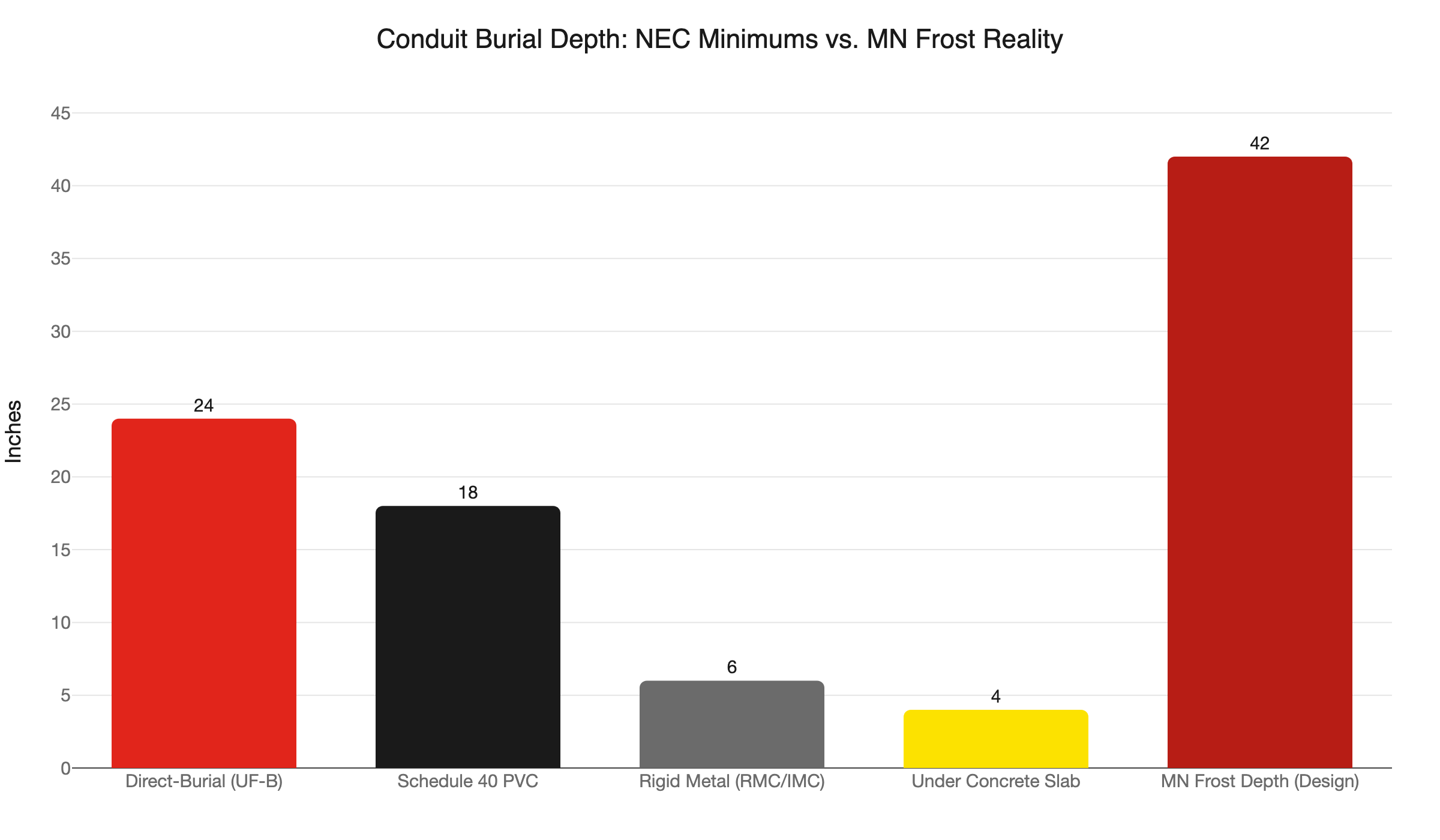
NEC minimum for Schedule 40 PVC conduit is 18 inches. In the Twin Cities, that is not enough for a durable install. Twin Cities design frost depth runs 42-60 inches. That puts every fitting and pole-base transition in the active frost zone every winter. Most Minnesota electricians trench deeper.
NEC sets minimum burial depth by wiring method:
- Direct-burial cable (UF-B): 24 inches
- Schedule 40 PVC conduit: 18 inches
- Rigid metal conduit (RMC or IMC): 6 inches
- Under a concrete slab at least 6 inches thick: 4 inches for conduit in the slab
The chart with this post compares those NEC minimums against the Twin Cities design frost depth. The NEC was written for national applicability. Running Schedule 40 PVC at 18 inches places every inch of conduit squarely in the active frost zone.
Ground heave cracks conduit joints. It lifts pole bases. It creates water entry points at the fittings where conductors transition from the buried run into the pole. You will not see the damage until the second or third winter. By then, you are excavating a trench in January.
The pole base is the most vulnerable point on the run. Conduit enters the pole through a fitting at or just above grade, right where heave is most active. A properly glued sweep elbow below grade, angled away from the pole base before turning upward, reduces the water wicking path at that transition.
Experienced Minnesota electricians trench to frost depth when site conditions allow. When they cannot go that deep, they run Schedule 80 PVC with expansion couplings at grade transitions.
Our post on underground electrical wire depth in Minnesota covers the full NEC table and MN frost depth context in detail.
What Makes a Fixture Code-Legal for an Outdoor Court?
The fixture must be listed and marked “Suitable for Wet Locations” per NEC 410.10(A). A weather-resistant housing and a high lumens rating are not substitutes for that listing.
NEC is direct: luminaires in wet locations must be listed and marked for wet use. Every outdoor pole light on a court is a wet-location luminaire by code definition.
One distinction matters. The NEC separates wet locations from damp locations. A covered porch ceiling is a damp location. An outdoor pole light exposed to rain is a wet location. “Suitable for Damp Locations” does not satisfy code for a court pole. Some lower-cost LED flood fixtures carry only a damp-location listing. Check the product data sheet before ordering, not after the fixtures arrive on site.
In practice, look for IP65 or higher ingress protection. That confirms the fixture is sealed against direct water jets from any direction. But IP65 is a performance spec from a separate standard, not a safety listing. Confirm the UL or ETL listing on the data sheet. A fixture can carry an IP65 label without being listed for wet use under UL 1598. Those are two different things.
A fixture without a wet-location listing fails inspection. Some inspectors red-tag the entire job. Beyond the inspection problem, an unlisted fixture on a metal pole with conductors running through it carries real fire and shock risk.
Does Adding a Court Outlet Trigger GFCI Requirements?
Yes. Any standard-voltage receptacle installed outdoors at a dwelling with direct grade-level access requires GFCI protection under NEC. No exceptions.
Court installs often include a convenience outlet: a scoreboard connection, a speaker supply, or a courtside charging outlet. Each one needs GFCI protection. A court outlet added later, even months after the lighting is installed, still triggers the requirement. The code applies to every new outdoor outlet regardless of when it goes in.
You have two ways to satisfy it. A GFCI circuit breaker in the panel protects everything downstream on that circuit. A GFCI outlet at the first location on the circuit protects all standard outlets downstream. Either method satisfies the code.
Our post on outdoor GFCI outlet installation covers both methods and explains when a GFCI breaker is worth the added cost over an outlet-level device.
Minnesota Just Moved to the 2026 NEC: What Does That Mean for Your Project?
Permits filed on or after August 17, 2026 must comply with the 2026 NEC. Permits filed before that date follow the 2023 NEC. Minnesota adopted the 2026 edition statewide. Any contractor quoting “current code” should be citing the 2026 NEC for your job.
DLI confirmed the 2026 NEC adoption on that date. For a court lighting project, the practical difference between the 2023 and 2026 editions is modest. The core requirements on continuous loads, wet-location fixtures, and burial depths are structurally consistent between both editions.
The bigger risk is stale knowledge. If a contractor references “current code” without naming the edition, ask which one. A contractor who has not updated since August 17 may install to the 2023 NEC on a 2026 NEC permit. That triggers a re-inspection. Ask before signing a contract.
Voltage Drop: The Hidden Problem on Long Panel-to-Court Runs
Most Twin Cities backyards put 75 to 150 feet between the main panel and the court. That is a real run, and voltage drop is the problem it creates.
The NEC governs conductor ampacity through Table 310.12. It does not mandate a maximum voltage drop percentage. That is a design recommendation, not a hard code violation. The standard most licensed electricians use is 3% maximum drop for a branch circuit.
At 5A continuous on a 100-foot run of 14 AWG copper at 120V, you exceed that 3% threshold. The fixtures see below-rated voltage. LED driver life shortens. Output drops. Step to 12 AWG on a 20A circuit and the 100-foot run falls to roughly 2% drop.
At 150 feet, step to 10 AWG at 120V, or shift the circuit to 240V. At 240V with the same wattage load, current is half the 120V equivalent. The same wire gauge handles a longer run under the 3% limit. A licensed electrician calculates the exact conductor size for your specific layout before specifying wire.
Can I Do This Work Myself?
Minnesota allows homeowner-pulled permits for electrical work on your own primary residence. The permit requirement does not go away. You still file, pay fees, and pass inspection.
A court lighting install involves trenching 75-150 feet, running a new panel circuit, weatherproofing pole-base conduit entries, and mounting fixtures at 18-20 feet. Every step has code requirements with real failure modes.
The honest tradeoff: a DIY install that passes inspection is a legitimate outcome. A buried conduit run that fails inspection means excavating the trench. That is a costly correction on a job that looked finished from the surface.
If you want it done right the first time, call a licensed electrician. Our team is locally owned and operated across the Twin Cities. We back every job with the UWIN(R) 100% satisfaction guarantee.
What About Energy Rebates for LED Court Lighting?
Energy Star certifies outdoor luminaires that meet minimum efficacy and quality requirements. Certified fixtures are listed at energystar.gov. They may qualify under federal incentive programs and are a solid baseline for product selection.
On the local side, Xcel Energy’s residential rebates focus primarily on HVAC and interior lighting. No dedicated sport-court LED rebate is confirmed at this time. That said, replacing four 400W metal halide heads with 150W LED fixtures cuts energy use by 62.5% per pole. Reductions at that scale occasionally qualify for a custom rebate through Xcel’s Business Solutions tier, even on a residential account. Call Xcel at 1-800-895-4999 before the job starts and ask.
Ready to Light Your Court the Right Way?
Our locally owned team serves Minneapolis, St. Paul, Bloomington, Brooklyn Park, Woodbury, Blaine, Maple Grove, Plymouth, and the wider Twin Cities metro. As America’s On-Time Electrician(R), we show up when we say we will. No malarky.
We handle permit filing, trenching, circuit installation, wet-rated fixture mounting, and inspection sign-off. Financing is available on larger projects - ask when you call. Plan early: permit review and inspection scheduling in the Twin Cities can add one to two weeks to a project timeline. We coordinate both for you.
Call 763-200-5956 or book online to get on our schedule. Visit our outdoor lighting services page for more on what our team installs and services across the Twin Cities.
Frequently Asked Questions
Do I need a permit to install pickleball court lights in Minnesota? +
How deep does conduit need to be buried for outdoor court lighting? +
What circuit size do I need for four-pole pickleball court lighting? +
What does Suitable for Wet Locations mean for outdoor light fixtures? +
Need an electrician now?