
Squirrel Chewed Wires in Attic: Minnesota's Hidden Fire Risk
Key Takeaways
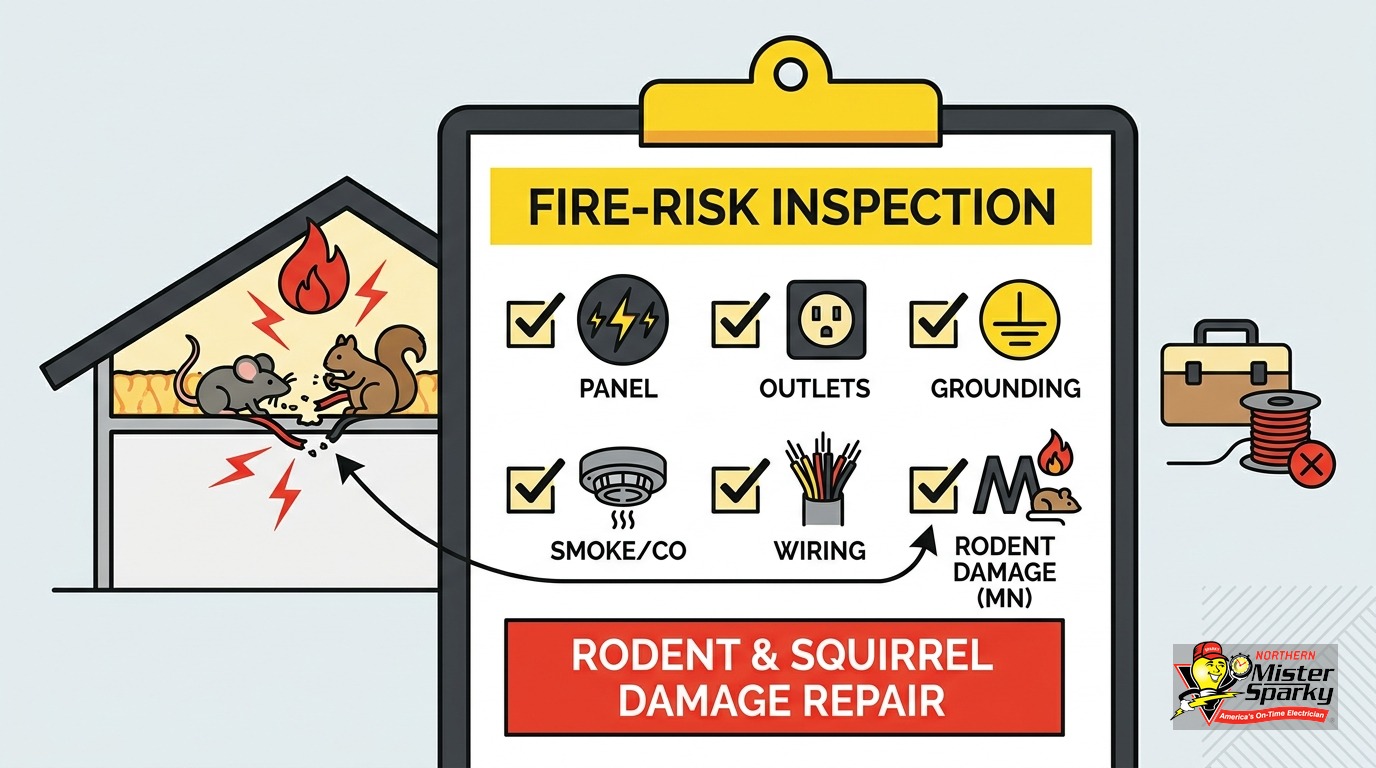
- Squirrel-chewed wires in attic spaces are one of the most overlooked fire hazards in Minnesota homes. Wildlife sources attribute roughly 30,000 residential fires per year to rodents gnawing electrical wiring.
- The Twin Cities hosts three squirrel species. Red squirrels are the most aggressive chewers and the most likely to exploit soffit gaps in older Minneapolis and St. Paul homes.
- September and October are the peak entry window in Minnesota. Squirrels seek a warm den before freeze, and a new generation of juveniles disperses every fall looking for territory.
- Any attic wiring repair in Minnesota requires a permit through the Minnesota Department of Labor and Industry. A licensed electrician pulls the permit and completes the repair to code.
- Homeowners insurance typically excludes the rodent damage itself. A resulting fire is usually covered - unless your insurer can show you knew squirrels were present and did nothing about it.
- A wiring repair is also the natural time to add AFCI breaker protection on the attic circuit, now required under Minnesota’s 2023 NEC.
- Call us at 763-200-5956 or book online. We are locally owned and operated in the Twin Cities, and we do not cut corners on attic repairs.
Why Do Squirrels Chew Electrical Wires?
Quick answer: Squirrels’ teeth grow continuously throughout their lives. They gnaw on hard materials - wire insulation, wood, pipe insulation, and ductwork - to keep their teeth filed to a working length. Wire insulation in an attic is conveniently available, never fights back, and is roughly the right diameter for the job.
This is not a preference. It is biology. A squirrel that gets into your attic will chew on whatever is there. None of it is targeted at wiring specifically. All of it causes damage.
When a squirrel strips the insulation off a wire, it leaves bare copper conductors in close proximity to each other or to grounded surfaces. Those conductors can touch directly, or they can arc across the gap without ever making contact. Arcing generates intense, localized heat. The NFPA reports that arcing is the heat source in 73% of home electrical distribution fires. In an attic loaded with fiberglass or cellulose insulation and dried wood framing, that heat source sits surrounded by fuel.
The problem is often invisible for weeks or months. You may not see any interior symptom while an arc slowly chars the insulation around a damaged section. By the time a breaker trips or a light starts to flicker, the damage has been present long enough that you cannot detect it from below the ceiling.
Is September the Most Dangerous Month for Attic Entry in Minnesota?
Quick answer: September and October are both high-risk months. Squirrels do not hibernate, so they actively seek a warm overwintering den before hard freeze. At the same time, a new generation of juveniles disperses in late summer, and those young animals are exploring territory they have never occupied before.
The combination of seasonal timing and juvenile dispersal makes fall the critical window for attic entries in the Twin Cities metro. An adult squirrel that enters in October can establish a nest, raise a litter in spring, and produce another litter the following late summer. A single entry point that goes unnoticed and unrepaired can support an infestation for several years, with gnawing damage accumulating each season.
The noise pattern is a useful diagnostic. Squirrels are diurnal - they are active during the day, typically in the morning and late afternoon. Scratching or thumping above your ceiling at those times points toward squirrels rather than mice or raccoons. Nighttime activity points to a different animal entirely. Knowing the difference helps you communicate clearly with a wildlife removal company and helps our team understand the likely timeline when we get into your attic.
Which Squirrel Species Are Most Common in Twin Cities Attics?
Quick answer: The Twin Cities hosts Eastern Gray, Fox, and Red squirrels. Red squirrels are the most aggressive attic invaders and the most likely to cause wiring damage. They are roughly half the size of a gray squirrel and can squeeze through gaps smaller than two inches - the kind of opening that is easy to miss on a casual exterior inspection.
The Minnesota DNR confirms that gray squirrels are among the state’s most common mammals, thriving in suburban environments where residential development fragments hardwood canopy. That description fits virtually every Twin Cities neighborhood built before the 1980s.
Red squirrels are a separate and more persistent problem. They are smaller, more territorial, and more inclined to use the same entry point year after year. Older Minneapolis and St. Paul homes with deteriorating soffit boards, gaps around bathroom exhaust vents, or damaged fascia near the roofline are particularly vulnerable. Once a red squirrel establishes a nest in your attic, that entry point becomes a permanent feature of the animal’s home range. Gnawing damage accumulates with each season of occupation.
Fox squirrels are larger and less likely to nest inside an attic, but they will chew on materials near entry points when exploring a structure. If any of the three species are active on your property, your wiring deserves a professional look.
What Does Squirrel Wire Damage Look Like in an Attic?
Quick answer: In the attic itself, look for chewed or missing insulation on wiring runs along joists or rafters, bare copper conductors, droppings, and nesting material. Inside the home, the symptoms are flickering lights, unexplained tripped breakers, dead outlets, or a burning smell from a ceiling fixture or junction box.
The visible damage in the attic is rarely easy to find on your own. Squirrel-chewed wiring is often buried under or inside blown-in insulation, making it invisible without a deliberate inspection of each circuit run. A quick look through the access hatch with a flashlight is not an inspection.
Inside the home, watch for these signals:
- Flickering or intermittent lights on a specific circuit, especially in a room fed by wiring that runs through the attic
- Breakers that trip without obvious cause, unrelated to appliance load or time of day
- Dead outlets or switches on a circuit that was working normally before the attic activity started
- A burning smell from a ceiling fixture or junction box, which may indicate that an arc has already occurred
- Scorch marks around an outlet, switch, or light fixture - these require an immediate call
Any one of these symptoms warrants a call to a licensed electrician. A tripping breaker is sometimes a nuisance. Sometimes it is the protection device doing exactly what it is designed to do because there is an active fault on the line. Our post on warning signs you need an electrician covers the full range of symptoms that deserve prompt attention.
Can Squirrel-Chewed Wires in an Attic Actually Start a Fire?
Quick answer: Yes. The mechanism is direct: stripped insulation leads to arcing, arcing generates heat, and heat ignites nearby insulation and framing. Wildlife sources estimate roughly 30,000 residential fires per year are attributed to rodents gnawing wiring. Pest researchers suggest that 20-25% of fires with an undetermined cause are attributed by fire investigators to rodent damage.
The attic environment makes the risk worse than in most other parts of the home. Fiberglass and cellulose insulation can smolder for hours before visible flames appear. There is typically no smoke detection anywhere near the wiring in the attic space. Once smoldering insulation ignites the roof sheathing or nearby framing, the fire can spread quickly through the concealed space. A fire that starts in an attic in the early morning hours gives a family very little time to respond.
Two factors amplify the risk in older Minnesota homes specifically. First, many homes built before the 1980s have wiring with insulation that has grown brittle with age. Squirrel gnawing on already-degraded insulation causes more exposure with less effort. Second, dense-pack cellulose insulation - common in energy-efficiency retrofits - is an effective smoldering medium. A small arc in cellulose can sustain a slow burn for a long time before breaking into open flame.
This is not a reason to panic. It is a reason to act promptly when you have any signal that a squirrel has been in your attic.
Does Homeowners Insurance Cover Squirrel Chewed Wire Damage?
Quick answer: Standard homeowners policies typically exclude the rodent damage itself as a maintenance issue. A fire caused by that damage is generally covered under the fire protection portion of your policy - unless your insurer can show you knew squirrels were present and took no action. That last part matters more than most homeowners realize.
Here is how the coverage picture typically works:
The chewed wires themselves are excluded. Insurers treat the presence of squirrels as a maintenance problem. The gap in your soffit or the missing section of fascia should have been noticed and repaired. The cost of rewiring a damaged circuit is yours.
A fire caused by the chewed wires is usually covered. Your policy’s fire protection typically extends to structure and contents damage from a fire, regardless of ignition source, as long as the loss was not foreseeable and preventable.
The foreseeable-loss exception can void your claim. If your insurer can document that you had notice of the infestation - a pest removal receipt, a service log, a note in your own claim history - and you took no action, they have grounds to argue that the resulting fire was a predictable consequence of that inaction. That is a coverage dispute no homeowner wants to face after a major loss.
The practical response is straightforward: act on the first sign of attic activity. Get the animal removed and the entry point sealed. Get the wiring inspected by a licensed electrician. Keep all records - pest removal receipts, inspection reports, permit documents, and photographs - somewhere you can find them quickly.
What Does a Legal Electrical Repair Require in Minnesota?
Quick answer: Minnesota requires a permit for any repair to home electrical wiring, including rodent damage. Only a licensed electrical contractor (or a homeowner on their own occupied home) can pull that permit. The Department of Labor and Industry administers the permits, and every repair must meet the current NEC standard and pass a required inspection.
This is the point where squirrel wire damage repair differs from squirrel removal. A pest control company removes the animal and seals the entry point. They cannot legally repair the wiring. A handyman who re-tapes stripped insulation or makes a buried splice inside the attic insulation is not just doing substandard work - he is creating an uncontrolled fire hazard and leaving you with no permit record.
Minnesota adopted the 2023 NEC effective July 1, 2023. Every permitted repair must meet that standard. Two code requirements apply directly to squirrel wire damage:
NEC 314 - accessible junction boxes. Any splice made to repair a mid-run section of damaged conductor must be enclosed in an accessible junction box. The box must remain accessible without tearing out a ceiling or disturbing structural members. No buried splice - no matter how neat it looks or how well the tape holds - meets this requirement.
Full-run replacement when access or damage extent requires it. When the damaged section runs through inaccessible framing, or when the damage is extensive enough that a splice would leave questionable conductor in a wall or ceiling cavity, the code-correct repair is full segment replacement from panel to fixture. Our home wiring repair service handles both scenarios, and we document the work with the permit record so you have a complete paper trail.
For a detailed walkthrough of the permit process and what to expect, see our post on electrical permits in Minnesota.
What Is AFCI Protection, and Why Does It Matter After Squirrel Damage?
Quick answer: An AFCI (arc-fault circuit interrupter) breaker monitors the circuit for the electrical signature of a developing arc and trips the circuit before the arc can ignite surrounding materials. Under Minnesota’s 2023 NEC, attic branch circuits require AFCI protection. A wiring repair is the natural time to verify that protection is in place and add it if it is not.
Here is the core concern: squirrels often damage more than one spot on a wire run. The most visible damage - the section with bare copper or visibly missing insulation - gets found and repaired. But if there is a hairline breach further along the same circuit run, or if several strands were stressed without fully stripping the outer jacket, there is a latent arc-fault condition that a standard breaker will never catch.
A standard breaker responds to overcurrent - a current load high enough to trip the thermal element. Arc faults do not always produce overcurrent. A small arc at low current levels can smolder for a long time without ever tripping a standard breaker. An AFCI breaker detects the arc’s electrical signature rather than just the load level, and shuts the circuit down before the heat has time to build.
Our post on AFCI breaker requirements explains exactly which circuits require AFCI protection and what the upgrade involves. When our team repairs squirrel-chewed wiring, we verify AFCI compliance on the affected circuit at the same time. If your panel does not already have an AFCI breaker on the attic circuit, we install one as part of the repair.
How Northern Mister Sparky Handles Squirrel Wire Damage
We are locally owned and operated in the Twin Cities. When you call us about a potential squirrel wire problem, here is the sequence:
Step 1: Thorough attic inspection. We access the attic, trace the affected circuits, and look for visible and hidden damage before we pull a permit. We document what we find and walk you through it before we recommend any repair scope.
Step 2: Permit. No repair goes to work without proper DLI documentation. The permit protects you with your insurer and ensures the work is inspected by the authority having jurisdiction.
Step 3: Code-correct repair. Accessible junction box for a localized splice. Full-run replacement when access or damage extent requires it. No buried splices, no tape-over fixes.
Step 4: AFCI verification. We confirm compliance on the repaired circuit and install an AFCI breaker if your panel does not already have one protecting that attic run.
Step 5: Inspection coordination. We schedule the required post-permit inspection so you are not managing that step on your own.
If you have a burning smell, scorch marks, or a breaker that trips and will not reset, call 763-200-5956 right now. Those are not symptoms to monitor and reset. They are symptoms that require a call today.
If you heard attic scratching this fall and want peace of mind before the coldest months dig in, book an inspection online. We will tell you exactly what we find. No malarky.
America’s On-Time Electrician(R). UWIN(R) 100% satisfaction guaranteed. Locally owned, Twin Cities proud.
Frequently Asked Questions
How do I know if squirrels chewed wires in my attic? +
Is it legal to repair squirrel-chewed wiring yourself in Minnesota? +
Will homeowners insurance pay for squirrel wire damage? +
What is AFCI protection and does my attic circuit need it? +
Need an electrician now?