
Rental Property Electrical Inspection in Minnesota
Key Takeaways
- Minneapolis and St. Paul run separate rental inspection programs. Rules, triggers, and paperwork differ between the two cities.
- Minnesota law makes it illegal for a landlord to do their own electrical work on any rental, leased, or tenant-occupied property. Only owner-occupants of their own single-family home are exempt under state law.
- The “certificate of compliance” in Minnesota is a utility-filing form, not a city document. Your licensed electrician signs it and files it with the power company before any new work is energized.
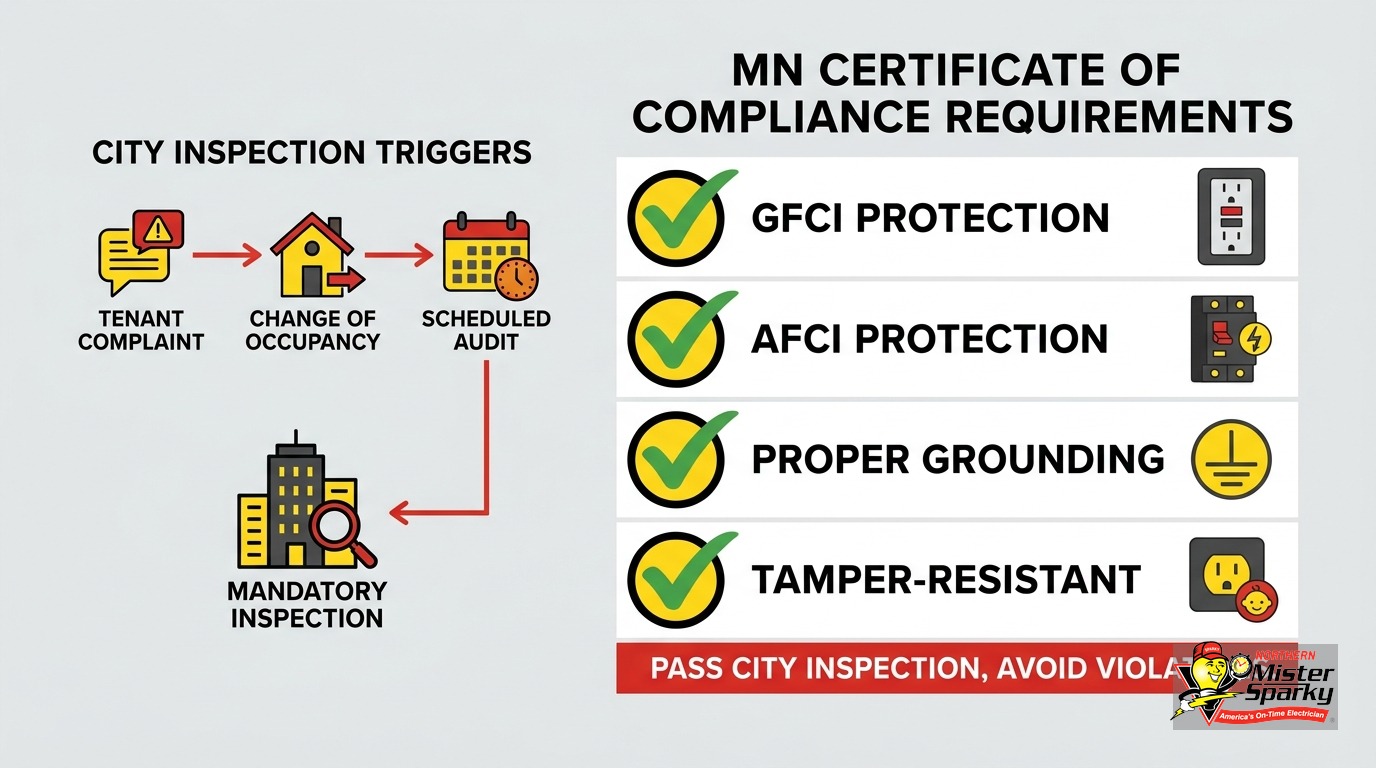
- Five events trigger a city electrical inspection on a rental: license renewal, any permit pull, a tenant or neighbor complaint, problem-property tier status, and starting work without a permit.
- Skipping a permit does not save money. An investigation fee is added on top of the standard permit cost when a city inspector finds work in progress without one.
- Active code violations can block an eviction filing. License revocation bars renting the unit at all.
What Is a Rental Property Electrical Inspection in Minnesota?
Short answer: A rental property electrical inspection in Minnesota is a licensed-electrician review of a unit’s wiring, service, panel, and devices. Most Twin Cities cities require it as part of rental licensing. Minneapolis and St. Paul each run their own program, and the triggers and paperwork differ between them.
Landlords who manage rental properties in the Twin Cities often discover the hard way that there is no single statewide rental inspection process. Cities operate as the Authority Having Jurisdiction. Minneapolis runs one program. St. Paul runs another. Suburbs vary. Before pulling any permit, confirm whether your city falls under local or state jurisdiction.
Minneapolis vs. St. Paul: Two Programs, Two Sets of Rules
If you own rental properties in both cities, you are working with two distinct inspection systems. Understanding the difference keeps you from applying one city’s rules to the other.
Minneapolis
Every rental property in Minneapolis must hold a valid rental license. An Electrical Safety Check is a required component of that license. A licensed electrician employed by a licensed firm must inspect the electrical system and certify that it meets current NEC and Minneapolis Housing Maintenance Code standards.
The Electrical Safety Check covers:
- All hazardous or disconnected wiring must be removed
- The service must not be over-fused or overloaded
- Wiring must comply with the current NEC and local housing code
Minneapolis also uses a tier system for rental properties. Well-maintained properties earn longer inspection cycles. Problem properties get more frequent inspections and tighter scrutiny. A tier demotion mid-cycle triggers a fresh inspection.
The tier system has real practical consequences. A tier demotion does not self-correct at the next renewal. The property must demonstrate sustained improvement across multiple clean inspection cycles. A landlord who earns a problem-property designation can expect more frequent inspections for a year or more.
For landlords managing a portfolio, this matters. One problem property competes for your time and budget even when everything else is in order. Getting it out of the lower tier quickly means fixing violations and passing reinspection. That reduces ongoing compliance overhead across the whole portfolio.
St. Paul
St. Paul uses a different mechanism. All buildings except owner-occupied single-family homes and duplexes must have and maintain a Fire Certificate of Occupancy issued by the Department of Safety and Inspections (DSI). Single-family rental and duplex landlords who do not live on the property must register it with DSI. Each property’s inspection grade is public on DSI’s Certificate of Occupancy Map. Tenants, buyers, and neighbors can look it up at any time.
Both cities require a licensed electrical contractor for any rental electrical work. That requirement comes from state law, not just local preference.
What Triggers a Rental Property Electrical Inspection in Minnesota?
Short answer: Five events bring a city inspector to a rental property’s electrical system: license renewal tied to the inspection cycle, any electrical permit pulled for new work, a tenant or neighbor complaint, a problem-property or lower-tier designation, and starting electrical work without a permit first.
Knowing the triggers lets you plan ahead instead of reacting. Here is how each one plays out.
1. Rental license renewal
Minneapolis inspection frequency depends on your property’s tier. Top-tier, well-maintained properties earn longer gaps between mandatory in-person inspections. Problem or lower-tier properties face inspections at every renewal cycle. Tier demotion mid-cycle brings a fresh inspection before the next renewal.
2. Any electrical permit
Pulling a permit means inspections follow automatically. Minneapolis and St. Paul are both local Authorities Having Jurisdiction. Permits and inspections go through the city, not the state Department of Labor and Industry. Two inspections are required for any permitted electrical work in Minnesota: rough-in and final. Rough-in happens before walls close, before insulation or drywall. Final happens after devices are installed and the panel is energized. Missing either leaves the permit open and the work uncertified.
3. Tenant or neighbor complaint
A single call changes the picture. St. Paul complaints go to DSI at 651-266-8989. Minneapolis complaints go to 612-673-3000. Both cities investigate and can dispatch an inspector without advance notice to the landlord.
4. Problem-property tier status
A Minneapolis property with a history of complaints, violations, or poor maintenance can be designated a problem property or placed in a lower tier. That status brings more frequent mandatory inspections by default. Returning to a higher tier requires demonstrated improvement across multiple inspection cycles.
5. Starting work without a permit
This is the most costly trigger. If an inspector finds electrical work in progress without an open permit, an investigation fee is added on top of the regular permit cost. Work must stop immediately. The permit must be pulled before anything resumes. Both required inspections still apply. You pay more and wait longer. There is no workaround.
What Is the Certificate of Compliance, and Who Files It?
Short answer: Minnesota’s certificate of compliance is not a city-issued document. Under MN Stat. 326B.36 Subd. 5, it is a form filed with the utility company. The property owner or licensed electrician signs it to confirm an inspection has been requested and conditions are safe for energization.
Most landlords who research compliance expect a certificate from a city office. That is not how it works in Minnesota.
Before any electrical installation is energized or reconnected, the certificate goes to the supplying utility. That might be Xcel Energy, Dakota Electric, or another provider depending on location. The certificate documents two things: (1) an inspection has been requested, and (2) conditions at the property are safe to energize.
If a condemnation or disconnect order is in place, an inspector’s approval order must also be filed with the utility. This must happen before reconnection. Your electrician handles both the permit and the utility filing as part of closing out the job. If they do not mention it, ask.
This is one of the most widely misunderstood parts of Minnesota electrical law. Insurance agents, property managers, and online landlord guides routinely describe it as a city document. It is not. Knowing what it actually is, a utility-filing mechanism tied to the permit process, helps you ask your electrician the right questions at job closeout.
Can a Landlord Do Their Own Electrical Work on a Rental Property in Minnesota?
Short answer: No. Minnesota law under MN Stat. 326B.36 makes it illegal for a landlord to do their own electrical work on any rental, leased, or tenant-occupied property. The only DIY exception under state law applies to owner-occupants of their own single-family home.
This is not a recommendation. It is a legal prohibition.
If a tenant occupies the property, a licensed electrical contractor is required. That rule applies across all Twin Cities cities and throughout Minnesota. It does not matter how straightforward the work looks. Swapping a breaker, running a new circuit, or replacing a panel all require a licensed contractor and a permit when the property is a rental.
Why does this matter in practice? Because unlicensed work discovered during a licensing inspection must be corrected. The city does not evaluate whether the circuit works. Code requires that the work was done by a licensed contractor, permitted, and inspected. If it was not, it gets corrected at the current owner’s expense.
Prior-owner unlicensed work is its own problem. When you buy a rental property, the previous owner’s shortcuts become your liability on closing day. A pre-purchase electrical inspection is one of the most effective ways to find out what was done before you own it, and before you own the correction bill.
What Code Standard Applies to Rental Electrical Work in Minnesota?
Short answer: Minnesota adopted the 2023 National Electrical Code effective July 1, 2023. All permits filed after that date are evaluated under the 2023 NEC. Pre-existing wiring does not have to be upgraded solely because of code adoption, but it must be maintained in good condition and must not constitute a hazard.
The 2023 NEC clarified and expanded requirements in several areas that come up during rental inspections. AFCI protection, GFCI placement, and tamper-resistant outlet requirements all received attention in the updated code. Any work permitted after July 1, 2023, is held to those standards.
Pre-existing wiring in an older rental is not automatically deficient. Minneapolis Housing Maintenance Code allows pre-code wiring to remain if it is maintained in good condition. Deteriorated insulation, abandoned conductors left in walls, and over-fused panels are among the most common violations inspectors flag.
Properties with aluminum wiring, knob-and-tube systems, or Federal Pacific and Zinsco panels need attention before any scheduled inspection. These systems do not automatically fail. But they carry documented risks and receive close scrutiny. Read more about dangerous electrical panel brands in Minnesota and aluminum wiring dangers and fixes before an inspector finds them for you.
What Happens When Unpermitted Work Is Discovered?
Short answer: Unpermitted work found in progress triggers an investigation fee on top of the standard permit cost. Work must stop until the permit is pulled. Both required inspections still apply. Unpermitted work from a prior owner, discovered during a license inspection, is the current owner’s responsibility to correct.
The investigation-fee scenario plays out like this. A city inspector visits for a routine license check or a complaint response. They find a new circuit partially roughed in without an open permit. The investigation fee is assessed. A permit is pulled retroactively at a higher cost than it would have been upfront. Walls may have to be opened to expose the rough-in for the required inspection. The job costs more and takes longer than it would have with a permit from the start.
Prior-owner unpermitted work is more complicated. Here is a common scenario: a landlord buys a property from an estate sale. Nobody mentioned the basement was finished without permits. The work was done by someone who knew enough to wire it, but not enough to code it. The license inspector finds it. Now the new owner has a correction order and a timeline.
“The previous owner did it” is not a defense a city inspector accepts. Correction requires a licensed contractor, a new permit, and both required inspections regardless of who originally did the work.
A permit history review before closing is the cleaner path. A licensed electrician can pull the permit record with you before you sign. That review shows what was permitted, what was not, and what you would be inheriting. The cost of that review is small compared to a correction order on unpermitted basement wiring.
What Does State Habitability Law Require?
Short answer: MN Stat. 504B.161 requires Minnesota landlords to maintain functional electrical systems as a condition of tenancy. This obligation cannot be waived in a lease. Tenants can file a rent escrow action if a landlord fails to make repairs after written notice. Repairs are typically required within 14 days of written notice.
The downstream consequences for failing to maintain electrical systems include:
- An active code violation can block a landlord from filing an eviction action
- License revocation bars renting the affected unit until compliance is restored
- A court can order rent held in escrow until repairs are completed
These are not hypothetical outcomes. They come up in Twin Cities housing court on a regular basis. The combination of a license violation and a pending eviction action can put a landlord in a worse position than the original electrical problem ever would have.
The 14-day window matters because courts use it to evaluate whether a landlord responded reasonably. A landlord who ignores written notice for three weeks has a harder time claiming good faith. Document every repair with dates and permits. That paper trail protects the landlord as much as the tenant.
Schedule a Rental Property Electrical Inspection in the Twin Cities
We are locally owned and operated, and we work with Twin Cities landlords on rental license compliance, Electrical Safety Check certifications, permit work, and code corrections. We know how Minneapolis and St. Paul’s programs work, and we help clients stay ahead of inspection cycles instead of reacting to them.
What we handle for rental property owners:
- Pre-inspection walkthroughs to find issues before the city does
- Permit pull and both mandatory inspections, rough-in and final
- Minneapolis Electrical Safety Check certification for rental license renewals
- Utility certificate filing under MN Stat. 326B.36 Subd. 5 before energizing any new work
We are America’s On-Time Electrician(R), and the UWIN(R) 100% satisfaction guarantee backs every job. No malarky, no surprises.
Call 763-200-5956 or book online to schedule a rental property electrical inspection in Minnesota. Our team serves Minneapolis, St. Paul, Bloomington, Brooklyn Park, Woodbury, Blaine, Maple Grove, Plymouth, and the surrounding Twin Cities metro.
Frequently Asked Questions
Do I need a permit for electrical work on my Minnesota rental property? +
What is the penalty for starting electrical work without a permit on a rental? +
How often does Minneapolis inspect rental properties? +
Can a tenant withhold rent over electrical problems in Minnesota? +
Need an electrician now?