
Stairway Lighting Code Requirements for Minnesota Homes
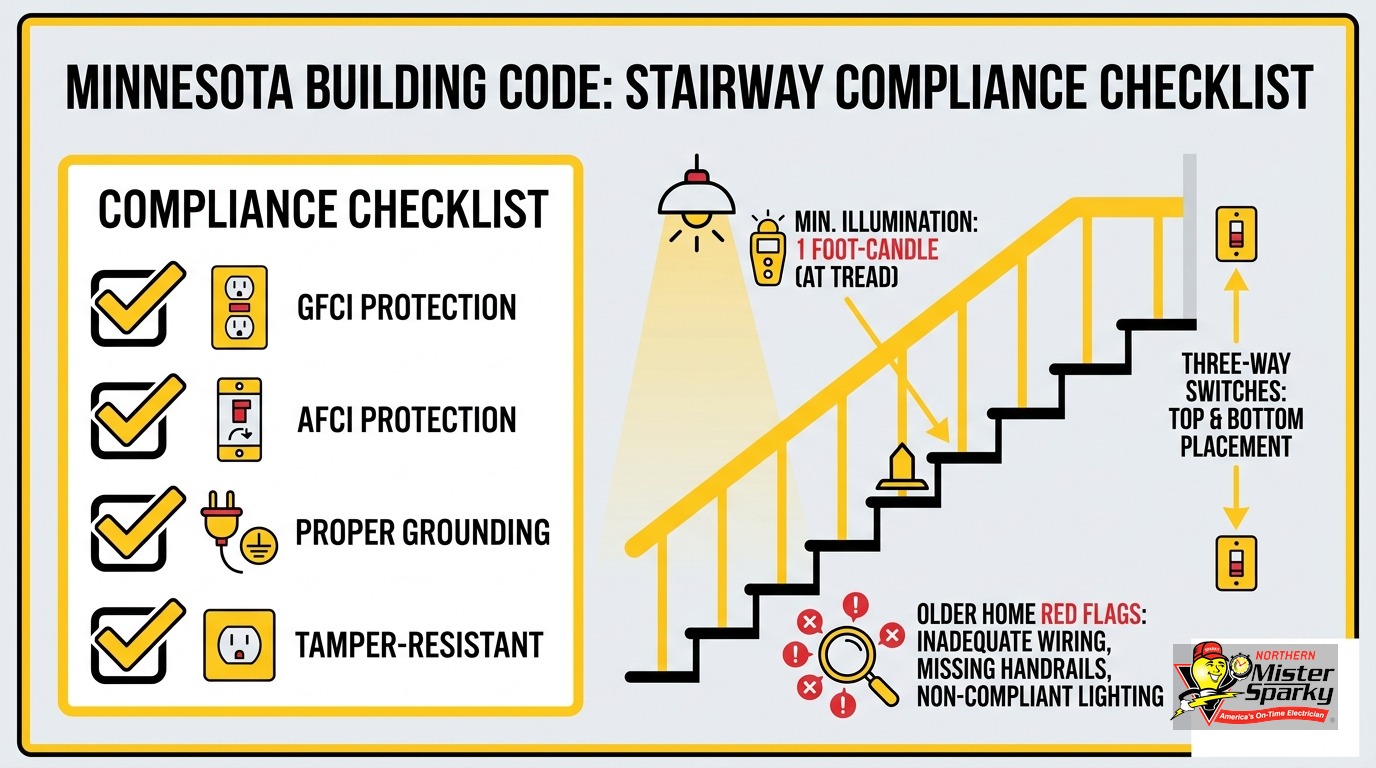
Key Takeaways
- Minnesota follows the 2018 IRC, not the 2021 edition. No minimum footcandle level applies to stairways under current Minnesota law.
- Interior stairs with six or more risers must have a wall-switch-controlled light at each floor level and each landing that provides access to a living area.
- A pull-chain fixture is not code-compliant. The control must be a wall switch.
- Minneapolis requires a TISH disclosure inspection before any home sale. Stairway lighting defects are classified as Category S (Safety) items.
- Homes built before 1965 routinely fail for missing top-landing switches, ungrounded circuits, or pull-chain fixtures in the basement.
- Northern Mister Sparky is locally owned and operated in the Twin Cities. We can assess your stairway lighting before a permit inspection, a TISH evaluation, or a sale.
Stairway lighting code requirements in Minnesota are specific, and many older Twin Cities homes do not meet them. The rules cover switch type, switch placement, and what “adequate” actually means under current state law.
The gap between what most online resources say and what Minnesota requires is real. Most articles cite the 2021 International Residential Code. Minnesota follows the 2018 edition. That difference affects what an inspector can legally require - and what you can push back on.
Here is what you need to know before a permit inspection, a sale, or a service call.
What Are the Stairway Lighting Code Requirements in Minnesota?
Quick answer: Minnesota’s stairway lighting rules come from 2018 IRC R303.7. Every interior stairway must have an artificial light source at each landing, including the top and bottom. On stairs with six or more risers, a wall switch is required at each floor level and landing. No minimum brightness level applies under Minnesota’s current code.
Every interior stairway needs a light. That light must be controlled by a wall switch - not a pull cord, not a plug-in lamp, not a remote app.
Where the switch goes matters. For any stair with six or more risers, you need one switch accessible from the top landing and another accessible from the bottom. Either switch should turn the light on or off independently.
That is the three-way switch arrangement. One switch at the top, one at the bottom, both controlling the same fixture. Without it, someone has to reach the far end of the stair before they can control the light. That is the safety problem the code is solving.
Most residential staircases clear the six-riser threshold easily. A standard run from a first floor to a second floor has 13 to 15 risers. A basement stair typically has 8 to 11. A short half-stair with five risers is the rare exception.
Which Stairway Lighting Code Does Minnesota Follow?
Quick answer: Minnesota follows the 2018 International Residential Code, adopted by reference in Minnesota Rule 1309, effective March 31, 2020. The 2021 IRC added an explicit 1 footcandle / 10.8 lux minimum for stair lighting. Minnesota has not adopted that cycle. Inspection findings that cite a footcandle floor may not reflect current Minnesota requirements.
This distinction matters most when you are selling.
An inspector trained in a 2021-cycle state might note that your stair light is too dim. They may cite a footcandle deficiency as a required repair. Minnesota’s code, through Minnesota Rule 1309.0303, requires a light source at each landing. It does not specify how bright that source must be. Knowing the actual code version lets you respond accurately to an inspection report.
That said, a dim stair light is a real safety problem with or without a footcandle floor. The code sets the legal minimum. It does not define common sense.
Minnesota’s code authority is the Department of Labor and Industry (DLI). DLI administers both the Minnesota Residential Code (Rule 1309, 2018 IRC) and the Minnesota Electrical Code (Rule 1315, 2023 NEC). Both apply to stairway lighting. Both agree on the same key threshold: six risers, switches at each level.
Does Switch Placement Matter? What the Code Requires for Three-Way Switches
Quick answer: Yes. Under 2018 IRC R303.7, any interior stair with six or more risers needs a wall-switch-controlled light at each floor level and each landing that provides access to a living area. A single switch at the bottom of the stair is a code violation. Both the IRC and the NEC require the dual-switch arrangement.
This is the most common deficiency our team finds in older Twin Cities homes.
A house built in 1958 might have one switch at the bottom of the basement stair. That satisfied the code at the time of installation. It does not today. When a permit is pulled for a remodel, that single switch becomes a required repair. A TISH evaluator will flag it on the same visit.
There is also a wiring question behind the switch question. A proper three-way circuit needs a three-conductor cable run between the two switch boxes, plus a feed from the panel. In older homes with two-wire wiring, a three-way retrofit may require new wire runs rather than a simple swap. Our three-way switch troubleshooting guide covers how these circuits work and what typically breaks them.
One more scenario worth knowing: stair lights controlled by motion sensors alone. The code requires a wall-switch-controlled outlet. A motion sensor with no manual wall switch may not satisfy R303.7. If you are installing a smart stair light, keep the wall switch in the circuit.
The Minnesota code also sets a minimum stairway headroom of 6’8” under Minnesota Rule 1309.0311. That is a structural issue, not an electrical one, but it surfaces in the same inspection report. Our scope is the electrical side.
What Does the National Electrical Code Add to the Picture?
Quick answer: The 2023 NEC, adopted as Minnesota’s electrical code under Minnesota Rule 1315, confirms the six-riser rule at NEC 210.70(A)(2)(a). Interior or exterior stairs with six or more risers must have a wall switch-controlled lighting outlet at each floor level and landing that includes an entryway. The NEC and the IRC are separate codes that reach the same conclusion.
The NEC is the electrical code side; the IRC is the building code side. An electrician pulling a permit works under both.
The NEC 210.70(A)(2)(a) language is worth knowing because it is precise about what “controlled” means. The outlet - the fixture or the receptacle feeding it - must be switch-controlled. The switch must be at each floor level and landing that provides access to an adjoining living area.
What this rules out is worth naming directly:
- A bare bulb on a pull-chain ceiling box: not compliant
- A plug-in lamp sitting on a stair landing: not compliant
- A smart-bulb app in lieu of a wall switch: not compliant
- A single switch at only one end of a six-riser-plus stair: not compliant
What this permits is straightforward: a properly wired three-way switch circuit feeding a wall- or ceiling-mounted fixture at each landing. The code is not asking for anything elaborate. It is asking for a switch you can reach before you start climbing.
What Do Home Inspectors Flag Most Often in Older Twin Cities Homes?
Quick answer: The six most common stairway lighting deficiencies in pre-1965 Twin Cities homes are: a single switch at the bottom only, a pull-chain fixture instead of a wall switch, no light source at the basement top or bottom landing, an ungrounded circuit feeding the fixture, an open or missing junction box cover, and knob-and-tube wiring on the stair circuit.
Let’s go through each one.
Single switch at the bottom only. The most common finding. The homeowner has always just flipped it on before going down. No one noticed there was no switch at the top until the inspector arrived. The repair is a three-way circuit between the two switch locations - usually a one-day job.
Pull-chain fixture. Common in Minneapolis basements built before 1960. The bare bulb on a pull cord fails both the IRC and the NEC. It also hangs in a space where people carry boxes and trip over things. Replacing it with a ceiling fixture wired to a wall switch is the standard fix.
No light at the top or bottom landing. Some older homes have a wall switch but the fixture is positioned mid-stair rather than at the landing itself. The code requires a light source at each landing, not just somewhere on the stair run. The fixture location matters.
Ungrounded circuit. Homes built before 1965 in Minneapolis, St. Paul, and the inner-ring suburbs frequently have two-wire wiring with no ground conductor. An ungrounded stair light is not a lighting code violation on its own, but it appears in inspection reports. If you are already opening walls to add a switch, running a properly grounded circuit is worth the incremental cost. Our guide on ungrounded outlets in older homes covers what options homeowners actually have.
Open junction box. A ceiling box with no cover plate is a NEC 314.25 violation. If a prior electrician spliced wires above the stair ceiling and left no cover, that is a Category S finding in most point-of-sale programs. A cover plate costs a few dollars. The repair takes minutes. Skipping it costs you at closing.
Knob-and-tube wiring. Knob-and-tube is not automatically a code violation in existing homes. But inspectors flag it as a safety concern, and many Minnesota insurers will not write a policy on a home with active K&T circuits. If your stair light runs on knob-and-tube, our knob-and-tube wiring replacement guide explains when replacement is required and when it is simply the right call to make.
For a full picture of what our team looks for before a sale, see what to expect from a pre-sale electrical inspection.
Minneapolis TISH Inspections: What Sellers Need to Know
Minneapolis requires a Truth in Sale of Housing (TISH) evaluation before any residential property is listed for sale. The requirement comes from Minneapolis Code of Ordinances Chapter 244. A certified TISH evaluator walks the property and produces a written report. That report must be made available to buyers before the sale.
Stairway lighting defects fall under the Safety category in TISH evaluations. A Category S item does not have to be repaired before closing - but it has to be disclosed. And a disclosed defect becomes a negotiating point for the buyer.
The math is simple. A two-hour repair from our team might run $250 to $400. That same deficiency in a TISH report can turn into a $1,000 closing credit or a price reduction. Sellers who address the issue before the evaluator shows up keep control of the cost.
Common stairway findings that TISH evaluators flag:
- Single switch with no return switch at the top or bottom landing
- Pull-chain fixture instead of a wall-switch-controlled outlet
- No light source at the landing itself
- Open or missing junction box covers at the stair ceiling
- Visibly damaged wiring near the fixture
We can walk through your stairways before you list. Addressing these items ahead of the evaluation keeps the report clean and the transaction on track.
Pre-Sale Inspections Beyond Minneapolis
Minneapolis is not the only Twin Cities municipality with a mandatory point-of-sale inspection program. Several suburbs and first-ring cities run their own disclosure requirements. St. Paul, Bloomington, and Richfield are among the cities with active programs. Requirements vary by city, but stairway lighting deficiencies surface on these reports the same way they do in Minneapolis.
If your property is outside Minneapolis, check with your city’s inspections department before listing. Ask whether a point-of-sale evaluation is required and which items are classified as safety deficiencies.
The code baseline is consistent statewide. The 2018 IRC and 2023 NEC apply across all of Minnesota. Local inspection programs add a disclosure layer on top of that baseline. They do not change what the code requires - they make deficiencies visible to buyers in writing.
No malarky: the right time to fix a stair lighting problem is before the inspection, not after.
How to Get Your Stairway Lighting Up to Code
The path to a compliant stair light follows the same steps in most homes.
We start with the existing circuit. If the stair light runs on a dedicated switch loop, we can usually add the second switch within the existing wiring. If the original wiring is two-wire or knob-and-tube, we assess whether a new circuit run is the right scope.
Next, we locate the switch positions. The top-of-stair switch should be accessible from the upper landing before you step onto the first tread. The bottom-of-stair switch should sit at the lower landing - not halfway up the wall, not three steps from the bottom.
Then we address the fixture if needed. A pull-chain comes out. A wall-switch-controlled fixture goes in. We can work from the existing ceiling box location or relocate it for better landing coverage.
Finally, we pull a permit when required. Any new circuit run or significant wiring work in Minnesota requires a permit from the local jurisdiction. The permit creates a record that the work was inspected and approved. That record matters when you sell.
One note on timing: if you are selling your home, call us before the TISH evaluator schedules. Pre-sale repairs done before the inspection keep you in control of the process and the cost. As America’s On-Time Electrician(R), we schedule quickly and show up when we say we will. The UWIN(R) 100% satisfaction guarantee backs every job.
Stairway lighting is one of the smaller electrical items in a home. But a missing switch, a pull-chain fixture, or an ungrounded circuit can derail a sale, trigger a re-inspection, or leave your family navigating stairs in the dark.
Northern Mister Sparky is locally owned and operated in the Twin Cities. We know the code, we know what inspectors look for in older Minneapolis and St. Paul homes, and we can fix what needs fixing. Call us at 763-200-5956 or book online to get on our schedule.
Frequently Asked Questions
Does Minnesota require a minimum brightness level for stair lighting? +
How many risers trigger the three-way switch requirement? +
What is a TISH inspection and does it cover stair lighting? +
Need an electrician now?