
Swim Spa Electrical Requirements for Twin Cities Homes
Key Takeaways
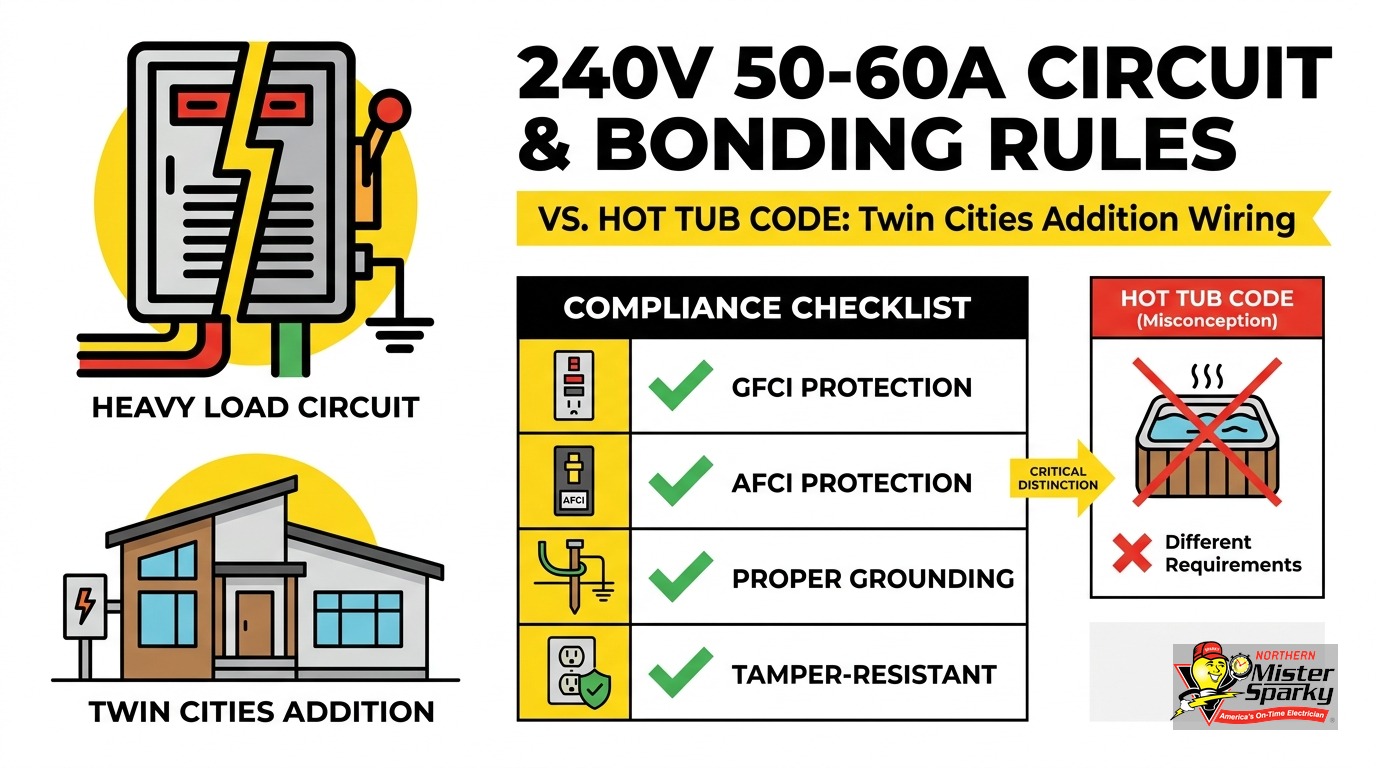
- A swim spa straddles two NEC Article 680 classifications: pool rules govern the swim channel, spa rules govern the therapy end.
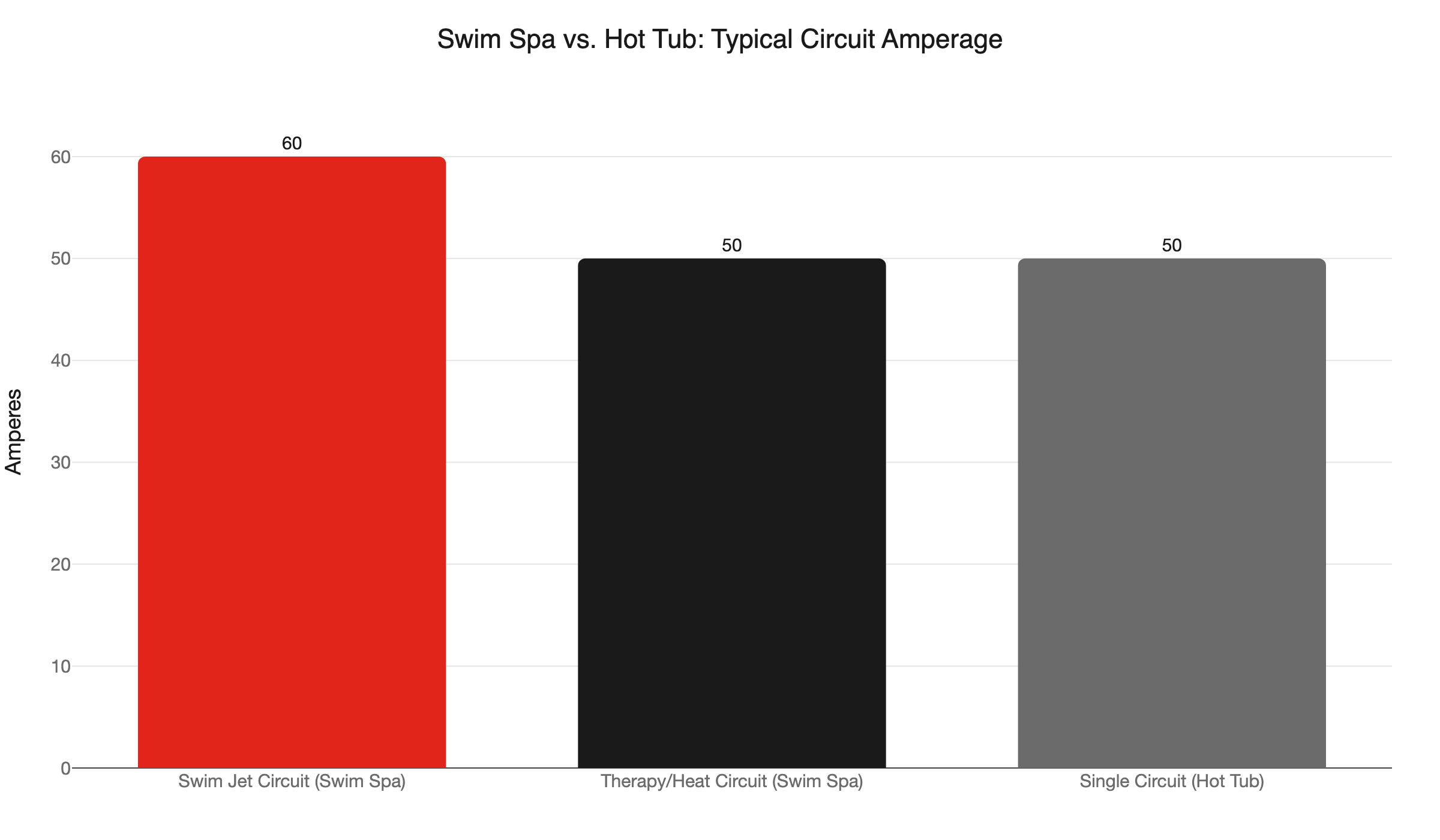
- Most swim spas require two separate 240V circuits, typically one 50-60A for the swim jets and one 30-50A for the heating and hydrotherapy side.
- A single 50A circuit - the standard hot tub setup - is not enough for most swim spa models.
- Equipotential bonding for the pool-side portion follows NEC 680.26, which is more extensive than hot tub bonding under NEC 680.43.
- Many Twin Cities homes have 100A service. A swim spa may require a service upgrade to 200A before installation.
- Minnesota DLI requires a licensed electrical contractor to pull the permit. An inspection must pass before you energize the unit.
- No Xcel Energy rebate exists specifically for swim spa electrical installation.
When a homeowner starts researching swim spa electrical requirements, they usually land on hot tub installation guides. That framing is wrong from the start.
A swim spa is classified under the National Electrical Code as a pool/spa combination, not as a larger hot tub. The swim channel end is governed by pool rules. The therapy end is governed by spa rules. That distinction changes the circuit count, the bonding scope, and the permit work. Almost every competitor page on this topic misses it entirely.
Here is the full picture.
What Makes Swim Spa Electrical Requirements Different from a Hot Tub?
A swim spa is classified as both a pool and a spa under the National Electrical Code. It carries pool-level bonding requirements on the swim-channel end, not just the lighter requirements that apply to a standalone hot tub. The scope is more extensive, requires more circuits, and calls for a deeper bonding installation than most homeowners expect.
The confusion is understandable. Both a swim spa and a hot tub are heated, pump-driven units you fill with water and sit in. They look similar in a showroom.
But the National Electrical Code classifies a swim spa under NEC 680.2 as a “pool/spa combination.” Minnesota has adopted NEC 2023 as the state electrical code. The swim-channel portion of the vessel - typically 8 to 14 feet of its 12-19-foot total length - functions as a permanently installed pool. That means Part II of Article 680 applies to that end. The therapy and seating section falls under Part IV.
Those two parts carry meaningfully different requirements. Pool bonding under Part II is more extensive than spa bonding under Part IV. Pool wiring methods are more restrictive. An electrician who treats the entire swim spa as a hot tub will under-spec the bonding work. An inspector will catch it. Corrections made after the deck is poured are far more expensive than getting it right the first time.
Our post on hot tub electrical wiring requirements explains the baseline for a standalone spa. A swim spa starts at that baseline and adds a second circuit and a full pool-side bonding scope on top of it.
Swim Spa Electrical Requirements: How Many Circuits Do You Need?
Most swim spas require two separate 240V circuits: one 50-60A for the swim jet pump system and one 30-50A for the heating and hydrotherapy side. Some dual-motor models specify a 60A circuit for the swim side and a 50A circuit for the therapy side. A single 50A circuit will not power most swim spa models.
This is the most common misunderstanding we see. Homeowners research hot tub wiring, read “50A 240V circuit,” and assume the swim spa will be wired the same way. It will not.
The swim jet pump is the high-draw component. A swim jet powerful enough to hold a swimmer in place draws significantly more current than a therapy jet pump. Running both systems simultaneously on a single 50A circuit trips the breaker almost immediately. Manufacturers including Arctic Spas and Master Spas specify two separate 240V circuits in their installation manuals.
Each circuit requires its own GFCI-protected disconnect. NEC 2023 Section 680.12 requires that disconnect to be placed within sight of the unit, between 5 and 50 feet from the water’s edge, and lockable. With two circuits, you need two compliant disconnects or a single listed dual-circuit enclosure. Your electrician will determine which layout works for your installation.
The underground conduit run also matters. NEC 680.21(A) requires rigid metal conduit, intermediate metal conduit, or rigid nonmetallic conduit for underground runs serving pool and spa equipment. Direct-burial cable is not permitted within the defined distances. This affects the trenching scope and materials cost and is rarely included in swim spa dealer estimates.
What Is Equipotential Bonding and Why Does It Matter for a Swim Spa?
Equipotential bonding connects all metal components near the water with a continuous #8 AWG solid copper conductor. It equalizes voltage so no current gradient can form across the water. A bonding failure can cause electric shock drowning. The swim-channel end of a swim spa follows the more extensive pool bonding rules of NEC 680.26, not the lighter hot tub standard.
Electric shock drowning is not a theoretical risk. It occurs when a wiring fault pushes current through the water. A swimmer loses muscle control before they can exit. The NEC bonding requirements exist specifically to eliminate that voltage gradient by connecting all metal to the same electrical potential.
For a standard hot tub, NEC 680.43 requires an #8 AWG solid copper conductor bonding all metal parts within 5 feet of the water. That is manageable on a compact, self-contained unit.
For a swim spa, the pool-channel end requires compliance with NEC 680.26. That section requires bonding of all metal within 5 feet of the water’s edge, all circulation and pump equipment, and - depending on the configuration and deck material - a perimeter bonding grid embedded in the surrounding concrete or decking. On a 15-foot swim spa with multiple pump motors and metal hardware running its full length, this is substantially more copper and substantially more labor than a hot tub job.
There is a critical timing implication here. If you are pouring a concrete deck around the swim spa, the perimeter bonding grid must be installed and inspected before the concrete goes down. Once the slab is poured, correcting a bonding problem requires demolition. Plan the inspection before the deck pour. This is not a step you can sequence backward.
Our post on electrical bonding and grounding covers the underlying principles in plain language if you want more background before your installation begins.
Does Your Twin Cities Home Have Enough Power for a Swim Spa?
Many Twin Cities homes built before the 1990s have 100-amp service. A swim spa drawing 80-100 amps across two circuits will exceed that service’s practical capacity. A service upgrade to 200 amps is often required before installation. That upgrade typically costs $2,000-$4,000 and is almost never mentioned by swim spa dealers.
This is the surprise cost that blindsides buyers after the unit ships. The swim spa arrives on a flatbed. The homeowner calls us. We assess the panel and find 100-amp service with no room to add two 240V double-pole breakers.
Before you sign a purchase agreement, have an electrician assess your electrical service. Two questions to ask upfront:
- Does the panel have open slots for two new 240V double-pole breakers?
- Is the service rated for 200 amps, or is it still at the 100-amp level common in pre-1990s construction?
If the answer to either question is no, build a service upgrade into your budget before the unit ships. That conversation is much easier before the swim spa is sitting on your driveway. Our post on 100-amp vs. 200-amp electrical service explains what that difference means in practical terms and what the upgrade involves.
The assessment itself is straightforward. A licensed electrician can walk through your current panel, identify available capacity, and tell you exactly what the swim spa installation will require. That conversation is worth having before you finalize any purchase.
What Are the Minnesota Permit Requirements for Swim Spa Electrical Installation?
A licensed electrical contractor must pull the permit through Minnesota DLI before any electrical work begins. A homeowner permit is technically available for your own principal residence, but the service work swim spa installations typically require disqualifies most DIY attempts. An inspection by the state electrical inspector must pass before the unit is energized.
Swim spa electrical installation is not a project to attempt without a license. Two 240V circuits, extensive bonding, GFCI protection, and a service capacity check require both the technical knowledge and the liability coverage that a licensed contractor carries.
The Minnesota DLI electrical permit process requires the contractor to pull the permit before work starts. After installation, the state electrical inspector - or a DLI-delegated municipal inspector - verifies:
- Bonding continuity across all metal parts and circulation equipment
- GFCI protection on both circuits
- Correct disconnect placement (within sight of the unit, 5-50 feet from the water, lockable)
- Proper conduit method for all underground runs
- Panel capacity and correct breaker sizing for both circuits
- Adequate service ampacity for the total added load
No one energizes the swim spa before that inspection passes. If a contractor suggests skipping the permit to save time or money, that is a serious red flag. An unpermitted installation creates liability when you sell the home. It may also void your homeowner’s insurance coverage for any incident connected to the unpermitted work.
Our post on electrical permits in Minnesota covers the full process, including how to verify a contractor’s license on the DLI website before you sign anything.
Does Xcel Energy Offer a Rebate for Swim Spa Electrical Work?
No. Xcel Energy’s Minnesota residential rebate program focuses on heat pumps, insulation, and smart thermostats. No rebate applies to swim spa electrical circuits or to the service upgrade that installation may require. Do not budget for a rebate that will not arrive.
Homeowners sometimes ask about this after hearing about Xcel rebates for heat pumps and EV chargers. Those programs are real and meaningful for those technologies. Swim spa electrical installation is not on the list.
If your swim spa installation triggers a service upgrade, it is worth asking your electrician whether the panel work qualifies for a federal tax credit under the Inflation Reduction Act. The IRA offers a 30% credit (up to $600) on qualifying panel upgrades for eligible households. That is a federal program, income-limited, and entirely separate from any Xcel rebate. Check IRS Form 5695 or ask your electrician to walk through the eligibility criteria.
Minnesota Winters and the Continuous Load Rule
A swim spa in the Twin Cities is a year-round appliance. In summer it is a fitness and recovery tool. In February, with temperatures below zero, the heater runs at sustained output to maintain water temperature.
That year-round heating load matters to the electrician sizing the circuits. NEC 210.19(A) requires that circuits serving continuous loads - any load running for more than three hours - be sized at 125% of the calculated load, not just the nameplate full-load amperage.
The practical math: if a swim spa heating circuit has a full-load amperage of 40A, the conductor and overcurrent device must be sized for 50A (40A x 1.25). If the swim jet circuit draws 48A at full load, the wiring and breaker must handle 60A. Minnesota’s climate zone (IECC Zone 6/7) means a swim spa heater qualifies as a continuous load for months at a stretch during winter.
Factory specs for swim spa heating wattage are typically validated at 50-60 degrees Fahrenheit ambient temperature. At -10 degrees Fahrenheit - a normal January low in the Twin Cities - the heater cycles nearly continuously. Real-world current draw during a Minnesota winter exceeds what a nameplate spec reflects. An electrician who sizes the circuits to nameplate amperage only, without applying the continuous-load factor, puts the installation in a situation where circuits run warm under sustained cold-weather load.
That causes two problems over time: tripped breakers during sustained heating cycles, and insulation degradation from chronic elevated temperature. Neither is visible until the damage is done.
Ask your electrician directly: “Did you apply the 125% continuous load rule to both circuits?” A competent electrician will answer immediately.
What to Expect During the Installation
A swim spa electrical installation is not an afternoon project. Here is a realistic sequence:
Before you order the unit: Have an electrician assess your electrical service. Confirm panel capacity, service amperage, and the route for two underground conduit runs to the installation location. Discovering you need a service upgrade after the unit ships is expensive and avoidable.
Permit: The contractor pulls the electrical permit through DLI before work begins. Budget a few business days for processing.
Rough-in work: Trenching for underground conduit runs, pulling wire for both circuits, installing GFCI-protected disconnects, and completing the bonding scope - including the perimeter grid if a concrete deck is planned. This is the step where inspection timing is critical.
Panel work: Adding two new double-pole breakers. If a service upgrade is required, that is a separate job and may require additional time to coordinate with your utility.
Inspection: The state electrical inspector reviews bonding continuity, circuit protection, conduit method, and disconnect placement before the unit is energized. If a concrete deck is planned, this inspection must happen before the slab is poured.
Energization: Once the inspection passes, the unit is powered on and tested.
Plan for two to four weeks from permit application to an energized unit under normal conditions. Add another two to four weeks if a service upgrade is needed, depending on utility scheduling in your municipality.
Ready to Schedule Your Swim Spa Electrical Work?
Northern Mister Sparky is locally owned and operated in the Twin Cities. We handle swim spa electrical requirements from the initial service assessment through the final inspection - two-circuit rough-ins, full bonding scope, permit coordination, and service upgrades when the panel needs to catch up to the load.
Call us at 763-200-5956 or book online to get started. We will assess your existing service before your unit ships so there are no surprises when the flatbed pulls up. That is what it means to be America’s On-Time Electrician(R) - and no malarky about it.
Frequently Asked Questions
Do swim spas need two electrical circuits? +
What is the difference between swim spa bonding and hot tub bonding? +
Do I need a permit for swim spa electrical work in Minnesota? +
Does my Twin Cities home need a service upgrade for a swim spa? +
Need an electrician now?