
Track Lighting Installation Wiring: Know Before You Buy
Key Takeaways
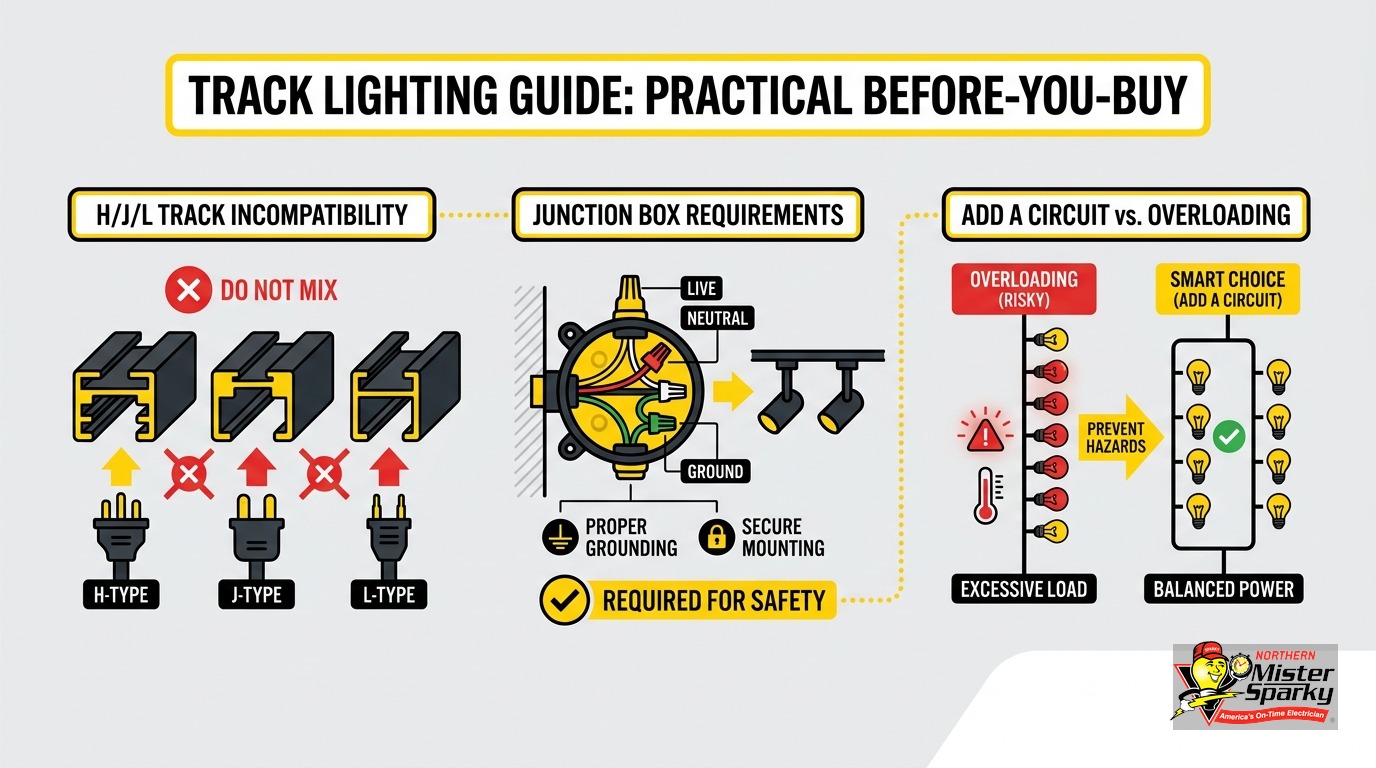
- H, J, and L track are physically incompatible. Buy heads before identifying your track type and you will likely make a return trip.
- Your junction box must be anchored to a joist or rated brace and rated for the combined weight of the track and all heads.
- A 15A breaker limits continuous load to 1,440 watts across the entire circuit, not just the track.
- LED heads cut wattage dramatically and may qualify for an Xcel Energy rebate.
- A head swap on an existing track typically does not require a permit. Running a new circuit does.
- Minneapolis and St. Paul homeowners file permits with their city, not the state DLI.
- Minnesota adopted the 2026 NEC on August 17, 2026. New circuits must comply.
Why Track Lighting Installation Wiring Catches Homeowners Off Guard
Most how-to articles on track lighting start at the wall. Cut power, connect black-to-black, mount the track, insert heads, restore power. That part is straightforward. It works when everything is already confirmed: right track, right box, right circuit.
The homeowner who finds a local electrician’s article is often at a different stage. They are standing in the lighting aisle at Home Depot, second-guessing the heads in the cart. Or they bought the wrong heads and are frustrated. Or they ran the track, switched on all six fixtures, and watched the breaker trip.
Track lighting installation wiring has three gates to clear before the work starts. Miss any one and you end up with a loose fixture, a ceiling box that pulls free, or a circuit that cannot handle the load. This guide walks through all three.
Gate 1: What Type of Track Do You Have?
Does Track Type Really Matter?
Yes. H, J, and L track systems use different copper contact geometry. A head designed for one system will not lock into another and can arc if forced. Per the NEC, track fittings must be designed specifically for the track they are installed in. Buy heads before confirming your track type and you will be making a return trip to the store.
Track lighting looks similar across brands. The channel profile and finish often appear identical on the shelf. The electrical contacts inside the channel are the difference.
H-type track is made by Halo (now part of Eaton) and compatible brands. J-type track is associated with Juno Lighting. L-type track was popularized by Lightolier. Most lighting retailers label their replacement heads by type. The contact positions and slot geometry differ across all three systems. A J-type head in an H-track sits in the wrong orientation. The conductors do not align. That creates arcing, which is a fire risk.
This is not a loose-fit problem you can muscle through. A mismatched head on a live track is a hazard.
How to identify your track before you buy:
- Look inside the track channel for a brand stamp or logo. Halo, Juno, Lightolier, and WAC each label their track.
- Pull an existing head out and check the type designation printed on the body or its original packaging.
- Bring a head to the store and test-fit a replacement before purchasing.
- If the track has no labels and no existing heads, pull it down and look for a model number on the housing. Search that number to confirm the system type.
Five minutes of identification before you drive to the store saves a frustrated return trip.
Gate 2: Is Your Junction Box Up to the Job?
Can a Standard Ceiling Box Handle Track Lighting?
Maybe, but not always. Under NEC 314.27, a standard ceiling box is rated for 50 lbs. An 8-foot track with six heads can approach or exceed that limit. A pancake box screwed into drywall with no joist behind it fails immediately. Before mounting anything, confirm the box is anchored to a joist or rated brace and rated for the combined load.
Track lighting is heavier than a single pendant or ceiling globe. The track itself has weight. Six heads add more. Most homeowners do not check the box rating before hanging something. The first sign of a problem is a track that rocks slightly. Or a ceiling ring that shows cracks around the drywall after a few months.
There are three things to verify before you mount the track.
1. Is the box anchored to a joist or a rated retrofit brace?
Look up into the box from below. Solid wood behind the metal means you are attached to a joist. A thin plastic brace from a 1980s renovation may or may not carry a load rating. Check it.
A pancake box, which is the low-profile box often found above single fixtures in finished ceilings, is sometimes mounted with drywall fasteners only. Those fasteners were not designed to hold a track under sustained load and vibration. If you have a pancake box sitting in drywall with no joist contact, replace it before you hang anything.
2. Does the box have enough cubic-inch volume for the conductors?
Every wire, pigtail, connector, and wire nut takes up volume inside the box. The NEC requires adequate fill. If you are adding a dimmer circuit or secondary switching leg, you may be adding conductors to a box sized for a single fixture. An electrician can verify fill calculations in a few minutes and tell you whether you need a deeper box.
3. What did the previous fixture weigh?
If the box previously held a small globe light, a flush mount, or a smoke detector, it was probably not sized for anything heavier. That prior fixture tells you something about what the installer expected the box to hold.
Signs a box needs replacement before track goes up:
- Thin pancake profile with no visible joist contact
- Drywall crumbling or discolored around the mounting ring
- Previous fixture was under 5 lbs
- Plastic brace with no printed weight rating
If the box is questionable, replace it. A track that pulls free of the ceiling is a fall hazard and a fire risk. This is not a step to skip.
Gate 3: Does Your Circuit Have Room for the Load?
How Do You Calculate Track Lighting Load?
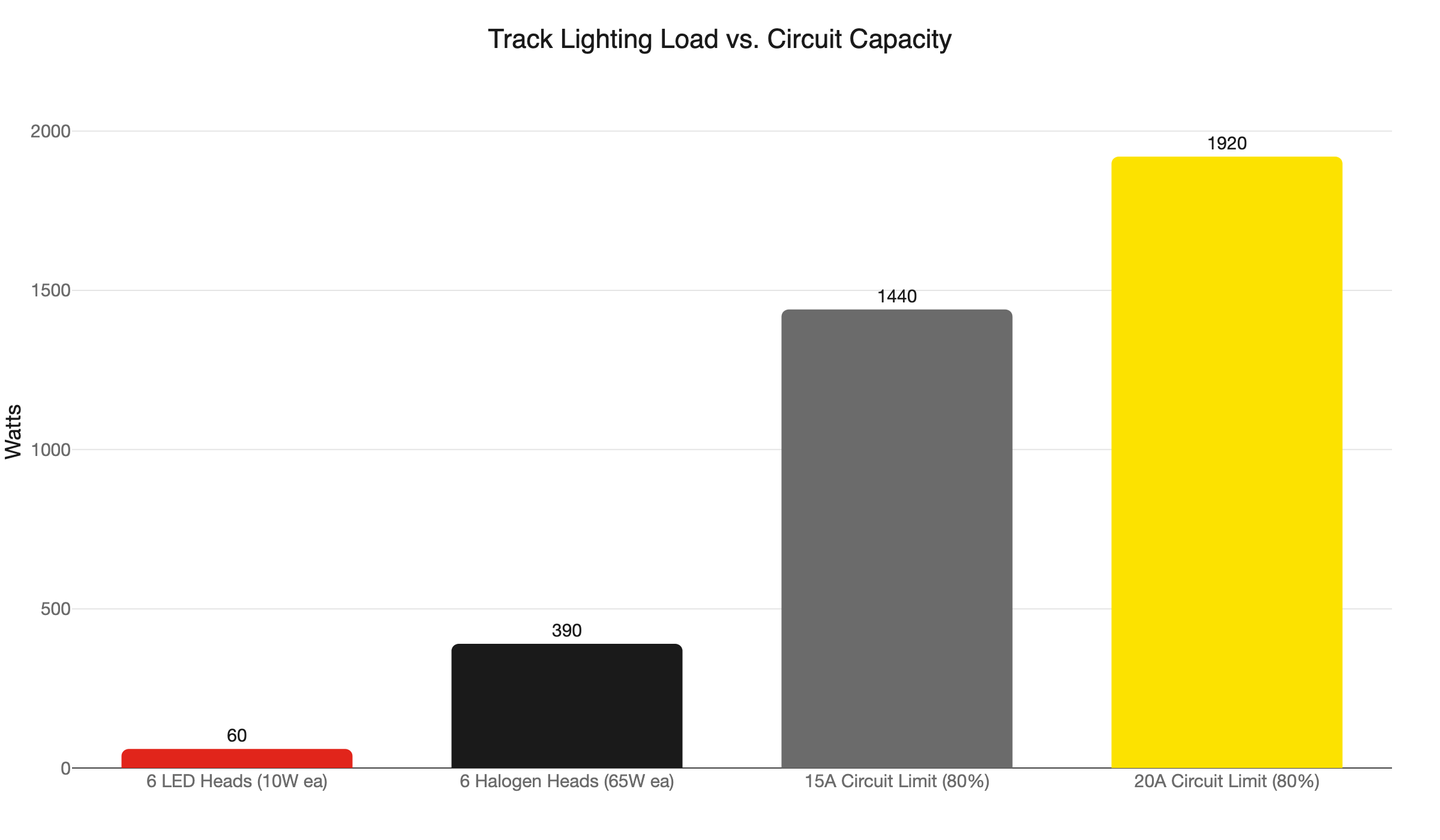
Add up the wattage of every head you plan to install. The total must stay under 80% of the circuit breaker’s rating to comply with the continuous-load rule. A 15A breaker allows 1,440 watts maximum across the full circuit. A 20A breaker allows 1,920 watts. Both limits apply to everything on the circuit, not just the track.
Per the NEC, the connected load on a track cannot exceed the track’s rating, and the branch circuit rating cannot exceed the track rating. Track and heads are treated as a system. A 20A track fed by a 15A breaker is a code violation. So is the reverse.
Continuous loads must stay at or below 80% of the breaker rating. That rule accounts for heat buildup in the wiring and breaker under sustained load. A circuit running at 90% for hours is more likely to trip and causes long-term wiring fatigue.
Here is what the math looks like on a real installation:
LED example: Six heads at 10 watts each equals 60 watts of track load. On a 15A circuit with a 1,440-watt budget, you have significant headroom. Even with other fixtures sharing the circuit, you are unlikely to get close to the limit.
Halogen example: Six heads at 65 watts each equals 390 watts of track load. Add a 150-watt ceiling fan, two 75-watt vanity strips, and a 60-watt table lamp on the same circuit and you are at 750 watts. You are using more than half the circuit’s budget. Adding anything else, a space heater, a lamp, a second track section, pushes the math further.
The overloaded circuit scenario: Older Twin Cities homes often run all the lighting for a floor on a single 15A circuit. If your kitchen, dining room, and hallway share one breaker, the circuit may already be at 60 to 70 percent capacity. Adding a six-head halogen track to that load pushes you closer to the edge. The breaker trips. You reset it and it trips again. Our post on why your circuit breaker keeps tripping walks through the most common causes and when a tripped breaker is telling you the circuit is overloaded rather than faulty.
Does Adding a New Circuit Require a Permit in Minnesota?
Yes. Adding a new circuit, adding an outlet, or doing any wiring beyond a like-for-like fixture swap requires a permit under Minnesota statute. Swapping heads on an existing track typically does not require a permit. Running new wire from the panel to support the track does.
Minnesota adopted the 2026 NEC with an effective date of August 17, 2026. Any permit filed on or after that date must comply with 2026 NEC requirements. For new lighting circuits in living areas, that includes AFCI protection. If your panel does not have room for an additional AFCI breaker, that conversation becomes about panel capacity first.
See our Minnesota electrical permit guide for what specifically triggers a permit, how to file, and what the inspection covers.
What About Minneapolis and St. Paul Homeowners?
This is where many Twin Cities homeowners run into trouble. Minneapolis, St. Paul, and many first-ring suburbs each operate as their own AHJ (authority having jurisdiction). This includes Minnetonka, Eden Prairie, and Eagan. For permitted electrical work in those cities, you file with the city building department, not the state Department of Labor and Industry (DLI).
St. Paul has its own electrical permits and inspections office, separate from the state. Filing your permit with the wrong authority means your inspection does not happen. That leaves unpermitted work on record. It can create problems at resale and when homeowner’s insurance gets involved.
Homeowners can pull their own permit on an owner-occupied single-family home under Minnesota law. The catch: you must personally perform all the work. No unlicensed helpers. Not a friend, not a family member, not someone working for trade on another project. If any unlicensed person performs any part of the permitted work, the permit is void and inspection coverage is gone.
Our Minnesota electrical permit guide covers city-by-city filing details and what to expect from the inspection process.
LED Heads and the Xcel Energy Rebate
If you are choosing between halogen or incandescent track heads and LED, the load numbers above already make the case for LED. Six halogen heads at 65 watts each draw 390 watts. Six LED equivalents at 10 watts each draw 60 watts. That is an 85 percent reduction in operating cost for roughly the same light output.
Xcel Energy residential LED rebates are available for qualifying ENERGY STAR or DLC-listed LED track heads through the home rebates portal. If you are buying new heads anyway, checking whether your model qualifies can put money back in your pocket before the job is done.
LED heads also run cooler at the ceiling plane. A six-head halogen track generates real heat above the junction box. That heat degrades insulation and connection quality over time. LED cuts that heat sharply.
One practical note on dimming: not all dimmers are compatible with all LED drivers. A mismatched dimmer produces flicker, hum, or heads that drop out below a certain level. Our guide on LED dimmer switch compatibility walks through how to match dimmers to drivers and avoid the most common frustrations with LED dimming systems.
When Should You Call an Electrician for Track Lighting?
Most track lighting projects fall into one of two categories:
Head swap on an existing track. The track stays. The junction box stays. The circuit stays. You are changing heads for a different style or output. If you have confirmed the track type matches, this is typically a DIY project in most cases. No permit required.
New track installation. You are hanging a track where none existed before, adding or replacing a junction box, and possibly running a new circuit. Each of the three gates above requires a judgment call that is easy to miss on a ladder at night.
Call us when:
- The junction box is questionable and you cannot confirm it is joist-anchored
- The circuit capacity math is tight or the circuit is already tripping
- You want to add a new circuit to power the track
- The track requires dimming and you have aluminum wiring or knob-and-tube anywhere in the circuit path
- You are in a finished ceiling and running wire means fishing through walls
- You cannot confirm the track type and do not want to risk arcing
Northern Mister Sparky is locally owned and operated in the Twin Cities. We are America’s On-Time Electrician(R), and we back every job with the UWIN(R) 100% satisfaction guarantee. No malarky, no invoice surprises.
Call 763-200-5956 or book online to schedule. If the project involves a new circuit or panel work, ask about financing options when you call.
Track Lighting in Wet and Damp Locations
One location question that comes up often: can track lighting go on a covered porch or in a bathroom?
The NEC permanently prohibits track lighting in nine locations, including wet and damp locations and anywhere subject to physical damage. A covered porch in Minnesota that sees rain blowing through on a summer afternoon qualifies as a damp location. A screened porch that collects humidity, freeze-thaw cycles, and seasonal condensation is not a candidate for standard track lighting.
Bathrooms are similar. Track above the shower or in the wet zone is a code violation. Track in the vanity zone, away from the tub and shower spray, may be permissible depending on the exact location and local AHJ interpretation.
If you want track-style fixtures in a wet-adjacent space, the right answer is a rated wet-location or damp-location fixture on a GFCI-protected circuit. Our guide to outdoor and landscape lighting installation covers what code requires for fixtures in exposed environments.
Key Takeaways
- H, J, and L track are not interchangeable. Identify your track type before buying heads. A mismatched head can arc.
- The junction box must be joist-anchored and rated for the combined weight of the track and all heads. A pancake box in drywall is not sufficient.
- A 15A breaker allows 1,440 watts of continuous load across the entire circuit. LED heads keep that total low. Halogen heads add up fast when other loads share the circuit.
- LED heads may qualify for an Xcel Energy rebate and run cooler and cheaper than halogen or incandescent.
- A head swap does not need a permit. Adding a new circuit does.
- Minneapolis and St. Paul homeowners file permits with their city building department, not the state DLI. Filing with the wrong office means no inspection.
- Minnesota is on the 2026 NEC as of August 17, 2026. New circuits in living areas require AFCI protection.
If any of these three gates raises a flag during your planning, that is the right time to bring in a licensed electrician. Call 763-200-5956 or book online to get it done right the first time.
Frequently Asked Questions
Do I need a permit to install track lighting in Minnesota? +
Can I mix H, J, and L track heads? +
How many watts can I run on a track lighting circuit? +
Need an electrician now?