
Add Wall Switch to Pull Chain Ceiling Light in Minnesota
Key Takeaways
- Adding a wall switch to a pull chain ceiling light requires a Minnesota electrical permit. Running new wiring is not a like-for-like repair.
- Minnesota adopted the 2026 NEC on August 17, 2026. Any permit filed now falls under that code.
- Minneapolis and St. Paul do not use the state DLI permit system. Both cities run their own inspection departments.
- Knob-and-tube wiring found at the ceiling box is a hard stop. It cannot be extended or modified under current code.
- Running 14/3 NM instead of 14/2 provides a neutral conductor at the switch box. That neutral is required for smart switches, dimmers, and occupancy sensors.
- NEC 200.7(C)(1) requires the white conductor in a switch loop to be permanently re-identified with black tape at both ends. Inspectors check for this.
- A switch loop run with 14/2 NM will not support a smart switch upgrade without opening the wall again later.
Why You Want to Add a Wall Switch to a Pull Chain Ceiling Light
That dangling cord in a basement or garage is original to the fixture. In homes built before 1950, utility spaces often had no wall switch at all. The pull chain was the only control.
It works fine until you are carrying an armload of laundry, hauling a cooler, or navigating a dark storage room in winter. Then it becomes a real problem.
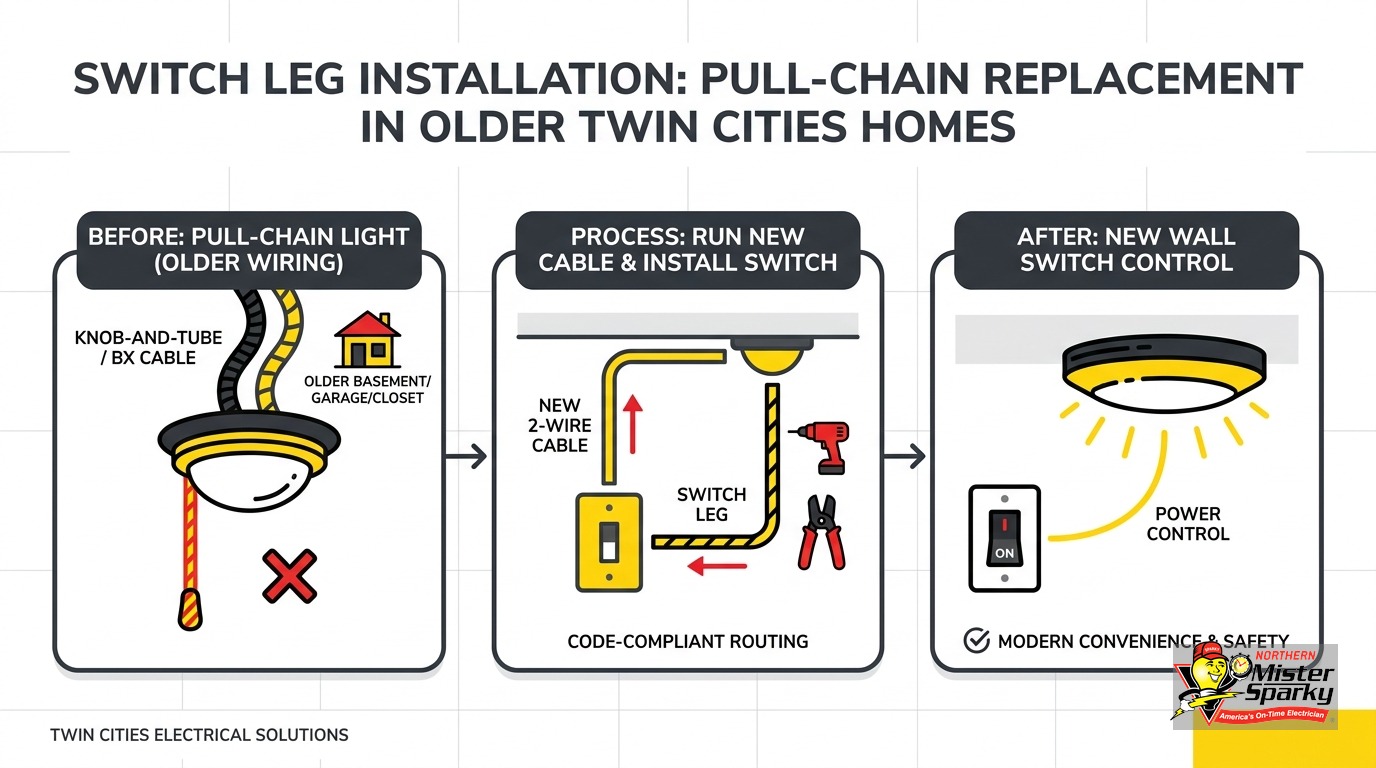
Adding a wall switch to a pull chain ceiling light is a practical fix. The electrician runs a switch leg from the existing ceiling box down to a new switch location on the wall, wires the switch into the hot conductor, and you get a proper wall control. The fixture stays in place. The pull chain either stays as a secondary control or gets bypassed with a short jumper wire inside the fixture.
In a newer home with modern NM cable, the job is clean and reasonably fast. In an older Twin Cities home, built before 1950, the job can surface knob-and-tube wiring, cloth insulation, or conductors with no ground at all. The outcome is different in those homes. This article covers what actually happens on the job in both scenarios, from pulling the permit to closing the final inspection.
Do You Need a Permit to Add a Wall Switch in Minnesota?
Yes. Running a switch leg is new wiring, not a repair to existing wiring. Minnesota requires a permit for any new wiring work, and a switch leg qualifies.
Under Minnesota Statute 326B.31, Subd. 23, homeowners on owner-occupied single-family homes can pull their own permit through the DLI online portal at ims.dli.mn.gov. When you hire a licensed electrician, the electrician pulls the permit for you.
Minnesota electrical code distinguishes between repairs and new work. Swapping out a light fixture in the same ceiling box is a like-for-like replacement and does not require a permit. Running new cable to a new switch location is new work. That distinction is where homeowners get tripped up.
The permit triggers two inspections. A rough-in inspection happens after the wire is run and before the walls are closed. A final inspection confirms the completed installation meets code. The DLI’s 2023 NEC residential inspection checklist is publicly available and shows exactly what an inspector reviews at each stage.
One more thing: Minnesota adopted the 2026 NEC effective August 17, 2026. Electrical licensing exams transitioned to 2026 NEC on September 8, 2026. Any permit filed now falls under 2026 NEC requirements. Any licensed electrician you hire is trained to that current standard.
Skipping the permit is not a shortcut. Unpermitted electrical work surfaces during home sales and insurance claims. It can require opening finished walls to prove the wiring is correct, or force a complete redo. The permit protects you. Our electrical permit guide for Minnesota homeowners walks through the full process and what to expect.
What Actually Happens When an Electrician Opens the Ceiling Box?
The ceiling box is step one. The electrician shuts off the circuit at the panel, opens the box, and reads what they find. In a pre-1950 Twin Cities home, what they find can change the entire scope of the job.
In a modern home, the ceiling box holds NM cable with a black hot conductor, a white neutral, and a bare ground. The electrician identifies the hot, plans the switch leg route down the wall to the new switch location, runs the cable, mounts the switch box, and makes the connections. Clean job, clear scope.
In an older home, the wiring looks different. Conductors may run as separate cloth-wrapped wires strung through ceramic knobs and porcelain tubes, with no ground at all. That is knob-and-tube wiring. The identification step happens before anything else. What is in that ceiling box determines whether this is a switch leg job or something larger.
Knob-and-Tube Wiring: A Hard Stop in Older Twin Cities Homes
Knob-and-tube wiring is common in Minneapolis, St. Paul, and the inner-ring suburbs built before 1950. It was the standard of its era. Left undisturbed and dry, it can stay in service. But it cannot be extended or modified under current code.
NEC Article 394.12 bars active knob-and-tube from being surrounded by insulation, and most insurance companies require its replacement for coverage. Many Twin Cities homeowners find this out when they add attic insulation and their insurer sends a letter.
Knob-and-tube switch loops also behave differently from modern wiring. The hot and neutral run as separate conductors taking different paths through the structure. There is no ground wire. The switch leg logic is the opposite of what a modern electrician expects from NM cable. Opening a ceiling box and finding knob-and-tube is a hard stop for a simple switch leg addition.
The fix is not to extend the K&T. The fix is to run a new circuit from the panel to a new-work ceiling box, then add the switch leg from there. That is a larger job, with a different permit scope and a higher cost.
A good electrician tells you this during the initial assessment, before any wire is pulled. You get an honest scope, a real number, and the choice is yours. If your home is pre-1950 and you are unsure whether the pull-chain light is on K&T, our knob-and-tube wiring replacement guide covers the assessment process, what replacement involves, and what to expect on cost.
Why Is 14/3 Wire Worth the Extra Cost?
Running 14/3 NM instead of 14/2 adds a third conductor to the switch leg. That third conductor becomes the neutral at the switch box. It costs a little more in materials. It is required for smart switches under current code.
NEC 404.2(C) requires a neutral conductor at switch locations controlling lighting loads in habitable rooms, hallways, bathrooms, and stairways. The reason is functional: smart switches, occupancy sensors, and dimmers need line-to-neutral voltage in standby to power their electronics. A neutral wire is how they get it.
A basic switch loop using 14/2 NM carries only a black conductor and a white conductor. The white wire gets re-identified as a second hot (the switch feed), and no neutral reaches the switch box. A standard mechanical toggle switch works perfectly. The moment you try to install a smart switch, an occupancy sensor, or most dimmers, you hit the wall.
Running 14/3 during the original job costs a few extra dollars in cable. It puts the neutral wire in the box now. When you want to upgrade to a smart switch later, the wire is already there. No wall opened. No new permit.
NEC 404.2(C) does include a narrow exception. If a switch location was wired before local adoption of 404.2(C), and the neutral cannot be extended without removing finished materials, a replacement electronic switch without a neutral is permitted at that location. No more than five such switches are allowed per branch circuit. That exception applies to retrofitting an existing, already-wired location. It does not apply to new wiring. New work means new standards.
What Is the White-Wire Re-Identification Rule?
NEC 200.7(C)(1) requires the white conductor in a switch loop to be permanently re-identified with black tape at both ends. The tape must fully encircle the insulation. Inspectors check for it. Missing tape means a failed inspection.
In a 14/2 switch loop, the white wire carries the hot supply feed from the ceiling box down to the switch. It is not a neutral. Without re-identification, a future electrician or homeowner sees a white wire and assumes neutral. Touching it live can cause a shock.
Black tape on each end takes about 30 seconds and a scrap of electrical tape. It is one of the most consistently skipped steps in online DIY guides. It is also one of the first things an inspector looks for at both the ceiling box and the switch box.
Re-identification must happen at both locations: where the cable originates at the ceiling box, and where it terminates at the switch box. Black tape at both ends, fully wrapping the white insulation. No partial wraps, no markers that rub off.
This step applies to the 14/2 scenario only. When you run 14/3, the white conductor carries neutral as designed. It does not need re-identification. The installation matches the function, and there is no ambiguity for anyone who opens the box later.
Will a Standard Switch Loop Support a Smart Switch?
Not if it was run with 14/2 NM. Most smart switches require a neutral wire. A 14/2 switch loop does not provide one. If a smart switch is in your plans, the electrician should run 14/3 now.
This is the caveat that every DIY tutorial leaves out. A homeowner reads a weekend-project guide, installs a wall switch with 14/2 NM, and the light works. A year later, they buy a smart switch. They open the box and find two conductors: a black hot and a re-identified white hot. No neutral.
The no-neutral options are limited. A no-neutral compatible smart switch will work with some fixtures but not all. Some models create a small bleed current through the load that causes LED bulbs to flicker or buzz. Compatibility lists are long and the devices are more expensive than standard neutral-required models.
The cleaner path is always to run 14/3 at the original job. If you already have a switch location wired with 14/2 and want to upgrade, our guide to smart switches without a neutral wire covers what the no-neutral product options actually do, when they work, and where they fall short.
Minneapolis and St. Paul: The Permit Path Is Different
Most Minnesota homeowners and electricians file residential electrical permits through the DLI portal. DLI is the Department of Labor and Industry, and it handles permitting and inspections for the majority of the state under MN Rules Part 1315.0200, which governs electrical code adoption by reference.
Minneapolis and St. Paul are exceptions. Both cities operate their own inspection departments and do not route through DLI. St. Paul uses the PAULIE online permitting system. Minneapolis maintains its own permit portal. Filing with DLI for work at an address in either city means applying at the wrong place.
This creates a practical problem if your electrician assumes DLI handles everything. It also affects scheduling. City inspection departments run their own calendars and turnaround windows. An electrician who files in the wrong system delays the rough-in inspection, which delays closing the wall, which delays the job.
Our team routes permits to the correct jurisdiction from the first filing. If your address is in Minneapolis, St. Paul, or another city with its own inspection authority, we know where the application goes. No re-filings, no scheduling gaps.
What Should You Expect on the Day of the Job?
The job follows a predictable sequence: circuit off, ceiling box opened, wiring identified, switch location marked, wire routed, boxes mounted, connections made, and rough-in inspection scheduled. Final inspection closes the permit.
For a home with modern NM cable in an unfinished basement or garage, the rough-in work is typically a half-day. Exposed framing and open ceiling joist bays make the wire run fast. Finished spaces where the wall needs to be opened and patched take longer.
Prepare by clearing the work area around the ceiling fixture and the planned switch location on the wall. If the panel is in a utility room, make sure the electrician can reach it without moving equipment. That is about all the prep you need to do.
For a pre-1950 home where knob-and-tube is a possibility, the scope can change at the ceiling box. The honest conversation about that happens before any wire is pulled. You will know the scope and cost before work begins.
One thing you should not expect: a firm price quoted over the phone without an on-site look at the existing wiring. Older homes hide surprises. A quote without an assessment is a guess. We do not operate that way.
After the final inspection, the permit closes and the work goes on record. That documentation matters at sale time. A permitted, inspected job means no questions about whether the wiring is safe or up to code. It protects the value of the home.
If other work makes sense in the same area during the visit, such as adding an outlet in the basement or upgrading closet lighting, your electrician can often combine related scope under a single trip. Our indoor lighting service covers ceiling light upgrades, and additional outlet installation in the same space can sometimes be permitted together.
Ready to Stop Reaching for That Chain?
Whether it is a basement storage room, a detached garage, or a closet where three attempts in the dark are routine, adding a wall switch to a pull chain ceiling light is a straightforward improvement. When the wiring cooperates, the job is clean. When the wiring is K&T or the scope is larger than expected, you want someone who reads the situation and tells you the truth before pulling a single wire.
We are Northern Mister Sparky, locally owned and operated right here in the Twin Cities. No malarky. Our team pulls permits, handles the inspections, and runs every job to current 2026 NEC code. As America’s On-Time Electrician(R), we show up when we say we will. The UWIN(R) 100% satisfaction guarantee backs every job we do.
Call us at 763-200-5956 or book online. If the assessment turns up K&T, a panel issue, or other qualifying work, financing options are available for larger jobs.
Frequently Asked Questions
Do I need a permit to add a wall switch to a pull chain ceiling light in Minnesota? +
What if my electrician finds knob-and-tube wiring in the ceiling box? +
Why does a new switch leg need 14/3 wire instead of 14/2? +
What is the white-wire tape rule for a switch loop? +
Need an electrician now?