
Smart Switch Without Neutral Wire: Twin Cities Guide
Key Takeaways
- Most Twin Cities homes built before the mid-2010s use a switch loop. No neutral wire runs to the switch box. This is normal and not a code violation.
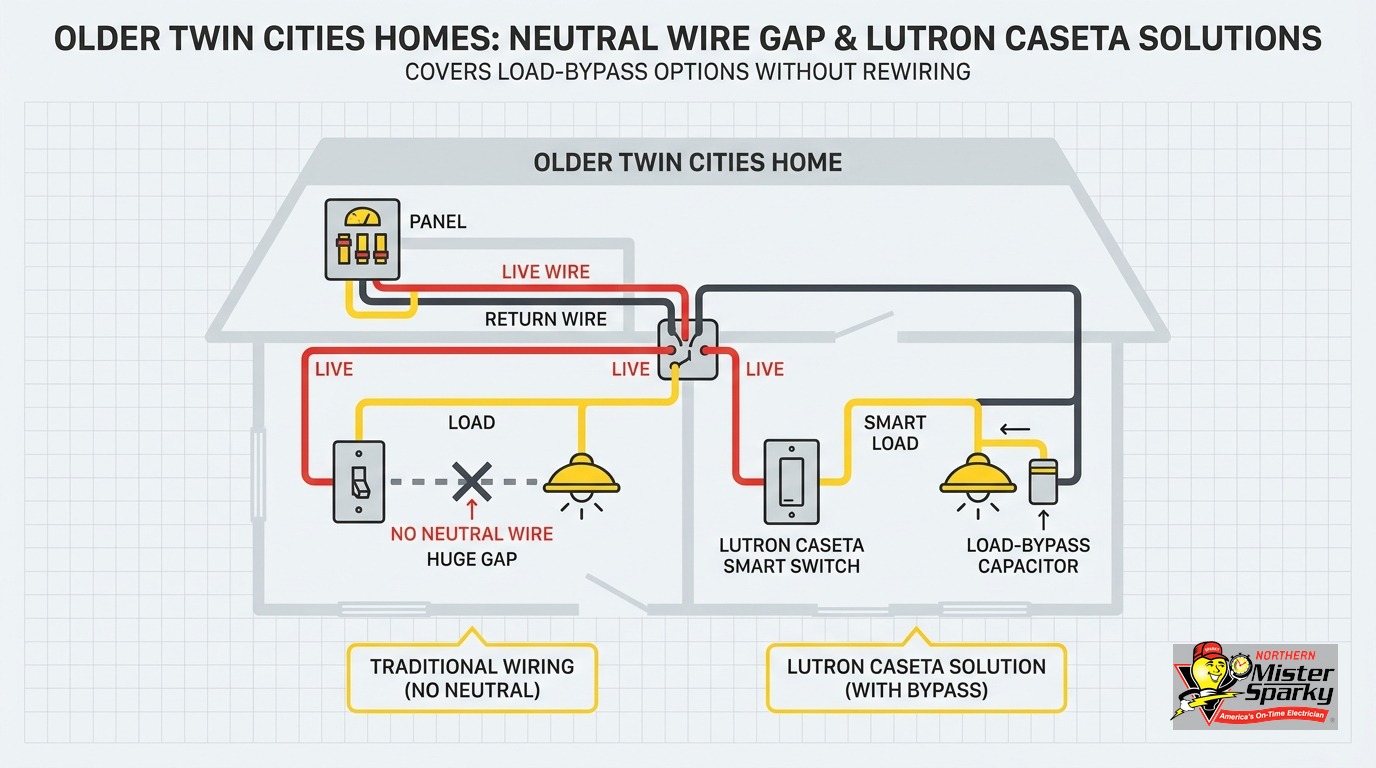
- No-neutral smart switches use power-stealing technology. They bleed a small current through the load wire to stay powered when the load is off.
- NEC 404.2(C) includes a retrofit exception: existing switch locations do not require rewiring if pulling a neutral would mean removing finished walls.
- The white wire in a switch loop is a re-identified hot. It is not a neutral. Confirm this before you order hardware.
- No-neutral dimmers require a minimum 25W equivalent load. Below that floor, LEDs will flicker or ghost.
- The Lutron LUT-MLC shunt capacitor fixes low-load LED flicker. It installs at the fixture, not in the switch box.
- Xcel Energy offers no rebate for smart light switches in Minnesota. The $50 smart thermostat rebate is a separate program.
- All installed switches must carry a UL or ETL listing under Minnesota rules.
Why Don’t Older Twin Cities Homes Have a Neutral at the Switch?
Quick answer: The code requiring a neutral at switch locations is relatively new. NEC 404.2(C) was added in the 2011 code cycle. Homes wired before local adoption of that cycle had no obligation to run a neutral to the switch box. Switch-loop wiring was the standard, not a shortcut.
Minneapolis and St. Paul carry some of the oldest housing stock in the Midwest. A large share of the homes we service are bungalows, ramblers, and two-stories built between the 1920s and 1960s. Almost all of them were wired with a switch loop.
The switch loop works like this. Power runs from the panel to the light fixture first. Two wires then drop from the fixture down to the switch. One wire carries the hot. The other returns to complete the circuit when the switch closes. The white wire in that pair gets re-identified - marked with black tape or a black marker at both ends - to show it is functioning as a hot, not a neutral. The switch interrupts the hot. The light turns on and off.
This wiring served homeowners well for decades. Incandescent bulbs do not care whether a neutral is present at the switch. Standard mechanical switches do not need one. The problem emerged when smart switches became common. Nearly every smart switch needs a neutral wire to power its internal electronics when the load is off. Without one, the switch powers down every time you flip the light off. It loses its connection to your home network. It stops responding to schedules and automations.
NEC 404.2(C) changed the rule starting with the 2011 code cycle. New construction and significant renovations must now run a neutral to every switch location. That rule does not retroactively require homeowners to rewire existing switch boxes. Your pre-2011 home is not in violation. It is simply wired to the standard that existed when it was built.
What Is a Smart Switch Without Neutral Wire?
Quick answer: A smart switch without neutral wire is a device designed to operate in a switch-loop configuration. It uses power-stealing technology to draw a small current through the load circuit and power its own electronics, without needing a separate neutral return path.
Standard smart switches need four connections: a hot, a load, a ground, and a neutral. The neutral gives the switch’s internal circuitry a continuous return path. Without it, the switch would lose power every time you turned the light off. It would drop off your Wi-Fi or smart home hub until you turned the light back on.
No-neutral models solve this by bleeding a small amount of current - typically 2 to 10 milliamps - through the load circuit even when the switch is in the off position. That trickle powers the radio, the processor, and the status indicator. From the light’s perspective, it is off. The switch stays awake and connected.
Model numbers matter here. No-neutral and neutral-required versions of the same switch often look identical in product photos. The spec sheet is the only reliable source. Look for explicit “no neutral required” language, the minimum load rating, and the maximum load rating. Ordering the wrong SKU is the most common homeowner mistake, and it is an easy one to avoid.
Minnesota Rules 3801.3620 requires all electrical equipment to be listed and labeled by a Nationally Recognized Testing Laboratory. Any no-neutral smart switch you install must carry a UL or ETL mark. Do not install unmarked imported devices regardless of price. The listing requirement is not a formality - it is what the inspector checks, and it is what protects you if something goes wrong.
The Re-Marked White Wire: Check This Before You Order Anything
This is the diagnostic step most guides bury in a footnote. It is also the step that prevents the most expensive mistakes.
In a switch loop, the white wire is carrying line voltage. It is a hot wire that has been re-identified with black tape or a marker. If you connect the neutral terminal of a smart switch to that white wire, you create a direct short. The breaker trips. In a worse case, you damage the switch, the fixture, or both.
Here is how to check your wiring type before you buy anything:
- Turn off the breaker that controls the switch.
- Use a non-contact voltage tester to confirm the power is off at the switch box.
- Pull the switch from the wall box, leaving the wires connected.
- Look at the wires. In a switch loop, both insulated conductors connect directly to the switch terminals. The white wire often has a band of black tape near the connection point.
- If no wire runs to a neutral bundle in the back of the box, you have a switch loop. There is no neutral present.
If you see three or four conductors - black, white, red, and bare copper ground - a neutral may be available. In that case, the white conductor would connect to a neutral bundle in the back of the box, not directly to a switch terminal.
Once you have confirmed a switch loop, you have two paths. You can install a no-neutral smart switch and work within its load constraints. Or you can have an electrician assess whether a neutral can be fished in without major demolition. In many Twin Cities homes with open basements or accessible attic runs, fishing a neutral takes less time and costs less than it appears from the wall. In others - particularly older homes with thick plaster walls and no accessible route - a no-neutral switch is clearly the right call. We can tell you which situation you are in after a quick look.
If the wiring does not clearly match a switch-loop or a neutral-present description, or if you are not confident in what you are seeing, stop. Call us. Confirming wiring type takes a few minutes. Installing the wrong device costs more than the switch.
How Does a Smart Switch Without Neutral Wire Actually Work?
Quick answer: The switch maintains a thin trickle of current through the load circuit at all times. When the load is off, that current - 2 to 10 milliamps - flows through the switch’s internal power supply and back through the bulb or fixture. It is too small to illuminate the load, but enough to keep the switch’s electronics running.
The engineering challenge is the load itself. An incandescent bulb offers low impedance. The power-stealing current flows through it easily, without producing visible light. LEDs are different. Many efficient LED bulbs have high impedance at very low currents. The switch’s trickle cannot flow cleanly through them. Instead, it partially excites the LED. That shows up as ghosting - a faint glow when the switch is off - or intermittent flickering as the switch loses and restores its power supply.
This is why the load minimum matters for no-neutral dimmers. When the total wattage equivalent of the controlled bulbs falls below the switch’s published threshold, the switch cannot maintain stable power. It does not fail quietly. You will notice the flicker immediately.
For multi-switch circuits, such as 3-way setups where two switches control one fixture, no-neutral smart switch installation adds complexity. The power-stealing path must work across all control points. Not every no-neutral model supports 3-way configurations. Some require a specific add-on switch paired with the primary. Check the product’s compatibility list before purchasing anything.
Understanding load-matching principles is useful for both standard and smart dimmers. Our post on LED dimmer switch compatibility covers what to look for when pairing a dimmer with any LED fixture.
What Is the NEC Retrofit Exception and Does It Apply to Your Home?
Quick answer: NEC 404.2(C) includes an explicit exception for existing switch locations. If extending a neutral to an existing switch box would require removing finished walls, ceilings, or floors, the code does not require you to do it. A no-neutral smart switch is a code-compliant alternative.
This is the single most useful fact for Twin Cities homeowners with pre-2011 wiring. You do not have to tear into your plaster or drywall to install a smart switch. Every competitor blog skips this. We will not.
The retrofit exception applies when all three conditions are true:
- The switch location was wired before the local jurisdiction adopted NEC 404.2(C).
- Extending a neutral to that location would require removing finish materials.
- You are replacing an existing switch, not adding a new circuit.
For most pre-2011 Twin Cities homes, all three conditions apply.
One constraint worth knowing: the code limits the number of no-neutral electronic switches under this exception. No more than five no-neutral electronic control switches on a single branch circuit. No more than 25 on the load side of a feeder. Most homeowners upgrading a bedroom or a hallway will not hit these limits. In an older home with a long daisy-chained switch run, an electrician should map the circuits before you purchase.
A note on Minnesota’s current code cycle: Minnesota adopted NEC 2026 effective August 17, 2026. Permits pulled on or after that date follow the new cycle. For most like-for-like switch replacements with no new wiring, no permit is required. Our post on electrical permits in Minnesota covers exactly when one is and is not needed.
What Is the LUT-MLC and Where Does It Go?
Quick answer: The LUT-MLC is a small shunt capacitor made by Lutron. It provides an alternate leakage path for the power-stealing current so it does not have to flow through a low-wattage LED. This stops flickering and ghosting. It installs at the fixture, wired in parallel with the load - not in the switch box.
The LUT-MLC shunt capacitor is Lutron’s purpose-built solution for low-load LED compatibility. When the controlled load falls below the no-neutral dimmer’s minimum threshold, the capacitor gives the power-stealing current a clean alternate path. The switch stays powered. The LED stays off when the switch is off.
Where it installs matters. Wire it at the fixture, in parallel with the light load. That is the point in the circuit where the current needs an alternate path. Installing it in the switch box adds conductor length to the current’s loop and reduces its effectiveness. Fixture mounting is the correct default.
Lutron ships the LUT-MLC in the box with its no-neutral dimmer models. It is not compatible with standard non-smart dimmers. Do not install it on a conventional dimmer switch. It is designed specifically for the power-stealing operating mode.
A few practical notes before you proceed:
- If you are installing a no-neutral on/off switch rather than a dimmer, a shunt capacitor is rarely needed. On/off switches draw current differently than dimmers.
- If you replace a Lutron no-neutral dimmer with a different brand’s no-neutral dimmer, remove the LUT-MLC. It is not universally compatible across manufacturers.
- A single low-wattage LED bulb almost always needs the capacitor. Two or more standard-output LED bulbs may clear the minimum load threshold without it. Check the switch’s spec sheet for the exact number.
Is There a Rebate for Smart Switches in Minnesota?
Quick answer: No. Xcel Energy’s Minnesota residential rebate program does not include smart light switches. The $50 rebate covers smart thermostats. Heat pumps, furnaces, air conditioners, and water heaters also qualify. Smart switches do not.
No malarky: if you are researching this upgrade and hoping to offset the cost with a utility rebate, save the time. No rebate exists for smart light switches through Xcel Energy in Minnesota.
The federal HOMES and HEAR programs, which cover some home energy efficiency upgrades, have not launched in Minnesota. As of mid-2026, the Minnesota Commerce Department is still awaiting formal DOE approval. No launch date has been confirmed.
The financial case for smart switches comes from reduced energy consumption over time. Schedules, occupancy triggers, and dimming reduce actual wattage drawn every day. That payback is real and measurable. It just does not arrive as a day-one rebate check.
If you are adding smart lighting controls as part of a broader project - panel upgrade, EV charger, whole-home automation - see our post on smart home pre-wiring for what to rough in before drywall goes up.
When Should You Call an Electrician Instead of Doing This Yourself?
Quick answer: Call an electrician when you cannot identify the wiring type, when you plan more than five no-neutral switches on one branch circuit, when the switch is part of a 3-way circuit, or when the box shows any sign of heat damage. Mistakes in switch boxes can damage devices, trip breakers, or create shock hazards.
Here are the specific situations that move this from a homeowner project to a professional one:
- You cannot identify the white wire. If you are not certain whether the white wire is a re-identified hot or a true neutral, do not guess. The wrong connection shorts the circuit and can damage the switch and the fixture.
- You have a 3-way or 4-way switch. Multi-location smart switch wiring requires specific configurations. No-neutral models in 3-way setups add another layer of complexity. Not every device supports it, and the ones that do require a matched add-on switch.
- The box shows signs of heat. Scorch marks, melted insulation, or a burning smell mean there is a separate problem that must be evaluated before anything is installed.
- You have knob-and-tube wiring. Knob-and-tube circuits are ungrounded. Smart switches on ungrounded circuits require additional safety measures. Our post on knob-and-tube wiring replacement covers what your options are.
- You want more than five no-neutral switches on one branch circuit. The NEC device-count limit applies under the retrofit exception. An electrician can map your circuits before you buy.
- You want to add a neutral instead. Sometimes fishing a neutral through the wall is feasible without significant drywall work. An electrician can assess the route.
The cost of a professional installation is easier to absorb than the cost of returning hardware, troubleshooting flicker for an afternoon, or repairing a shorted circuit. Smart switch installation in a confirmed switch-loop home typically takes us about 30 minutes per switch. That includes wiring verification, load confirmation, and testing before we leave. For most homeowners, it is the faster path.
When in doubt, a call to us costs nothing.
What to Expect When Northern Mister Sparky Handles This
We are locally owned and operated in the Twin Cities. When you schedule a smart switch installation with us, here is exactly what happens.
First, we confirm your wiring type before recommending any device. We do not send you to the hardware store for hardware that will not work in your box. Second, we source UL-listed devices and verify the controlled load against the switch’s minimum requirement. If you need a shunt capacitor at the fixture, we install it at the fixture - correctly. Third, if your project requires a permit, we pull it. You do not have to navigate that on your own. Fourth, we test every switch before we pack up. You get working smart switches, not a weekend troubleshooting project.
As America’s On-Time Electrician(R), we show up when we say we will. The UWIN(R) 100% satisfaction guarantee backs every job we do.
Call us at 763-200-5956 or book online. We serve Minneapolis, St. Paul, Bloomington, Brooklyn Park, Woodbury, Blaine, Maple Grove, Plymouth, and the surrounding Twin Cities metro.
Frequently Asked Questions
Can I install a smart switch without a neutral wire? +
How do I know if I have a neutral wire at my switch? +
Will a no-neutral smart switch work with LED bulbs? +
Do I need a permit to install a smart switch in Minnesota? +
Need an electrician now?