
Smart Lighting Control System Wiring for Twin Cities Homes
Key Takeaways
- Most pre-1990 Twin Cities homes have 2-wire switch loops with no neutral at the switch box. A whole-home dimming project almost always requires new cable runs, no-neutral compatible dimmers, or both.
- NEC 404.2(C) requires a grounded neutral conductor at switch locations in all new construction. Minnesota adopted the 2026 NEC on August 17, 2026.
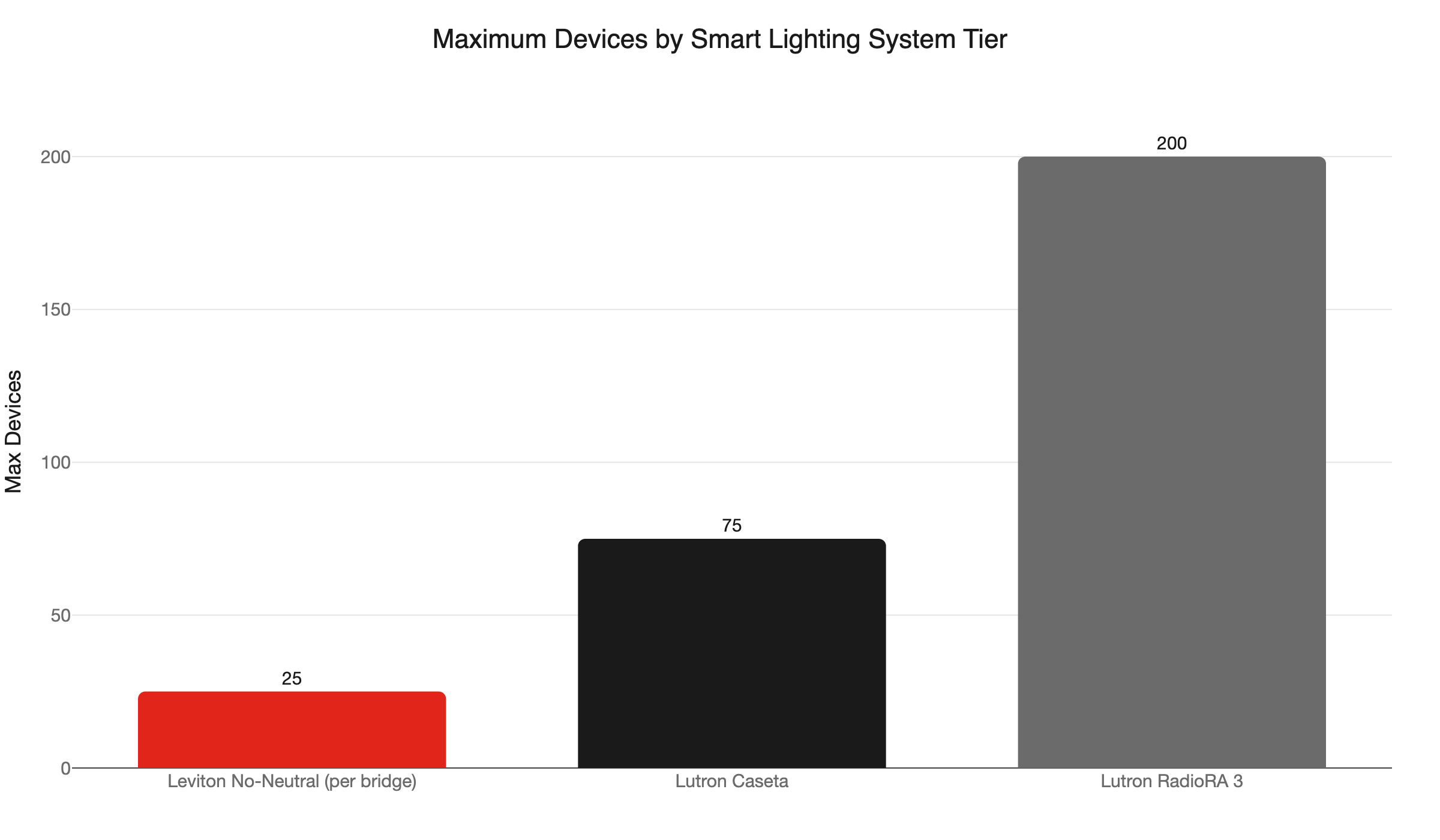
- Lutron Caseta supports up to around 75 devices. Lutron RadioRA 3 handles 200 or more and requires professional programming software, not just an app.
- A dimmer mismatched to the fixture’s load type (LED vs. incandescent vs. ELV) causes flicker, hum, and shortened fixture life.
- Installing 15 to 40 smart switches is not a like-for-like swap. A Minnesota electrical permit is required in almost every case.
- Our team pulls the permit, assesses every switch location for neutral availability, specifies the right hardware for each fixture, and programs the system before we leave.
What Is Smart Lighting Control System Wiring Installation?
Short answer: Smart lighting control system wiring installation means replacing standard wall switches with networked dimmers, keypads, or occupancy sensors across part or all of your home. It involves neutral wire assessment, hardware specification, permitting, cable work, device installation, and system programming.
One switch in a new home is a 30-minute project. Fifteen to forty switches in a 1960s Minneapolis bungalow is a different job entirely. You are building a network, not swapping hardware.
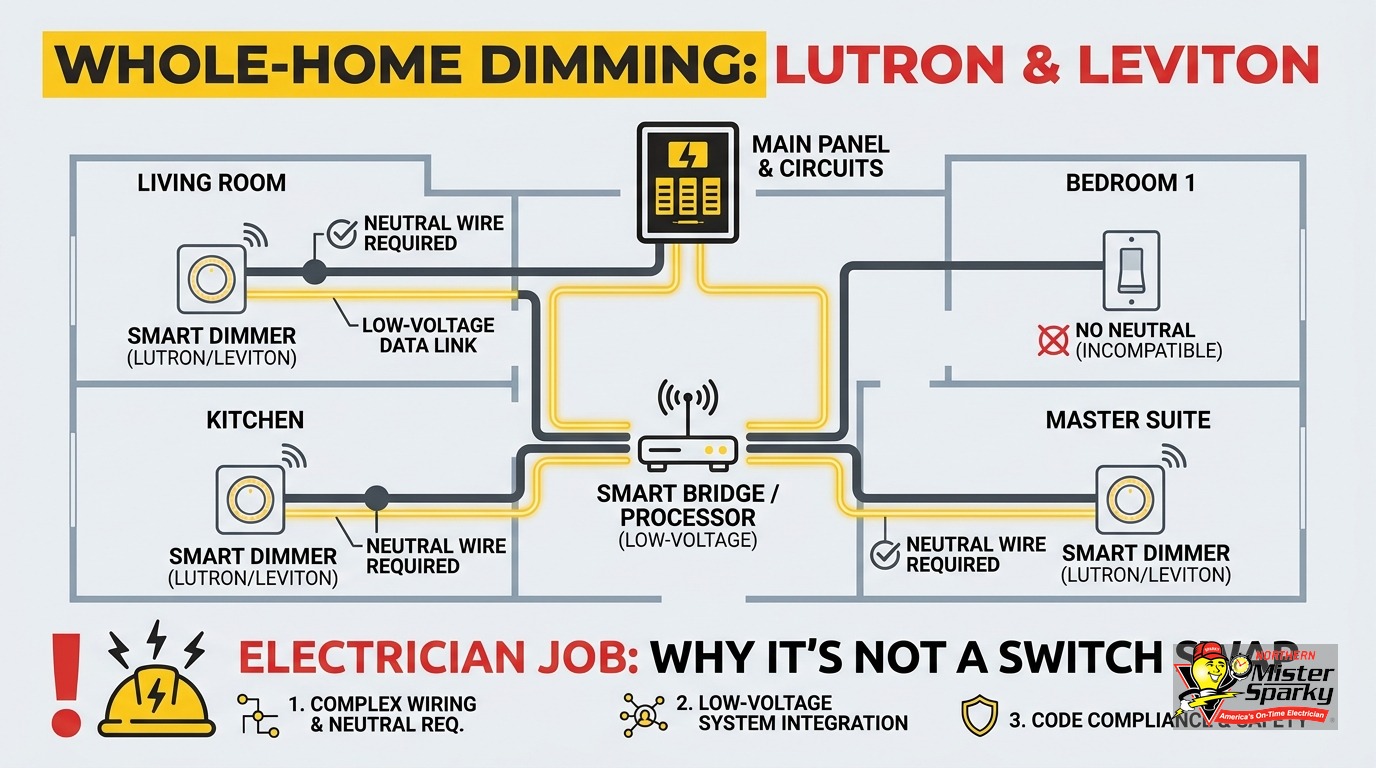
The device retailer’s install guide assumes a new-construction switch box with all four wires present: line, load, neutral, and ground. That assumption is wrong for most of the housing stock in the Twin Cities. Older homes were wired with a switch loop: power runs to the fixture first, and only two wires drop to the switch. No neutral.
Smart dimmers need a neutral. Without one, the dimmer cannot maintain the continuous low-level power it needs to stay connected to the hub, respond to schedules, or communicate with other devices on the network.
This guide explains what a whole-home smart lighting project actually involves, what the code requires, how the two major system platforms differ, and why a permit is not optional.
Why Whole-Home Dimming Is Not a Switch Swap
We get the call often. A homeowner in Maple Grove or south Minneapolis opens a box of smart dimmers, pulls the old switch, counts two wires, and finds a note in the instructions: “If no neutral wire is present, contact a licensed electrician.”
That is the moment a switch swap becomes a full electrician job.
The cause is almost always the same: a switch loop. This wiring method was standard before smart switches existed. Power runs from the panel to the ceiling fixture, and a 2-wire cable drops to the switch. The switch box gets a hot wire and a switched-hot, but no neutral. The white wire is often wrapped in black tape or left unmarked, repurposed as a second hot conductor.
Smart dimmers need a neutral to stay powered when the light is off. Without one, they cannot hold a Wi-Fi or RF connection, respond to automations, or dim smoothly. Some will ghost-dim, flicker, or fail to turn off completely.
Your options when there is no neutral:
- Run new 3-wire cable. A licensed electrician fishes 14/3 or 12/3 NM-B cable from the switch box to the fixture or to a neutral junction. This is the cleanest solution and future-proofs each location for any smart device.
- Use a no-neutral compatible dimmer. Select Lutron Caseta and Leviton Decora Smart models work without a neutral. But code limits you to five no-neutral electronic switches per branch circuit in retrofit work. You cannot solve the whole house this way without careful planning.
- A hybrid approach. New cable in rooms where walls are already open, no-neutral dimmers where they are code-compliant, and load matching throughout.
A proper smart lighting control system wiring installation starts with figuring out which rooms need new cable before a single device is ordered.
What Does the Neutral Wire Requirement Actually Mean?
Short answer: NEC 404.2(C) requires a grounded neutral conductor at switch locations in all new construction controlling line-to-neutral loads. The 2023 NEC removed the “future fishing” exception. In retrofit work, no-neutral dimmers are allowed but capped at five per branch circuit.
The reasoning is straightforward. Smart switches draw a small amount of current continuously, even when the light is off. That current needs a return path to neutral. Without a neutral in the box, the switch is forced to use the load (the fixture) as an improper return path. The result is the flickering and ghost-dimming that homeowners report.
The 2023 NEC removed the “future fishing” exception that previously allowed a 2-wire switch loop if a neutral could theoretically be added later. Three-wire cable (14/3 or 12/3 NM-B) is now the standard for all new switch wiring.
Minnesota adopted the 2026 NEC effective August 17, 2026. Any permit filed on or after that date must comply with the 2026 code. If you are remodeling today and your electrician pulls a permit, the neutral mandate applies to any new switch wiring in that project.
For retrofits where the neutral cannot be reached without opening walls, the code does allow a no-neutral smart switch. But the limit is five no-neutral electronic switches per branch circuit and 25 per feeder. A 30-switch whole-home project will likely exceed those limits in some circuits. New cable will be required in at least some rooms, regardless of which dimmer brand you choose.
See our post on smart switches without a neutral wire for a deeper look at how these options work and where they fall short.
Twin Cities Homes and the Neutral Problem
The older housing stock in Minneapolis, St. Paul, and the inner-ring suburbs presents specific challenges for smart lighting control system wiring installation.
Pre-1960s and 1970s homes in neighborhoods like South Minneapolis, Macalester-Groveland, Richfield, Northeast Minneapolis, and West St. Paul are almost entirely 2-wire switch loops throughout. A whole-home dimming project in these homes may require new cable in 20 or more switch locations.
A few realities that affect scope and cost:
Box fill. Adding a neutral wire and load conductor to an old, shallow single-gang box often means the box no longer meets NEC box fill requirements. The electrician replaces the box with a deeper unit. It is a small step, but it applies in every room where the existing box is undersized.
Plaster and lath construction. Homes built before the 1950s often have plaster over wood lath rather than drywall. Fishing new cable through these walls takes longer and requires more care to avoid cracking the surface. Labor reflects that complexity. See our guide on wiring in plaster and lath walls in older Twin Cities homes for more on what that work involves.
Knob-and-tube wiring. A small percentage of the oldest homes still have knob-and-tube in parts of the house. Installing smart dimmers on knob-and-tube circuits raises code and insurance concerns that require evaluation before any work proceeds.
Shallow wall cavities. Older exterior walls may have less clearance behind the box than modern framing. That limits which low-profile boxes will fit and which dimmers have the right form factor.
None of these issues makes a whole-home smart lighting project impossible. They make upfront assessment essential. Any honest quote for this type of project starts with a room-by-room walk-through, not a per-switch estimate over the phone.
Lutron Caseta vs. RadioRA 3: Which System Fits Your Project?
Short answer: Lutron Caseta is a wireless RF system supporting up to around 75 devices, with select no-neutral dimmer models available. Lutron RadioRA 3 handles 200 or more devices, integrates with full home automation platforms, and requires Lutron Designer programming software. They are not interchangeable products.
Lutron Caseta is the right fit for:
- Projects with 10 to 70 switch locations
- Homes where some rooms can use no-neutral dimmers (the PD-6WCL dimmer and PD-5WS-DV switch do not require a neutral)
- Homeowners who want Apple HomeKit, Amazon Alexa, or Google Home integration
- Clients who want a reliable, expandable system without a full renovation
For 3-way switching, Caseta uses a standard single-pole dimmer paired with a battery-powered Pico remote, wall-mounted like a second switch. This avoids running 14/3 traveler wire to the second location. It does require an electrician to plan the switching topology for every 3-way location in the home.
Lutron RadioRA 3 is the right fit for:
- Full renovations or new construction where 3-wire cable is already in the walls
- Projects with more than 75 switch, keypad, and sensor locations
- Whole-home automation integration with Control4, Savant, or Crestron
- Scene keypads, daylight harvesting, and whole-home “away” mode programming
RadioRA 3 requires Lutron Designer, a Windows-only programming platform. It is not DIY-friendly at any stage. System design, device addressing, and scene programming all require a trained installer. If a vendor quotes you a RadioRA 3 system without mentioning that software, ask them directly: are they Lutron-certified to program it?
Lutron’s ELV (electronic low-voltage) dimmers also require a neutral wire. Lutron’s own installation documentation says to contact a licensed electrician if no neutral is present. That guidance applies across Caseta ELV models as well.
Does Leviton Decora Smart Need a Neutral Wire?
Short answer: The standard Leviton Decora Smart Wi-Fi Dimmer requires a neutral wire. The no-neutral variant costs around $49.99 but needs a companion Wi-Fi Bridge (around $19.99) that covers up to 25 devices per bridge across 2,500 square feet. At scale, that bridge infrastructure requires design before any hardware is purchased.
A 40-switch home using the Leviton no-neutral system might need two or three bridges, each assigned a defined coverage zone. Getting those zones wrong produces drop-outs and automations that fail to fire reliably. Troubleshooting after installation is time-consuming and expensive.
Both Leviton Decora Smart and Lutron Caseta require matching the dimmer to the fixture’s load type. LED, incandescent, ELV, and MLV fixtures each behave differently under a dimmer. A mismatch produces:
- Flickering at certain dim levels
- Audible humming from the fixture or the dimmer itself
- Premature LED driver failure
- Minimum-dim problems (the light cuts off before reaching zero)
Both manufacturers publish compatibility lists. Before a single dimmer is ordered, an electrician cross-references each fixture against the list. This step is easy to skip when ordering online. It is expensive to undo after installation.
See our guide on LED dimmer switch compatibility for a closer look at why load-type matching matters in practice.
Do You Need a Permit for Smart Lighting in Minnesota?
Short answer: Yes, in almost every case. Installing or replacing a switch is not a like-for-like minor repair in Minnesota when new wiring is involved. A whole-home system with 15 to 40 switch locations requires an electrical permit and a passed inspection.
The permit protects your investment. An unpermitted whole-home smart lighting installation can create problems at resale. Your homeowner’s insurance carrier may deny a claim if unpermitted electrical work contributed to a fire or equipment failure. In some Twin Cities cities, unpermitted work must be torn out and redone before a sale can close.
Minnesota’s homeowner DIY exemption is narrower than most people assume. It applies only to an owner-occupied single-family homestead where the homeowner personally performs the work. It does not extend to condos, duplexes, or rental properties. A 20-switch whole-home system is not within any reasonable reading of “minor repair.”
There is also a jurisdictional issue. Plymouth, Maple Grove, and Saint Paul operate their own electrical permitting departments. Permits go to the city, not to the state DLI. The process, forms, and inspection scheduling differ by jurisdiction. An experienced electrician knows which applies and how each one works. A homeowner navigating this alone often runs into delays and confusion.
Our full guide to electrical permits in Minnesota covers the process from application through final inspection.
What Does a Professional Smart Lighting Installation Look Like?
Short answer: It starts with a room-by-room neutral assessment before any hardware is ordered. Then comes system specification, permit application, rough-in cable work, device installation, and full system programming. The job closes with a passed inspection.
Here is the sequence our team follows:
Site walk and neutral assessment. Every switch location gets checked: is a neutral present? What is the load type at the fixture? Is the box deep enough to meet box fill requirements? This step prevents ordering the wrong hardware and eliminates the most common mid-project surprises.
System specification. Based on device count, home size, neutral availability, automation goals, and budget, we recommend the right platform. Every dimmer gets matched to the fixture’s load type using the manufacturer’s compatibility list.
Permit application. We apply before any work starts. In Plymouth, Maple Grove, or Saint Paul, that means coordinating with the city’s own permitting department. In most other Twin Cities jurisdictions, it goes through the state DLI.
Rough-in work. Where new 14/3 cable is needed, we run it. Where boxes are too shallow for the added conductors, we replace them. We install the hub or repeater (Caseta Smart Bridge Pro or RadioRA 3 main repeater) in a central, accessible location.
Device installation. Dimmers, keypads, and occupancy sensors go in. Pico remotes for 3-way locations get paired and mounted. Everything gets tested for function and load compatibility before walls are touched.
Programming and scene setup. For Caseta, we configure rooms, groups, and scenes in the Lutron app and confirm integration with the homeowner’s preferred smart home platform. For RadioRA 3, we run Lutron Designer, program the full switching topology, and document every scene assignment for the homeowner’s records.
Inspection and closeout. We schedule the inspection, accompany the inspector, and close out the permit. You keep the documentation.
Is There Any Rebate Help for Smart Lighting in Minnesota?
Short answer: Xcel Energy’s residential rebate program currently covers smart thermostats but does not list a dedicated residential smart-lighting dimmer rebate. Commercial and industrial LED rebates are active through October 31, 2026. Residential customers should verify current offerings on Xcel’s rebate hub before building a budget around rebate assumptions.
Smart lighting projects deliver real energy savings. Lower average dim levels, occupancy-based automation, and scheduled shutoffs cut electricity use in a meaningful way. But that benefit does not currently come with a direct residential rebate from Xcel. Confirm before you assume.
A smart lighting project paired with a panel upgrade or broader remodel may qualify for other state or federal incentives. Our team can walk you through what applies to your specific scope when we do the site assessment.
Start with an Assessment, Not a Cart
A whole-home smart lighting control system wiring installation is one of the most satisfying projects a Twin Cities homeowner can undertake. Done right, it changes how you live in the home. One button sets the room for dinner. Another shuts everything down for the night. Lights respond to how the space is actually used.
Done without a proper assessment, it becomes an expensive collection of devices waiting for the wiring to catch up.
Our team is locally owned and operated in the Twin Cities. We are America’s On-Time Electrician(R), and we back every job with the UWIN(R) 100% satisfaction guarantee. No malarky: if the system does not perform as planned when we leave, we come back and make it right.
Call us at 763-200-5956 or book online. We start with a full site walk, give you an honest neutral assessment for every room, and quote the right system for your specific wiring and project goals.
Frequently Asked Questions
Does a smart dimmer need a neutral wire? +
Do I need a permit to install smart switches in Minnesota? +
What is the difference between Lutron Caseta and Lutron RadioRA 3? +
Need an electrician now?