
Cost to Wire a Finished Basement in Minnesota: 2025 Guide
Key Takeaways
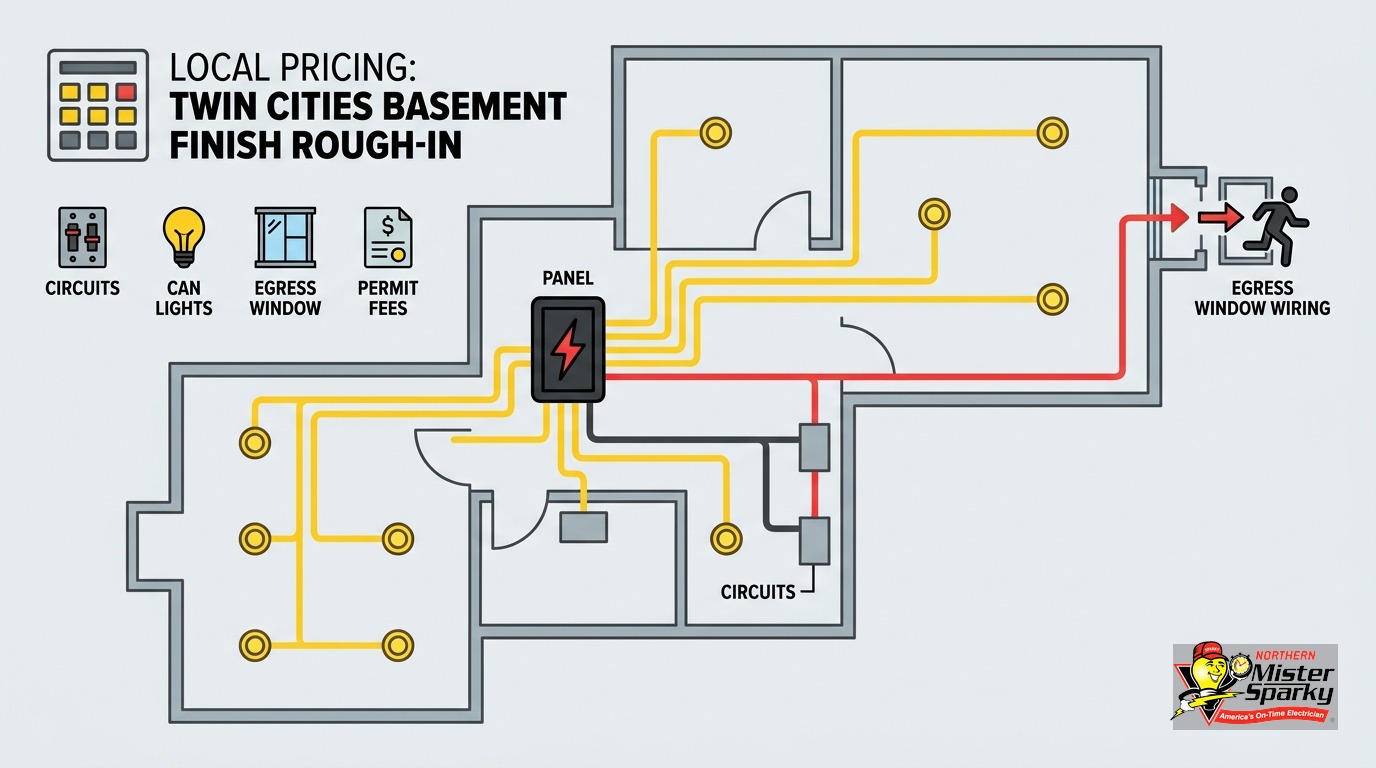
- Electrical rough-in for an 800 sq ft Twin Cities basement ranges from $3,500 (budget, code-minimum) to $15,000 (high-end smart home).
- Minnesota adopted the 2023 NEC on July 1, 2023. Basement bedroom circuits now require AFCI breakers, not standard breakers.
- Many Twin Cities homes carry 100A panels that cannot absorb five or six new basement circuits without a subpanel.
- About 66 Minnesota cities handle electrical inspections locally. Your electrician needs to route the permit to the right authority.
- A legal basement bedroom requires an egress window plus three specific electrical items: an AFCI circuit, a hardwired interconnected smoke detector, and potentially a CO detector.
- Call 763-200-5956 or book online to get a same-day written estimate from our locally owned Twin Cities team.
Planning a basement finish in the Twin Cities means wiring before the drywaller shows up. The cost to wire a finished basement in Minnesota runs from $3,500 for a code-minimum rough-in to $15,000 for a high-end build with smart home pre-wiring. What you pay depends on panel capacity, scope, permit jurisdiction, and whether a bedroom is in the plan. Here is what Twin Cities homeowners need to know before signing with any electrician.
What Does It Cost to Wire a Finished Basement in Minnesota?
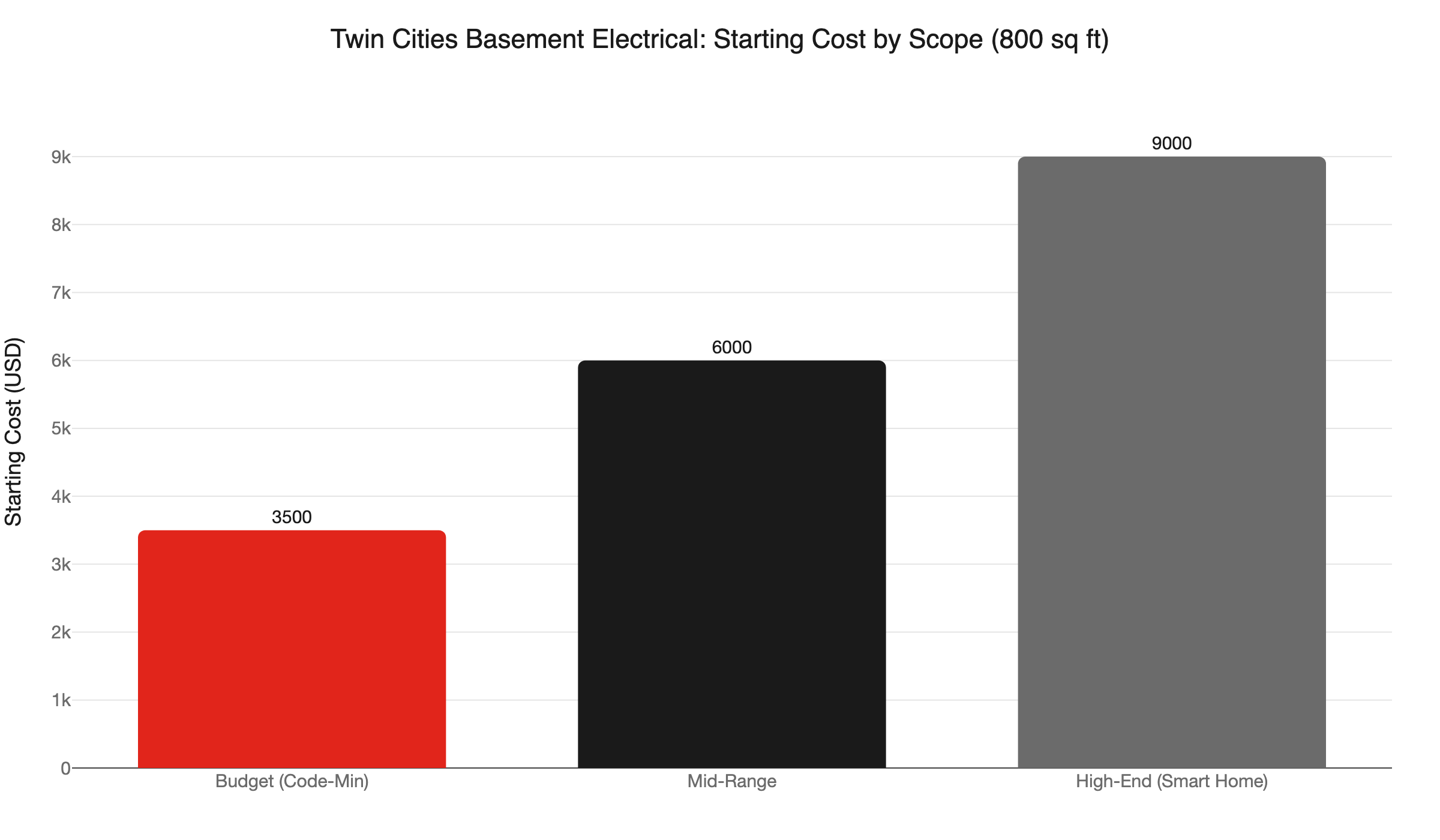
Short answer: For an 800 sq ft Twin Cities basement, electrical rough-in starts at $3,500 for a budget scope and reaches $15,000 for a high-end smart home build. Most homeowners finishing a family room, home office, and bathroom land in the $6,000 to $9,000 mid-range.
Here is how those three tiers break down:
Budget: $3,500 to $6,000
This covers code-minimum work: receptacle placement (required every 12 feet along finished walls), one or two dedicated circuits for a home office or small appliance, standard overhead lighting, and a panel check. Functional and fully permitted, but nothing extra. Source
Mid-range: $6,000 to $9,000
Adds recessed can lighting across an open-plan layout, dimmer switches, a dedicated circuit for a wet bar or mini-fridge, and a thoughtful outlet layout for a finished living space. This is where most Twin Cities family room and home office projects land. Source
High-end: $9,000 to $15,000
Includes home theater pre-wiring, smart lighting control, structured media wiring, and dedicated circuits for high-draw equipment like a sauna or commercial-grade fitness machine. Add $1,200 to $3,500 for a subpanel if your main panel cannot handle the new load. Source
These ranges do not include a main panel upgrade or service entrance work. We cover panel capacity in its own section below.
What’s Included in a Basement Electrical Rough-In?
Short answer: Rough-in covers everything installed before the drywall goes up - wire runs, electrical boxes, and panel connections. The electrician returns after drywall for trim-out: outlets, switch plates, and fixtures. A rough-in inspection is required before drywall can close the walls.
A licensed Minnesota electrician handles these tasks during a typical basement rough-in:
- Panel audit. Before touching wire, we check how many open slots your panel has and whether your service entrance can handle the new load.
- Circuit layout. We plan each circuit: lighting, general receptacles, dedicated appliance circuits, bathroom GFCI circuits, and any bedroom AFCI circuits.
- Wire pulls. All Romex (NM-B cable) runs through the framing before drywall. We keep wiring away from exterior foundation walls to meet Minnesota’s building code emphasis on moisture control in basements.
- Box installation. Outlet, switch, and can light boxes go in at rough-in.
- Panel connections. Breakers are installed and every circuit is labeled.
- Rough-in inspection. The inspector checks wire gauge, staple spacing, box fill, GFCI placement, and AFCI breaker compliance before drywall can close the walls.
Trim-out is sometimes priced as a separate phase. Ask your electrician upfront whether their quote covers both rough-in and trim-out, or just one.
Does Your Older Twin Cities Home Have Room on the Panel?
Short answer: Many older Twin Cities homes run on 100A service, which often lacks the capacity for five or six new basement circuits. A subpanel ($1,200 to $3,500) or a full panel upgrade may be required before any basement wiring can begin. A site visit answers this question before any contracts are signed.
Most Twin Cities homes are 50 to 100 years old and were wired for the loads of their era. Source A finished basement with a home office, lighting circuits, a dedicated appliance circuit, and a bathroom can need five or six new 15A and 20A branch circuits. A 100A panel already feeding a full house may have only three to five open breaker slots. That gap is a real problem.
Signs your panel may not have room:
- Breakers that trip under normal household loads.
- Fewer than four open breaker slots.
- A fuse box rather than a circuit breaker panel - that needs to go before any new circuits are added.
- The panel is more than 25 years old and already showing signs it needs an upgrade.
A subpanel - a secondary breaker box fed from your main panel - solves the slot problem without replacing the whole panel. If your main panel is at or near its service amperage limit, a full upgrade is the smarter investment. We check panel capacity on every site visit before writing a basement estimate. There is no accurate way to price a rough-in without that step.
What Are AFCI Breakers and Why Does Minnesota Now Require Them?
Short answer: AFCI (Arc-Fault Circuit Interrupter) breakers detect dangerous arc faults in wiring before they start a fire. Minnesota adopted the 2023 NEC on July 1, 2023, and that code requires AFCI protection on all 15A and 20A bedroom branch circuits - including basement bedrooms. Each AFCI breaker costs $35 to $60, versus $5 to $15 for a standard breaker. Source
Here is what that means for your project budget:
- A basement bedroom with three circuits (lighting, receptacles, and a dedicated circuit) needs three AFCI breakers. That is $105 to $180 in breakers alone, compared to $15 to $45 with standard breakers.
- General living areas and kitchenettes in the basement may also require AFCI protection depending on circuit type and location. Your electrician determines what applies.
- Any permit pulled after July 1, 2023, must comply with the 2023 NEC. If a quote you received predates that change, ask the contractor to confirm their pricing accounts for AFCI breakers.
- The Minnesota DLI publishes a 2023 NEC inspection checklist for one-family dwellings that details exactly what the inspector will look for during rough-in and final.
AFCI breakers are not optional and not negotiable. An inspector will fail the rough-in if standard breakers are installed where AFCI is required.
Adding a Legal Basement Bedroom Triggers More Electrical Work
Finishing a basement bedroom is not just adding a bedroom circuit. Minnesota requires an egress window - a minimum 44-inch clear opening - for any room classified as a bedroom. Without it, the room is not a legal bedroom regardless of how it is used or finished. Each egress window runs $2,000 to $4,000 installed, including the foundation cut, window well, waterproofing, and installation. Source
The egress window also triggers three electrical requirements that general contractor cost guides consistently overlook:
1. An AFCI-protected bedroom circuit. Required under 2023 NEC Section 210.12. Every 15A and 20A branch circuit in the bedroom must have AFCI protection. Standard breakers will not pass inspection. Source
2. A hardwired smoke detector interconnected with the home’s existing alarm network. A battery unit tossed on the ceiling does not meet code. The detector must tie into the home’s smoke alarm system so one alarm triggers all of them. Our smoke detector installation service covers the wiring and interconnection. Source
3. A CO detector if any gas-burning mechanical equipment - furnace, water heater, or boiler - is in or adjacent to the basement. If in doubt, install one. Most inspectors will flag the omission at final.
Plan for an additional $500 to $1,200 in electrical costs for the bedroom-specific scope, on top of your rough-in estimate. These items are non-negotiable and will be checked at both rough-in and final inspection.
Who Pulls the Electrical Permit - DLI or Your City?
Short answer: About 66 Minnesota cities have adopted their own electrical inspection authority. If your address is in one of them, the permit goes to the city inspector, not the Minnesota Department of Labor and Industry. A licensed MN electrician routes the permit correctly - get it wrong and you can delay your rough-in inspection by weeks. Source
For projects under DLI’s authority, the fee structure works like this:
- $25 permit fee plus a $1 surcharge per permit.
- $55 minimum inspection fee per trip.
- A basement rough-in typically requires two electrical trips: one before drywall (rough-in) and one after trim-out (final). That is a $110 minimum in inspection fees, not counting the permit. Apply at ims.dli.mn.gov. Source
Cities with local authority handle permits differently. Blaine, for example, routes electrical permits to DLI but manages its own building permits on a flat-fee-per-room basis for basement finishes. Source Minneapolis has its own electrical inspectors entirely.
One thing homeowners often miss: replacing an existing light fixture does not require a permit in Minnesota. Adding a new circuit or a new outlet always does. Unpermitted wiring is a liability at resale and a real hazard if the work was never inspected. Our post on how Minnesota electrical permits work walks through the full process if you want to understand what your electrician handles on your behalf.
A licensed Minnesota electrician pulls the right permit automatically. You do not have to figure out the jurisdiction split yourself.
How Do Recessed Lights Factor Into the Final Cost?
Short answer: Recessed can lighting is the most common upgrade in a basement finish and one of the most consistently underestimated line items. Expect $1,500 to $3,500 added to your rough-in budget for a properly designed layout in an 800 sq ft open-plan basement.
Here is why the cost adds up:
- Can count. Best practice for standard basement ceiling heights is one fixture every 6 to 8 feet. Source An 800 sq ft open-plan space typically needs 10 to 16 cans on a single 15A lighting circuit.
- Dimmer compatibility. Most homeowners want dimmers in a living or media space. Dimmers require compatible dimmer switches and LED fixtures that are rated for dimming. This is a separate cost that rough quotes often miss.
- Switch layout. A basement with distinct zones - living area, bar, hallway - needs three-way switches at stairwells and multiple switch locations. Each three-way switch adds to the rough-in labor and material cost.
- Fixture cost. The rough-in budget covers labor and boxes. The fixtures themselves are a separate purchase. Specify the fixture model before rough-in so the box location and circuit sizing are matched correctly.
Our recessed lighting installation guide covers fixture spacing, circuit sizing, and the dimmer compatibility question in full detail. Read it before you finalize your lighting plan. Moving cans after drywall is expensive.
Are There Xcel Energy Rebates for Basement Electrical Work?
Short answer: Rebates specifically for electrical rough-in wiring have not been confirmed. Xcel Energy does offer rebates on qualifying LED lighting products, which can apply to the recessed fixtures installed during your basement finish. Check xcelenergy.com for current offers before your electrician orders materials.
A few notes on how rebates work:
- Rebates are product-specific. The LED fixture must appear on Xcel’s qualifying product list for the current program year.
- Your electrician does not typically file the rebate on your behalf. You submit it with your receipt after installation.
- Rebate amounts and eligible products change each year. Confirm current offers before finalizing your material budget - do not assume last year’s rebate still applies.
- If your basement project includes HVAC or plumbing scope, those rebates are handled separately through the appropriate contractor. Electrical is our lane.
What Do Twin Cities Labor Rates Look Like for Electrical Work?
Short answer: Minnesota electrician labor runs above the national average. Union presence in the metro and Minnesota’s prevailing wage standards push hourly rates higher than what you see in most national cost guides. Expect $65 to $125 per hour for a licensed Twin Cities electrician. Source
Labor makes up a significant share of any basement rough-in. A two-person crew typically spends eight to twelve hours on a basic basement scope. Add panel work, a subpanel, and a full can light layout, and a mid-range job can run fifteen to twenty hours of on-site labor.
This is why national cost guides miss on Minnesota pricing. They average in markets with far lower labor costs. A local quote from a licensed MN electrician is the only number that reflects your actual project.
No malarky: the cheapest quote and the right quote are rarely the same thing. Correcting improperly installed wiring after drywall closes the walls costs significantly more than doing it right during rough-in.
Get the Real Cost to Wire a Finished Basement in Minnesota
No two basements price the same. Panel capacity, square footage, room count, permit jurisdiction, and bedroom requirements all move the number. The only accurate figure comes from a site visit with a licensed electrician who checks your panel before writing anything down.
Northern Mister Sparky is locally owned and operated in the Twin Cities. We are America’s On-Time Electrician(R). We pull the right permits, install AFCI breakers where the 2023 NEC requires them, and give you a written estimate before any work starts. Our UWIN(R) 100% satisfaction guarantee backs every job.
Call us at 763-200-5956 or book online to schedule a site visit. We will check your panel, scope the circuit layout, and give you a written estimate the same day.
Frequently Asked Questions
How much does it cost to wire a finished basement in Minnesota? +
Do I need a permit to wire a basement in Minnesota? +
What are AFCI breakers and do I need them for a basement? +
Does a finished basement need a subpanel? +
Need an electrician now?