
Bathroom Vanity Light Wiring: 4 Things to Check First

Key Takeaways
- Your vanity light should run on a dedicated lighting branch circuit, not the bathroom’s 20A receptacle circuit.
- Wire gauge in the junction box is a fast diagnostic: #14 AWG typically means a 15A lighting circuit; #12 AWG at the vanity box may flag a code violation if the light is tapped off the receptacle circuit.
- Any fixture above a tub, or within 3 feet horizontal and 8 feet vertical of the tub rim, must carry a damp or wet location listing per NEC 410.10(D). Builder-grade fixtures frequently lack this rating.
- Permit requirements vary by municipality. Minneapolis sometimes exempts like-for-like replacement; most metro suburbs require a permit for fixture work.
- Minnesota’s NEC code transition lands August 17, 2026. Permits filed before that date fall under the 2023 NEC; permits filed after fall under the 2026 NEC.
- Swapping to LED during the fixture change can make you eligible for Xcel Energy residential lighting rebates.
Why Is Bathroom Vanity Light Wiring More Complex Than a Simple Swap?
Most DIY guides treat a vanity light swap as a pure hardware exercise: cut power, swap the fixture, restore power. That is not wrong, but it leaves out four diagnostic steps a licensed electrician runs first. Miss them and you may inherit a code violation, or install a fixture that fails inspection.
Replacing a builder-grade vanity light is one of the most common renovation-season projects in Twin Cities homes. The fixture looks dated. The new one is already in the cart. The online tutorials make it look like a 20-minute job.
For most swaps in most bathrooms, it is a 20-minute job. But four questions that no DIY article covers can flip the script fast. This post covers those four questions in plain language. Know the answers before you pick up a screwdriver.
Which Circuit Does Your Vanity Light Run On?
Your vanity light should be on a dedicated lighting branch circuit. NEC 210.11(C)(3) prohibits the 20A bathroom receptacle circuit from supplying lighting or exhaust fans. If your vanity light is wired off the receptacle circuit, that is a code violation you need to resolve before swapping the fixture.
Here is why this matters beyond code compliance. The 20A receptacle circuit is designed for high-draw appliances: hair dryers, curling irons, electric shavers. Running the vanity light off that same circuit exposes the fixture to load fluctuations those appliances generate. It also means the breaker trips every time someone uses a hair dryer.
A properly wired bathroom has at least two separate circuits:
- A dedicated 20A circuit for the receptacle outlets only
- A separate branch circuit for the lighting and exhaust fan
To identify your circuits before starting, use a non-contact voltage tester and a helper at the panel. Flip breakers one at a time. Note what loses power in the bathroom. A single breaker that kills both the outlet and the vanity light is a red flag worth logging before you proceed.
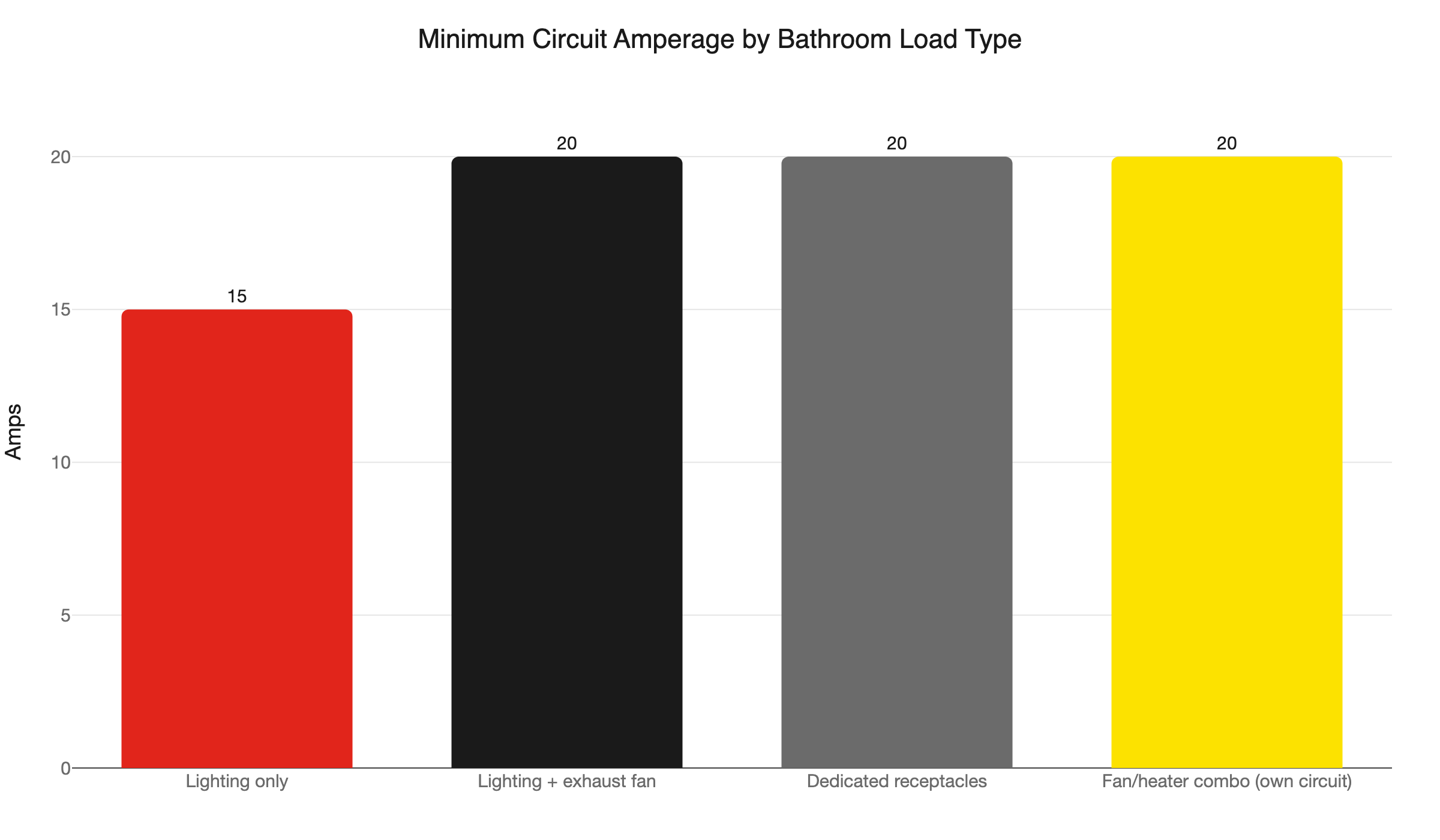
If you find the vanity light and exhaust fan sharing a circuit, that circuit must be at least 20A. A lighting-only circuit can be 15A. Add an exhaust fan to the same branch and the minimum goes to 20A. Add a fan with a built-in heater and the NEC requires a dedicated 20A circuit for the heater alone.
Identifying your circuit before the swap takes five minutes. It can save you from inheriting a violation that belonged to whoever wired the bathroom last.
What Does Wire Gauge Tell You?
Wire gauge in the junction box gives you a fast circuit identity clue. #14 AWG typically means a 15A lighting circuit. #12 AWG is the minimum required on the 20A receptacle circuit - so finding it at the vanity light box may mean the fixture is incorrectly tapped off the receptacle circuit, a violation of NEC 210.11(C)(3).
You do not need a multimeter for this check. Look at the wire diameter. #14 AWG is noticeably slimmer than #12 AWG. If you are not confident eyeballing the difference, a wire gauge tool runs under $10 at any hardware store.
Two scenarios explain #12 AWG at the vanity light junction box:
- Someone correctly wired a separate 20A lighting circuit. Acceptable, as long as it is truly separate from the receptacle circuit.
- Someone tapped the vanity light off the 20A receptacle circuit. A code violation under NEC 210.11(C)(3), regardless of whether the breaker has ever tripped.
Scenario 2 is more common in older Twin Cities homes where the original wiring predated the requirement for a dedicated bathroom receptacle circuit. The symptom can be subtle. The breaker only trips under heavy load. The problem hides for years before someone finally looks inside the box.
Either way, #12 AWG at the vanity box is a signal to trace the circuit before you proceed. For a deeper look at how wire sizing connects to panel capacity, see our guide on bathroom remodel electrical requirements.
Does Your New Fixture Need a Damp or Wet Location Rating?
Yes, if the fixture is above a tub or within 3 feet horizontally and 8 feet vertically of the tub rim. NEC 410.10(D) requires a damp or wet location listing in those zones. Builder-grade fixtures commonly carry no location rating or a dry-only rating. Either is a code violation inside the moisture zone.
The zone dimensions surprise most homeowners. Three feet horizontally from the near edge of the tub. Eight feet vertically above the tub rim. In a compact bathroom with a single vanity light bar mounted close to the tub, that fixture may sit well inside the zone.
Location ratings appear on the fixture label or in the manufacturer’s spec sheet. Look for one of these phrases:
- Damp location - rated for areas with moisture in the air, but not direct water contact
- Wet location - rated for direct water contact or outdoor exposure
“Dry location only” means exactly that. Installing a dry-location fixture inside the moisture zone is a code violation. It is also a safety issue: moisture infiltration into a non-rated fixture can cause arc faults over time.
Confirm the location rating on the spec sheet before you purchase. The cost difference between a damp-rated and a dry-rated fixture is usually small. Getting flagged by an inspector and buying a second fixture costs significantly more.
Do You Need a Permit in Minnesota to Replace a Vanity Light?
It depends on your municipality. Minneapolis may exempt a true like-for-like replacement. Most suburban municipalities - including St. Paul, West St. Paul, and North St. Paul - require a permit for any fixture work. The DLI inspector directory tells you who inspects your address and what they require.
Minnesota routes electrical inspection authority through the Department of Labor and Industry (DLI). Some addresses fall under DLI state inspection. Others fall under a local AHJ - a city or county building department with its own permit requirements. The rules differ between them, and there is no single statewide answer.
The fastest way to determine your requirement: visit the DLI electrical permits for homeowners page and use the inspector directory to find your AHJ. State-inspected addresses apply through ims.dli.mn.gov/ims. City-inspected addresses apply through the local building department.
If you are in Saint Paul, the city moved to the PAULIE online permit system as of July 1, 2026. The DSI office handles electrical permits at (651) 266-8989.
Minnesota homeowners can pull their own permit and perform their own electrical work under Minnesota Statute 326B.31, Subd. 23. The condition: you must occupy the property as your primary residence. This applies to the permit, the work, and the inspection. Rental property owners cannot do their own electrical work under a homeowner permit. The work must be performed by a licensed electrical contractor.
See our detailed walkthrough of the Minnesota electrical permit process for what to expect, what inspectors check, and how to schedule.
How Does the Minnesota 2026 NEC Transition Affect Your Project?
Permits filed before August 17, 2026 must comply with the 2023 NEC. Permits filed on or after that date fall under the 2026 NEC. For a basic vanity light swap, the edition difference rarely changes your project scope. For larger bathroom remodels that touch circuits or the panel, the edition in effect at permit issuance matters more.
Minnesota is mid-transition between NEC editions this renovation season. For a straightforward fixture replacement, the 2023 and 2026 editions do not diverge dramatically on the rules that apply. Circuit separation requirements, location ratings, and the permit process stay substantially consistent between editions.
For projects that go further - adding a circuit, relocating a fixture to a new junction box, or upgrading a panel as part of a bathroom remodel - the edition matters. Changes between the two editions can affect arc fault circuit interrupter requirements, tamper-resistant outlet rules, and other details that ripple into project scope.
The practical takeaway: pull your permit before August 17 if you plan to work this summer. Do not let the paperwork slide past the transition date without confirming which code applies to your project.
Can You Get a Rebate When Switching to LED Vanity Lighting?
Possibly, and it is worth checking before you buy. Xcel Energy’s residential programs include home lighting incentives for customers in Minneapolis, St. Paul, and most inner-ring suburbs. Check their rebate finder or call the One-Stop Efficiency Shop at 612-244-2427 before purchasing a fixture to confirm current amounts and qualifying products.
A fixture swap is the natural moment to move from incandescent or fluorescent to LED. LED fixtures use roughly 75% less energy than incandescent equivalents and last significantly longer. On a Minnesota winter utility bill - where lights run for more hours each day - that efficiency gap adds up fast.
Xcel does not always publish current rebate amounts prominently on their website. The rebate finder tool and the One-Stop Efficiency Shop line are the most reliable ways to get a current figure before you shop. An Xcel representative can also confirm which fixture types and lumen ratings qualify.
Even without a rebate, the energy savings make the LED switch worthwhile during any planned fixture replacement.
The Actual Wiring Steps
Once you have confirmed circuit identity, wire gauge, fixture location rating, and permit requirement, the physical swap is straightforward.
Before you start: Confirm power is off with a non-contact voltage tester at the junction box after you flip the breaker. Do not rely on the light switch alone. A switch controls the hot wire but does not de-energize the neutral. Junction boxes can also contain wiring from more than one circuit.
The sequence:
- Remove the old fixture by unscrewing the mounting screws. Pull the fixture away from the wall carefully. Builder-grade fixtures often have minimal wire slack, so go slowly.
- Photograph the existing wiring before disconnecting anything. The photo takes five seconds and prevents reassembly mistakes.
- Unscrew the wire nuts. Standard color coding: white (neutral) to white, black (hot) to black, bare copper or green (ground) to ground. Confirm what you see matches the photo.
- Check the new mounting bracket for a grounding screw - typically green. Land the bare copper or green ground wire on that screw before the fixture goes up. This step is easy to skip and frequently shows up on inspections.
- Reconnect in order: white to white, black to black, ground to ground. Use wire nuts rated for the wire gauge in the box.
- Tuck wires into the box without forcing them. Pinched insulation against a sharp bracket edge is a common source of arc faults in bathroom fixtures.
- Mount the fixture, restore power at the panel, and test both the switch and the breaker.
One question that comes up during this step: does the lighting circuit need GFCI protection? The NEC does not require GFCI for bathroom lighting fixtures - only for receptacles. A bath fan and light combo over the tub may require GFCI per the manufacturer’s installation instructions even where the NEC does not mandate it. For the full breakdown of what requires GFCI protection in a bathroom, see our guide on GFCI outlet requirements.
If your bathroom also needs a new or replacement exhaust fan, that job often pairs naturally with a fixture swap. Our guide on bathroom exhaust fan installation covers circuit requirements, duct routing, and when the fan job needs its own permit.
When to Call a Licensed Twin Cities Electrician
Do not push forward on your own if any of these conditions apply:
- You open the junction box and find wiring you do not recognize: extra conductors, aluminum wiring, or anything that does not match standard three-wire color coding.
- The wire gauge is #12 AWG and you cannot confirm the vanity light has always run on a circuit separate from the 20A receptacle circuit.
- The new fixture location falls inside the tub moisture zone and you are not certain the fixture carries a damp or wet location listing.
- Your municipality requires a permit and you would prefer a licensed contractor to pull it, perform the work, and handle the inspection.
- The breaker trips when you test the circuit, or you cannot isolate which breaker controls the vanity light.
- The existing junction box is too shallow for the new fixture’s wiring volume - a box fill issue that requires a licensed assessment to resolve correctly.
Northern Mister Sparky is locally owned and operated in the Twin Cities. We know the permit landscape across Minneapolis, St. Paul, and the surrounding suburbs. We pull permits and handle inspections as part of every job. No malarky: what we quote is what you pay.
Call us at 763-200-5956 or book online to schedule. We back every job with the UWIN(R) 100% satisfaction guarantee. As “America’s On-Time Electrician(R)”, we show up when we say we will.
Frequently Asked Questions
Do I need a permit to replace a vanity light in Minnesota? +
Does a bathroom vanity light need GFCI protection? +
What wire gauge should I find in my vanity light junction box? +
What does a damp location rating mean on a bathroom light fixture? +
Can a Minnesota homeowner pull their own electrical permit? +
Need an electrician now?