
Boat Dock Wiring Minnesota: Safety, GFCI, and Code
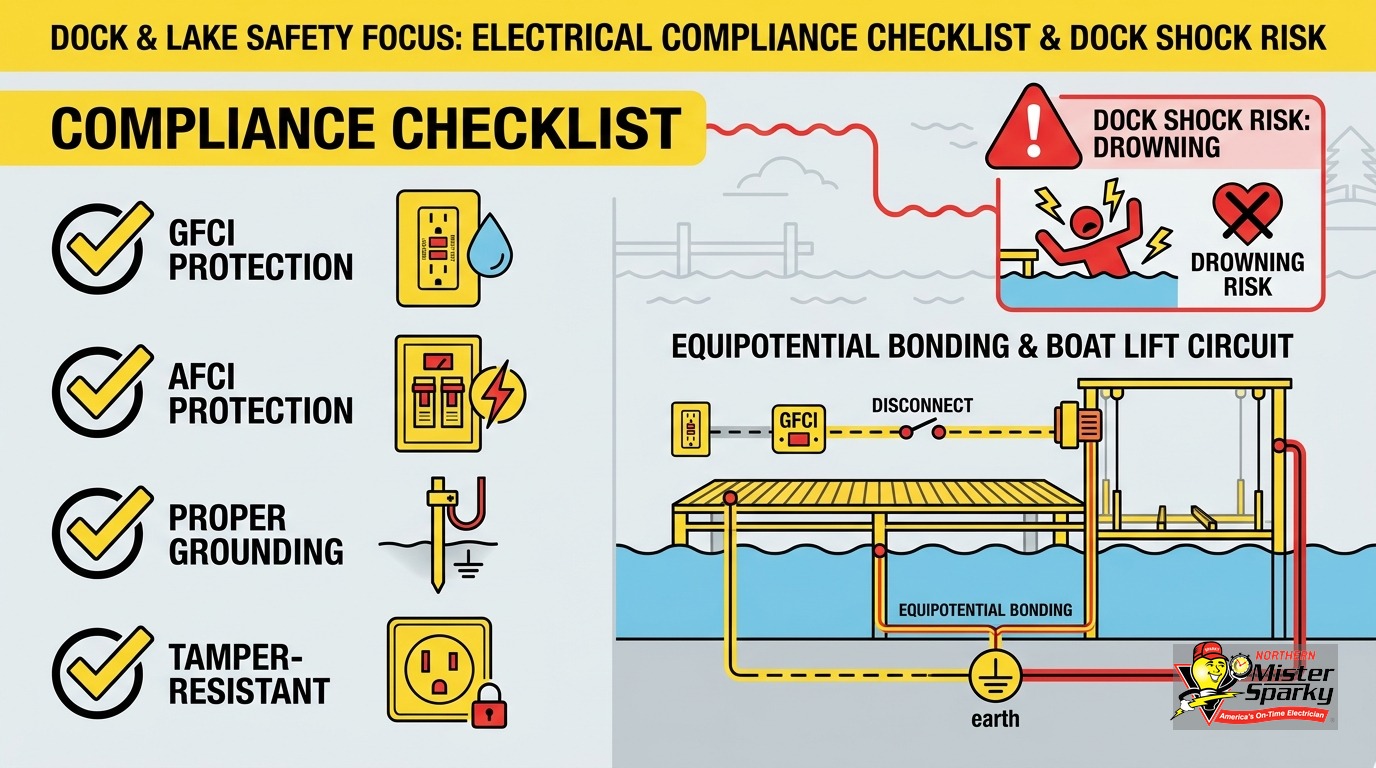
Key Takeaways
- A man died from electric shock drowning at Lake Vermilion, Minnesota, on July 17, 2026. This is a local, documented risk - not a hypothetical.
- Freshwater is more dangerous than saltwater for ESD. Swimmers become the path of least resistance when current enters a lake.
- Minnesota adopts the 2026 National Electrical Code on August 17, 2026. Dock permits pulled on or after that date must meet the new standard.
- NEC 555.10 requires a permanent warning sign at every docking facility, including residential docks. Most Minnesota dock owners do not have one.
- All 15/20A 125V outlets on a dock require GFCI protection under NEC Article 555.
- NEC 555.13 requires bonding all exposed metal dock parts: ladders, cleats, handrails, steel pilings, and metal conduit.
- NEC 555.14, introduced in the 2023 NEC, adds an equipotential plane requirement near outdoor service equipment within 10 feet of water.
- Ice heaving - not faulty original installation - causes most dock wiring damage in Minnesota. Inspect every spring before anyone swims.
- Boat lift motors require a dedicated circuit with GFCI at the breaker and must be bonded into the dock’s equipotential system.
Boat Dock Wiring Minnesota: Why This Summer Is Different
July 17, 2026. A 39-year-old man grabbed a boat plugged into a boathouse on Lake Vermilion. He could not let go. Witnesses reported visible electrocution. St. Louis County emergency responders could not revive him.
That is not a story from Florida or South Carolina. It happened in northern Minnesota, at a dock much like the ones on every lake in this state.
This summer also carries a code deadline. The Minnesota Department of Labor and Industry adopts the 2026 National Electrical Code on August 17, 2026. Permits pulled on or after that date are inspected under the new standard. Permits pulled before August 17 fall under the 2023 NEC. That transition is weeks away.
If your dock has not had a licensed electrical inspection in several years - or ever - this is the season to schedule one. We are Northern Mister Sparky, locally owned and operated in the Twin Cities metro. We handle the boat dock wiring Minnesota homeowners need to pass inspection and keep families safe. Here is what the code requires and what Minnesota winters do to wiring you thought was solid.
What Is Electric Shock Drowning, and Why Is Freshwater More Dangerous?
Electric shock drowning occurs when AC current leaks from a faulty dock circuit into surrounding water. A swimmer enters that water and their body becomes the electrical path. Even a small amount of AC current causes involuntary muscle paralysis in water, and a slightly higher level across the heart can trigger ventricular fibrillation. A standard ground fault delivers far more than either threshold. There is no visible warning - no bubbles, no color change - before a swimmer is already in danger.
Saltwater and freshwater respond very differently when current enters them. Saltwater is a strong conductor. It distributes current evenly across a wide area and keeps the voltage gradient low at any single point. Freshwater is a poor conductor. When current enters a freshwater lake, it concentrates along the path of least resistance. A swimmer in that water often becomes that path. The majority of ESD fatalities recorded by the Electric Shock Drowning Prevention Association occur at freshwater lake and river docks - not at ocean or saltwater marina sites.
Minnesota has roughly 11,000 lakes. Virtually every dock in this state sits in freshwater. The physics that makes freshwater more dangerous applies to all of them.
Does My Dock Need GFCI Protection?
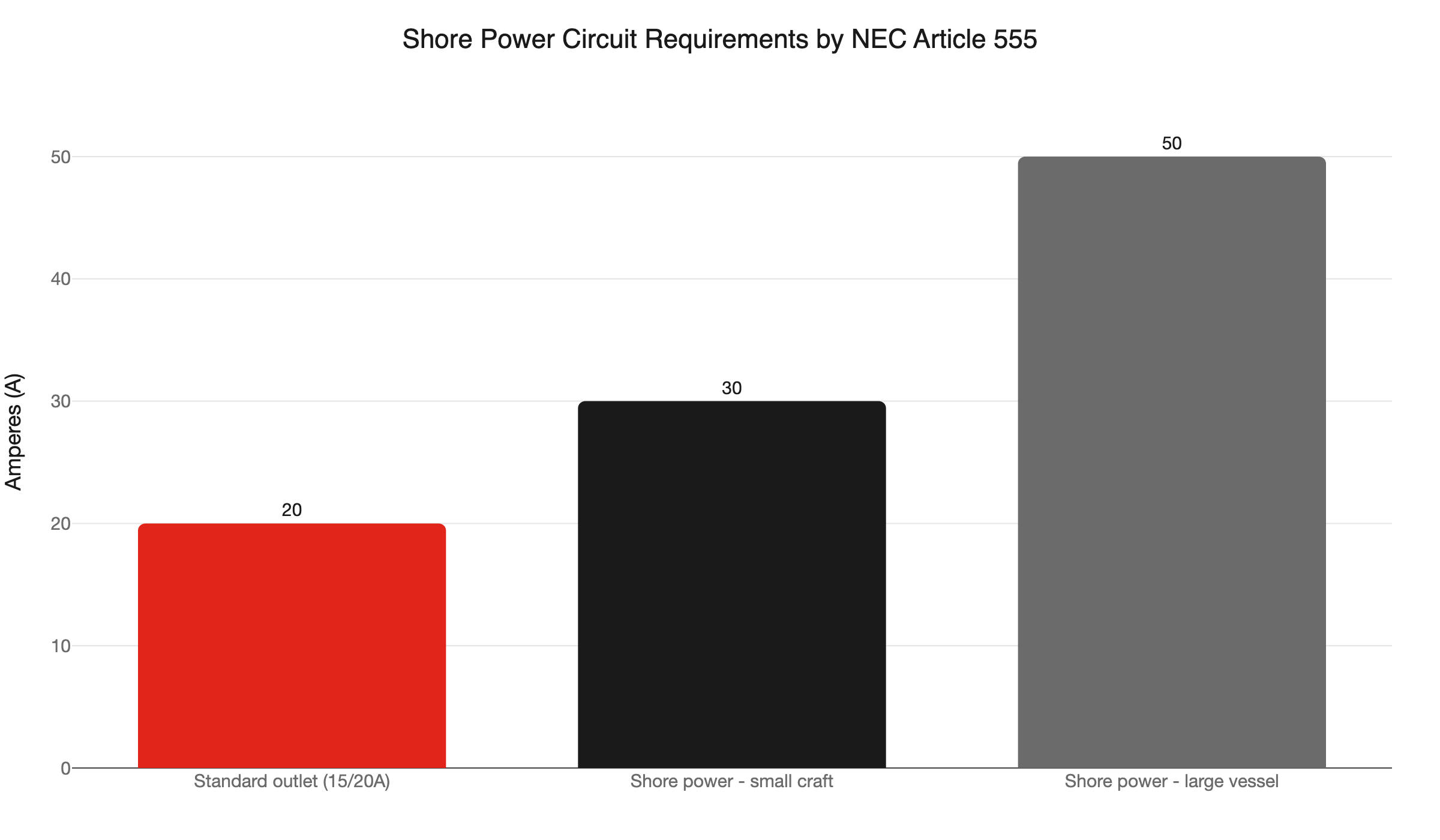
Yes. NEC Article 555 requires GFCI protection on all 15/20A 125V outlets at any docking facility, including private residential docks. Shore power at 30A and 50A needs ground fault protection at the breaker - not just at the outlet. Several NEC articles together govern dock wiring, with one adding GFCI requirements on all equipment in, on, or near a natural body of water, including boat hoists and their circuits.
If your dock has a plain duplex outlet with no GFCI, that is a code violation. It is also a direct fault path to the water anyone is swimming in.
GFCI devices do not last forever. Moisture, UV exposure, and Minnesota’s freeze-thaw cycles shorten the lifespan of internal components. A GFCI that looks fine may still fail to trip when a ground fault occurs. Press the test button on every dock GFCI at the start of each season. Replace any that do not trip and reset cleanly.
Shore power connections add another layer of risk. A vessel plugged into a dock outlet can develop a fault inside the boat. That fault travels back through the shore power cord and into the dock’s electrical system - and from there into the water. Ground fault protection at the breaker level is what stops that current before it reaches anyone in the water. The Lake Vermilion incident followed exactly that pattern.
For a broader look at GFCI requirements throughout a home, see our guide to GFCI outlet requirements explained.
What Is Equipotential Bonding and Why Does My Dock Need It?
Equipotential bonding ties all exposed metal parts of a dock into one continuous electrical network held at the same voltage potential. Current does not flow between points at equal potential. Bonding eliminates the voltage gradient that a swimmer’s body would otherwise bridge near the dock structure.
NEC 555.13 requires bonding all exposed non-current-carrying metal parts on a dock that could become energized. That list includes:
- Dock ladders
- Steel pilings and posts
- Metal handrails and grab bars
- Cleats and mooring hardware
- Metal conduit runs along the dock structure
The bonding conductor must be sized per NEC Table 250.122. For a 30A breaker, the minimum is 10 AWG. Undersized bonding conductors are one of the most common findings on older dock installations.
The 2023 NEC added Section 555.14 as an entirely new requirement. This section requires equipotential planes adjacent to all outdoor service equipment or disconnecting means that control equipment in or on water, where voltage exceeds 250V to ground and the equipment is within 10 feet of the water. The bonding conductor for that plane must be solid copper - insulated, covered, or bare - at a minimum of 8 AWG.
Most dock owners have never heard of Section 555.14. A dock inspection that predated the 2023 NEC adoption did not check for it. If your dock panel or disconnect is within 10 feet of the water’s edge, 555.14 compliance is now the baseline - not an upgrade.
Our post on electrical bonding and grounding explained walks through the full principles behind both NEC 555.13 and the broader grounding system requirements.
The Warning Sign Every Minnesota Dock Owner Is Probably Missing
NEC 555.10 requires every docking facility - including residential docks - to post a permanent sign reading exactly:
“WARNING - POTENTIAL SHOCK HAZARD - ELECTRICAL CURRENTS MAY BE PRESENT IN THE WATER.”
The sign must be visible from all approaches to the dock. Not just one end. Every point from which someone can access the water near that dock.
Most private dock owners in Minnesota have never installed this sign. Many do not know the requirement exists. The absence is not just a code citation if an inspector shows up. If an ESD incident occurs at a property without the required warning sign, the property owner’s liability exposure increases substantially. A family that swam there without any warning had no way to protect themselves.
If you do not have this sign, that is a fast fix. But it is also a reliable signal. If this basic visible requirement was never installed, the electrical system underneath it likely has not seen a professional eye in years either.
Minnesota’s 2026 NEC Transition: What Changes After August 17?
The Minnesota Department of Labor and Industry adopts the 2026 National Electrical Code effective August 17, 2026. Permits filed before that date are inspected under the 2023 NEC. Permits filed on or after August 17 must comply with the 2026 NEC. Which code edition your dock permit falls under depends entirely on when you pull it.
This transition matters in three concrete ways.
First, any electrician trained primarily on the 2020 NEC or earlier may not know the 2023 additions to Article 555. Section 555.14 on equipotential planes is new to the 2023 NEC. Several GFCI and bonding provisions were updated alongside it. A contractor who has not worked through those changes will miss things during installation and inspection.
Second, Minnesota electrical licensing exams shift to the 2026 NEC on September 8, 2026. The industry is in a knowledge transition right now. When you hire an electrician for dock work, ask directly which code edition they are current on. Ask specifically about the 2023 updates to NEC Article 555.
Third, many lake properties carry unpermitted dock wiring. A panel added by a previous owner without permits was never inspected. If that is your property, you are almost certainly not current on code - regardless of which edition applies. Unpermitted dock panels are where serious bonding and grounding gaps hide.
What Are the Most Common Boat Dock Wiring Failures in Minnesota?
Ice heaving and UV degradation cause the majority of dock wiring failures here. The original installation is rarely the problem. A single Minnesota winter shifts dock posts, stresses conduit runs, and pulls wire connections loose at junction points. Cable jackets exposed to direct sun on the water degrade within one to three seasons.
These are not slow, invisible processes. They produce real faults that create real ESD risk by the time you return in May.
Check these items every spring before anyone swims near the dock:
- Conduit: Look for cracks, kinks, or separation at connectors. A cracked conduit run is an open path for water to wick toward connection points. Water at a connection that freezes and thaws repeatedly is a ground fault in progress.
- Cable jackets: Exposed cable that is chalky, cracked, or brittle needs to be replaced. UV damage happens faster on the water than on land.
- GFCI outlets: Press the test button on every one. Any that do not trip and reset cleanly must be replaced before the dock is used.
- Panel and junction boxes: Open each enclosure and look for rust staining, condensation marks, or standing moisture. Water in any electrical enclosure is an immediate hazard.
- Breakers: Breakers that feel sticky or trip with unusual resistance may be moisture-compromised. Replace them.
- Shore power connections: Check the inlet housing for corrosion and confirm the locking mechanism seats fully. A loose shore power connection arcs at the contact point.
If your dock wiring is more than five years old and has not been professionally inspected, schedule an inspection before anyone swims this season. Our post on lake cabin electrical winterization covers the right way to decommission dock wiring in the fall and reduce spring damage from ice heaving.
Boat Lift Circuit Requirements
A boat lift motor is not a plug-in appliance. Running it on an existing dock outlet is not acceptable and not code-compliant. NEC prohibits extension cords for boat lifts. That is a code prohibition, not a recommendation. It applies to temporary and occasional use as well as permanent setups.
A properly wired boat lift circuit must include:
- A dedicated branch circuit breaker - nothing else shares the circuit
- Motor overload protection sized to the lift manufacturer’s specifications
- GFCI protection at the breaker level, not only at an outlet
- The lift frame bonded into the dock’s equipotential bonding system per NEC 555.13
Lift motors draw substantially higher current at startup than during normal operation. Running a lift on a shared circuit creates repeated overload events. Over time, those overloads degrade wire insulation at connection points and can initiate arc faults where wires meet terminals. A properly sized dedicated circuit eliminates all of that.
If your lift currently plugs into a dock outlet or runs through an extension cord, that needs to change before the end of this season. A licensed electrician can run a dedicated branch circuit to a weatherproof enclosure at the lift location with all required protection already built in.
Does My Boathouse or Dock Panel Need Its Own Ground Rod?
Yes. Under NEC 250.32, any detached structure fed from the main cabin or home requires its own grounding electrode system at that structure. A boathouse, a separate dock panel, and a lift motor enclosure all qualify. That typically means a ground rod at the boathouse, bonded to the panel enclosure there.
Many lake properties do not have this. The dock panel was added at some point, wired back to the cabin, and no one installed a grounding electrode at the far end. Sometimes a previous owner did the work. Sometimes a contractor who was not familiar with the detached structure requirement handled it.
Without a grounding electrode at the detached structure, fault current can return along paths that create voltage gradients in the surrounding water. That is exactly the scenario that produces ESD risk near a dock - and it can exist even when the rest of the wiring looks fine.
If your dock panel was never permitted and inspected at time of installation, there is a strong chance this piece is missing. Our post on detached garage subpanel installation covers NEC 250.32 in detail, including what a compliant installation looks like and what the permit and inspection process involves for any detached structure fed from a main building.
Schedule Your Boat Dock Wiring Inspection in the Twin Cities
The August 17 code transition is weeks away. The Lake Vermilion death was less than a month ago. If you have lake property in the Twin Cities metro - Minneapolis, St. Paul, Bloomington, Brooklyn Park, Woodbury, Blaine, Maple Grove, or Plymouth - now is the time to get on the schedule.
Call Northern Mister Sparky at 763-200-5956 or book online to schedule your boat dock wiring inspection. We are locally owned and operated in the Twin Cities, backed by the “America’s On-Time Electrician(R)” standard and our UWIN(R) 100% satisfaction guarantee. Our electricians are current on the 2023 NEC changes to Article 555. They know what a Minnesota winter does to conduit runs and connection points - and they know what to look for on an older lake property that has never been inspected.
If your dock needs bonding work, a new boat lift circuit, a shore power inlet upgrade, or a panel addition, ask about our financing options when you book. Dock electrical projects qualify. End-of-summer scheduling fills quickly. Do not wait until after August 17 to get on the calendar.
Frequently Asked Questions
Is GFCI protection required on residential boat docks in Minnesota? +
What is electric shock drowning and how does it happen at a dock? +
When does Minnesota's 2026 electrical code take effect for dock permits? +
Need an electrician now?