
Carport Electrical Wiring Outlets: What Minnesota Code Requires
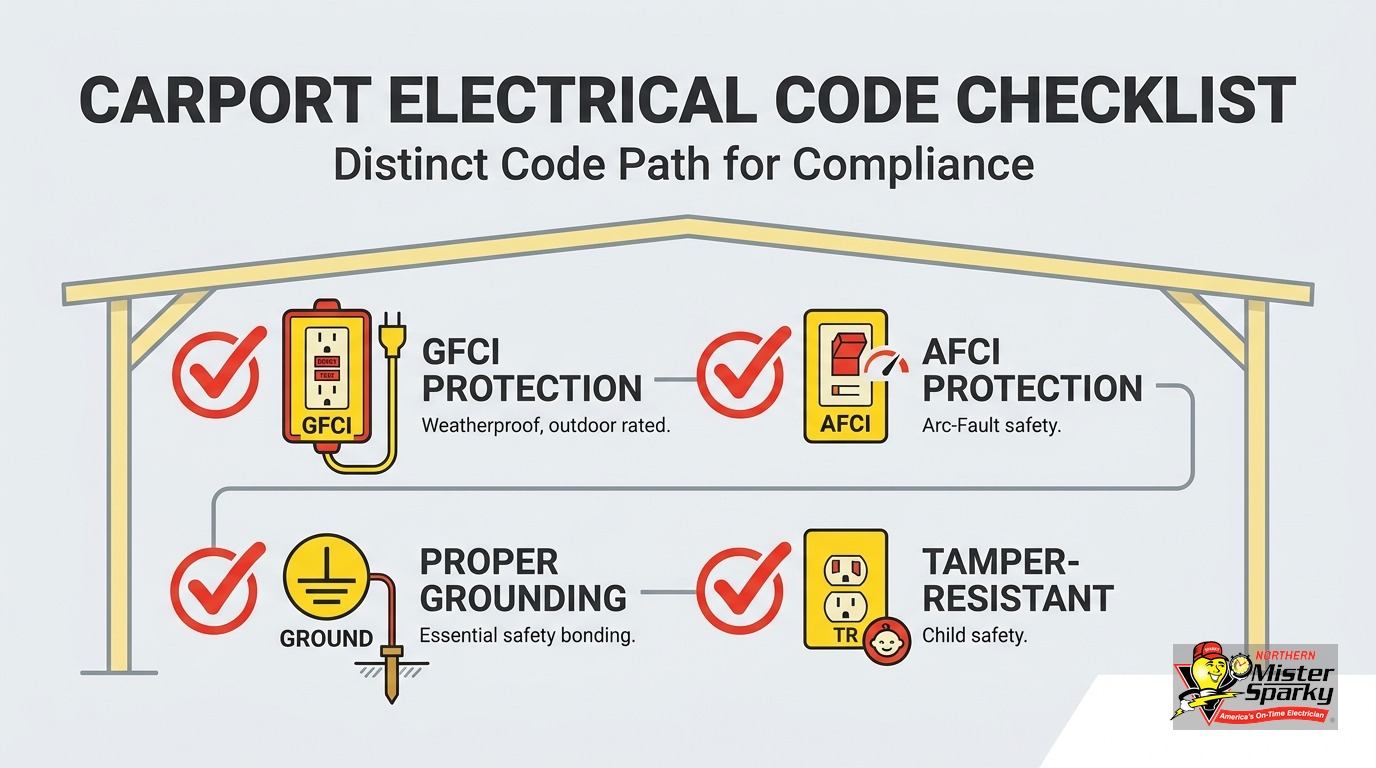
Key Takeaways
- An open-sided carport is classified as an outdoor location under the NEC, not a garage. That distinction changes every code section that applies to the wiring.
- NEC 210.8(A)(3) requires GFCI protection on every outdoor receptacle at a dwelling unit. Carport outlets qualify, attached or detached.
- NEC 210.8(F), added in the 2020 NEC, extends GFCI protection to hardwired outdoor lighting outlets, not just receptacles. A light mounted under a carport roof likely qualifies.
- Most Twin Cities carports are wet locations. Wet locations require extra-duty in-use covers that stay weatherproof while a cord is plugged in.
- Romex (NM-B cable) is not permitted in exposed outdoor runs. Carport wiring requires UF-B cable or conductors in listed conduit.
- Minnesota adopted the 2026 NEC on August 17, 2026. Permits filed after that date must comply with the newest edition.
- Roughly 40 Twin Cities municipalities handle their own electrical permits. Verify your authority having jurisdiction (AHJ) before filing anything.
- Call 763-200-5956 or book online to schedule your carport electrical estimate with our locally owned Twin Cities team.
Why a Carport Follows a Different Electrical Code Path Than a Garage
Most online guides treat carports as inexpensive garages. The NEC does not.
An enclosed garage has walls. The NEC assigns it specific rules: NEC 210.11(C)(4) requires at least one dedicated 120V/20A branch circuit for receptacles, and interior walls can use standard Romex in protected locations. That dedicated-circuit rule applies to garages, not carports.
A carport has a roof and posts. No enclosed walls. Every outlet is exposed to weather. The NEC treats it as an outdoor location under NEC 210.52, which routes carport wiring through the outdoor code path: GFCI protection under NEC 210.8, cover requirements under NEC 406.9, and conduit or UF-B cable for exposed runs.
Both code paths can end up with a GFCI-protected 20A circuit and weatherproof covers. But the sections that govern them differ, and the inspection checklist differs. Running a carport job as if it were a garage job is the most common reason carport electrical work fails inspection in the Twin Cities.
The gap in most online articles is exactly this: they describe what outdoor outlets need without explaining that a carport lands on a fully outdoor code path rather than a mixed indoor/outdoor one. That distinction determines your cover type, your conduit requirements, and which NEC sections the inspector checks when they walk the job.
Does a Carport Count as a Wet Location or a Damp Location?
Short answer: Most Twin Cities carports are wet locations. An open-sided structure exposed to blowing rain and snow meets the definition of wet under NEC 406.9. Misclassifying as damp means wrong hardware and a failed inspection.
The NEC draws a clear line between two outdoor location types:
Damp location: Covered and substantially protected from direct precipitation. A deep covered porch where rain almost never reaches the wall qualifies. The cover only needs to close when nothing is plugged in.
Wet location: Exposed to weather, including wind-driven rain, sleet, and snow. An open carport with unenclosed sides fits this definition. The outlet cover must stay weatherproof while a cord hangs out of it.
A standard flip-lid cover satisfies the damp requirement but not the wet requirement. Installing one in a wet-location carport means a failed inspection and hardware that will eventually fail in the field.
In the Twin Cities, seasonal blowing snow and rain penetrate most carport configurations from multiple angles. Unless your carport has substantial protective walls or an exceptional overhang depth, classify it as wet and specify hardware accordingly. When in doubt, wet is the safer call — the hardware costs a few dollars more and eliminates the risk of a re-inspection.
What GFCI Protection Does a Carport Outlet Need?
Short answer: Every receptacle must be GFCI-protected under NEC 210.8(A)(3). A GFCI breaker at the panel or a GFCI outlet at the first device on the circuit both satisfy the code. A GFCI breaker is typically the cleaner solution for a dedicated carport run.
A GFCI breaker protects everything downstream on the circuit: all receptacles and all hardwired connections. There is no in-wall GFCI outlet to track down if the circuit trips. For a carport fed by a single dedicated circuit, one breaker at the panel handles the whole job.
There is also a requirement that catches many homeowners off guard. NEC 210.8(F), added in the 2020 NEC, extends GFCI protection beyond receptacles to all outdoor “outlets,” including hardwired luminaires. A light mounted to a carport post or the underside of the roof is an “outlet” under the NEC. Its branch circuit must have GFCI protection if it is on a single-phase circuit rated 150V to ground or less at 50A or less.
That covers virtually every carport lighting circuit. If your carport has both a receptacle and a hardwired light on the same circuit, a single GFCI breaker protects both with one device and one point of failure to monitor.
If a GFCI outlet is used instead of a GFCI breaker, it must be at the first outlet on the circuit and the downstream protection must be confirmed with the inspector. Some electricians mark downstream outlets “GFCI Protected” as required when the protection comes from an upstream device rather than the outlet itself.
What Kind of Cover Does a Carport Outlet Need?
Short answer: A wet-location carport outlet requires a listed extra-duty in-use cover — the box-style hood that stays sealed while a cord is plugged in. The standard flip-lid cover is not acceptable in a wet location. NEC 406.9(B) is the controlling section.
The two tiers of outdoor cover requirements:
Damp location (NEC 406.9(A)):
- Listed weather-resistant (WR) receptacle
- Weatherproof outlet box
- Cover that closes when nothing is plugged in
Wet location (NEC 406.9(B)):
- Listed WR receptacle
- Weatherproof outlet box
- Cover listed and marked “extra-duty” — must remain weatherproof while a cord is plugged in
The extra-duty cover is the larger box-style in-use cover common on exterior walls and job sites. It extends out from the wall and shields the plug and cord from rain and snow even while something is plugged in. That bulk is exactly what a Minnesota winter demands.
The receptacle itself must carry the “WR” marking. A standard indoor duplex receptacle is not listed for outdoor use. In an outdoor environment it can corrode internally and fail in ways that are not visible until there is an arc or a ground fault. Inspectors check WR markings at the final inspection, and an unmarked receptacle in a wet location box is a quick fail.
Can I Use Romex for Carport Wiring?
Short answer: No. Romex (NM-B cable) is not listed for wet or damp locations. Carport wiring requires UF-B cable or individual THHN/THWN conductors in listed conduit — Schedule 40 PVC, EMT, or rigid metallic conduit — for any exposed outdoor run.
This is the most common code violation in DIY carport electrical work. Romex is ordinary house wire, designed for protected indoor locations. Its outer jacket absorbs moisture in exposed outdoor environments, degrades, and eventually fails. A Romex run in an open carport will not pass inspection, and it will not perform reliably over a Minnesota winter regardless of what the inspector does.
The two permitted options for outdoor runs:
UF-B cable (Underground Feeder): Listed for wet locations and direct burial. You can run it in conduit or bury it directly. It is the most common choice for the underground portion of a run from the house to a detached carport.
THHN/THWN conductors in listed conduit: Individual wires pulled through conduit. Schedule 40 PVC is common for post-mounted or slab-embedded runs — it resists moisture and does not rust. EMT suits surface-mounted runs in sheltered areas under the carport roof. Rigid metallic conduit is appropriate where physical impact protection matters, such as a run along a post that gets bumped by vehicles.
Romex is fine for the interior wall portion of the run before the circuit exits the house. The outdoor requirement begins at the point where the circuit transitions to an outdoor location — typically the exterior box on the house wall where the conduit begins.
For a broader look at when conduit is required versus when Romex is permitted, see our post on conduit vs. Romex for residential wiring.
Does Carport Electrical Work Require a Permit in Minnesota?
Short answer: Yes. Any new circuit or outlet requires a permit and inspection. Roughly 40 Twin Cities municipalities have their own local electrical inspection authority — filing with the state DLI when your city runs its own program means filing with the wrong office and delays the project. Verify your AHJ first.
Minnesota homeowners can pull their own electrical permit on an owner-occupied single-family home, but must perform all work personally and still pass inspection. If you hire a licensed electrician, the contractor files the permit. You should not file and then hand the work to a contractor — that creates a permit ownership mismatch that complicates the inspection.
Identifying your authority having jurisdiction (AHJ) is the first step before any paperwork. Cities like Minneapolis, St. Paul, Bloomington, and many suburbs run their own electrical inspection programs separate from the state Department of Labor and Industry. Filing a state DLI permit when your city handles its own permits does not get the right inspector to your door.
The electrical subpermit for a carport typically costs $100 to $200 on top of any structural permit. The permit application must include wire gauge, circuit amperage, conduit type, and outlet locations. A rough diagram of the outlet placement and circuit routing satisfies this requirement in most jurisdictions.
Timing matters right now: Minnesota adopted the 2026 NEC effective August 17, 2026. Any permit filed on or after that date must comply with the 2026 edition. Minnesota is among the first states in the country running this code. Any carport project permitted today is a 2026 NEC project, and the licensed electrician you hire should be current on the transition.
Our post on electrical permits in Minnesota walks through the AHJ verification step and what inspectors check at rough and final stages.
How Deep Does Underground Conduit Need to Be for a Detached Carport?
Short answer: NEC minimum burial depths vary by conduit type: 18 inches for PVC conduit under a yard, 6 inches for rigid metallic conduit, and 24 inches for direct-buried UF-B cable without conduit. Local AHJs may require more. Minnesota’s 48-to-60-inch frost depth means proper bedding and backfill matter as much as raw depth.
If your carport is detached, the electrical run from the house goes underground. Frost heave in the Twin Cities metro is real and severe. A conduit run that is too shallow, improperly bedded, or connected with undersized fittings can shift, crack a joint, or expose wire by the third Minnesota winter.
The NEC minimums are a floor, not a complete specification. Your local AHJ may require greater depth, particularly if the run crosses a driveway or parking area. Trench depth under vehicular traffic is greater than trench depth under a lawn. Confirm the required depth with your AHJ before digging.
The trench cost and routing adds considerably to a detached carport job compared to an attached one. A longer run also requires a voltage drop check. If the wire gauge is sized only for the breaker amperage and not for the run length, voltage at the outlet end drops below the useful range for motors and tools. The electrician sizes the conductor for the actual run, not just the breaker size.
What Size Circuit Does a Carport Need?
Short answer: The NEC does not mandate a dedicated circuit for an open carport the way it does for a garage under NEC 210.11(C)(4). But a 20A, 120V circuit is the right baseline for any vehicle bay. Size for the loads you will realistically run, including anything you may add in the next five years.
A 15A circuit handles a shop light and a phone charger. It does not handle a battery charger, a portable compressor, and a car warmer at the same time. Most carport owners who start with a 15A circuit end up calling for a second run within a few years.
Common load scenarios that change the circuit design:
Chest freezer or second refrigerator in the carport: Needs its own dedicated circuit — 15A or 20A. Sharing it with a general-use circuit causes nuisance tripping and risks a spoiled freezer during a summer heat wave when the other loads are also running.
EV charger: A Level 2 EV charger requires a dedicated 240V circuit — a completely separate scope from the general outlet circuit. Our EV charger installation service covers what that involves in the Twin Cities, including load calculation, panel capacity check, and financing options for larger installations.
Lighting on a separate circuit: Splitting the carport into a receptacle circuit and a lighting circuit keeps the lights on if the outlet circuit trips. For a working carport with power tools, this setup is worth planning from the start.
The right time to specify the circuit count is before conduit goes in. Adding a second circuit through an existing conduit run is only possible if the conduit was sized for it. Oversizing the conduit on the first run costs little upfront and saves a complete tear-down later.
How Does a Carport Compare to a Garage for Electrical Code Purposes?
Short answer: A garage is partially enclosed, so it gets a hybrid code treatment: dedicated circuit rules for the interior, outdoor rules for exposed outlets. A carport is fully open. Every outlet, every hardwired light, and every exposed wire run follows outdoor code requirements from start to finish.
An attached garage must have at least one dedicated 20A receptacle circuit under NEC 210.11(C)(4). Interior receptacles need GFCI protection. Interior walls can use Romex. Outlets in protected interior locations can use standard indoor covers. The outer wall of the garage, or any outlet under an open overhead door, gets the outdoor treatment.
None of those “interior” concessions apply to a carport. There are no interior walls. Every device is an outdoor device. Every circuit that serves a hardwired light is subject to NEC 210.8(F). Every outlet is in a wet location unless the specific installation proves otherwise.
The inspection checklist for a carport is narrower than a garage in some ways — no arc-fault considerations for interior circuits, no interior Romex decisions to make — but stricter on every item it does touch. Every component must meet outdoor wet-location standards, with no mixed code path to navigate.
For the complete attached garage electrical breakdown, including the 210.11(C)(4) dedicated circuit requirement and AFCI considerations, see our post on attached garage electrical wiring code.
Ready to Wire Your Carport the Right Way?
The carport electrical wiring outlets most homeowners install get the GFCI right but miss the wet-versus-damp classification, use a flip-lid cover in a wet location, or run Romex where conduit is required. Any one of those items fails inspection. All three together are a safety issue that the weather will eventually expose.
Minnesota is now on the 2026 NEC — the newest edition in the country, effective August 17, 2026. If you are planning carport electrical work in Minneapolis, St. Paul, Bloomington, Maple Grove, Woodbury, or anywhere else in the Twin Cities metro, you are working under an updated code with AHJ requirements that vary city by city. Getting the permit filed with the right authority, to the right code, matters from the first day of the project.
Our team is locally owned and operated in the Twin Cities. We are America’s On-Time Electrician(R), and every job is backed by the UWIN(R) 100% satisfaction guarantee. No malarky — just licensed electricians who show up on time, pull the permit, and wire it to pass inspection the first time.
Call 763-200-5956 or book online to schedule your carport electrical estimate.
Frequently Asked Questions
Do all carport outlets need GFCI protection? +
Can I use Romex wire in a carport? +
Do I need a permit for carport electrical work in Minnesota? +
What is the difference between a damp location and a wet location outlet cover? +
Need an electrician now?