
Conduit vs Romex: When to Use Each in Residential Wiring
Key Takeaways
- Romex (NM-B cable) is code-correct for concealed, dry locations: inside finished walls, ceilings, attics, and crawlspaces.
- Conduit is required whenever wire is exposed: unfinished garage walls, open basement ceilings, outdoor surfaces, and underground feeds to a detached structure.
- Romex inside outdoor conduit is a code violation. Use THWN-2 or XHHW-2 in any wet-location conduit.
- Minnesota adopted the 2026 NEC with an effective date of August 17, 2026. Permits filed on or after that date must meet the new code.
- The most common real-world trigger for this question is an EV charger in an unfinished garage. The wall run is exposed, so conduit is required for that section.
- All new circuits in Minnesota require a permit, regardless of who does the work.
- Twin Cities electricians typically choose EMT over PVC for exposed outdoor runs. PVC can become brittle in sustained sub-zero temperatures.
What Is Conduit vs. Romex - and When Should You Use Each in Residential Wiring?
Romex is the standard sheathed cable for concealed, dry spaces inside your home. Conduit is a protective tube required wherever wire is exposed to physical damage, weather, or moisture. The structure of your house protects Romex; conduit protects wire when the structure does not.
“Romex” is the brand name most people use for NM-B (nonmetallic-sheathed) cable. It is the white or yellow cable stapled to studs before drywall goes up. NEC Article 334.10 permits NM-B in one-to-three-family dwellings, concealed in dry locations. The moment a run becomes exposed, the code requires a different approach.
Conduit is a raceway. Wire is pulled through it after the conduit is installed. The three types you will encounter on residential projects are:
- EMT (electrical metallic tubing): thin-walled metal, the standard for exposed indoor and exterior runs
- PVC Schedule 40: gray plastic, the standard for underground runs
- RMC (rigid metal conduit): thick-walled metal, used where maximum physical protection is required
Understanding which type applies depends on where the wire runs and what it is exposed to.
Where Is Romex Permitted by Code?
Romex is permitted in concealed, dry locations inside a residence - inside finished walls, ceilings, attics, and crawlspaces where the building structure provides physical protection. It is appropriate for the vast majority of interior residential wiring.
Every outlet, switch, and light fixture in a finished room typically runs on Romex. If the wire is behind drywall, above a finished ceiling, or inside an attic or crawlspace, Romex is code-compliant and the practical choice.
The NEC’s definition of “dry location” matters here. It means the wire is protected from weather and moisture by the surrounding structure. A finished basement ceiling? Romex is fine. The same wire run across an exposed block wall? That is a different situation.
One note specific to Minnesota: the state does not restrict Romex the way some jurisdictions do. Some cities require metal conduit for all residential wiring. Minnesota has no such local amendment. Romex in concealed residential spaces is fully permitted here. If a contractor tells you otherwise, ask them to cite the specific code section.
NM-B cable comes in several common sizes. Use 14/2 for 15-amp circuits. Use 12/2 for 20-amp circuits. Dryer and range circuits take 10/2 or 10/3 for 30-amp loads. The gauge must match the breaker size - that is a separate requirement from wiring method, and both matter at inspection.
When Does Code Require Conduit for Residential Wiring?
Conduit is required any time wire is exposed - visible on a wall or ceiling surface, on the exterior of a building, or transitioning above ground from a buried underground run. It is also required for all outdoor and underground wiring beyond what direct-burial cable allows.
NEC 334.12 prohibits NM-B cable where it is subject to physical damage. The practical test: can you see the cable without opening a wall or ceiling? If yes, conduit is likely required for that run.
Common situations that trigger a conduit requirement:
- Unfinished garage wall runs: Any circuit feeding an outlet, EV charger, or heater in an unfinished garage. The surface is exposed; conduit is required.
- Open basement ceilings: Wire running along exposed joists or block walls in an unfinished basement. If it is visible and reachable, it needs protection.
- Exterior wall surfaces: Any wire on the outside of the house, including service entrance conductors.
- Above-grade stub-ups: Where an underground feed transitions from buried to above-ground at a detached garage or outbuilding.
- Wet and damp locations: Any space the NEC classifies as wet or damp, including some crawlspaces and exterior areas.
The rule also applies within an attached garage if wire runs on an exposed surface. A Romex cable you can reach and touch is almost always in the wrong location without conduit around it.
For specifics on what attached garage wiring requires, see our post on attached garage electrical wiring code.
Does My Unfinished Garage Wall Need Conduit?
Yes. An exposed run down an unfinished garage wall requires conduit. NEC 334.12 prohibits NM-B where subject to physical damage. An open stud bay or block wall surface qualifies. EMT is the standard choice for this application in the Twin Cities.
The typical scenario: the garage has drywall on one wall and exposed block or open studs on the rest. A new circuit needs to run from the sub-panel down to an outlet, a heater, or a charger. The exposed run goes in EMT conduit. The wire pulled through that EMT is THWN-2, not Romex.
The EMT run requires weatherproof fittings where it connects to boxes and the panel. In an exposed garage run, most electricians use metal boxes rated for the environment.
If the garage is fully finished with drywall, the calculation changes. Wire concealed inside a finished wall or ceiling cavity can use Romex. The drywall provides the physical protection the NEC requires. But any exposed section of a run still needs conduit for that portion.
Minnesota inspectors check this carefully. The most common write-up on a garage circuit inspection is exposed NM-B cable on a wall surface, or Romex pulled through outdoor-rated conduit instead of THWN-2.
What About Running Wire to a Detached Garage?
An underground run from the house to a detached garage can use direct-burial UF cable or conduit. Either is code-compliant for the underground portion. The above-grade transition - where the wire exits the ground - must be in RMC, IMC, or Schedule 80 PVC per NEC 300.5(D).
The NEC provides two compliant options for the underground section:
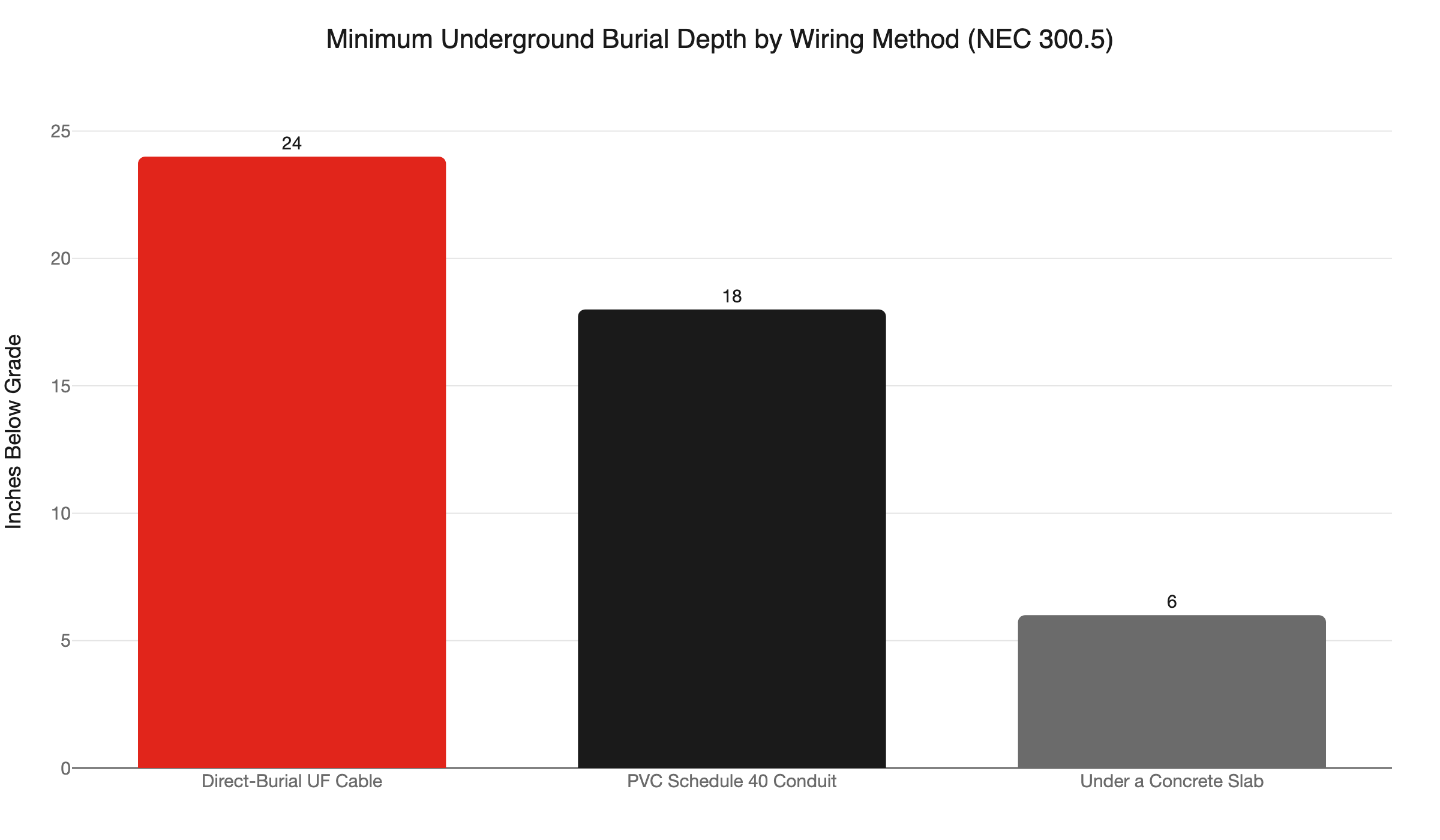
- Direct-burial UF cable at a minimum depth of 24 inches below grade
- PVC Schedule 40 conduit at a minimum depth of 18 inches, or 6 inches under a concrete slab
Most electricians in the Twin Cities prefer the conduit option. If you need to upgrade the circuit later, you pull the old wire out and pull new wire in. No digging required. That convenience is worth the modest extra cost at install time.
The above-grade transition is the detail most homeowners miss. NEC 300.5(D) requires RMC, IMC, or Schedule 80 PVC from 18 inches below grade up to the termination point. That stub-up protects the wire from shovels, lawn equipment, and physical impact at grade level. PVC Schedule 40 is not permitted for this section.
A question that comes up often in Minnesota: does the conduit need to go below the frost line? No. Electricity does not freeze. The NEC’s 18-inch minimum applies regardless of climate. The Twin Cities frost line is approximately 42 inches, but electrical conduit does not need to reach that depth. Going deeper under driveways is common to avoid future excavation disturbance.
If the detached garage project includes its own sub-panel, see our guide on detached garage subpanel installation.
Can I Use Romex Inside Outdoor Conduit?
No. NM-B (Romex) is not rated for wet locations. Wire pulled through outdoor or underground conduit must be THWN-2 or XHHW-2. Both carry a wet-location rating. Running Romex through outdoor conduit is a code violation, and it is one of the most common mistakes on DIY garage and outbuilding projects.
The “W” in THWN-2 stands for wet location. Any wire running through conduit exposed to moisture needs that rating. That includes outdoor EMT, underground PVC, and conduit in any wet-classified space.
XHHW-2 is an alternative with the same wet-location approval. Both are commonly stocked at electrical supply houses. THWN-2 is more common in residential work because it pulls easily through conduit bends.
Wire type and conduit type are two separate decisions. Installing the correct conduit does not make the wire inside it code-compliant. An inspector checks both independently. Getting one right and one wrong means a failed inspection.
Which Type of Conduit Should You Use?
For exposed outdoor runs in Minnesota, use EMT with weatherproof fittings. For underground runs, use PVC Schedule 40. For the above-grade stub-up on a buried feed, use RMC, IMC, or Schedule 80 PVC. Avoid PVC on exposed exterior surfaces in the Twin Cities: it becomes brittle in sustained sub-zero temperatures.
Here is a quick breakdown by application:
- EMT (electrical metallic tubing): The workhorse for exposed indoor and exterior runs. Easy to bend and cut. Requires weatherproof fittings and boxes outdoors. Standard choice for garage wall runs in Minnesota.
- PVC Schedule 40: Standard for underground runs. Less expensive than metal conduit. Do not use it for exposed outdoor runs in a Minnesota winter - it can crack in sustained cold.
- RMC (rigid metal conduit): Thick-walled and the most physically robust. Required for the above-grade stub-up on underground feeds. Used where conduit faces vehicle traffic or severe impact risk.
- Schedule 80 PVC: Thicker than Schedule 40. An approved alternative to RMC for the stub-up transition on underground runs.
For fitting and box requirements: match the fitting rating to the location. Outdoor runs need weatherproof (WP) rated boxes and fittings. Using standard indoor fittings on an outdoor run is a common inspection failure.
For a detailed code-level breakdown of each conduit type, Nassau National Cable’s guide on when conduit is required covers each type with NEC citations.
The 2026 NEC Transition: What Changes for Twin Cities Homeowners?
Minnesota adopted the 2026 NEC with an effective date of August 17, 2026. Permits filed before that date must comply with the 2023 NEC. Permits filed on or after that date must comply with the 2026 NEC. If you are pulling a permit this summer, confirm with your inspector which code cycle applies to your permit number.
Minnesota’s Department of Labor and Industry is the state authority on electrical code adoption. Minnesota adopts the NEC without state amendments. National rules apply exactly as written.
The DLI has published a 2026 NEC FAQ that addresses the most common code-change questions. If your project lands on the August 17, 2026 seam, ask your AHJ which code cycle governs your permit.
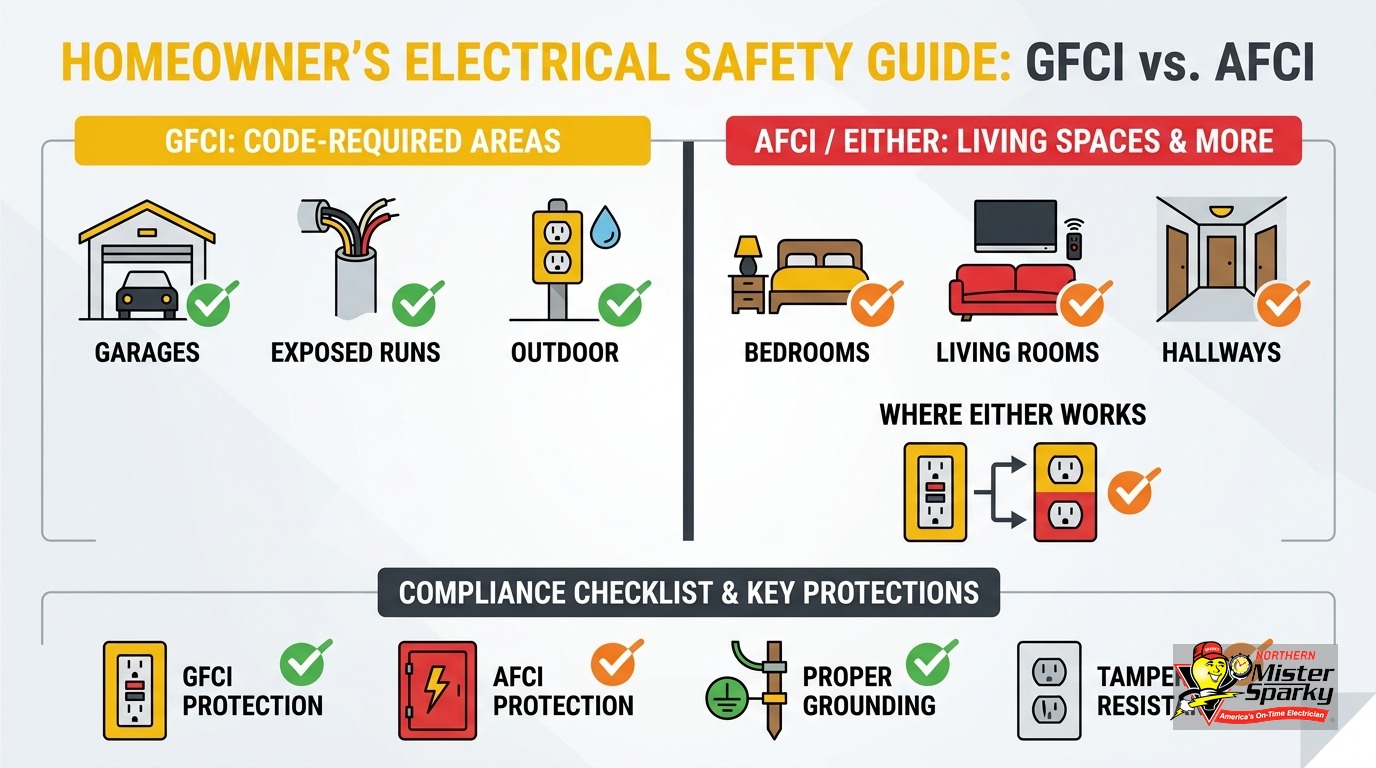
The core conduit-versus-Romex rules have not changed significantly between the 2023 and 2026 editions. NEC Article 334 governs NM-B cable in both. But other provisions have evolved. AFCI protection requirements now cover more spaces in the home. GFCI requirements have expanded as well. A new garage circuit may need protection under the 2026 code that was not required under an older edition. Your electrician will know which provisions apply based on your permit date.
EV Charger Wiring: Conduit or Romex?
For most Twin Cities EV charger installs, the wall run in an unfinished garage requires conduit. The circuit runs exposed along a wall or ceiling to reach the charger location. That exposed portion must be in EMT. Concealed runs inside a finished wall can use Romex for that section.
An EV charger is the most common reason Twin Cities homeowners run into the conduit-versus-Romex question right now. A Level 2 charger needs a 240-volt circuit - typically 50 amps for maximum flexibility. That circuit runs from the main panel or sub-panel to the charger mounting location.
In most unfinished garages, part or all of that run is exposed. The panel is on one wall. The charger location is on another. The run between them travels along an exposed surface. That run goes in EMT, with THWN-2 wire inside.
If the main panel is full, a garage sub-panel may be the right approach. The feed from the house to the garage follows the underground rules covered above. The run inside the garage from sub-panel to charger follows the exposed-run rules.
For a full walkthrough of what an EV charger installation involves in the Twin Cities, see our guide on EV charger installation.
Do You Need a Permit for Garage or Outdoor Wiring in Minnesota?
Yes. All new circuits in Minnesota require a permit, regardless of whether a homeowner or a contractor does the work. The permit triggers an inspection. That inspection protects you at resale and keeps your homeowner’s insurance valid.
Minneapolis and St. Paul each run their own electrical inspection programs. The Minneapolis residential electrical inspection checklist is a public document that shows exactly what inspectors look for. St. Paul’s DSI residential garage wiring guidance covers garage-specific requirements for that city.
Most metro-area cities operate their own inspection programs as well. If you are outside a major city, your township likely falls under the state DLI inspection program. File with the correct authority having jurisdiction before any work starts.
An inspection that catches a problem before drywall goes up costs almost nothing to fix. The same problem found after walls are closed is expensive. Unpermitted work can void your homeowner’s insurance. It also creates a documented liability when you sell the property.
For more on how the Minnesota permit process works, see our guide on electrical permits in Minnesota.
When to Call a Licensed Twin Cities Electrician
The conduit-versus-Romex decision is one layer of a garage or outdoor wiring project. Underneath it sit circuit sizing, breaker sizing, wire gauge, GFCI and AFCI protection requirements, and sub-panel load calculations. Getting the wiring method right but the circuit sizing wrong is still a problem.
Our team at Northern Mister Sparky is locally owned and operated right here in the Twin Cities. We are America’s On-Time Electrician(R), and every job comes with our UWIN(R) 100% satisfaction guarantee. No malarky: we show up when we say we will, do the work to code, and pull the permit.
If you are planning a garage circuit, an EV charger, a workshop sub-panel, or any outdoor wiring project, call us at 763-200-5956 or book online. For larger projects like panel upgrades or sub-panel installs, financing options are available - just ask when you call. We will give you a straight answer on exactly what your project requires.
Frequently Asked Questions
Can I use Romex on an exposed garage wall? +
What wire goes inside outdoor conduit? +
Do I need a permit to add a circuit to my garage in Minnesota? +
Need an electrician now?