
Circuit Breaker Replacement Cost: Twin Cities 2026 Guide
Key Takeaways
- Replacing a single circuit breaker in the Twin Cities runs $100-$375 all in, including parts and labor.
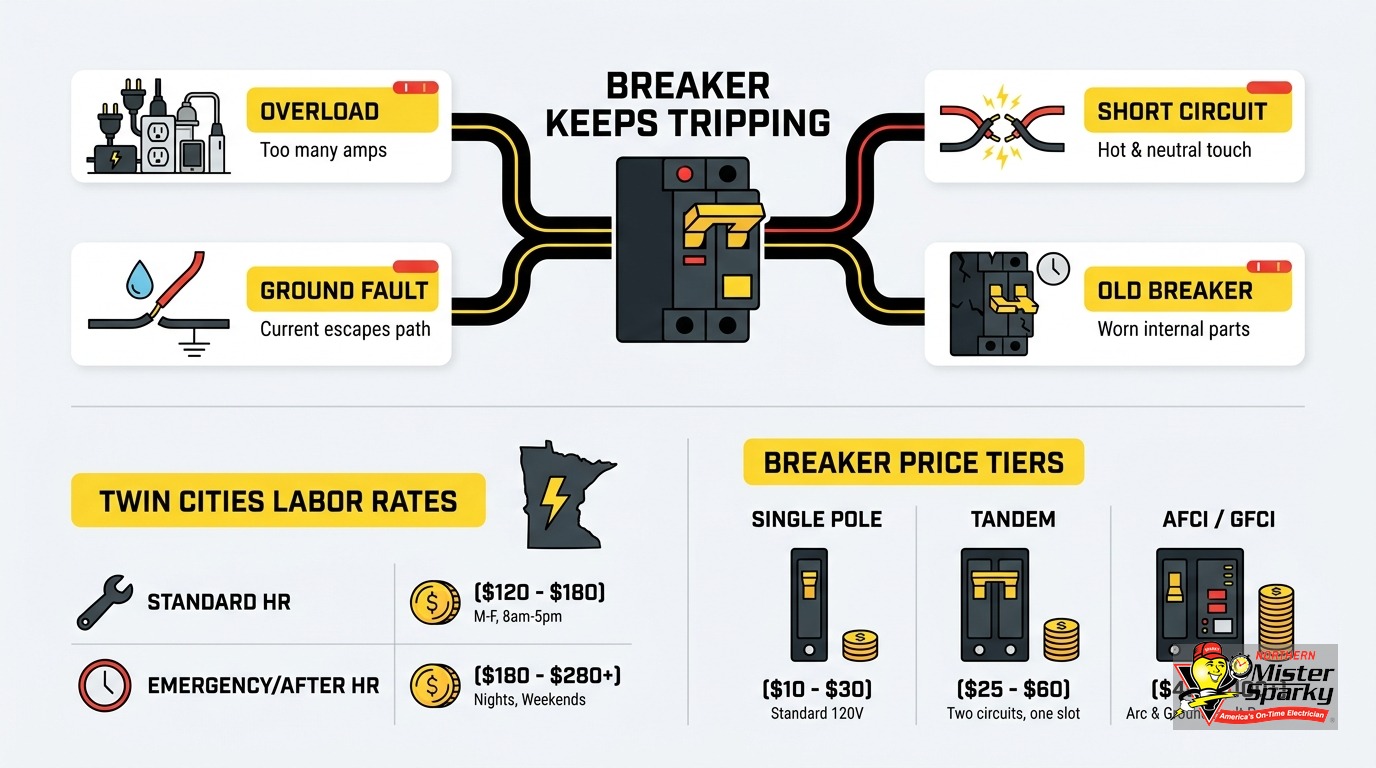
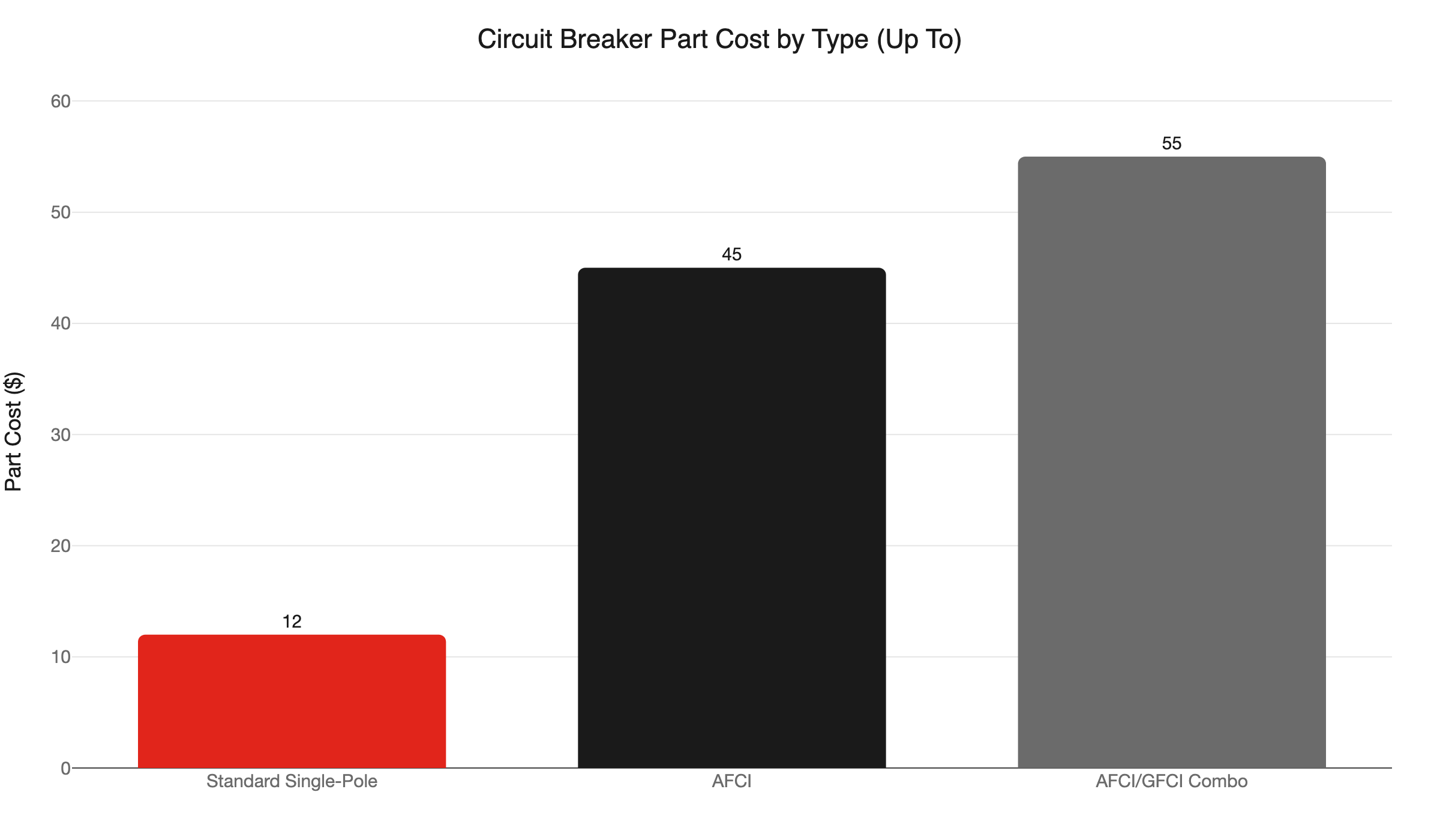
- Standard single-pole breakers cost $5-$12 for parts. AFCI breakers run $30-$45. AFCI/GFCI dual-function combo breakers run $40-$55.
- Twin Cities electricians bill $35-$100 per hour. Most jobs also carry a minimum service charge before any work begins.
- Minnesota requires a permit for any breaker replacement or repair. Homeowners may DIY only on a single-family homestead they own and occupy. Condos, apartments, and rentals require a licensed contractor.
- August 3, 2026 is a real planning date. Permits filed before that date follow 2023 NEC rules. Permits filed on or after August 3 follow the expanded 2026 NEC, which adds AFCI requirements to more circuits and can raise material costs on panel-level work.
- The Xcel Energy rebate pays up to $1,500 for panel amperage upgrades, not like-for-like breaker swaps.
- Call 763-200-5956 or book online to get a firm estimate for your Twin Cities home.
What Does Circuit Breaker Replacement Cost in the Twin Cities?
The short answer: A single-breaker swap in the Minneapolis-St. Paul metro runs $100-$375, all in. That range covers parts and labor. AFCI and AFCI/GFCI combo breakers push toward the upper end because the parts cost more than a standard breaker. The type your job requires depends on the circuit and Minnesota’s current code.
Most national cost guides quote $50-$130 per hour for electrical labor. That is a broad national range. It does not tell you what you will actually pay here.
Twin Cities electricians bill customers $35-$100 per hour. The average Minneapolis electrician earns about $47.66 per hour in wages. What you pay on your invoice reflects more than wages. Licensed electricians carry workers’ compensation insurance, liability insurance, and vehicle costs. They also pay permit fees and the overhead of running a properly licensed operation.
That overhead matters. It is what allows a contractor to stand behind the work with a written guarantee.
Most jobs also carry a minimum service charge. For a straightforward single-breaker swap, that minimum is often the largest labor line on the invoice. The hands-on work may take less than an hour once the electrician is on site.
All-in costs for a single breaker swap run $100-$375 nationally, which aligns with what you will see in the Twin Cities. A GFCI circuit breaker installation averaged $307-$373 nationally as of May 2026. For panel-level work, Minneapolis panel replacements average $1,677, roughly 5% above the national average.
How Much Does Each Type of Circuit Breaker Cost?
The short answer: Standard single-pole breakers cost $5-$12 per breaker in parts. AFCI breakers run $30-$45. AFCI/GFCI dual-function combo breakers run $40-$55. Those part costs then combine with labor. The type your job requires is determined by the circuit and Minnesota’s current code, not your preference.
Here is the breakdown, sourced from current market data:
- Standard single-pole breaker: $5-$12 per breaker
- AFCI breaker: $30-$45 per breaker
- AFCI/GFCI dual-function (combo) breaker: $40-$55 per breaker
A standard breaker handles overloads and short circuits. That is its full job. An AFCI breaker does the same thing and also detects arc faults, which are a leading cause of residential fires. A standard breaker cannot catch an arc fault. An AFCI/GFCI combo breaker adds ground-fault protection on top, covering circuits near water or moisture sources.
Tandem breakers are a fourth type worth knowing. A tandem, or piggyback, breaker fits two circuits into one panel slot. They are used when a panel is out of physical space but still has available amperage. Not every panel accepts tandem breakers. They do not provide AFCI or GFCI protection the way a full-size specialty breaker does. Your electrician will confirm compatibility before recommending one.
The part cost gap adds up fast at scale. On a 20-circuit panel where 15 circuits require AFCI under current code, choosing AFCI breakers instead of standard ones adds several hundred dollars in material before a single hour of labor. That gap grows further when the 2026 NEC expands AFCI scope, which is covered below.
What Does Labor Cost for a Circuit Breaker Replacement in Minneapolis?
The short answer: Twin Cities electricians bill $35-$100 per hour, and most jobs carry a minimum service charge. A simple single-breaker swap on an accessible, modern panel often wraps up in under an hour of hands-on work, making the minimum charge the primary labor cost on the invoice.
Minneapolis electrician billing rates run $35-$100 per hour. That range reflects the variety of firms, experience levels, and job complexity across the Twin Cities market.
Labor costs move higher when:
- The panel is in a tight, cold, or awkward location - a cold garage, crawlspace, or exterior-wall enclosure
- The existing wiring is aluminum or knob-and-tube
- The circuit is difficult to trace or identify in an older panel
- Multiple breakers need replacing in the same visit
- The job surfaces additional problems once the panel is open
Labor stays at the lower end when the panel is modern, accessible, and code-compliant, and the scope was clearly defined before arrival.
One cost that surprises homeowners: the minimum service fee applies even on quick jobs. It covers travel time, diagnosis, and the cost of showing up prepared. For a breaker swap that takes 45 minutes on site, that minimum can represent the majority of the labor line.
If your breaker keeps tripping and you are wondering whether it is a single bad breaker or a panel that has hit its limits, our guide on why your circuit breaker keeps tripping walks through the most common causes before you schedule service.
Do You Need a Permit to Replace a Circuit Breaker in Minnesota?
The short answer: Yes, always. Minnesota requires a permit for any replacement, alteration, or repair of electrical equipment. Homeowners can pull their own permits and do their own work only on a single-family homestead they own and occupy. Condos, apartments, and rental properties require a licensed contractor for all electrical work.
The Minnesota Department of Labor and Industry is explicit: a permit is required for any electrical replacement or repair, including a single circuit breaker. The homeowner exemption is narrow. It applies only to a single-family home you own and occupy as your homestead.
Apply for permits online at ims.dli.mn.gov. Questions go to dli.electricity@state.mn.us or 651-284-5026.
Permit fees vary by city and project type. In Rosemount, a panel board replacement carries a $100 reconnect fee. Other jurisdictions have different schedules. Your contractor will know the local fee structure for your area.
Skipping the permit is not a savings. It creates a paper trail problem that shows up later. Unpermitted electrical work can complicate homeowner’s insurance claims, home sale disclosures, and any future permit applications. The permit is the document that confirms the work was done correctly and inspected.
When Northern Mister Sparky handles your job, permit filing is part of the process. You do not navigate the paperwork yourself.
For a complete breakdown of how Minnesota electrical permits work and what homeowners are and are not allowed to do, read our electrical permit guide for Minnesota homeowners.
Will the 2026 NEC Code Change Raise My Circuit Breaker Replacement Cost?
The short answer: It can, depending on when your permit is filed. August 3, 2026 is the Minnesota cutoff. Permits filed before that date follow 2023 NEC AFCI requirements. Permits filed on or after August 3 fall under the 2026 NEC, which expands AFCI protection to more circuits and can raise material costs on any panel-level project.
Minnesota adopted the 2023 NEC on July 1, 2023. The 2026 NEC takes effect August 3, 2026. Here is what changes for AFCI requirements:
Under 2023 NEC (in effect through August 2, 2026):
AFCI protection is required on all 15A/20A 120V branch circuits serving bedrooms, living rooms, dining rooms, kitchens, laundry rooms, hallways, closets, basements, attached garages, and attics. Bathrooms are covered by GFCI only. Source
Under 2026 NEC (effective August 3, 2026 in Minnesota):
AFCI scope expands to virtually every living-space 15A/20A circuit. The primary exceptions are dedicated HVAC circuits, well pump circuits, sump pump circuits, outdoor circuits, and pool circuits on dedicated runs.
Why does this matter for your budget? Most Minneapolis and St. Paul jurisdictions require AFCI upgrades on all applicable circuits when a panel is opened for work - not just the single breaker being replaced. At $30-$45 per AFCI breaker, 10 extra circuits requiring AFCI under the 2026 NEC could add $300-$450 in material before labor. Many older Twin Cities homes have 20 or more branch circuits. The math changes meaningfully depending on which code version governs your permit.
If you are weighing a panel project, filing your permit before August 3 may save real money on materials.
Minnesota also added GFCI requirements under the 2023 NEC that go beyond the base national code. Dryers, ovens, ranges, and microwaves now require GFCI protection. An HVAC GFCI requirement takes effect September 1, 2026. These requirements stack on top of AFCI scope when a panel is opened.
Call 763-200-5956 before you schedule. We can tell you whether your permit timing makes a material difference for your specific scope.
Does the Xcel Energy Rebate Apply to Circuit Breaker Replacement?
The short answer: No, not for a like-for-like breaker swap. Xcel’s rebate covers panel upgrades that increase service amperage, not replacements at the same capacity. If your job requires going from 100A to 200A service, the rebate changes the math on a panel upgrade significantly.
Xcel Energy offers up to $1,500 toward residential panel amperage upgrades such as going from 100A to 200A service. Some Twin Cities contractors cite stacked rebate potential up to $2,500 when combined with other eligible incentives. The program runs through 2026, and funds are limited.
This distinction matters most in older Twin Cities neighborhoods. South Minneapolis, St. Paul, Edina, and Bloomington have a large inventory of homes built in the 1950s through 1970s. Many are still on 60-amp or 100-amp service panels. If breakers are tripping because the panel cannot handle modern electrical loads, a single breaker swap is the wrong solution.
Consider the numbers. A Minneapolis panel upgrade averages $1,677. With a $1,500 Xcel rebate, your net cost drops to roughly $177 for a complete service upgrade. A $375 stopgap breaker swap on a panel that needs replacing still leaves you with the full panel cost later. The breaker job earns no rebate. You pay for both.
If an amperage upgrade is the right call, Northern Mister Sparky handles the Xcel rebate paperwork as part of the project. We will tell you upfront whether your home and situation qualify.
When Should You Replace One Breaker Instead of Upgrading the Panel?
The short answer: Replace a single breaker when it is old or faulty and the rest of the panel is sound. Upgrade the panel when the problem is genuine overload, aging infrastructure, or new circuits. A breaker tripping under loads it handled before is usually a bad breaker. A breaker tripping on normal loads is usually a panel telling you something bigger.
Signs a single-breaker swap makes sense:
- The breaker trips under loads it handled without issue in recent years
- The breaker is physically damaged, feels loose, or will not hold reset
- The panel was inspected recently and confirmed to be in good condition
- No other circuits are tripping frequently
- You are not adding any new major appliances or electrical loads
Signs you need to think bigger than one breaker:
- Multiple circuits trip repeatedly, not just one
- You are adding a high-draw circuit: EV charger, induction range, heat pump, home addition, or workshop
- Your panel is 25-30 years old or older and has never been fully evaluated
- The panel is a known-problem brand common in Minnesota’s older housing stock
- No open slots remain in the panel for new circuits
Our signs you need an electrical panel upgrade guide walks through the symptoms in detail and helps you understand which situation applies to your home. When you call for our circuit breaker replacement service, we assess the full panel when we arrive, not just the single breaker you called about. You get an honest picture of what your home actually needs.
Minnesota homes from the 1960s and 1970s were designed around three or four major appliances on 60-amp or 100-amp service. Add an EV charger, central air conditioning, an induction range, and a home office load. Those panels are out of room. A single breaker swap is the wrong tool for that job. We will tell you that clearly, before we do any work.
What to Expect When You Call Northern Mister Sparky
We are locally owned and operated in the Twin Cities. We are “America’s On-Time Electrician(R)” - that means we show up when we said we would, no malarky. Every job is backed by the UWIN(R) 100% satisfaction guarantee.
Here is how a circuit breaker replacement typically unfolds from your side:
1. Book your visit. Call 763-200-5956 or book online. A few quick questions at booking (panel brand, home age, which circuit is tripping) help us arrive with the right parts and no surprises.
2. Diagnosis on site. We assess the breaker, examine the panel, and look at the connected circuit. If we find something beyond a single bad breaker, we tell you before touching anything additional. No surprise invoices.
3. Code and permit review. We confirm which NEC version applies based on your permit filing date. We note any AFCI or GFCI upgrades the code requires before the panel is closed. You know the full scope upfront.
4. The work itself. Parts go in, connections are made, and the circuit is tested under load. Most single-breaker swaps finish in under two hours from arrival. More involved jobs take longer. We give you an honest time estimate before we start.
5. Inspection and close-out. We handle any permit-required inspections. You receive documentation for your records, your homeowner’s insurance file, and any future home sale disclosure.
If the diagnosis points toward a panel upgrade, we walk you through the Xcel Energy rebate eligibility and financing options. Larger jobs qualify for financing. Ask about it when you call.
We serve Minneapolis, St. Paul, Bloomington, Brooklyn Park, Woodbury, Blaine, Maple Grove, Plymouth, and the surrounding Twin Cities metro. Call 763-200-5956 or book online today.
Frequently Asked Questions
How much does it cost to replace a circuit breaker in the Twin Cities? +
Do I need a permit to replace a circuit breaker in Minnesota? +
What is the difference between a standard, AFCI, and GFCI circuit breaker? +
Does Xcel Energy offer rebates for circuit breaker replacement? +
Will the 2026 NEC code change affect my circuit breaker replacement cost in Minnesota? +
Need an electrician now?