
Deck Electrical Outlets and Lighting: Minnesota Code Guide
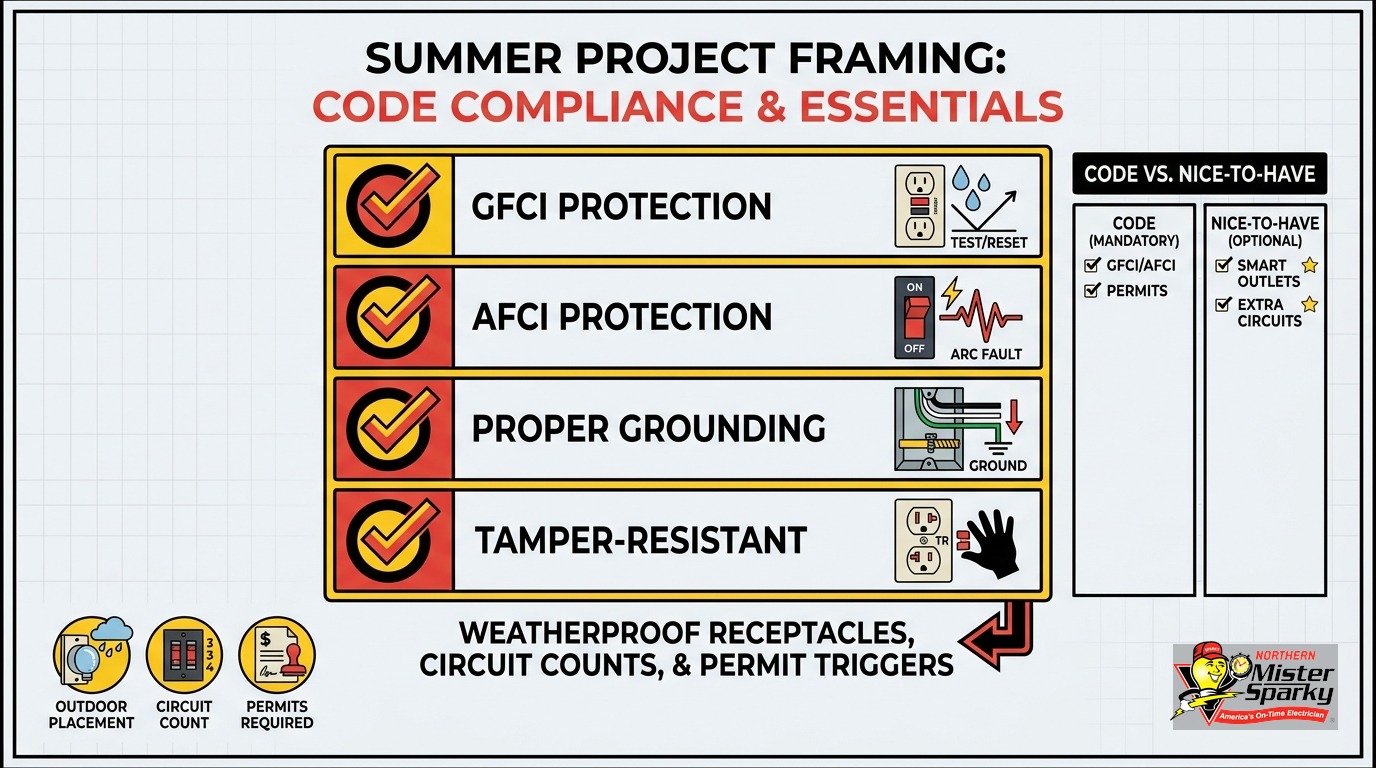
Key Takeaways
- Any attached deck larger than 20 sq ft with interior access requires at least one GFCI-protected receptacle, no higher than 6.5 ft above the walking surface.
- That receptacle must be labeled “WR TR” - weather-resistant AND tamper-resistant are two separate requirements on one device.
- Open unroofed deck = wet location = in-use bubble cover required. Covered porch = damp location = standard weatherproof flip-cap cover.
- Any new outlet or circuit extension requires a Minnesota electrical permit, separate from the deck building permit.
- Low-voltage deck lighting (12V or 24V) is generally permit-exempt. The outlet the transformer plugs into must still be GFCI-protected.
- Minnesota transitions to the 2026 NEC on August 3, 2026. Permits filed before that date use 2023 NEC rules.
- Minneapolis and Saint Paul run their own permit departments and do not use the state DLI system.
Does Your Deck Require at Least One Outlet?
Yes, if your deck is attached to the house, provides interior access, and covers more than 20 square feet. A 4x6 foot deck at 24 square feet already clears that threshold. The NEC has required at least one receptacle on qualifying decks since the 2008 code cycle. Landings smaller than 20 sq ft are exempt.
NEC 210.52(E)(3) sets this minimum. The outlet must sit within the deck perimeter and no higher than 6.5 feet above the walking surface.
This is also separate from the required front and rear outdoor receptacles. NEC 210.52(E) requires each single-family home to have at least one accessible outdoor receptacle at the front and one at the rear. Deck outlets do not substitute for those. They are additive.
If your deck was built before the 2008 code cycle and has no outlet, you are not required to add one retroactively - unless you are currently doing permitted electrical work on the deck.
What Does Code Actually Require for Deck Electrical Outlets and Lighting?
A qualifying new deck requires one GFCI-protected WR TR receptacle no higher than 6.5 feet above the walking surface, an appropriate cover for the location type, and an electrical permit with rough-in inspection before wiring is concealed. Low-voltage deck lighting is generally permit-exempt. Additional circuits and 120V deck fixtures are optional.
Here is the full breakdown:
Code-required for a new qualifying deck:
- One GFCI-protected receptacle within the deck perimeter, max 6.5 ft above the walking surface
- WR-listed (weather-resistant) device per NEC 406.9
- TR-listed (tamper-resistant) device per NEC 406.12
- Cover plate matched to location type (wet vs. damp - detailed below)
- Electrical permit and rough-in inspection before wiring is closed up
Not code-required, but worth planning for:
- More than one outlet (one is the code minimum, not the practical maximum)
- A dedicated 20A circuit (sharing existing capacity is allowed if it exists)
- Switch-controlled 120V deck lighting (only front and rear entrance lighting carries a mandate under NEC 210.70)
- A ceiling fan circuit on a covered porch
- A separate outdoor outlet for the low-voltage landscape transformer
What Type of Outlet Do You Actually Need for a Deck?
The correct device is marked both “WR” and “TR” - two separate ratings on one receptacle. For an open unroofed deck, you also need an in-use bubble cover that seals around the cord while plugged in. A standard flip-cap cover does not meet code on an exposed deck.
Here is what each marking means:
WR (Weather-Resistant): The device is built to resist corrosion and moisture intrusion. Standard indoor receptacles are not rated for outdoor use even when mounted inside a weatherproof box.
TR (Tamper-Resistant): Spring-loaded shutters inside the slots block objects from making contact unless both slots are engaged at the same time. Required per NEC 406.12 in all 15A and 20A 125V receptacles in dwelling unit locations.
At most hardware stores, weatherproof covers and tamper-resistant outlets are shelved in separate aisles. The device you need - marked “WR TR” on the packaging - is a single unit and is widely stocked. Read the label before you buy. Picking up an indoor TR outlet and a weatherproof cover separately will not get you to code on an outdoor deck.
Wet Location vs. Damp Location: Which Cover Do You Need?
The cover requirement depends on your deck’s exposure to weather.
Open unroofed deck = wet location. Direct rain exposure. Requires a WR TR device plus an in-use bubble cover. Flip-cap covers protect only when nothing is plugged in. The bubble cover is what protects the outlet while a cord is actually inserted. NEC 406.9(B) requires in-use protection at wet locations.
Covered porch or pergola = damp location. Protected from direct rain. Requires a WR TR device and a standard weatherproof cover. The flip-cap type is code-compliant at damp locations when the outlet is not in use.
Does Adding a Deck Outlet Require a Permit in Minnesota?
Yes. Any new outlet, circuit extension, or new wiring requires an electrical permit. Replacing an existing outlet with an identical device at the same location - without altering the wiring - does not trigger a permit.
Minnesota DLI administers electrical permits for most of the state. The electrical permit is separate from any deck building permit. The correct sequence:
- Pull the deck building permit. Complete structural framing, guardrails, and stairs.
- Pull the electrical permit before any wiring begins.
- Complete rough-in wiring.
- Schedule and pass rough-in inspection before deck boards are installed and wiring is concealed.
- Install devices and cover plates.
- Pass final electrical inspection.
Skipping the rough-in inspection and closing up the deck before it happens is the mistake that costs the most money to fix. Boards come up. Schedule the inspection first.
For a full walkthrough of Minnesota’s electrical permit process, see our guide to electrical permits in Minnesota.
Minneapolis and Saint Paul do not use DLI. Saint Paul uses the PAULIE online permit system and operates its own inspection department. Minneapolis runs its own process as well. If you are working in either city, you apply directly with the city, not the state system. Most other Twin Cities suburbs use the DLI online portal at ims.dli.mn.gov.
GFCI Protection: The Rule That Covers Every Outdoor Outlet
Every 125V and 250V outdoor receptacle at a dwelling must be GFCI-protected. NEC 210.8(A)(3) is clear on this. There are no exceptions for decks.
Three code-compliant ways to satisfy the requirement:
- Install a GFCI receptacle directly at the deck outlet location.
- Use a GFCI receptacle inside the house on the same circuit, wired so the deck outlet feeds from its LOAD terminals.
- Install a GFCI breaker at the panel protecting the full circuit.
All three satisfy the code. Option 1 is easiest to verify and test. Option 3 adds panel cost but protects everything on the circuit.
One common callback on new deck electrical: the GFCI trips repeatedly every time deck lighting runs. Cheap low-voltage landscape transformers can leak small amounts of current to ground and trigger nuisance trips. A UL-listed transformer with proper isolation eliminates the problem. If your GFCI trips consistently when the lights are on, the transformer is the first thing to check - not the outlet or the breaker.
For more on outdoor GFCI installation and requirements, see our page on outdoor GFCI outlet installation.
Minnesota Is Transitioning to the 2026 NEC on August 3, 2026
This affects every permit filed this summer.
Per Minnesota DLI, the 2026 NEC takes effect on August 3, 2026. Permits filed before that date must comply with 2023 NEC rules. Permits filed on or after August 3 must comply with 2026 NEC rules. As of today, July 21, there are 13 days left in the 2023 NEC window.
For most residential deck projects, the device and cover requirements are stable across code cycles. The WR, TR, GFCI, and in-use cover rules have been in place for several editions. If your deck project involves panel work, conduit routing, or anything at the service entrance, verify the specific requirements with your electrician before the permit is filed.
There is no malarky about the date: a permit filed on August 3 or later operates under a different code edition than one filed August 2. If your contractor pulls the permit and specifies the wrong code year, it creates a paperwork headache at inspection that nobody wants.
Deck Electrical Outlets and Lighting: Low-Voltage vs. Line-Voltage
Understanding the difference between these two systems tells you when a permit is required and when it is not.
Low-voltage deck lighting (12V or 24V DC) runs from a plug-in transformer. These systems fall under NEC Article 411 and are generally exempt from permit requirements. No burial depth is required for cable runs in these systems. A typical 200W outdoor transformer handles 15 to 25 LED deck lights, which covers most residential decks comfortably. When routing low-voltage cable through deck posts, do not cut or notch more than 25% of post depth.
What you still need: the transformer plugs into a standard outdoor outlet, and that outlet must be GFCI-protected. If the outlet is new, it needs a permit. The lighting system itself does not.
Line-voltage deck lighting (120V) is wired directly into the electrical system. Ceiling fans on a covered porch, recessed stair lights hardwired into junction boxes, switch-controlled perimeter fixtures - these are line-voltage installations. They require a permit, a rough-in inspection, and licensed installation. They also offer more functionality: dimming, switch control, and dedicated circuits.
Neither type is code-mandated on a deck. Switch-controlled deck perimeter lighting is a nice-to-have. Only entrance lighting at the front and rear doors carries a mandate under NEC 210.70.
For outdoor lighting options and installation in the Twin Cities, see our outdoor lighting service page.
How Many Circuits Does a Deck Really Need?
One 20A circuit satisfies the code minimum for a new deck. For a deck used for entertaining, outdoor cooking, or tools, two circuits is the smarter plan - one for high-draw loads, one for ambient lighting and speakers.
A 15A circuit safely carries 1,800 watts before hitting 80% of rated capacity, which is the practical ceiling for continuous loads. A power tool (600 to 900W), a portable speaker (50 to 100W), an outdoor fan (100 to 200W), and string lights (50W) together can approach or exceed that without anything actively cooking.
A second circuit separates high-draw tool loads from lower-draw entertainment loads. Running both from one circuit means a single tool startup can trip the breaker on everything else.
If your plans include a hot tub, an outdoor kitchen, or an EV charger nearby, those require their own dedicated circuits regardless of what the deck circuit does.
Who Can Wire a Deck Outlet in Minnesota?
Generally, a licensed electrical contractor. The homeowner exemption exists but is narrow: the homeowner must own and personally occupy the home, personally perform all the work, and still pull a permit and pass inspection.
Minnesota DLI’s homeowner exemption has specific conditions. All of these must be true:
- You own and personally occupy the home.
- You personally and physically perform all the electrical work - not a handyman, not a neighbor who knows wiring.
- You pull the permit and submit to inspection.
The exemption does not cover rental properties, vacation homes, or any property you do not live in. It does not allow hiring an unlicensed person to do the work on your behalf. The permit and inspection requirements are identical whether a homeowner or a licensed contractor does the work.
For most homeowners, a licensed electrician is faster, handles the permit filing, and takes liability off the table if something goes wrong at inspection. Minnesota is one of the stricter states on who can legally perform electrical work - for good reason.
What Happens If You Skip the Permit?
Unpermitted electrical work can trigger insurance denials, double-fee fines, open-it-up orders that require exposing concealed wiring, and complications that stall a home sale. The permit fee is modest. The exposure from skipping it is not.
Here is what Minnesota’s enforcement process looks like in practice:
- Insurance claim denial. A homeowner’s policy has grounds to deny fire or water damage claims that trace back to unpermitted electrical work. That exposure is not theoretical.
- Double-fee fines. When unpermitted work is discovered, the fine is typically the full permit fee plus an equal penalty. You still owe the original permit fee on top of that.
- Open-it-up orders. An inspector can require you to expose concealed wiring for a retroactive rough-in inspection. On a finished deck with wiring buried under boards and behind trim, that is an expensive fix.
- Home sale complications. Unpermitted work shows up in home inspections and title searches. It can stall a sale, require escrow holds, or result in a price reduction at closing.
The electrical permit for a single outdoor outlet addition is not an expensive or complicated filing. The cost of skipping it can be significantly higher.
Ready to Get Your Deck Wired Right?
Northern Mister Sparky is locally owned and operated in the Twin Cities. We pull the permit, schedule the inspection, and install to code - that is what being America’s On-Time Electrician(R) means on the ground. Every visit is backed by the UWIN(R) 100% satisfaction guarantee.
Whether you need one GFCI outlet added to an existing deck, a new circuit run for outdoor entertaining, or line-voltage lighting installed on a covered porch, our team serves Minneapolis, Saint Paul, Bloomington, Brooklyn Park, Woodbury, Blaine, Maple Grove, Plymouth, and the surrounding metro.
Call 763-200-5956 or schedule your deck electrical service online.
Frequently Asked Questions
Do I need a permit to add an outlet to my deck in Minnesota? +
What type of outlet is required on an outdoor deck? +
Does low-voltage deck lighting require a permit in Minnesota? +
Need an electrician now?