
Two EV Chargers, One Home: Do You Need a Panel Upgrade?
Key Takeaways
- Two 32-amp Level 2 chargers require two dedicated 40-amp circuits under NEC Article 625.42, consuming 80 amps of panel capacity total.
- A 200-amp service typically leaves 60-80 amps of usable headroom after existing loads. Many Twin Cities homes can add two chargers without a service upgrade.
- A 100-amp service almost never has that room. Plan for a service upgrade before anything else.
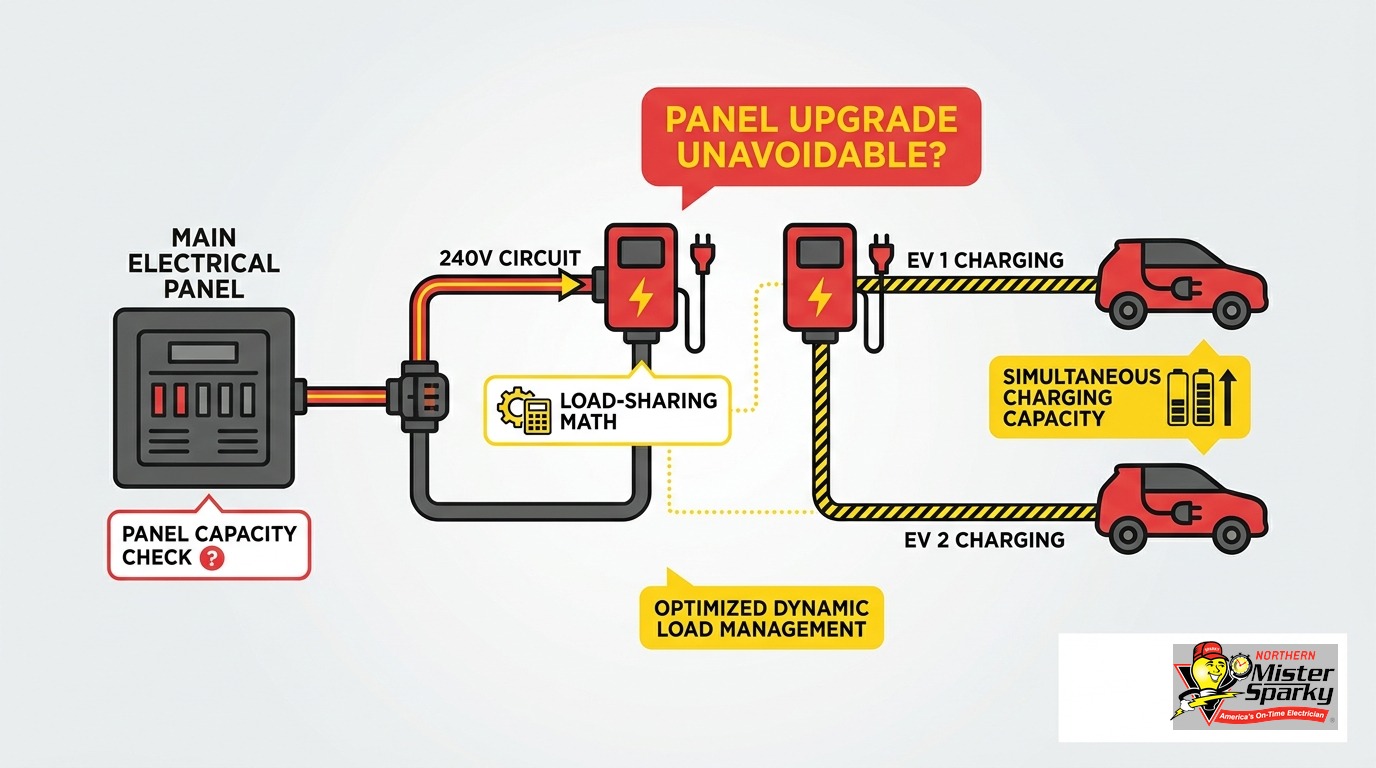
- Load-sharing EVSE lets two charging units share one 60-amp circuit. That single product choice drops the panel demand from 80 amps to 60 amps and often eliminates the upgrade entirely.
- Federal incentives for EV purchases and charger installation are both terminated. Xcel Energy utility programs are the last remaining financial option worth investigating.
- In Minnesota, a licensed electrician must pull the permit for any new 240-volt circuit. Homeowners cannot self-permit this work.
Does Two EV Charger Installation Actually Require a Panel Upgrade?
Short answer: Not always. Whether your home needs an upgrade depends on your service size and how much usable capacity your existing loads leave behind. A 200-amp service often has enough room for two dedicated EV circuits. A 100-amp service almost never does. Load-sharing EVSE is a third option that changes the math for many homeowners who fall between those two poles.
The confusion starts with how installers frame the question. They ask whether you need an upgrade, answer with a vague maybe, and leave you no better off. The math behind the answer is not complicated. Panel capacity is finite. Your existing loads consume part of it. Two new EV circuits each require 40 amps of whatever remains. Whether you have 80 amps left is a question a load calculation answers.
For most 200-amp Twin Cities homes, that headroom exists. For 100-amp homes, it does not. For homes with enough room for one circuit but not two, a load-sharing system is often the bridge that skips the upgrade entirely.
Understanding your current panel situation is the prerequisite. Our post on 100-amp vs. 200-amp electrical service walks through what those two service sizes mean in practice and when a service upgrade makes financial sense.
How Much Panel Capacity Do Two EV Chargers Actually Need?
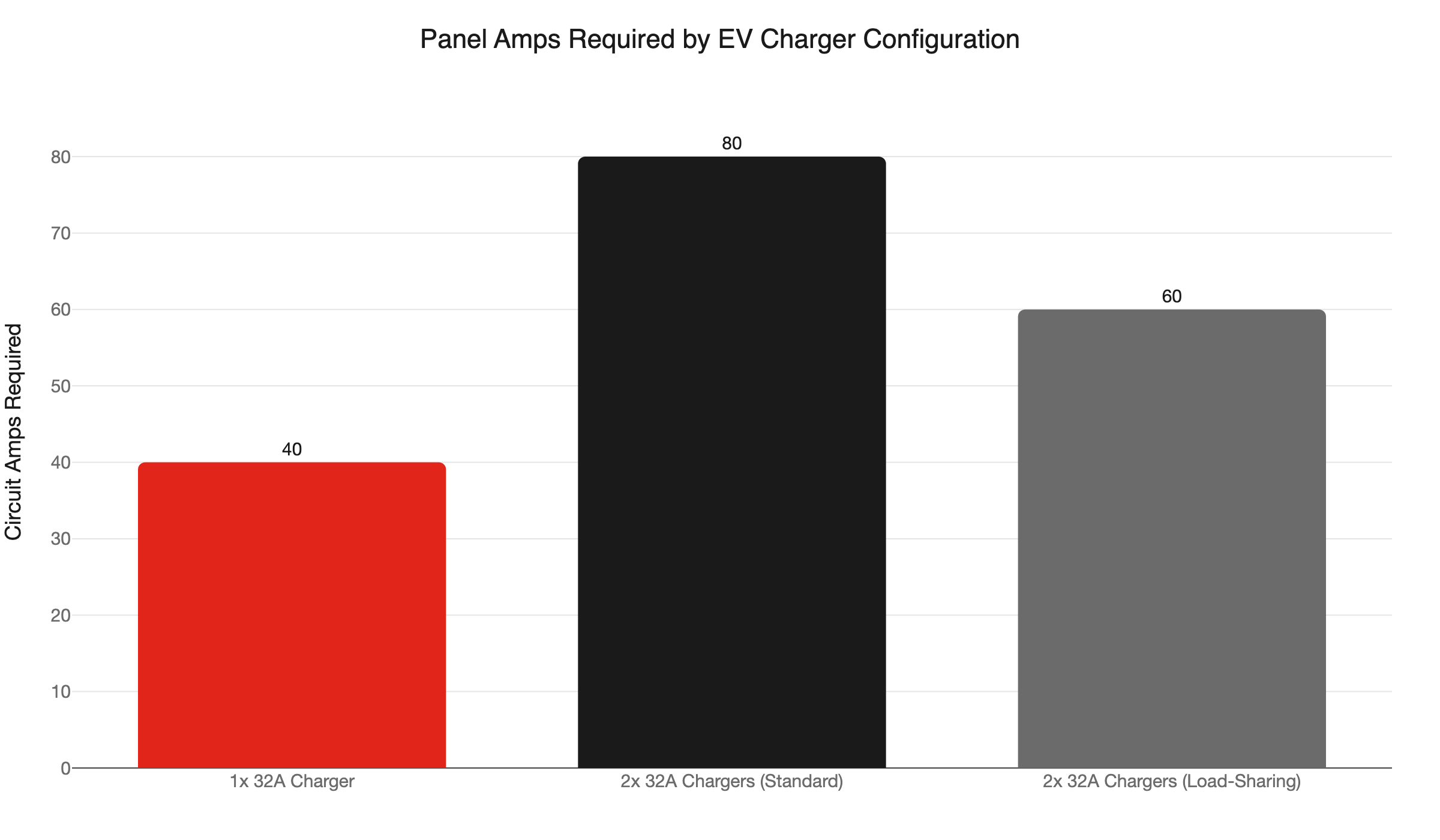
Short answer: Two 32-amp chargers require 80 amps of dedicated panel capacity under NEC Article 625.42. Each circuit must be sized at 125% of the charger’s continuous draw. A 32-amp charger on a 40-amp circuit, twice over, equals 80 amps consumed.
Here is the math most guides leave out.
NEC Article 625.42 classifies EV charging equipment as a continuous load. A continuous load is one that runs for three or more hours without interruption. That covers overnight EV charging. Continuous loads require branch circuits sized at 125% of the equipment’s draw. A 32-amp charger draws 32 amps continuously, so its dedicated circuit must be rated at 40 amps (32 × 1.25 = 40). Run two of those circuits and you have consumed 80 amps of panel capacity.
NEC Article 625.40 adds a second constraint. Each EVSE outlet must have its own dedicated branch circuit. You cannot feed two charger heads from one shared receptacle.
The 125% sizing rule is not bureaucratic padding. It keeps wiring from running at its thermal limit for hours on end. An undersized circuit overheats slowly and eventually fails. This is the reason a licensed electrician, not a chart on a box, determines your actual circuit requirements.
What your existing loads already consume. A typical Twin Cities home on a 200-amp service has roughly 160 amps of usable load capacity under a standard NEC Article 220 load calculation. Here is where that headroom goes in a common all-electric home:
- Electric range or cooktop: 42-50 amps (10-12 kilowatts at 240 volts)
- Central air conditioning or heat pump: 20-30 amps
- Electric water heater: 18-24 amps
- Lighting, outlets, and general loads: 20-30 amps
That totals 100-134 amps of committed load. Remaining headroom on a 200-amp service is typically 26-60 amps. Homes at the lower end of that range cannot fit two standard 40-amp EV circuits without a service upgrade. Homes at the higher end can.
A 100-amp service starts with only 80 amps of usable capacity under NEC 220 methodology. After the same load set, remaining headroom is typically under 20 amps. Two EV chargers are not feasible without a service upgrade, and even one dedicated circuit will require a full load calculation before it can be added.
What Is Load-Sharing EVSE?
Short answer: Load-sharing EVSE is a paired charging system where two units share one circuit. Each draws up to 24 amps simultaneously. When one car finishes charging, the other gets the full available amperage automatically. This product category reduces panel demand from 80 amps to 60 amps and frequently eliminates the need for a service upgrade.
Most homeowners have never heard of load-sharing EVSE. The concept is straightforward. Instead of running two separate 40-amp circuits, you run one 60-amp circuit and connect two charger heads to it. Built-in power-sharing logic splits the available current between whichever cars are actively charging.
The panel math changes immediately. Two standard circuits require 80 amps. A load-sharing system needs 60 amps. For a 200-amp home with 60-70 amps of headroom, that 20-amp difference is often what determines whether an upgrade is necessary at all.
The practical trade-off is charging speed. Each car receives up to 24 amps simultaneously rather than 32-48 amps on dedicated circuits. At 24 amps, a Level 2 charger adds roughly 18-20 miles of range per hour. For a typical Minnesota daily commute, overnight charging at 24 amps still restores a full usable charge by morning.
When one vehicle reaches full charge, the system automatically redirects all available current to the second car. In most real-world overnight scenarios, both cars are full before the alarm goes off.
Several manufacturers produce load-sharing EVSE systems with coordination built into the units. Our post on EV load management and avoiding a panel upgrade covers the full range of options and how each interacts with different panel configurations.
Does Your Service Size Determine What Is Possible?
Short answer: Service size is the primary factor, but your existing load profile matters equally. Two homes with identical service sizes and different appliance sets will have different usable headroom. The only reliable answer comes from a full NEC Article 220 load calculation performed by a licensed electrician.
Here is how different scenarios typically break down:
200-amp service with gas appliances. This is the most favorable scenario for two EV chargers. No electric range and no electric water heater means far less committed load. Most of these homes have 80-100 amps of available headroom, which comfortably covers two standard 40-amp circuits. This is the scenario where a panel upgrade is least likely to be necessary.
200-amp service with all-electric appliances. More constrained. After accounting for an electric range, electric water heater, and HVAC, typical headroom is 40-60 amps. This is exactly where the load-sharing vs. standard circuit decision matters most. A load-sharing system at 60 amps may fit where two standard circuits at 80 amps would not.
100-amp service. Plan for a service upgrade. Headroom after essential loads is typically under 20 amps. Two EV chargers are not feasible at this service size. Even a single dedicated 40-amp circuit will require a careful load calculation, and in most 100-amp homes will still require an upgrade first. Our EV charger installation service page covers what that process looks like from assessment through permit.
Older panels and split-bus equipment. Some Twin Cities homes still carry split-bus panels or panels from discontinued manufacturers. These introduce concerns separate from raw load capacity. A licensed electrician needs to evaluate the panel itself before any new circuits are added, regardless of what the service size label says. Age and manufacturer matter as much as amps in older equipment.
Why Minnesota Winters Make Two Chargers Non-Negotiable
Cold climate range loss is not a minor footnote. It is the reason a “charge one car at a time” workaround fails the Twin Cities.
Minnesota EV owners lose 20-40% of rated range at typical winter operating temperatures. When it is minus-10 to 20 degrees Fahrenheit overnight, a vehicle rated at 250 miles may deliver 150-200 miles of real-world range. Two household members both commuting and both expecting a full charge in the morning cannot rotate that through a single charger on a reliable schedule in January.
Level 1 charging at 120 volts adds roughly 4-5 miles of range per hour. In cold weather, with the vehicle running battery and cabin preconditioning before the morning commute, Level 1 may barely maintain charge rather than restore it. Level 2 charging at 24-32 amps is the practical minimum for restoring meaningful range overnight in a Minnesota climate.
Minnesota had 3,269 public electric charging ports statewide as of 2025. Public chargers handle opportunistic top-ups during the day. They do not replace reliable overnight home charging when two vehicles both need a full charge before a cold January morning.
The infrastructure and code requirements around a two-charger installation are worth getting right now. The system will work hardest when the weather is worst.
What Happened to the Federal EV Tax Credits?
Short answer: Both are terminated. The $7,500 new clean vehicle credit under Section 30D expired for vehicles acquired after September 30, 2025. The Section 30C EV charger installation credit expired for equipment placed in service after June 30, 2026. Both were ended by the One Big Beautiful Bill Act, signed into law July 4, 2025.
Many homeowners are still planning around incentives that no longer exist. The facts are worth having clearly before you budget for a two-charger installation.
The IRS instructions for Form 8911 state it directly: “The credit will not be allowed for any property placed in service after June 30, 2026.” If you installed a qualifying charger before that date, you may still have a valid claim on your 2025 or 2026 tax return. If you are installing now, there is no federal credit to apply.
The IRS FAQ on the One Big Beautiful Bill Act lays out the full table of terminated or modified credits: Section 30D (new EV), Section 30C (charger installation), Section 25C (home efficiency), and Section 25D (residential solar) are all affected.
What remains available? Xcel Energy’s “EV Accelerate At Home” program offers managed charging with reduced electricity rates for participating customers. Enrolling a second vehicle in that program can double the bill savings from off-peak rate access. Check xcelenergy.com directly for current program availability, eligibility, and rates before making financial projections. Program terms change, and a locally owned electrician cannot verify current utility offerings on your behalf.
What Does the Permit Process Look Like in Minnesota?
Short answer: The licensed electrician pulls the permit through Minnesota DLI, not the homeowner. Every new 240-volt branch circuit in Minnesota requires a permit. The electrician handles the application, schedules the final inspection, and ensures the work passes before the job closes out. You do not file anything.
Minnesota adopted NEC 2020. Under Minnesota DLI electrical licensing requirements, a licensed electrician must obtain the permit for any new branch circuit or sub-panel work. Homeowners cannot self-permit new 240-volt circuits. This is not a gray area.
The permit matters at two points in the life of your home. First, during a sale: unpermitted wiring surfaces at inspection, and unresolved open permits can delay or kill a closing. Our post on electrical permits in Minnesota covers exactly what a missing permit means and how it gets resolved when you are selling a home.
Second, and more immediately: the inspection that follows the permitted work is the mechanism that confirms your installation meets code before two cars are plugged in every night. A passing inspection means a licensed state inspector reviewed the circuit sizing, the grounding, the breaker rating, and the connection quality. That is the protection a properly permitted job gives you.
What Should You Expect From the Installation Process?
Short answer: A thorough two-EV installation starts with a panel audit and load calculation before anything is quoted. If two standard circuits fit, we run them. If headroom is tight, we walk you through the load-sharing option. If an upgrade is required, we tell you that directly and explain what it involves.
When our team arrives for a two-charger assessment, we pull the panel cover and document every existing breaker load. We check the service entrance size. We do a full NEC Article 220 load calculation against your actual loads, not a generic template. That calculation tells us whether two standard 40-amp circuits fit, whether a load-sharing system is the smarter path, or whether the service itself needs to grow before either option is viable.
We do not guess and we do not quote a number before we know the answer. No malarky: if the panel cannot support what you want without a service upgrade, we say so up front.
We pull the permit. We handle the inspection schedule. You receive the completed permit documentation when the work passes, which you keep with the home.
We serve Minneapolis, St. Paul, Bloomington, Brooklyn Park, Woodbury, Blaine, Maple Grove, Plymouth, and the surrounding metro area. As a locally owned and operated Mister Sparky franchise and America’s On-Time Electrician(R), we back our work with the UWIN(R) 100% satisfaction guarantee.
Call 763-200-5956 or book online. We will schedule a panel assessment and give you the load calculation numbers before any work begins.
The Bottom Line
Two EV charger installation in one home is achievable for most Twin Cities homeowners on 200-amp service. The panel math is not guesswork: two 32-amp chargers need 80 amps of capacity, a load-sharing system needs 60 amps, and your available headroom depends on what your existing loads already consume. A 100-amp service will need a service upgrade before either option is on the table.
Federal incentives are gone for both vehicles and charger hardware. Xcel Energy programs are the remaining financial option worth verifying before you finalize a budget.
The permit requirement in Minnesota protects you. It puts a licensed state inspector behind the work before both vehicles charge every night through a Minnesota winter. That is not a formality. It is the check that confirms the installation is safe for daily use over years of hard weather.
Ready to know what your panel can actually support? Call 763-200-5956 or book online. We will run the numbers first and build the plan around what we find.
Frequently Asked Questions
Do I need a panel upgrade to install two EV chargers in my home? +
What is a load-sharing EV charger? +
Are there still federal tax credits for EV charger installation? +
Need an electrician now?