
Electric Driveway Gate Opener Wiring Installation: MN Guide
Key Takeaways
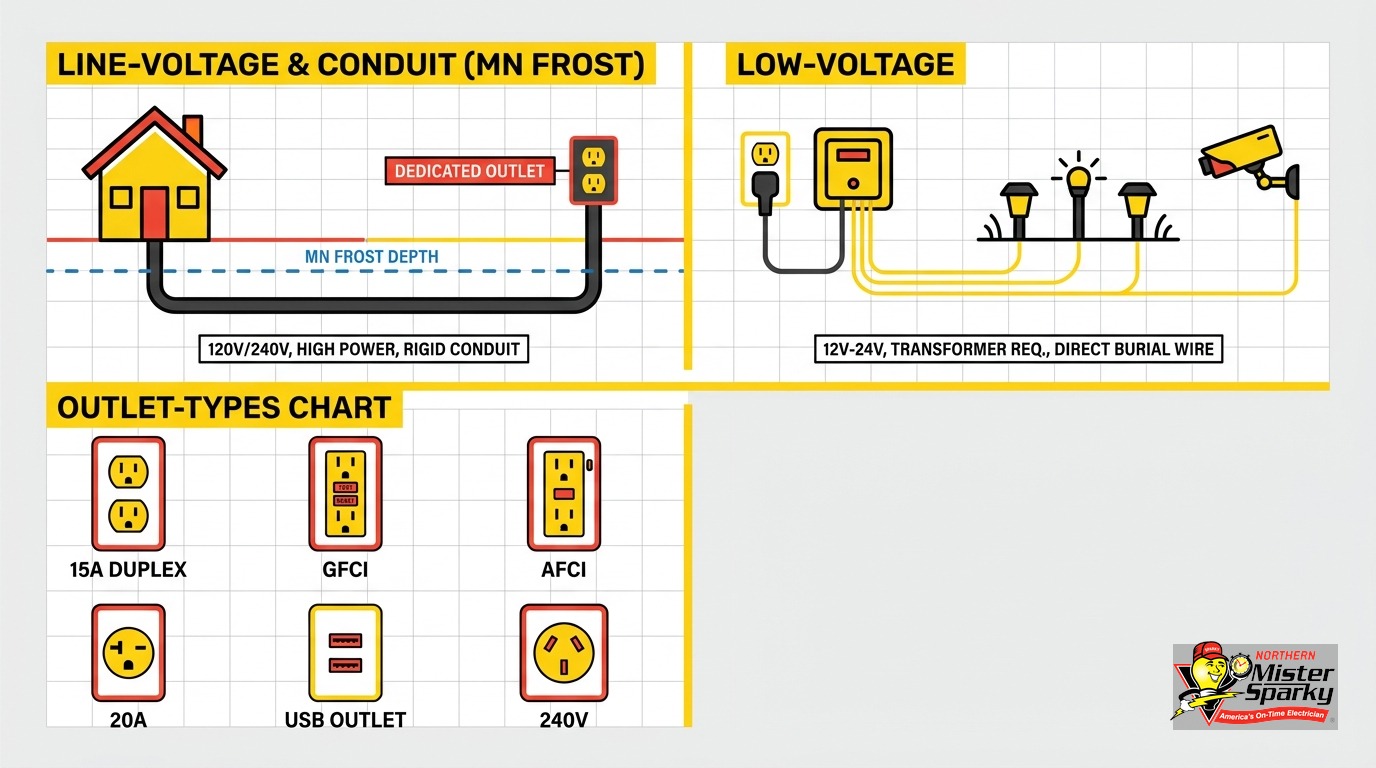
- Electric driveway gate opener wiring installation covers two separate systems: a 120V line-voltage circuit from the panel to a post outlet, and low-voltage control wiring between the opener, keypad, and sensors. They run in separate conduits.
- NEC Table 300.5 sets the minimum burial depth at 18 inches for Schedule 40/80 PVC conduit in open ground and under a residential driveway. Minnesota’s 42-48 inch frost line applies to plumbing, not electrical conduit.
- The riser, where conduit exits the ground at the gate post, is the most common failure point in Twin Cities installations. It requires Schedule 80 PVC or rigid metal conduit from 18 inches below grade up to the enclosure.
- Every outdoor receptacle at the gate post needs GFCI protection under NEC 210.8(A)(3). The exception for ceiling-mounted garage door opener outlets does not apply here.
- A permit is required for any new circuit in Minnesota. File before you dig.
- A dedicated 20A circuit is standard practice for most residential gate openers.
What Goes Into Electric Driveway Gate Opener Wiring Installation?
Most homeowners picture a single run of wire from the house to the gate. The actual job involves two separate electrical systems, a permit, a trench, and a code-compliant outdoor outlet at the post.
The line-voltage side brings 120V power from your electrical panel out to a weatherproof outlet at the gate post. That outlet feeds the opener motor. The low-voltage side runs the control wiring, which connects the motor unit to the keypad, safety sensors, and any loop detectors you install.
Both systems run underground in separate conduits. Both need to be installed correctly before the gate opener installer connects anything above grade. If your gate post sits close to the house, a licensed electrician can knock this out in a few hours. If the post is at the far end of a long driveway or on the other side of buried irrigation or a retaining wall footer, the trench and pull get more complicated.
Line-Voltage vs. Low-Voltage: What Is the Difference?
The line-voltage circuit carries 120V from your panel to the post outlet. The low-voltage control wiring runs at 12-24V between the opener components. They look similar underground, but they have completely different code requirements, conduit specs, and burial depths. Mixing them in the same conduit is a code violation.
The line-voltage portion is the high-stakes side of the job. It requires a licensed electrician in Minnesota, a dedicated breaker, correctly sized wire, burial-rated conduit, a GFCI-protected weatherproof outlet, and a permit.
The low-voltage control wiring runs at 12-24V and is typically included in the gate opener kit. NEC Table 300.5 allows low-voltage wiring rated at 30V or less to be buried as shallow as 6 inches in open ground. The installation requirements are far lighter.
The separation rule is critical. NEC 300.3 requires line-voltage and low-voltage wiring to run in separate conduits. They can share a trench to reduce excavation costs. But each system stays in its own pipe. Running both through a single gray conduit is one of the most common mistakes on DIY gate installs, and it fails a rough-in inspection every time.
How Deep Does the Conduit Need to Go in Minnesota?
NEC Table 300.5 sets the minimum depth at 18 inches for Schedule 40/80 PVC conduit in open ground and under a residential driveway. Minnesota’s 42-48 inch frost line does not apply to electrical conduit. Frozen soil does not damage buried conduit or the conductors inside. The real failure point in MN installations is the riser above grade, not the trench depth.
This is the question we hear most often on gate opener jobs in the Twin Cities. Homeowners who have dealt with frozen pipes know the frost line runs deep here - typically 42-48 inches in the metro and deeper in northern Minnesota. The assumption is that electrical conduit should go below the freeze line. It should not.
Electrical conduit is not plumbing. Frozen soil does not apply hydraulic pressure to a sealed conduit. The wire inside does not burst the way water does when it freezes. NEC burial depths are set for mechanical protection of the conductor, not for freeze protection of the conduit run.
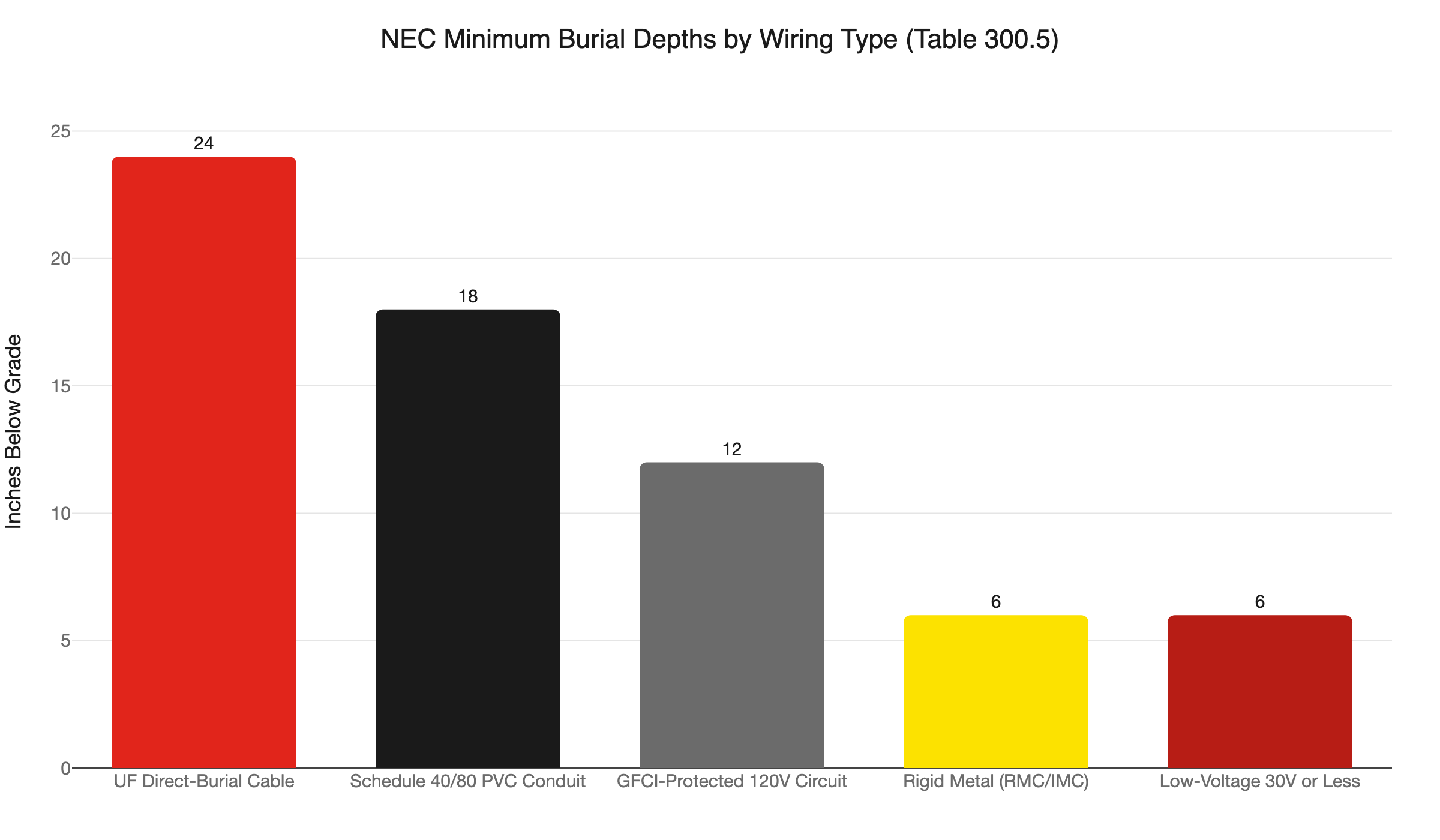
Here is the full NEC Table 300.5 breakdown for the most common wiring types:
- UF direct-burial cable: 24 inches minimum
- Schedule 40 or 80 PVC conduit in open ground: 18 inches minimum
- GFCI-protected 120V residential circuit: 12 inches minimum
- Rigid metal conduit (RMC or IMC): 6 inches minimum
- Low-voltage wiring at 30V or less, listed system: 6 inches minimum
The GFCI exception is worth noting. If the 120V circuit is GFCI-protected, the minimum burial depth drops to 12 inches. Most installers go to 18 inches regardless, because the extra 6 inches of trench depth costs almost nothing and gives a buffer against a shallow measurement on inspection.
Minnesota adopted the 2026 NEC on August 17, 2026. Any permit filed today falls under the 2026 code. The burial depth table is unchanged from the 2023 edition. See our guide on underground electrical wire depth in Minnesota for a full breakdown of how the frost line and NEC minimums interact across different project types.
Why Is the Riser the Most Common Failure Point in Minnesota?
NEC 300.5(J) requires Schedule 80 PVC or rigid metal conduit from 18 inches below grade up to the above-grade enclosure wherever conduit exits the ground. Plain Schedule 40 PVC at the riser is a code violation. It also cracks under the repeated mechanical stress of Minnesota freeze-thaw cycles.
The trench is not where gate opener wiring fails in the Twin Cities. The riser is.
The riser is the section of conduit that exits the ground and rises to the gate post enclosure. At that soil-to-air transition point, the pipe experiences repeated lateral stress each winter as the ground freezes and heaves. Schedule 40 PVC, the standard gray conduit sold at hardware stores, has a thinner wall. It handles buried horizontal runs fine. It is not rated for that kind of mechanical abuse at the transition zone.
Schedule 80 PVC has a significantly thicker wall. Rigid metal conduit is thicker still. NEC 300.5(J) specifies that from 18 inches below grade up to wherever the conduit terminates above grade, it must provide physical protection equivalent to Schedule 80 PVC or better.
When a riser cracks, water enters the conduit. In Minnesota, that water freezes. The expanding ice pushes wire connections apart or fills the conduit run with ice that eventually forces the wire jacket into the enclosure connection point. The GFCI trips, the gate stops working, and the homeowner calls us in February wondering why the installation failed after a single winter.
The fix is always a riser replacement. The cost is avoidable if the riser is specified correctly from day one. Contractors who bid gate opener jobs purely on price routinely spec Schedule 40 for the entire run. Ask directly what conduit type they plan to use at the riser before you hire anyone.
Does the Outlet at the Gate Post Require GFCI Protection?
Yes. NEC 210.8(A)(3) requires GFCI protection on all 125V, 15A and 20A outdoor receptacles at a dwelling unit. A grade-level post outlet is accessible and fully covered by this rule. The not-readily-accessible exception used for ceiling-mounted garage door opener outlets does not apply here.
There are two valid ways to comply. You can install a GFCI outlet in the weatherproof enclosure at the post. Or you can protect the entire circuit with a GFCI breaker at the panel, which covers every device on the run. A GFCI outlet at the post is simpler and less expensive for a single-location install. A GFCI breaker at the panel is cleaner if the circuit also feeds other outdoor outlets or accessories down the line.
NEC 210.8 was extended in the 2023 and 2026 editions to cover outdoor single-phase circuits up to 50A at 150V or less to ground. The gate post outlet at 120V/20A falls under the original 210.8(A)(3) residential rule, but the expanded coverage matters if you plan to add EV charging or higher-draw outdoor circuits nearby.
One practical maintenance note: GFCI devices in outdoor enclosures can nuisance-trip in cold weather when moisture accumulates behind the outlet face. A quality in-use weatherproof cover rated for the enclosure keeps water out and reduces nuisance trips. If you are already dealing with a tripping outdoor outlet, the GFCI outlet troubleshooting guide covers the most common causes.
Do You Need a Permit to Wire a Gate Opener in Minnesota?
Yes. Any new circuit requires an electrical permit. In Minneapolis, St. Paul, Plymouth, and Maple Grove, file with the city. In most other Twin Cities suburbs, file with the Minnesota DLI at (651) 284-5026 or dli.electricity@state.mn.us. Starting work before filing adds an investigation fee on top of the normal permit cost.
Permit jurisdiction in the Twin Cities is fragmented enough that it is worth a quick call before you schedule anything. If your property is in Bloomington, Brooklyn Park, Woodbury, or Blaine, you almost certainly file with the state DLI. If you are in Minneapolis or St. Paul, the city runs its own program. Plymouth and Maple Grove also have their own permit offices. When in doubt, start with DLI and they will direct you.
Homeowners at owner-occupied residences can pull their own permit, but only if they physically perform all the electrical work themselves. Hiring an electrician and pulling the permit yourself is not allowed under Minnesota rules. If you hire a licensed electrician, which we recommend for any line-voltage underground work, they pull the permit as part of the job.
The permit process for a gate opener circuit typically involves a rough-in inspection before you close the trench and a final inspection after the circuit is energized. Build both into your project timeline. Metro-area inspectors are generally available within a few business days, but you cannot backfill until the rough-in passes.
See our full guide on electrical permits in Minnesota for the complete jurisdiction map and what to expect at each inspection.
What Circuit Size Does a Gate Opener Need?
A 20A dedicated circuit is standard. Most residential gate openers draw 3-7 amps at 120V during operation, but the motor start-up surge demands headroom. A dedicated 20A circuit prevents nuisance trips and keeps the opener isolated from other outdoor loads.
Sharing a gate opener circuit with landscape lighting, irrigation controls, or other exterior outlets is tempting when the conduit is already open in the trench. Avoid it. Mixed-use circuits trip when multiple devices run at the same time. They also create permit complications if the original circuit was not sized or protected for the combined load.
A 20A dedicated circuit runs on 12 AWG copper wire from the panel to the post. For runs over 100-150 feet, wire sizing may need to increase to control voltage drop. A licensed electrician will calculate the run length and spec the right gauge. Our guide on wire gauge and breaker size explains how that calculation works for homeowners who want to understand the math.
If the panel is already full, adding a new 20A breaker may require a panel upgrade or a tandem breaker installation. Mention it when you call for a quote so we can scope the full job accurately.
Electric Driveway Gate Opener Wiring Installation: The Full Process
Here is the complete sequence for a properly permitted installation, from panel to gate post:
1. Plan and permit. Measure the run from panel to gate post. Confirm permit jurisdiction and file before any excavation. Call 811 to locate buried utilities before you break ground.
2. Trench. Dig to at least 18 inches deep for Schedule 40/80 PVC conduit. Width should accommodate two separate conduits side by side. Leave the trench open for inspection.
3. Install conduit. Run Schedule 40 PVC from the house to the point 18 inches below grade at the post. Switch to Schedule 80 PVC or rigid metal conduit for the riser, from 18 inches below grade up to the enclosure above grade. Use weatherproof LB fittings where conduit enters the house.
4. Pull wire. Pull 12 AWG copper wire for the 120V circuit through the line-voltage conduit. Pull the manufacturer-supplied low-voltage control wire through the separate conduit in the same trench.
5. Install the outlet. Mount a GFCI outlet in a listed outdoor weatherproof enclosure at the post. Install an in-use cover rated for the enclosure. Test the GFCI reset before calling for inspection.
6. Panel connection. Install a dedicated 20A breaker. Connect the circuit. Label the breaker clearly.
7. Rough-in inspection. The inspector confirms conduit depth, conduit type at the riser, and outlet location before you close the trench. Do not backfill before this passes.
8. Backfill and final. After the rough-in passes, backfill the trench and complete all above-grade connections. Schedule the final inspection. After it passes, the gate opener installer can connect the gate hardware and low-voltage control wiring.
Why Hire a Licensed Electrician for This Job?
The line-voltage portion of gate opener wiring is not the right place for a DIY approach in Minnesota. The trench work is mechanical and manageable. The code compliance piece is not.
The most common mistakes on unpermitted gate wiring installs: wrong conduit type at the riser, line-voltage and low-voltage wires sharing a single conduit, missing GFCI protection at the post outlet, and wire gauge undersized for the run length. Any one of these fails a permit inspection. Most also create a real safety risk at an outdoor outlet running through Minnesota winters.
Minnesota requires electricians to be licensed through the DLI. Ask any electrician you are considering to provide their license number before you hire. You can verify it directly on the DLI website.
We are locally owned and operated in the Twin Cities. As America’s On-Time Electrician(R), we show up when we say we will. If the installation surfaces a related need - a full panel, a subpanel for a long driveway run - we offer financing options for larger jobs. Call 763-200-5956 or book online to get a gate opener wiring quote.
Frequently Asked Questions
How deep does electrical conduit need to be for a driveway gate opener in Minnesota? +
Does a gate opener outlet require GFCI protection? +
Do I need a permit to wire a driveway gate opener in Minnesota? +
Can line-voltage and low-voltage control wires share the same conduit underground? +
Need an electrician now?