
Cost to Move an Electrical Panel: Minnesota Remodel Guide
Key Takeaways
- The cost to move an electrical panel typically runs $1,200 to $4,800 for a standard relocation covering labor, materials, and permits combined.
- A long conduit run, an amperage upgrade, and drywall repair can push totals to $8,000 to $18,000.
- Minnesota adopted the 2026 NEC effective August 17, 2026. Any permit filed today triggers 2026-code compliance, not 2023.
- Xcel Energy customers may qualify for a $1,500 rebate when a panel move includes an amperage upgrade.
- A subpanel fed from the existing main panel often costs $1,000 to $3,000 and can eliminate the need to relocate the main panel at all.
- Permit jurisdiction depends on your city: Minneapolis files with the city; most suburbs use the state DLI.

Your contractor just told you the panel has to move. Maybe the kitchen renovation places a new island exactly where the breaker box sits. Maybe the basement finish puts drywall right in front of it. Either way, the cost to move an electrical panel is now on your project budget - and you deserve a clear picture of what drives it.
This guide is for Twin Cities and greater Minnesota homeowners who are mid-remodel or planning one. We cover real cost ranges, who issues permits in your city, which incentives are still active in 2026, and when skipping the move makes more financial sense than committing to a full relocation.
Why Does a Remodel Force a Panel Move?
Short answer: Federal electrical code requires a protected clear zone in front of every panel. When a remodel puts a wall, cabinet, or appliance in that zone, the panel must move before the project passes inspection.
The National Electrical Code sets the rules. NEC 110.26 requires at least 36 inches of clear depth in front of the panel, a minimum 30-inch-wide access path, and 6 feet 6 inches of headroom. Those are hard minimums, not suggestions.
The rule that catches the most remodels is NEC 110.26(E). It designates the footprint extended 6 feet directly above the panel as “dedicated equipment space.” No pipes, ducts, or plumbing are allowed in that zone. A basement finish that routes new HVAC ductwork through the ceiling directly above the panel creates a code violation - even if the panel face itself is still accessible.
Kitchen remodels and basement finishes are the two most common triggers. A kitchen island or new cabinet run can land squarely in front of the breaker box. A basement finish surrounds what used to be an open utility wall with framed walls and drywall.
Sometimes the violation is obvious. Sometimes it requires a careful measurement to confirm. That measurement is worth taking before you agree to any relocation scope, because it may reveal that the clearance zone is not actually compromised and the move is optional.
For a full breakdown of clearance dimensions and how they apply room by room, see our guide on electrical panel clearance requirements.
What Does the Cost to Move an Electrical Panel Include?
Short answer: Three buckets - labor, materials, and permits. If the service entrance (your exterior meter socket) is also moving, utility coordination adds both cost and time that most estimates do not call out separately.
Labor is the largest piece. It covers disconnecting and de-energizing the panel, running new conduit and conductors to the new location, re-terminating every circuit at the new position, and restoring service. If the service entrance is moving, Xcel Energy must de-energize the line before any work can start. Scheduling that utility coordination typically adds several days to the project timeline.
Materials include the panel enclosure (or a replacement unit if yours is aging or undersized), conduit, wire, and mounting hardware. Long runs through finished walls drive this cost up quickly.
Permits are mandatory in Minnesota every time. Moving a panel is a permitted electrical job regardless of how short the move is. Permit fees vary by jurisdiction. Plan for $150 on the low end and $1,200 or more in municipalities with higher fee schedules.
Contingency is worth including in your budget. Add 5 to 15 percent to the base estimate for code-required upgrades discovered during the job and for drywall or flooring repair along the new conduit run and at the new panel location.
How Much Does It Cost to Move an Electrical Panel?
Short answer: Budget $1,200 to $4,800 for a standard relocation. A longer run combined with a panel upgrade and finish repairs can reach $8,000 to $18,000.
National cost data from currentcost.org breaks the project into components: labor runs $1,200 to $6,000, materials add $350 to $3,000, and permits add $150 to $1,200 depending on jurisdiction. For a standard residential relocation, the total project range from oneanddoneprep.com lands between $1,200 and $4,800.
The premium scenario - a 120-foot conduit run, a simultaneous 200-amp upgrade, Xcel utility coordination, multiple inspections, and drywall repair on both ends - can reach $8,000 to $18,000. Most Twin Cities remodel projects land somewhere between those two figures.
What drives your specific number:
- Distance of the move. Every additional foot of conduit adds materials and labor. Moving a panel 6 feet across the same wall is a different job than relocating it to an adjacent room or a different floor.
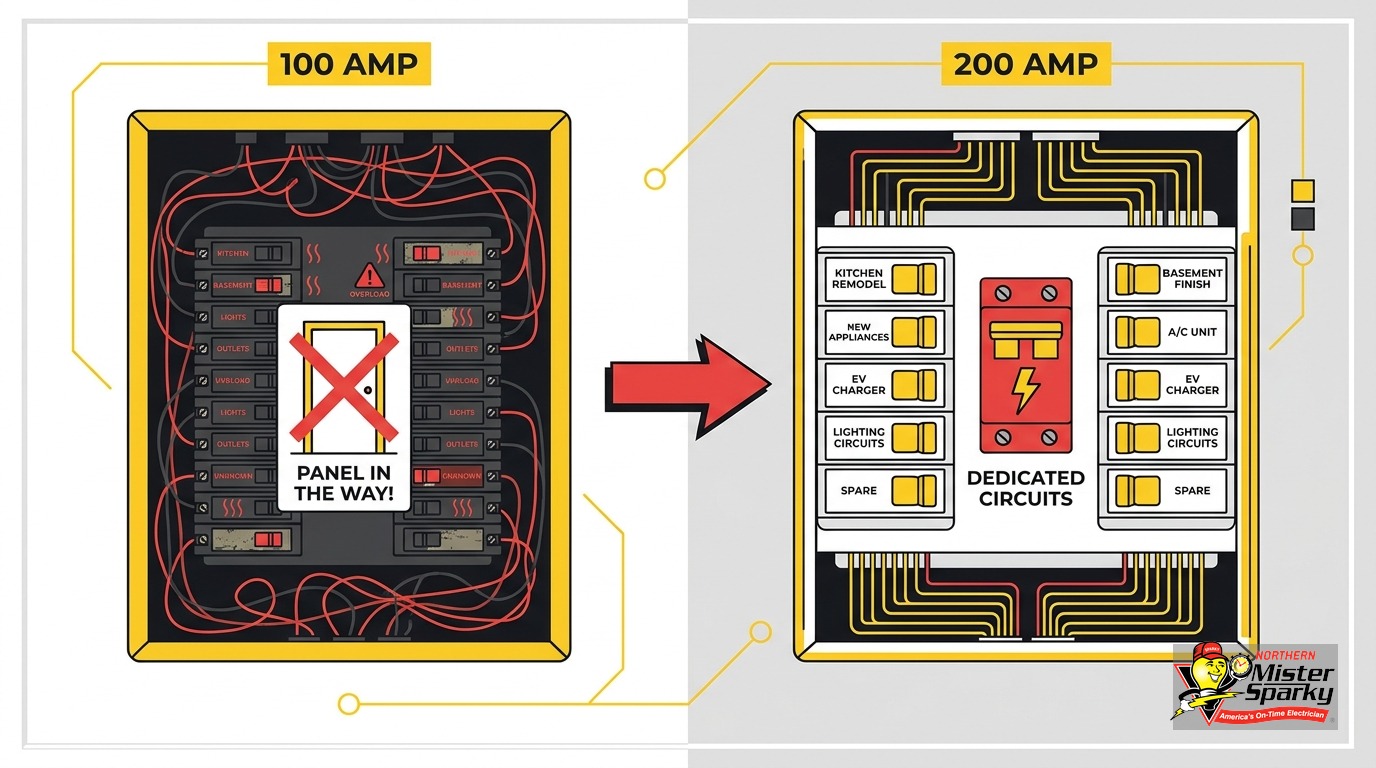
- Panel condition and amperage. If the existing panel is aging or your home runs on 100-amp service, combining the relocation with an upgrade is almost always cheaper than returning for a separate project later. Ask your electrician to evaluate the panel’s condition during the estimate visit.
- Service entrance involvement. Relocating the meter socket on the exterior requires Xcel coordination, weatherhead work, or underground line rerouting. Each of those adds time and cost that short-move estimates do not include.
- Finish work. New conduit runs through finished walls and ceilings mean drywall repairs and painting. In a kitchen, that might include tile or backsplash repair. National benchmarks undercount this in finished spaces.
- 2026 NEC compliance. Any permit filed on or after August 17, 2026 is a 2026-code job. Equipment or installation requirements under the new code may add cost that a pre-adoption estimate did not capture. Confirm with your electrician that the quote reflects the current code cycle.
Plan using mid-range figures as your baseline. Ask your electrician to flag which of the factors above apply to your specific job and by how much.
Is Moving the Panel Always Necessary?
Short answer: No. A subpanel is often the smarter, cheaper option when the remodel is confined to one area and the main panel’s clearance zone is not actually compromised.
Before committing to a full panel relocation, answer one question: does the remodel actually violate the NEC 110.26 clearances, or does it only come close?
A licensed electrician can measure this in a few minutes on site. If the remodel layout does not intrude on the clearance zone or the dedicated equipment space above the panel, there may be no code requirement to move it. In that case, the issue is your contractor’s layout preference, not a hard electrical code conflict. You have options.
When the main panel does need to stay where it is - or when the remodel simply needs more circuits delivered to a new area - a subpanel is the right tool. A licensed electrician runs a feeder cable from the main panel to a new subpanel in or near the remodel area. The main panel stays exactly where it is. Installed cost for a subpanel typically runs $1,000 to $3,000 depending on feeder distance and panel size.
That is often meaningfully less than a full panel relocation. It also keeps future access to the main panel clean, with no new clearance complications created by the remodel layout.
For a structured comparison of when a subpanel is the right call versus a full service upgrade or relocation, see our guide on subpanel vs. service upgrade decisions.
What Does the Minnesota Permit Process Look Like?
Short answer: You file with either the state DLI or your local city, depending on your address. Hiring a licensed electrician means the contractor handles the filing. The permit triggers a mandatory inspection before any electrical work can be covered by drywall or finishes.
Minnesota’s permit jurisdiction depends on your city. Minneapolis is a local authority having jurisdiction - permits go to the city directly. Most suburbs (Plymouth, Eagan, Woodbury, Blaine, Maple Grove, Brooklyn Park) use the state DLI at ims.dli.mn.gov. Confirm with your electrician before assuming which system governs your address; getting it wrong delays the job.
When you hire a licensed contractor, the contractor pulls the permit. Homeowners can technically pull their own permit on a single-family owner-occupied home, but must personally perform all the work. A panel relocation is not a realistic DIY project. Hire a licensed electrician and let them handle the filing.
Here is the most important Minnesota-specific timing issue right now: Minnesota adopted the 2026 NEC with an effective date of August 17, 2026. Any permit filed today triggers 2026-code compliance. Permits filed before August 17 were under the 2023 NEC.
None of the national cost-estimating sites mention this, and it matters. If your contractor’s estimate was prepared before August 17 and the permit has not been pulled yet, ask them directly whether the quote reflects 2026 NEC requirements. Code adoption affects equipment specifications, breaker types, and installation methods - all of which affect cost.
For a complete guide to the Minnesota permit process and what to expect from the inspection, see electrical permits in Minnesota.
Are There Rebates or Incentives Available to Minnesota Homeowners?
Short answer: The Xcel Energy panel upgrade rebate (up to $1,500) is live and worth timing alongside a panel move. A state grant program is funded but has not launched. The federal 25C credit ended December 31, 2025 and is gone.
Xcel Energy rebate - active now
If you are moving the panel and upgrading the amperage at the same time, Xcel Energy customers can apply for a panel upgrade rebate of up to $1,500. Requirements: a licensed electrician must perform the work, and the upgrade must increase the panel’s amperage. Replacing at the same amperage does not qualify.
Timing the rebate alongside the relocation makes financial sense. You are already paying for labor and permits. Upgrading amperage during the same project mobilization costs far less than returning later for a standalone upgrade. If you are on Xcel’s grid, ask your electrician to document the before/after amperage for the rebate application.
Minnesota state grant program - not yet available
Minnesota allocated $5.8 million for a residential panel upgrade grant program covering upgrades to at least 200 amps or smart panels. As of today, the program has not launched. It is awaiting U.S. DOE approval with no confirmed start date. Grants will not be retroactive. Track updates through the Minnesota Commerce Department’s energy programs page.
Federal 25C credit - ended
The federal Energy Efficient Home Improvement Credit (25C), which previously covered panel upgrades, ended December 31, 2025. It is no longer available.
The only active incentive right now is the Xcel rebate. If you qualify, build the application into your project plan from the start.
What Adds Cost in a Minnesota Remodel Specifically?
National cost benchmarks reflect average conditions across all markets. Minnesota remodels have specific characteristics that push costs higher than the published ranges suggest.
Finished basements. Minnesota homes use basement space at high rates. A panel that sat in an open utility area becomes surrounded once the basement is finished. Routing new conduit through insulated walls and finished ceilings takes more labor than rough, open-stud work. National averages do not account for this. Budget for it explicitly in any basement-adjacent panel move.
For a look at what the electrical portion of a full basement finish costs in total, see our guide on basement finishing electrical costs.
Xcel utility coordination. If the service entrance is moving, Xcel must de-energize the line before work starts. You cannot work around this timing - Xcel sets the appointment. Build several days of buffer into your remodel schedule for this dependency, especially during busy summer and winter seasons when service call volume is high.
Cold-climate timing. If the panel is on an exterior wall and the meter socket is involved, outdoor work in a Minnesota winter adds complexity. Schedule electrical work in warmer months when the choice is available. If the job runs into cold weather, confirm your electrician has the equipment and protocols to work safely.
Mid-code-cycle projects. Projects that started under the 2023 NEC and are now filing permits under the 2026 NEC may face equipment changes mid-job. Your electrician should flag this proactively. If they do not bring it up, ask directly how the August 17 code transition affects your scope and estimate.
How Long Does a Panel Move Take?
Short answer: The electrical work itself takes one to two days. Permit processing, inspection scheduling, and Xcel coordination extend the total window to one to two weeks in most cases.
The labor - disconnecting, relocating, re-terminating, restoring service - is a one- to two-day job for a licensed crew. Permit processing from the state DLI or local city adds one to three business days. Inspector scheduling adds more time on top of that, depending on your jurisdiction’s current workload.
If Xcel coordination is required for service entrance work, add additional days for the utility appointment. Xcel scheduling is not always quick during peak demand months in Minnesota.
Plan the overall window at one to two weeks from permit filing to final inspection sign-off. Your general contractor needs to know this timeline before finalizing the remodel schedule. The panel move must be inspected before finish work (drywall, cabinets, flooring) covers the new conduit runs. It is a gating step, not a finishing step. Getting the electrical permit pulled and the inspection scheduled early protects the rest of your remodel timeline.
Getting an Accurate Estimate for Your Twin Cities Remodel
The cost ranges in this guide are a planning tool. They tell you whether a number is in the ballpark. They do not replace a site visit.
The actual cost to move your panel depends on the distance of the move, your existing equipment’s condition, whether the service entrance is involved, your city’s current permit fee schedule, and what the 2026 NEC requires for your specific installation. Two remodels in the same neighborhood can produce very different numbers based on those factors alone.
No malarky: get an on-site estimate before your remodel contractor finalizes the layout. The right electrician can also tell you whether a subpanel solves your problem for less than a full relocation - and that conversation is worth having before any plans are drawn in permanent ink.
We are locally owned and operated, licensed in Minnesota, and back every job with the UWIN(R) 100% satisfaction guarantee. As America’s On-Time Electrician(R), we show up when we say we will and give you straight answers before you commit to anything.
Call 763-200-5956 or book online to schedule your estimate. The earlier we see the layout, the more options we can put in front of you.
Frequently Asked Questions
How much does it cost to move an electrical panel? +
Do I need a permit to move an electrical panel in Minnesota? +
Is there an alternative to moving the main electrical panel? +
Need an electrician now?