
Gas Fireplace Won't Turn On: Diagnosing Electrical Problems
Key Takeaways
- The most common gas fireplace won’t turn on electrical problem traces to a failing thermopile, a corroded wall switch, or a loose terminal at the gas valve - not to the gas supply.
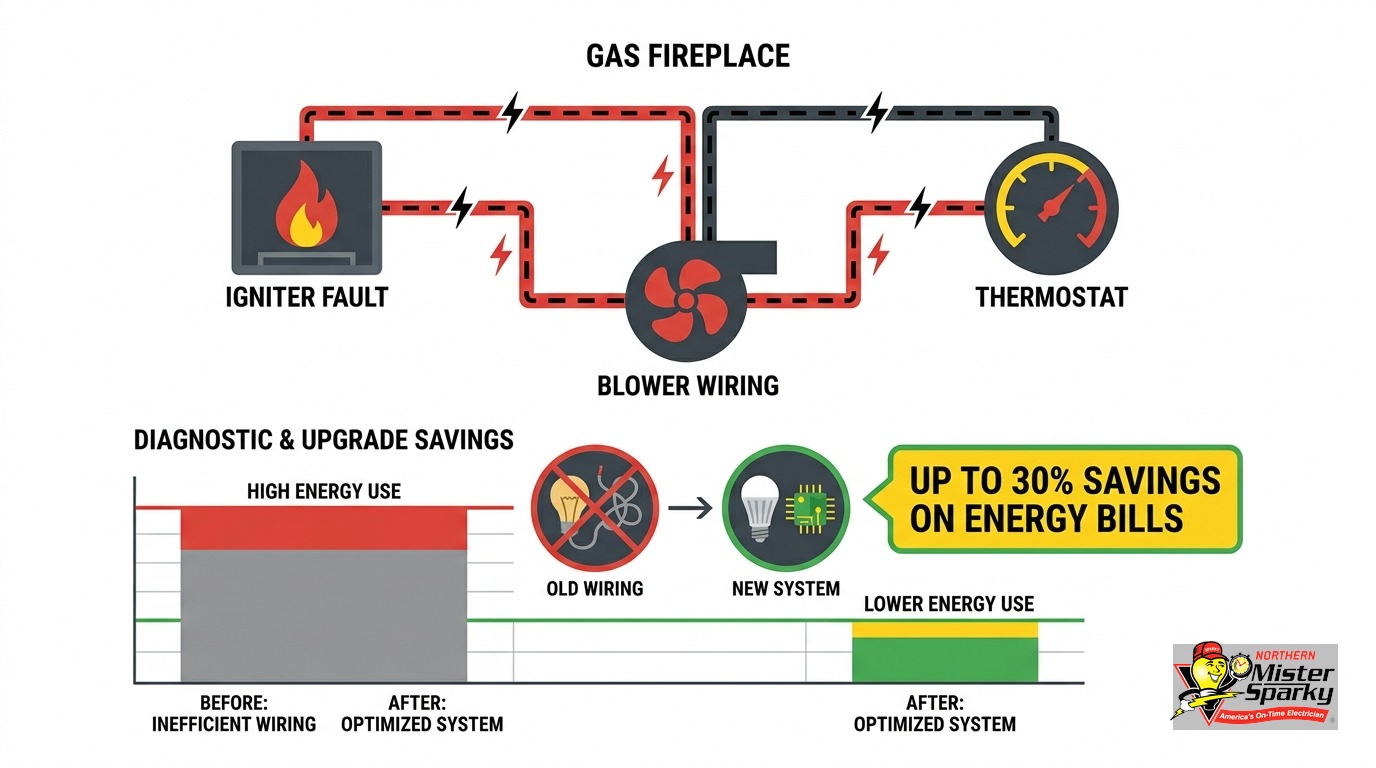
- Gas fireplaces use two separate electrical circuits: a millivolt control loop for ignition and a 120V circuit for the blower fan. A fault in one does not affect the other.
- A healthy thermopile reads 300-750 mV with the pilot burning. Below 300 mV, replace it. A single thermocouple should read 25-30 mV; below 25 mV, replace it.
- Standard toggle wall switches can silently kill a millivolt circuit. The corrosion layer that builds on ordinary switch contacts adds enough resistance to block the signal even when the switch is physically in the ON position.
- Smart thermostats like Nest and Ecobee require 24VAC. Millivolt systems generate roughly 500 mV and need a plug-in transformer to run smart controls.
- Minnesota adopted the 2026 NEC on August 17, 2026. Adding a blower outlet or new circuit requires a permit under Minn. Stat. § 326B.
When a gas fireplace won’t turn on, is it an electrical problem or a gas problem?
Short answer: If your fireplace clicks, sparks, or shows a standing pilot flame but the main burner won’t fire, the fault is almost always electrical. A gas supply failure looks different: no pilot at all, no ignition click, nothing.
Gas supply problems are rarely subtle. When gas is cut off, the pilot won’t light and the igniter clicks into nothing. What homeowners usually describe as a “gas problem” - the pilot burns but the fireplace won’t respond to the thermostat or wall switch - is the control circuit. When the fireplace lights fine but no warm air moves, the blower’s 120V circuit is the issue.
Two completely separate electrical systems live inside a typical gas fireplace.
The first is the millivolt control loop. It powers the gas valve, wall switch, and thermostat. It draws no power from your home’s wiring. The pilot flame heats a thermopile, which generates a small DC voltage - roughly 300-750 millivolts when healthy. That voltage is what opens the main gas valve.
The second is the 120V blower circuit. It runs the fan motor through a thermal snap switch. It connects to your home’s electrical system and is entirely separate from the millivolt loop.
Knowing which half failed is the first and most important step. Everything else follows from there.
What system type do you have: millivolt or IPI?
Short answer: If your fireplace has a pilot flame that burns constantly, even when the fireplace is off, it is a millivolt system. If the pilot only lights when you call for heat, it is an IPI system. The diagnosis differs completely for each type.
Millivolt systems are common in Twin Cities homes built before the late 1990s. The pilot heats a thermopile, which generates DC voltage to power the gas valve. The wall switch and thermostat are wired in series with the valve. When the switch closes, the circuit completes and the valve opens. The whole system is self-powered from the flame.
IPI (intermittent pilot ignition) systems use a control board and a spark igniter. When you call for heat, the board fires a spark to light the pilot, then opens the main valve. These systems run on 120V AC or batteries. For an IPI unit that won’t turn on, start here:
- Is the circuit breaker for the fireplace tripped? Reset it and try again.
- Are the batteries in the remote or wall switch dead? Replace them.
- Is the control board’s power LED lit? No LED usually means no power to the board.
- Does the igniter spark? Clicking without ignition often points to a dirty igniter tip.
The rest of this guide focuses on millivolt systems. They have more electrical failure points and are the ones most commonly misdiagnosed in older Twin Cities homes.
How do you test a thermopile or thermocouple when your gas fireplace won’t turn on?
Short answer: Set your multimeter to DC millivolts, disconnect the leads at the gas valve, and read the output with the pilot burning for at least five minutes. Below 300 mV on a thermopile or below 25 mV on a single thermocouple means a replacement is needed.
Here is the step-by-step procedure:
- Light the pilot and let it burn for at least five minutes. The thermopile needs time to reach full operating temperature.
- Locate the gas valve at the back of the firebox. Look for terminal labels: TP (thermopile), TH (thermostat or wall switch), and often TH/TP (a shared terminal bridging both).
- Disconnect the TP leads from the gas valve.
- Set your multimeter to DC millivolts.
- Touch one probe to each TP lead. Polarity does not matter on a millivolt circuit.
- Read the output with the pilot still burning.
According to Mountain View Hearth Products’ standing pilot troubleshooting guide, a healthy thermopile reads 300-750 mV. Below 300 mV, replace the thermopile. A standard thermocouple - a single element, not a stacked thermopile - should read 25-30 mV; below 25 mV, replace it.
A thermopile that tests fine in isolation but drops below threshold once reconnected to the gas valve usually points to a wiring fault rather than a bad component. Look for corroded connections at the terminal screws, loose terminals, or a failing wall switch elsewhere in the control loop. Resistance anywhere in that series circuit reduces the voltage available at the valve.
What are the TH, TP, and TH/TP terminals on a gas valve?
Short answer: TP receives power from the thermopile. TH connects to the wall switch or thermostat. TH/TP is a shared terminal bridging both. Polarity does not matter. Use 18 AWG two-conductor wire and tighten every terminal screw firmly.
The millivolt circuit is simple in concept. The thermopile generates voltage and feeds it into the TP terminal. The TH terminal connects to your wall switch or thermostat. When you switch the fireplace on, the circuit completes from TH through the switch and back to TH/TP. The gas valve opens.
The DoItYourself.com millivolt wiring thread confirms the basics: polarity does not matter, 18 AWG two-conductor wire is the correct gauge, and screw terminals must be tight. A loose terminal is one of the more frustrating failure modes because it causes intermittent behavior. The fireplace lights some days and skips other days with no clear pattern.
Thermostat circuit continuity test: Disconnect the TH and TH/TP wires from the gas valve. Set your multimeter to ohms. Flip the wall switch to ON. Mountain View Hearth Products’ guide notes that zero resistance with the switch in the ON position means no continuity - the switch or wiring has failed and needs replacement.
Why does a wall switch kill a millivolt circuit?
Short answer: Millivolt circuits carry only about 500 millivolts. Ordinary toggle switches develop an oxide layer on their contacts over time. That layer adds enough resistance to block the signal entirely, even when the switch physically moves to ON.
This surprises homeowners. The switch moves. It feels fine. Nothing looks wrong. But electricians on the Mike Holt Forums have documented that millivolt circuit contacts must be silver or gold to carry the signal reliably. Standard residential toggle switches use contacts that oxidize. The oxide film is invisible, but it adds enough resistance to kill the millivolt signal.
In Minnesota, the heating season runs from October through April. The thermal cycling across those months, repeated moisture swings, and temperature shifts as the fireplace runs and rests all accelerate contact corrosion. A wall switch that lasts a decade in a moderate climate may fail here after five seasons.
The fix is straightforward. If the thermopile tests healthy and the terminal connections are tight, swap the wall switch. Use a switch rated for millivolt or low-voltage applications, not a standard 120V toggle. Parts cost under $20. This single repair resolves a large percentage of “gas fireplace won’t turn on electrical problem” calls that arrive mid-heating season.
Is the blower wired separately from the control circuit?
Short answer: Yes. The blower runs on 120V AC through a thermal snap switch mounted inside the firebox. It has no connection to the millivolt control loop. A fireplace that lights but produces no warm airflow has a fault on the 120V side only.
The blower circuit works like this. Power arrives from a 120V outlet or a hardwired connection. A thermal snap switch - a bimetallic device - stays open when the firebox is cold. Once the firebox reaches its set temperature, typically around 110-130 degrees F, the snap switch closes and the blower starts. When the unit cools back down, the switch opens again and the blower stops.
If the blower never runs, check in this order:
- Is it plugged in? Many blowers connect via a standard plug to an outlet behind or beneath the firebox.
- Is the outlet live? Test with a phone charger or a non-contact voltage tester.
- Is the thermal snap switch stuck open? Test with a multimeter set to continuity mode when the firebox is hot.
- Has the blower motor burned out? If the snap switch closes and the outlet is live but the blower still won’t spin, the motor has likely failed.
Xcel Energy supplies the 120V service that runs the blower. CenterPoint Energy delivers the natural gas for the burner. Two separate utilities in one appliance - which is also why blower wiring and gas valve wiring require two separate diagnostic paths.
If you need to add a 120V outlet for a blower that currently has none, that is a permitted electrical job in Minnesota. Our post on what it costs to add an electrical outlet covers the scope and typical pricing for that kind of work.
Can a smart thermostat work with a millivolt gas fireplace?
Short answer: Not directly. Nest, Ecobee, and similar thermostats require 24VAC to power themselves. A millivolt system generates roughly 500 mV - far too low. A 120V-to-24VAC plug-in transformer wired as a relay bridges the gap between the two systems.
OHMefficient’s guide on connecting a Nest thermostat to a gas fireplace explains the configuration. A plug-in 24VAC transformer supplies power to the thermostat. The thermostat’s relay output switches the 24V control signal. That signal is wired back through the transformer relay to complete the millivolt circuit at the gas valve. The thermostat controls the fireplace without drawing on the millivolt system for its own power.
Before purchasing hardware, confirm:
- You have a 120V outlet near the fireplace to power the transformer.
- You can run 18 AWG two-conductor control wire from the thermostat to the fireplace location.
- If you need to add a new outlet that does not exist, that is a permitted job in Minnesota.
IPI systems are generally easier to integrate with smart thermostats since they already run on 120V. If you are replacing an aging millivolt fireplace anyway, ask about an IPI conversion at the same time. It simplifies future thermostat upgrades considerably.
Our post on smart thermostat C-wire wiring covers how the transformer and C-wire concept work if you want to understand the power side before committing to a specific thermostat model.
What electrical work at your fireplace requires a permit in Minnesota?
Short answer: Any work beyond a like-for-like device swap requires a permit under Minn. Stat. § 326B. Adding a new outlet, running a new circuit, or moving existing wiring all qualify. Homeowners can pull their own permit on an owner-occupied single-family home but must do all the work themselves.
Minnesota DLI’s electrical permit page for homeowners is the authoritative source. The permit process requires at minimum two inspections: rough-in before walls close, and final after devices are installed.
The 2026 NEC is now in effect. Minnesota adopted the 2026 NEC on August 17, 2026. All permits filed on or after that date must comply. That matters for fireplace work because the 2026 NEC has expanded AFCI and GFCI requirements. Depending on where your blower outlet is located and when your home was built, a new outlet may now require arc fault or ground fault protection. Our post on arc fault vs. ground fault breakers explains the difference and when each type applies.
Jurisdiction is split in the Twin Cities metro. About 66 Minnesota cities act as their own authority having jurisdiction and issue permits independently of the state DLI. Minneapolis and St. Paul homeowners in particular should confirm which body to file with before starting any wiring work. Filing with the wrong body delays the project. Our post on electrical permits in Minnesota walks through how to identify your local jurisdiction.
Like-for-like swaps - replacing a failed wall switch with an equivalent millivolt-rated switch, swapping a burned-out blower motor for the same part - generally do not require a permit. When in doubt, call the DLI or your city’s building department before starting.
When should you call an electrician instead of diagnosing it yourself?
Short answer: Call when you have tested the thermopile, confirmed the wall switch, and checked all terminal connections at the gas valve - and the fireplace still will not fire. Also call for any new wiring, outlet installation, or circuit work, which is permitted work in Minnesota.
Here is what our team handles:
- Blower outlet installation: Running 120V into a firebox cavity means working near combustion components. A licensed electrician pulls the permit, does the work, and schedules the inspection.
- Smart thermostat wiring: Installing the transformer and relay, running new control wire through finished walls, and verifying the 24V signal at the gas valve.
- Intermittent ignition diagnosis: If the fireplace lights some days and not others, the fault is often a marginal thermopile, a corroded terminal, or a failing switch. All three require a multimeter and hands-on access inside the firebox.
- IPI control board replacement: Identifying the correct replacement board, testing input and output voltages, and confirming the board is the actual failure point before ordering parts.
- Any new circuit or wiring: Panel work, running wire, adding outlets - all permitted work in Minnesota, and all jobs where a licensed electrician handles the permit and inspection.
One straight answer before you call: some gas fireplace problems belong to a gas technician, not an electrician. If your pilot won’t stay lit even after replacing the thermopile, or if you smell gas near the unit, call a licensed gas professional. Our team handles the electrical side. Gas valve and combustion components are outside our scope.
Ready to get it fixed?
Northern Mister Sparky is locally owned and operated in the Twin Cities. We are backed by the America’s On-Time Electrician(R) guarantee and the UWIN(R) 100% satisfaction guarantee - which means we show up when we say we will and do not leave until the job is right.
Call 763-200-5956 or book online to schedule a diagnostic visit. We serve Minneapolis, St. Paul, Bloomington, Brooklyn Park, Woodbury, Blaine, Maple Grove, Plymouth, and surrounding communities. If your fireplace project is part of a larger electrical job - a panel upgrade, new circuits, or a whole-home inspection - ask about financing options when you book.
Frequently Asked Questions
Why won't my gas fireplace turn on even though the pilot light is on? +
Can I use a Nest or Ecobee thermostat with a millivolt gas fireplace? +
Do I need an electrical permit to add a blower outlet for my fireplace in Minnesota? +
What millivolt reading means my thermopile needs replacing? +
Need an electrician now?