Generator Interlock Kit Installation Cost: Twin Cities Guide
Key Takeaways
- Generator interlock kit installation cost in the Twin Cities runs $400-$850 or more. Hardware alone is $115-$260 before labor.
- Twin Cities electrical labor is $100-$140 per hour, which puts local jobs above most published national estimates.
- An interlock kit keeps your existing AFCI and GFCI breaker protection active when the generator is running. A standard transfer switch does not.
- Minnesota permits come from the state DLI, not your city. The minimum inspection fee is $55, plus $35 per generator source and $12 per circuit.
- Permits pulled before August 17, 2026 fall under the 2023 NEC. On or after that date, the 2026 NEC applies.
- Interlock kits are panel-brand-and-series-specific. Roughly 70% of residential panels have a compatible OEM kit available.
- Xcel Energy offers no rebate for residential generators.
- Twin Cities winter priority loads: furnace inducer and blower, sump pump, refrigerator and freezer, basic lighting.
What Is a Generator Interlock Kit?
Short answer: A generator interlock kit is a mechanical slide or bracket mounted to your existing electrical panel. It prevents the main breaker and the generator back-feed breaker from being on at the same time, a code requirement that stops your generator power from flowing backward onto the utility line and endangering line workers.
An interlock kit is not a separate sub-panel. It has no breakers of its own. It does not pre-select which circuits the generator can reach. Instead, it gives you access to the whole panel.
When you lose power and need to run your generator, here is the sequence:
- Shut off all branch circuit breakers.
- Turn the main breaker off.
- Slide the interlock cover to unlock the generator breaker.
- Flip the generator breaker on.
- Start your generator and plug it into the inlet box on your exterior wall.
- Turn on only the branch circuits you want, staying within your generator’s watt rating.
That is the full process. It is mechanical, fast, and handled at your existing panel. A licensed electrician installs the kit, the inlet box, and the new back-fed breaker. You operate it manually during an outage.
How Much Does Generator Interlock Kit Installation Cost in the Twin Cities?
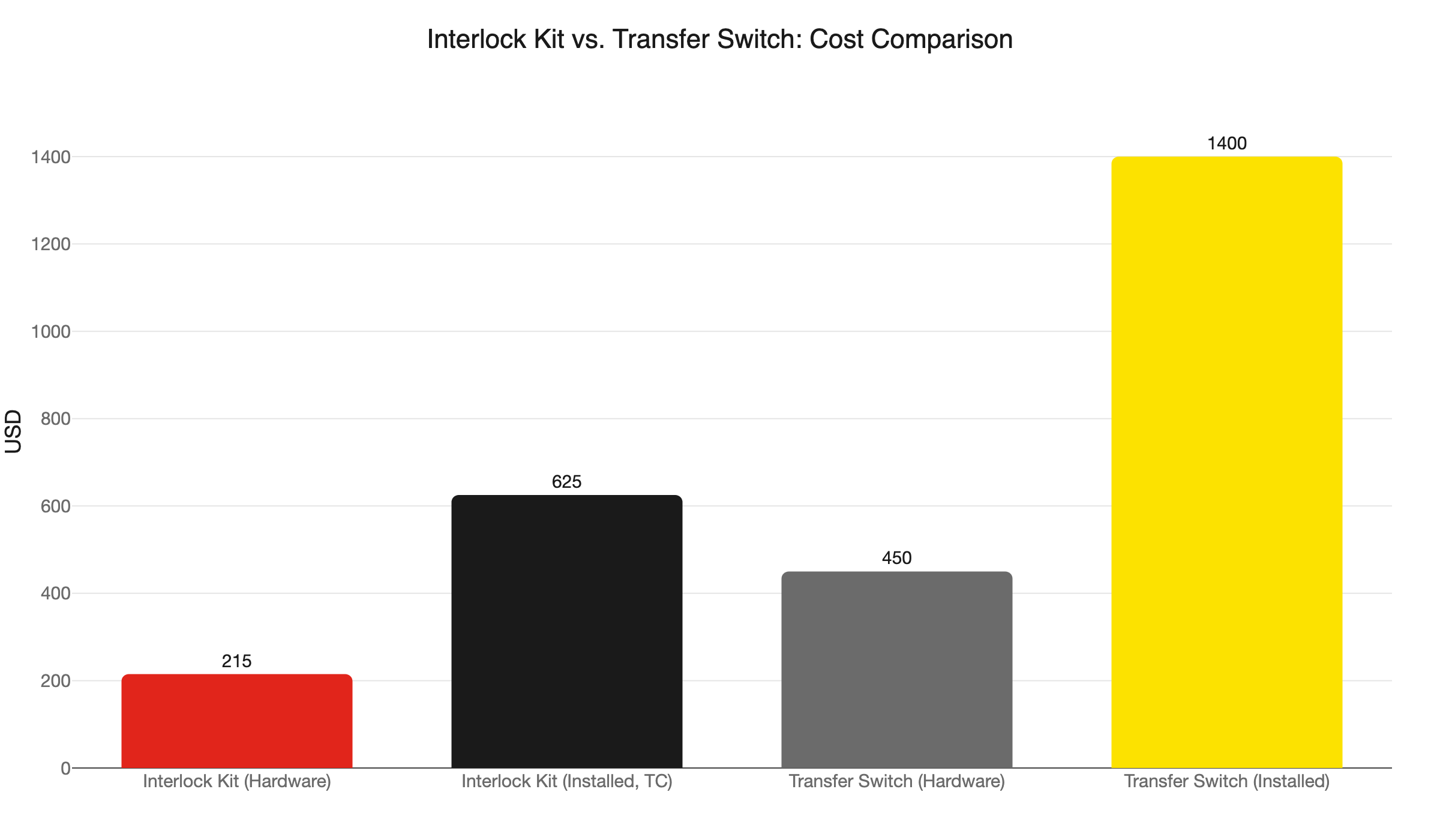
Short answer: Plan on $400-$850 or more for a professionally installed interlock kit in the Twin Cities. Hardware runs $115-$260 before labor. Local electricians charge $100-$140 per hour, and the Minnesota state permit adds a minimum of $55 plus per-circuit fees. Total cost lands firmly above the lower national estimates published for lower-labor markets.
Here is what makes up the total:
Hardware:
- OEM interlock kit: $60-$140. The kit must match your panel brand and series exactly. Source
- Generator inlet box (30A or 50A): $55-$120.
- 30A or 50A double-pole back-fed breaker: $15-$40 depending on your panel brand.
Labor:
A straightforward installation takes 2-4 hours. At $100-$140 per hour, labor alone is $200-$560 on a typical job. More complex situations add time: a panel in a finished basement, an inlet box location far from the panel, conduit runs through finished walls, or older wiring that needs attention before the permit inspection passes.
Permit fees:
The DLI minimum inspection fee is $55. Add $35 per generator source and $12 per circuit. Source A simple install with one new inlet circuit typically runs around $102 in permit fees on top of hardware and labor.
On the lower numbers you may have seen:
Some published ranges cite $200-$400 installed. Source Those figures reflect lower-labor markets, primarily the Southwest and Southeast. They do not apply to the Twin Cities. Use $400-$850+ as your planning figure here.
How Does That Compare to a Manual Transfer Switch?
Short answer: A manual transfer switch costs $400-$1,600+ installed, with a national average of $1,200-$1,600. Hardware alone for a standard 8-10 circuit, 30A kit runs $380-$520. The interlock kit is consistently the lower-cost option, and the installation is simpler. Source
A manual transfer switch is a separate sub-panel. Your electrician installs it between your main panel and a set of pre-selected circuits, typically 8-10. Before anything is installed, you choose which circuits get covered: the furnace, the refrigerator, a few lights, the sump pump.
During an outage, you flip each circuit’s handle from “utility” to “generator.” Only the pre-wired circuits are accessible in generator mode.
That selectivity is the main advantage. You cannot overload your generator because only the pre-wired circuits are available. The trade-off is cost and installation complexity. The electrician runs new dedicated wiring from the sub-panel to each selected circuit. Hardware for an 8-10 circuit kit is $380-$520, and installed totals run $400-$1,600+ nationally, with a commonly cited average of $1,200-$1,600. Source
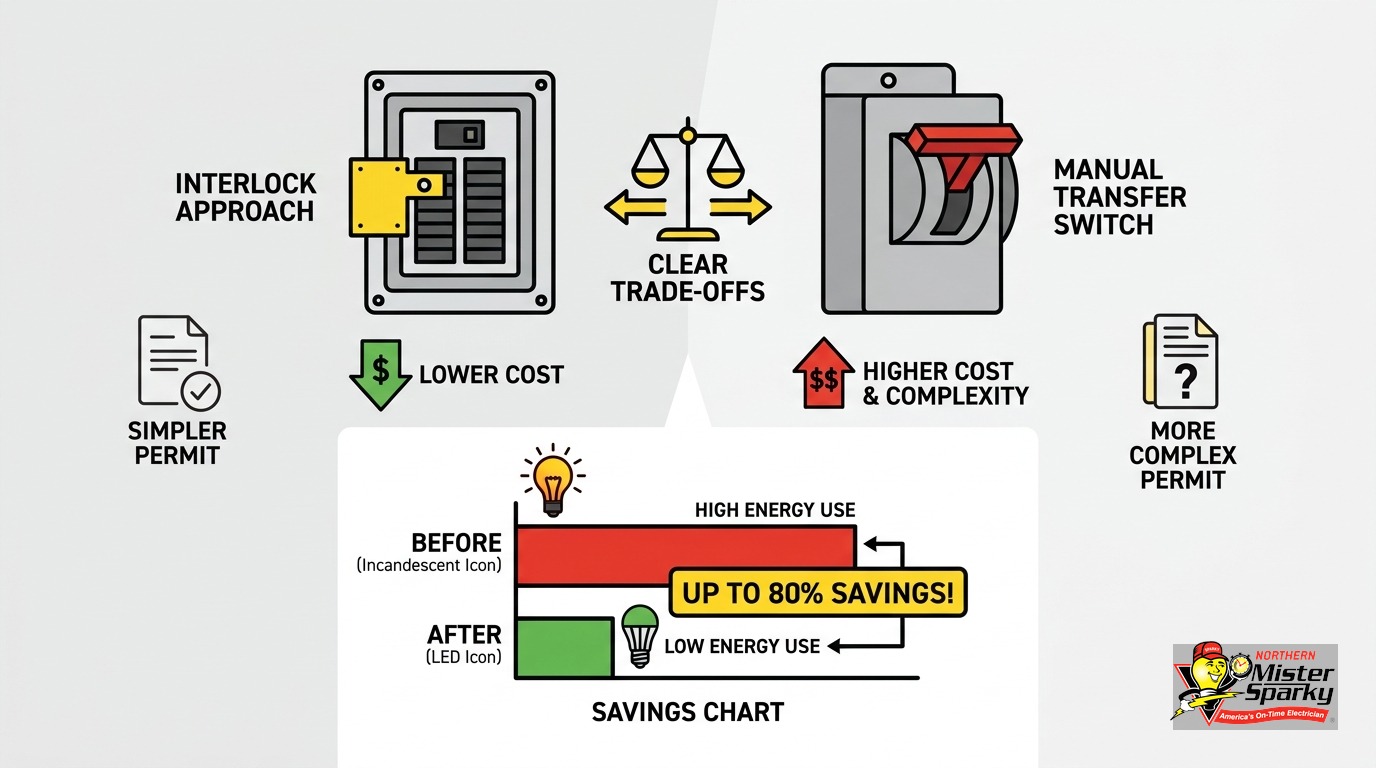
For most Twin Cities homeowners with a modern, compatible main panel, the interlock kit delivers flexibility at meaningfully lower cost.
For a detailed look at the full transfer switch process, see our guide to portable generator transfer switch installation.
Does an Interlock Kit Keep Your AFCI and GFCI Protection?
Short answer: Yes, and this is the most underreported advantage of interlock kits. The generator feeds through your existing main panel breakers, so any arc-fault (AFCI) or ground-fault (GFCI) protection on those circuits stays active. A standard manual transfer switch routes generator power through a separate sub-panel and does not carry that protection forward.
Major transfer switch manufacturers acknowledge this limitation in their own installation documentation. Source It is not a defect unique to any brand. It is a structural consequence of how sub-panel wiring works. The sub-panel’s breakers are standard thermal-magnetic breakers. They do not carry the AFCI or GFCI protection that your main panel’s breakers have.
With an interlock kit, the wiring path does not change at all. Every branch circuit still runs through its original breaker. Bedrooms wired with AFCI protection keep it. Bathrooms with GFCI breakers keep that too. Kitchen circuits with GFCI protection stay protected throughout the outage.
If your home was built or rewired in the last 15 years, you likely have AFCI protection on bedroom, living room, and hallway circuits. You almost certainly have GFCI protection in kitchens, bathrooms, the garage, and outdoors. On an interlock kit, all of that stays active when the generator is running.
Most comparison articles frame this as a transfer switch downside. What they miss: the interlock kit approach does not have this problem at all. That is a real safety advantage worth weighing when you choose between the two options.
What Permits Does Minnesota Require for a Generator Interlock Installation?
Short answer: Minnesota requires a state electrical permit for every generator connection. The Department of Labor and Industry (DLI) issues permits and conducts inspections, not your city or county. The minimum inspection fee is $55, plus $35 per generator source and $12 per circuit. Your electrician pulls the permit before work begins.
This surprises some homeowners. In most states, electrical permits come from the local municipality. In Minnesota, they come from the state. Minneapolis, Bloomington, Maple Grove, Plymouth, none of them issue electrical permits for this work. Source
A DLI inspector checks several things on a generator interlock installation:
- The interlock kit is an OEM-listed, panel-specific product. Generic brackets are not acceptable. Listed kits are evaluated to UL 67 as a panelboard accessory. Source
- The back-fed generator breaker has a retainer clip securing it in the ON position. NEC 408.36(D) requires this to keep the breaker from being knocked loose during generator operation. Source
- The installation meets NEC Article 702, which covers optional standby systems. Source
- The inlet box is correctly rated, weatherproofed, and appropriately located on the exterior wall.
The 2026 NEC code-change window:
Minnesota adopted the 2026 NEC, effective August 17, 2026. Permits pulled before that date are governed by the 2023 NEC. Permits pulled on or after that date fall under the 2026 NEC. Source If your project is scheduled near that transition, confirm the applicable code edition with your electrician before work begins.
For a full walkthrough of the DLI permit workflow, see our guide to the Minnesota electrical permit process.
Will an Interlock Kit Work with Your Panel?
Short answer: Probably, but not guaranteed. Interlock kits are panel-brand-and-series-specific, and roughly 70% of U.S. residential panels have a compatible OEM kit available. Source A Square D Homeline kit fits only Homeline panels. It will not fit a Square D QO panel, even though both carry the Square D name and look nearly identical.
Panels with widely available interlock kits include:
- Square D Homeline series (separate from QO)
- Square D QO series (separate kit from Homeline)
- Eaton BR series
- Siemens residential panels
- GE/ABB residential load centers
If you do not know your panel brand and series, look at the inside of the panel door. The label identifies the brand and model number. Your electrician will confirm the correct part number before ordering.
One additional factor: a minority of local jurisdictions do not accept interlock kits regardless of NEC 702 permissibility. Source This is uncommon in Minnesota, but your electrician should verify with the authority having jurisdiction (AHJ) before ordering hardware.
If your panel has no compatible kit, a transfer switch is the right path forward. In some cases, that conversation also surfaces underlying panel issues worth addressing first. See our guide to signs your panel may need an upgrade if your panel is older or already causing recurring breaker problems.
What Loads Should You Prioritize in a Minnesota Winter?
Short answer: Prioritize your furnace, sump pump, refrigerator, and basic lighting. Those four keep your family warm, your basement dry, your food safe, and your house lit during a Twin Cities winter outage. Stagger high-inrush appliances when you first restore power on a 30A generator feed.
This conversation is different from what you will read in articles written for Phoenix or Atlanta. A Minnesota winter outage is not about comfort. It is about keeping the house intact.
Furnace inducer and blower motor: Modern gas furnaces draw 5-8 amps at steady state, with a significant startup surge. Without the furnace, a hard cold snap can freeze your pipes in hours. This is always the first circuit to turn on.
Sump pump: Spring ice melt and late-winter rain events still happen in the Twin Cities. Losing sump pump power during a March ice-melt surge means a flooded basement. A typical sump pump runs at 1/3-1/2 HP and draws little power in steady operation.
Refrigerator and chest freezer: A full freezer holds temperature for about 48 hours if you keep the door closed. But generator power keeps food safe indefinitely. If you have a chest freezer full of venison or beef, this circuit is worth the wattage.
Basic lighting: Modern LED circuits draw almost nothing, a few watts per bulb. Keep a lighting circuit on. Avoid space heaters on a 30A generator feed. They draw 12-15 amps each and are largely unnecessary if the furnace is running.
Managing load on a 30A inlet:
An interlock kit gives you access to every circuit in your panel. That flexibility is the whole point. But it means you are managing total load yourself. Source Motors have high inrush current at startup, 3-6 times their running current. The furnace blower, refrigerator compressor, sump pump, and well pump all have startup surges.
Do not start them all at once. Start the furnace first and let it stabilize. Then start the refrigerator. The sump pump cycles on its own float switch. Stagger everything else from there.
For help matching your generator wattage to your actual winter loads, see our home generator sizing guide.
Does Xcel Energy Offer a Generator Rebate?
Short answer: No. Xcel Energy does not offer rebates for portable or standby generators. Residential rebate programs cover heat pumps, HVAC equipment, insulation, and solar. There is no generator rebate program. Source
No malarky: save yourself the call. If you have seen generator rebate claims tied to Xcel online, they describe large commercial demand-response programs. Those are not available to homeowners adding a portable generator inlet.
Budget for the full hardware, labor, and permit cost without expecting a rebate to offset it.
When Should You Choose the Transfer Switch Instead?
A transfer switch is the right call in several specific situations:
Your panel has no compatible interlock kit. Roughly 30% of residential panels do not have a listed OEM kit. Source A transfer switch works around that limitation.
You want foolproof load management. The transfer switch limits the generator to pre-wired circuits only. There is no risk of overloading by turning on too many breakers at 2 a.m. in a dark house.
Someone in your home is not comfortable managing the panel. Operating an interlock kit requires turning on branch circuits one at a time and tracking total load. A transfer switch reduces that to a single handle flip per pre-wired circuit.
You are planning a whole-house standby generator. Standby generators use automatic transfer switches as standard equipment. An interlock kit is not appropriate for automatic-transfer applications. That is a different project scope and budget entirely.
For most Twin Cities homeowners with a modern, compatible main panel, the interlock kit is the more cost-effective solution. The transfer switch earns its higher price tag when load management simplicity or panel incompatibility make it the cleaner fit.
What to Expect When We Handle the Installation
We are locally owned and operated in the Twin Cities. When you book with Northern Mister Sparky, here is how a generator interlock kit installation goes.
Assessment. We confirm your panel brand and series, verify a compatible OEM kit is available, and evaluate the best inlet box location. If the panel has issues that need addressing first, age, corrosion, capacity, we tell you plainly before work begins.
Permit. We pull the DLI permit before work starts. Permit fees are passed through at cost. We confirm which NEC edition governs your project, especially important if your job falls near the August 17, 2026 code-change date.
Installation. A typical job takes 2-4 hours. We mount the interlock kit to the panel, install the generator inlet on the exterior wall, wire the dedicated back-fed circuit to the new breaker, and test the full system with your generator before we leave.
Inspection coordination. The DLI inspector schedules directly. We coordinate with you and make sure the work passes on the first visit. Our installations are backed by the UWIN(R) 100% satisfaction guarantee.
As America’s On-Time Electrician(R), we show up when we say we will. Call 763-200-5956 or book online to schedule your generator interlock kit installation.
Frequently Asked Questions
How much does generator interlock kit installation cost in Minnesota? +
Do I need a permit for a generator interlock kit in Minnesota? +
Does a generator interlock kit preserve AFCI and GFCI protection? +
What is the difference between an interlock kit and a manual transfer switch? +
Need an electrician now?