
Grow Light Dedicated Circuit for Twin Cities Homes
Key Takeaways
- Minnesota law allows adults 21 and older to grow up to 8 cannabis plants at home, with a maximum of 4 mature plants. Basements are the most common setup location. They come with specific electrical code requirements.
- A grow light dedicated circuit is a code requirement, not a preference. Grow lights running 12-18 hours a day qualify as a continuous load under NEC 210.20(A). That rule caps usable circuit capacity at 80%.
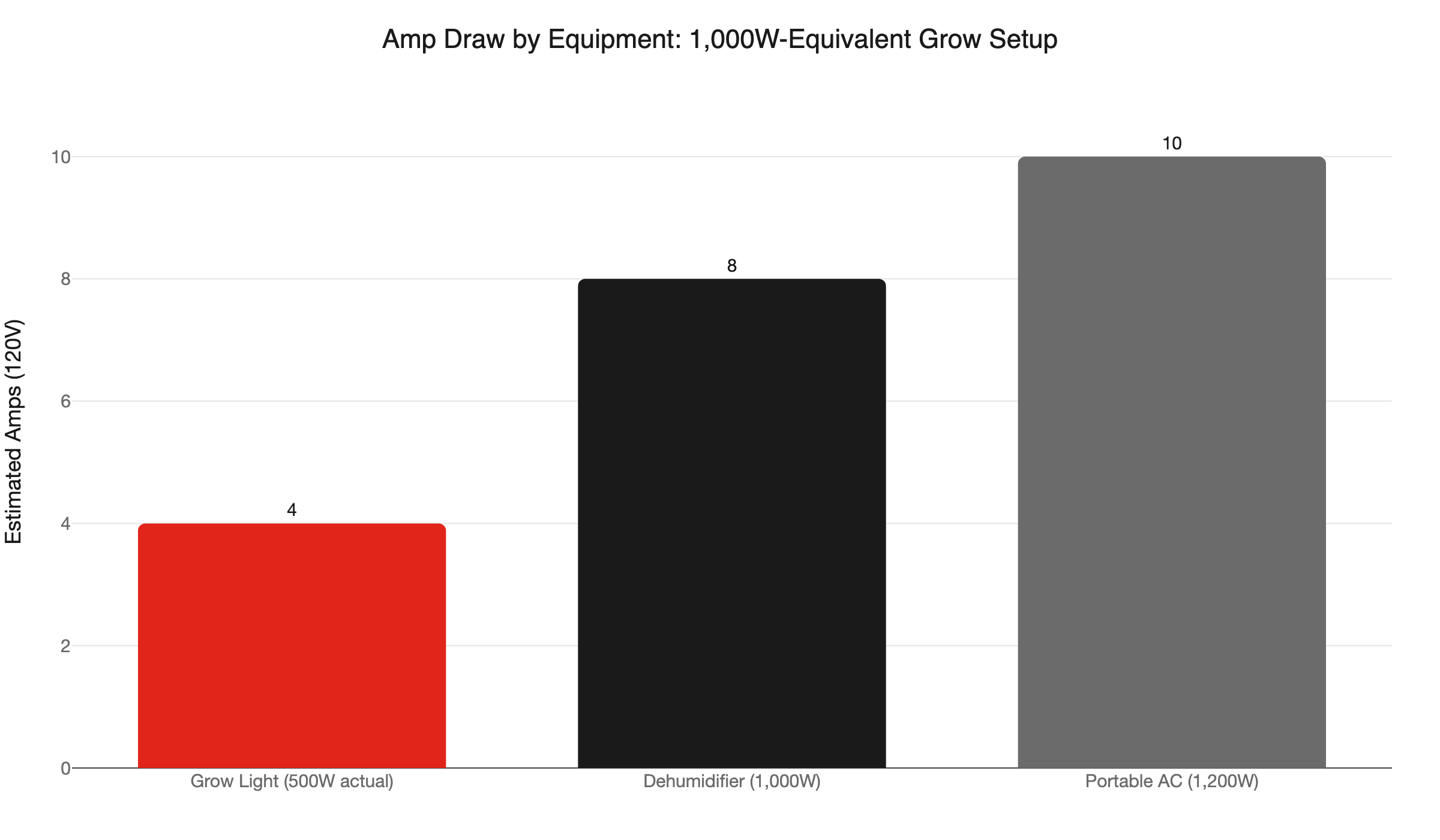
- One 1,000W-equivalent LED typically drives a need for three circuits: one for the light, one for the dehumidifier, and one for the portable AC the heat load makes necessary.
- All basement receptacles require GFCI protection since the 2020 NEC, finished or unfinished. Finished basement circuits also require AFCI protection.
- Running a new circuit to your panel is a permitted job in Minnesota. Minneapolis and St. Paul permit through their own city offices. Every other Twin Cities suburb goes through state DLI.
- Minnesota adopted the 2026 NEC effective August 17, 2026. Permits filed after that date must comply with the new edition.
What Is a Grow Light Dedicated Circuit?
A dedicated circuit serves one load only. It has its own breaker, its own wire run to the panel, and its own outlet or connection point. Grow lights running 12-18 hours a day are a continuous load under NEC 210.20(A). Code requires the circuit to be rated at 125% of that load, capping usable capacity at 80%.
The 80% rule translates directly to amps. A 20-amp circuit has a real continuous-load ceiling of 16 amps. A 15-amp circuit has a ceiling of 12 amps. Everything sharing the circuit counts toward that ceiling. If your light, a timer relay, and a small fan all run together for 18 hours, their combined draw cannot exceed the circuit’s continuous limit.
Undersized wire, not a tripped breaker, is the primary fire risk when a circuit is overloaded long-term. Wire too small for the load overheats inside the wall. The breaker may never trip. The insulation deteriorates anyway.
Wire gauge rules are fixed: 20-amp circuits require 12 AWG wire minimum. 15-amp circuits require 14 AWG minimum. These are not suggestions.
How Many Amps Does a Grow Light Actually Pull?
Far fewer than the marketing number suggests. A “1,000W equivalent” LED typically draws 250-500 watts at the wall. At 120V, 500W is about 4.2 amps - well within a 20-amp circuit’s 16-amp continuous ceiling. Plan from the spec sheet’s actual wall draw, not the marketing wattage.
LED manufacturers use “equivalent” wattage to compare light output against older HID technology. A “1,000W equivalent” means the light produces output comparable to a 1,000W HID fixture. It does not mean it draws 1,000W. Look for “actual wattage,” “wall draw,” or “system watts” on the spec sheet.
At realistic numbers, the light itself is not the sizing challenge. Here is the math applied:
- 500W LED at 120V: 4.2A. A 15-amp circuit’s 12A continuous ceiling covers it.
- Two 500W LEDs: 8.4A combined. A 20-amp circuit’s 16A ceiling covers both with margin.
- Add a small circulation fan to either scenario: still fine.
- Add a dehumidifier or portable AC to either scenario: the plan changes.
The circuit for the light alone is straightforward. What the light’s heat output demands is the harder conversation.
Why One Grow Light Usually Means Three Circuits
The gear sites cover amps and volts. They skip the heat.
Every 1,000 watts of electrical power inside a grow space produces roughly 3,400 BTU per hour of heat. A 4x8 grow tent running 1,000-1,200W generates 12,000-16,000 BTU per hour. That rivals a small window AC running nonstop. The difference is that the heat source is inside the tent, surrounded by plants and irrigation.
That heat has to go somewhere. In a basement, it raises the room temperature and drives up humidity. High humidity damages plants and creates mold risk. The dehumidifier runs to control it. The dehumidifier generates its own heat while it works. Net heat in the room rises. The AC runs harder to keep up. This is the cascade.
Here is what it looks like in practice for a single 1,000W-equivalent light:
The grow light. Your 500W LED draws roughly 4-5A on its own 20-amp dedicated circuit. The circuit has room. But the 3,400+ BTU/hr it generates fills the grow space.
The dehumidifier. A 1,000W dehumidifier draws roughly 8-10A. It adds its own heat load while removing moisture from the air. It needs its own dedicated circuit.
The portable AC. At 12,000-16,000 BTU of cooling demand, a portable air conditioner draws 8-15A. It needs its own dedicated circuit.
That is three circuits for one light. Add a second light and you add at least one more circuit, then revisit whether the AC and dehumidifier circuits are still sized correctly. A homeowner who calls us planning to “just add an outlet” for a basement grow tent typically leaves that first conversation with a plan for three to five circuits. No malarky - that is what the load math produces.
For more on how continuous-load sizing applies across different equipment categories, see our guide to dedicated circuits for appliances.
Does Adding a Grow Light Circuit Require a Permit in Minnesota?
Yes. Running new wire to your electrical panel is a permitted job in Minnesota. Swapping a switch or outlet is exempt - running a new circuit is not. Owner-occupied homeowners can self-permit, but the work still requires a licensed electrical inspection before it is covered up.
Minnesota’s Department of Labor and Industry publishes homeowner electrical guides. The existing home electrical guide and the new work guide cover what is and is not permit-exempt. Review these before deciding whether to hire out or handle the permitting yourself.
Here is the Twin Cities detail that matters. Minneapolis and St. Paul each run their own permit offices. They do not route through the state. Every other suburb in the metro - Bloomington, Brooklyn Park, Woodbury, Blaine, Maple Grove, Plymouth - goes through state DLI.
Minnesota adopted the 2026 NEC effective August 17, 2026. Any permit filed after that date must comply with the updated edition. Licensing exams also transitioned to the 2026 NEC on September 8, 2026.
Skipping the permit carries real consequences beyond a fine. An unpermitted circuit that causes a fire can void your homeowner’s insurance claim for that loss. It can also surface as a defect on a home inspection when you sell. Our guide to the Minnesota electrical permit process covers what to expect from application through inspection sign-off.
When we run grow room circuits, we handle the permit application, the inspection scheduling, and the coordination with the city or DLI. You get the signed permit at the end.
What GFCI and AFCI Requirements Apply to a Basement Grow Room?
All basement receptacles require GFCI protection - finished or unfinished, 120V or 240V. Finished basement circuits also require AFCI protection. A basement grow tent triggers both code requirements simultaneously, typically calling for combination AFCI/GFCI breakers on each circuit.
GFCI: the moisture layer
A grow environment is wet by design. Irrigation, hand-watering, misters, and elevated humidity all put water in proximity to electrical equipment. GFCI protection detects current leaking to ground. It responds to as little as 5 milliamps and cuts power in about 1/40th of a second.
NEC 210.8(A)(5) required GFCI on all basement receptacles starting with the 2020 NEC, covering finished and unfinished spaces equally. The 2023 NEC extended the requirement to 240V circuits. If your portable AC or a 240V grow light uses a 240V outlet, that outlet still requires GFCI. A damp basement grow room is precisely the environment this code was written to address.
AFCI: the arc fault layer
NEC 210.12(A) requires AFCI protection on circuits in finished basement spaces. Arc faults occur when insulation is damaged, connections work loose, or wire is pinched behind a wall. They produce concentrated heat that can ignite wood framing well before a standard breaker trips.
A finished basement grow room triggers both requirements at once. That typically means combination AFCI/GFCI breakers - one breaker handling both protections per circuit - or careful planning to meet each requirement separately.
For a detailed breakdown of where AFCI applies and how it interacts with GFCI requirements, see our post on AFCI breaker requirements.
Is Your Electrical Panel Ready for a Grow Room?
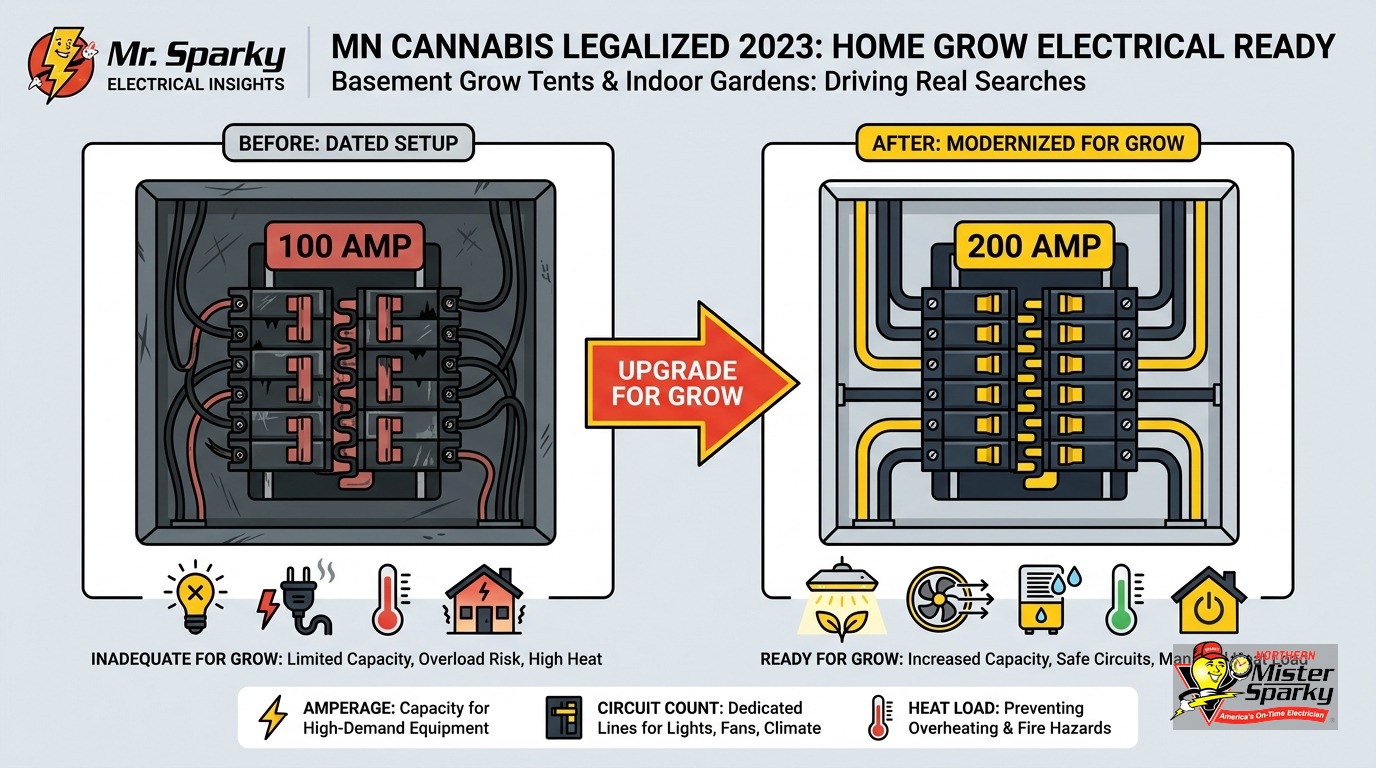
Maybe - and you need to know before the permit gets pulled. A grow room’s continuous loads can add 25-35 amps to your service. On a heavily loaded 100-amp panel, that may require a subpanel or a service upgrade before any new circuits go in.
Most Twin Cities homes built before 1990 have 100-amp service. That sounds adequate until you list what is already running. Central HVAC, electric water heater, kitchen circuits, laundry, existing lighting, and outlets all share that service. Many of those panels are already well-loaded before a grow room enters the picture.
A panel assessment before any permits get pulled looks at three things:
- Available slots. Can the panel physically accept three to five new breakers?
- Available capacity. Does the service size support the new continuous load without overloading the main breaker?
- Existing conditions. Are there double-tapped breakers, undersized wire, or other deficiencies that need correcting first?
The answers determine the project scope. Sometimes the panel has room and the circuits go straight in. Sometimes a small subpanel adds the slots without a full service upgrade. Sometimes a 200-amp service upgrade is the right call before anything else.
Review the signs that your electrical panel may need an upgrade before scheduling any grow room work. It is a useful checklist for knowing what questions to bring to a licensed electrician.
How We Plan a Grow Room Electrical Project
We are locally owned and operated in the Twin Cities. We have sized circuits for grow rooms ranging from a single 300W seedling tent to a multi-light basement production setup. Here is the actual sequence we follow.
Collect real specs first. We ask for the equipment list before the site visit: spec sheets for the lights, dehumidifier, AC unit, and any other continuous loads. We use actual wall draw only - not marketing equivalents.
Apply the continuous load rule. Everything running 3 or more hours at maximum draw is continuous. In a grow room, that is nearly everything. Each circuit gets sized so the load stays at or below 80% of circuit capacity.
Confirm wire gauge. Every 20A circuit gets 12 AWG minimum. Every 15A circuit gets 14 AWG minimum. No shortcuts based on run length or panel access.
Specify GFCI and AFCI coverage. Basement receptacles need GFCI. Finished basement circuits need AFCI. We note which circuits need combination breakers and specify them in the permit drawings.
Assess the panel. We check available slots, total service capacity, and existing conditions. This step determines whether new circuits go straight in, a subpanel is the right move, or a service upgrade comes first.
Pull the permit. Every new circuit to the panel gets permitted. In Minneapolis or St. Paul, we coordinate with the city permit office. Everywhere else in the metro, we go through DLI. We handle the application and schedule the inspection.
Inspect and verify. We walk the inspector through the completed work and deliver the signed permit to you. The job is not done until it passes.
What Does a Grow Room Electrical Project Cost?
In the Twin Cities, a single new 20A circuit runs $300-$600 depending on distance and panel access. A three-circuit grow room package - covering the light, dehumidifier, and AC - typically lands at $900-$1,800. Permit fees and inspection coordination are included. Panel work, if needed, scopes separately.
A few factors move the number:
- Distance from the panel to the grow space
- Whether the basement is finished or unfinished (finished walls add fishing time)
- Combination AFCI/GFCI breakers per circuit (add $75-$150 each)
- Whether the panel needs upgrading before circuits go in
Financing is available for larger projects. Ask when you call and we will walk you through the options.
Call Before You Buy the Equipment
The tent, the light, the dehumidifier, and the AC unit can all be returned before you own them. New electrical circuits cannot. Get the load calculation done first. Know what your panel can absorb and what the permit process requires before any equipment ships.
We are America’s On-Time Electrician(R), locally owned and operated in the Twin Cities. Every job we complete is backed by the UWIN(R) 100% satisfaction guarantee.
Call 763-200-5956 or book online. We will run the numbers with you, plan the permit, and give you a clear scope before anyone touches a wire.
Frequently Asked Questions
Do I need a permit to add a grow light circuit in Minnesota? +
How many circuits does a basement grow room need? +
Do basement grow room outlets need GFCI protection? +
What wire gauge does a grow light circuit need? +
Need an electrician now?