
Holiday Lights Safety: A Twin Cities Homeowner Guide
Key Takeaways
- Holiday lights safety starts with load math. A standard 15-amp, 120-volt circuit holds 1,800 watts total and only 1,440 watts of safe continuous load.
- A warm outlet, flickering lights, or a breaker that keeps tripping means you are overloaded. Stop, unplug, and spread the load.
- LED strands run far cooler and use significantly less energy than incandescent, so dozens fit where only a few incandescent strands do (DOE).
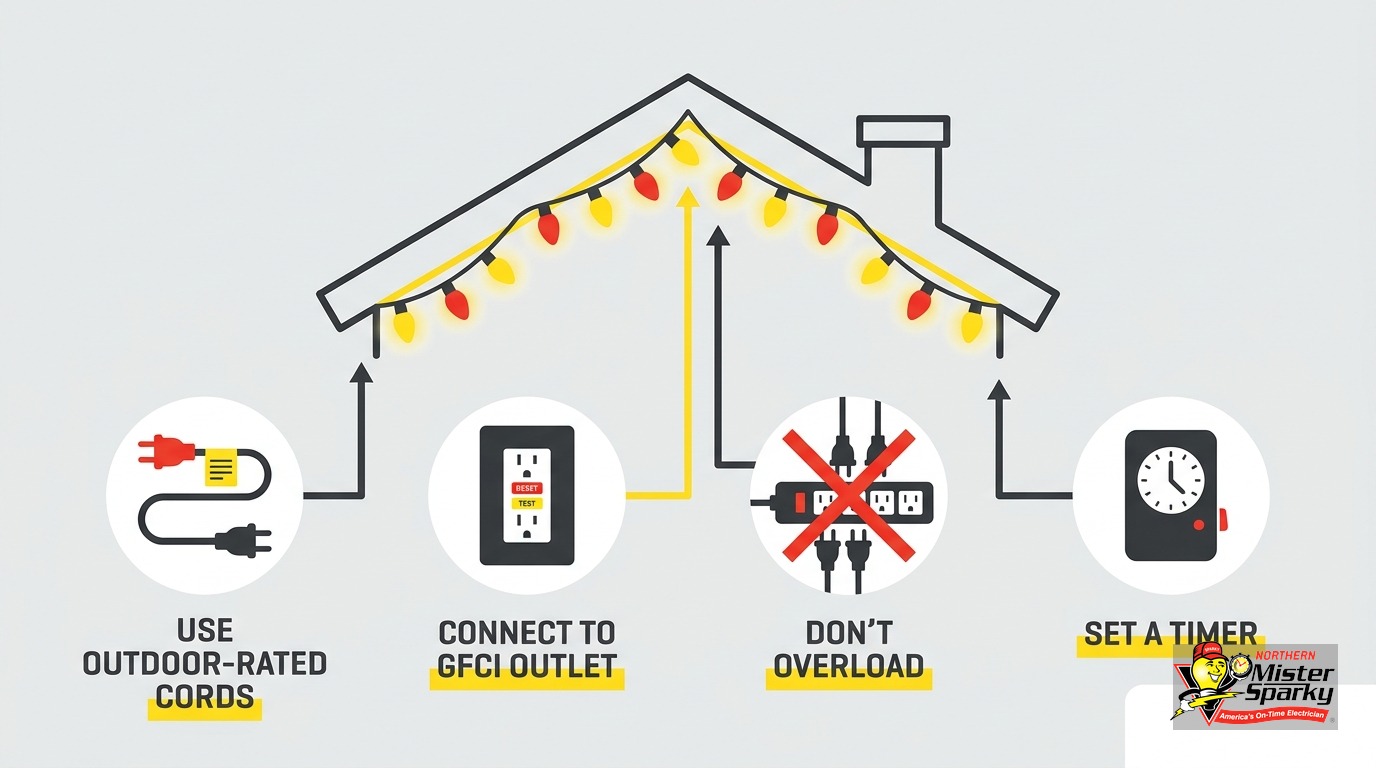
- Outdoor and garage holiday displays must plug into GFCI-protected outlets under Minnesota code (MN DLI).
- Older Twin Cities homes with aged panels, aluminum wiring, or knob-and-tube need a check before you add seasonal load.
- Call Northern Mister Sparky at 763-200-5956 or book online for a fast outlet or panel check.
Holiday Lights Safety Starts With What Your Outlets Can Take
Holiday lights safety comes down to one thing most homeowners never see: how much power a single outlet can actually handle. String too many bulbs on one tired circuit and you invite warm outlets, tripped breakers, and real fire risk. We are Northern Mister Sparky, your locally owned and operated Twin Cities electrician. This is the plain-language guide to keeping your lights bright and your home safe all season.
The stakes are not small. Electrical distribution or lighting equipment is the leading cause of home Christmas tree fires and was involved in more than 2 of every 5 (44%) of them, while decorative lights alone started nearly 1 in 5 (19%) of those fires (NFPA). U.S. fire departments respond to home fires every year that start with a Christmas tree (NFPA). Holiday decorations cause many home fires each year, and Christmas trees add to that total (ESFI). Almost all of it is preventable with a little planning.
What Causes a Warm Outlet When You Plug In Holiday Lights?
A warm outlet means the circuit is pulling more current than it should. A standard 15-amp, 120-volt circuit holds 1,800 watts total. Code limits continuous load to 80% of that, or 1,440 watts. Cross that line and the wiring heats up, the outlet warms, and the breaker trips.
Here is the simple math. Watts equal volts times amps. Your typical living-room and outdoor receptacles sit on 15-amp circuits. Multiply 15 amps by 120 volts and you get 1,800 watts of hard ceiling. Electricians plan for the safe continuous figure of 1,440 watts, because holiday displays run for hours at a time.
Now add the bulbs. Old incandescent C7 and C9 strands can pull 100 watts or more each. Ten of those strands alone can max out a single circuit. Remember that the circuit is not just your lights. The same circuit may already feed a television, a phone charger, or a space heater in the next room. When their draw stacks on top of your lights, the outlet warms and the breaker does its job.
A warm outlet is a warning, not a quirk. If you feel heat on the faceplate or the plug, unplug and reduce the load. If it keeps happening, our overloaded circuit repair team can find out why.
How Many Strings of Holiday Lights Can One Outlet Handle?
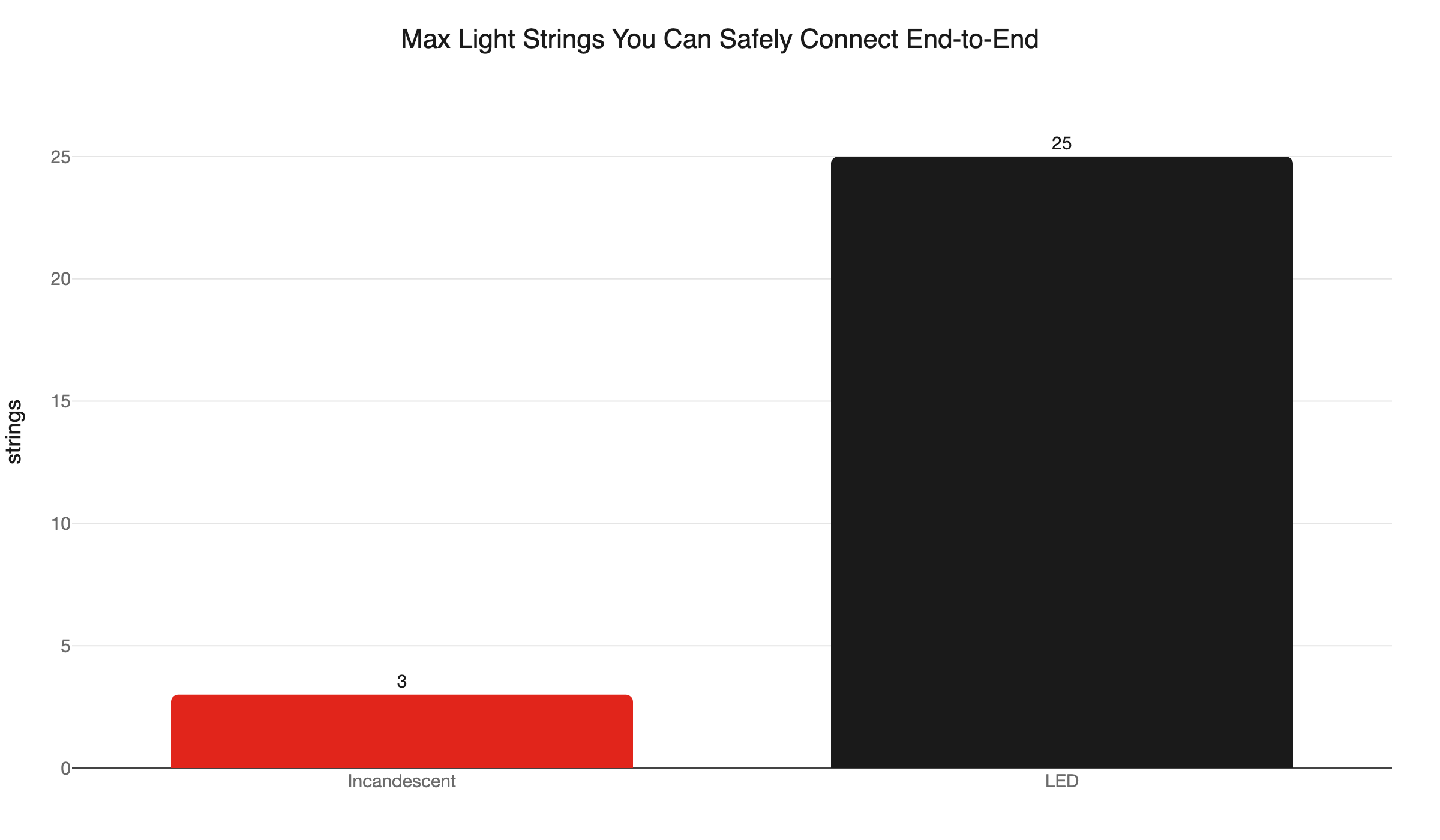
It depends on the bulb. You should never connect more than three strings of incandescent lights end-to-end (ESFI). LED strings pull only a few watts each, so you can safely link multiple strands without overloading a wall socket (DOE). Always read the tag on the first plug.
That end-to-end limit is different from the total the circuit can carry. Even if your LED strands allow 25 connections, you still have to respect the 1,440-watt safe ceiling on the circuit itself. The manufacturer tag lists the maximum number of strands you can daisy-chain. Follow it exactly, and do not try to beat it with power strips or splitters.
For a big display, split the load. Run separate strands to separate circuits instead of feeding everything through one outlet. Keep decorations at least 3 feet from any heat source, and maintain a safe distance from overhead power lines when you install anything on a ladder (ESFI).
Planning a permanent or large seasonal setup? Our outdoor lighting installation team can add dedicated, GFCI-protected circuits sized for your display, so you stop juggling extension cords every December.
Are LED Holiday Lights Safer Than Incandescent?
Yes. LEDs use significantly less energy than incandescent lighting and run far cooler, which cuts both fire risk and burn risk (DOE). Cooler bulbs are less likely to ignite a dry tree or a stray cord. Lower wattage also means you overload outlets far less often.
The savings show up on your winter utility bill, too. Twin Cities homes run lights for weeks in the darkest months of the year. LED strands sip power where incandescent strands gulp it. Over a full season, the difference adds up on your Xcel Energy or local co-op statement.
There is a bonus for load planning. Because each LED strand pulls only a few watts, you can run a fuller display on the same wiring without tripping a breaker. That is the whole point of holiday lights safety: bright displays that do not stress the panel.
If you are ready to upgrade older lighting or add new fixtures, Xcel Energy and area co-ops offer energy-saver and rebate programs for lighting and panel work. Ask us where those programs apply to your project.
What Are the Warning Signs of an Overloaded Circuit?
Watch for four signs: a warm or discolored outlet, lights that flicker or dim, a breaker that trips again and again, and a faint burning smell. Any one of these means you are overloaded. Unplug, spread the load across other circuits, and call an electrician if the problem repeats.
Let us break down each sign. A warm faceplate or a plug that is hot to the touch means too much current is flowing through that outlet. Discoloration or scorch marks are a serious red flag. Stop using the outlet and get it inspected.
Flickering or dimming lights, especially when another appliance kicks on, point to a circuit stretched past its limit. A breaker that trips is not being difficult. It is protecting your home from an overheating wire. Resetting it over and over without fixing the cause is a mistake.
A buzzing sound from an outlet or switch, or any burning smell, means stop now. Unplug the display, leave the breaker off, and call for help. These are the same hazards we cover in our top 5 electrical hazards guide, and they get worse under heavy holiday load.
Does Minnesota Code Require GFCI Outlets for Holiday Lights?
Yes. Minnesota follows the National Electrical Code (MN DLI). Under that code, receptacles outdoors, in garages, unfinished basements, and crawl spaces must have GFCI protection (MN DLI). Those are the exact spots holiday displays plug into.
A GFCI, or ground fault circuit interrupter, watches the flow of electricity and shuts off in a fraction of a second if it senses a fault. That fast cutoff protects you from shock when snow, rain, or slush reaches a cord or connection. Outdoor holiday lights and decorations should always plug into a GFCI-protected circuit (ESFI).
Test each GFCI before the season. Press the “test” button, confirm the power cuts, then press “reset.” If it will not trip or reset, it needs service. If your outdoor and garage outlets are not GFCI-protected, a portable GFCI adapter is a temporary fix, but a proper protected outlet is the safe answer. Our team can add code-compliant outlet installation where you need it.
How Does Minnesota Cold Change Holiday Lights Safety?
Cold makes standard cords brittle, so PVC jackets can crack and expose bare wire. Only outdoor-rated cords marked SJTW or “W” belong outside, plugged into a GFCI outlet. Minnesota winter also loads your circuits with furnace and space-heater demand, so your lights end up competing for the same power.
Sub-freezing temperatures are hard on cheap cords. An indoor extension cord left outside in a Twin Cities January can crack at the first sharp bend. Buy cords rated for outdoor use, inspect them before you plug in, and toss any with cuts, splits, or exposed copper.
Keep connections up off the ground and out of standing water and snow. Use weatherproof covers on outdoor plugs. Elevate the junction of two cords on a hook or clip so meltwater cannot pool at the connection.
The bigger cold-weather trap is shared load. Never run holiday lights on the same circuit as a space heater. A space heater alone can pull most of a 15-amp circuit, and adding lights on top is asking for a tripped breaker or worse. No malarky: keep heaters and lights on separate circuits, every time.
Do Older Twin Cities Homes Need an Electrical Check Before the Holidays?
Often, yes. A large share of Minneapolis and St. Paul homes were built before 1980. Many still run decades-old panels that were never sized for modern seasonal load. Some have aluminum branch wiring or knob-and-tube. A simple rule: if your home is older than your furnace, get your outlets checked before you load them.
Aluminum branch wiring showed up in a lot of homes built from the mid-1960s to the early 1970s. It can loosen and overheat at connections over time. Knob-and-tube wiring, found in the oldest housing stock, was never designed for today’s plug-in demand. Both deserve a professional look before you add a heavy holiday display.
Undersized and aging panels are the quiet problem. A panel built for a smaller electrical era can run out of room fast when you stack lights, a tree, kitchen appliances, and winter heating. If your breakers trip more each December, that is your panel telling you it is out of room.
Those are the same signs you need a panel upgrade we see all winter. When the panel is the limit, a panel upgrade gives you the headroom to run your display safely. Financing is available on larger jobs like panels, generators, and EV chargers, so cost does not have to stall a needed fix.
Your Twin Cities Holiday Lights Safety Checklist
Run through this list before you light up the house:
- Buy UL-listed lights and cords, and choose LED strands to run cooler and cut load.
- Inspect every strand and cord. Toss anything with cracks, cuts, frayed jackets, or exposed wire.
- Connect no more than three incandescent strings, or up to 25 LED strings, end-to-end.
- Add up the wattage and stay under the 1,440-watt safe limit per 15-amp circuit.
- Plug all outdoor and garage displays into GFCI-protected outlets, and test the GFCI first.
- Use only outdoor-rated cords marked SJTW or “W” outside, and keep connections out of snow and water.
- Keep decorations at least 3 feet from heat sources and 10 feet from overhead power lines.
- Never share a circuit with a space heater.
- Put your lights on a timer, and unplug displays when you leave or go to sleep.
- If an outlet feels warm or a breaker keeps tripping, stop and call an electrician.
When to Call Northern Mister Sparky
If your outlets run warm, your breakers keep tripping, or your older home has never had its wiring checked, do not guess. We are Northern Mister Sparky, locally owned and operated in the Twin Cities and backed by America’s On-Time Electrician(R). Our team shows up on time, explains the fix in plain language, and stands behind the work with the UWIN(R) 100% satisfaction guarantee.
We can add GFCI outlets, repair overloaded circuits, size a panel for your seasonal load, or wire dedicated outdoor lighting so your display runs safely every year. Financing is available on larger jobs.
Keep your lights bright and your home safe this season. Call 763-200-5956 or book online today, and let us handle the wiring so you can enjoy the holidays.
Frequently Asked Questions
How many holiday light strings can I plug into one outlet? +
Why does my outlet feel warm when I plug in Christmas lights? +
Do outdoor holiday lights need a GFCI outlet in Minnesota? +
Are LED holiday lights really safer than incandescent? +
Need an electrician now?