
Home Daycare Electrical Code Requirements Minnesota
Key Takeaways
- Minnesota home daycare electrical code requirements come from Rule 9502.0425, enforced by the Department of Children, Youth, and Families (DCYF) during your pre-license inspection.
- All outlets accessible to children under first grade must have tamper-resistant or shielded receptacles. Plastic plug covers fall short on permitted work under the 2020 NEC.
- Extension cords used as permanent wiring are a direct violation and one of the most common correction order items.
- Minnesota adopted the 2020 NEC on November 17, 2020. GFCI protection is now required at bathrooms, kitchen countertop receptacles, garages, unfinished basements, laundry areas, and outdoor locations.
- Any family child care home using basement space for child care requires a mandatory fire marshal inspection before DCYF issues the license.
- UL-listed smoke detectors are required on every level of the home. Carbon monoxide detectors are required under IBC 915.1.1 for homes classified as R-3 occupancy.
- Most electrical corrections require a permit pulled by a licensed electrician. Unpermitted work can stall your license application.
What Are the Home Daycare Electrical Code Requirements in Minnesota?
Home daycare electrical code requirements Minnesota providers must satisfy are defined in Rule 9502.0425 and enforced by DCYF at your licensing inspection. Requirements cover tamper-resistant receptacles on child-accessible outlets, no extension cords as permanent wiring, properly grounded appliances, adequately sized wiring, and compliance with Minnesota’s 2020 NEC.
If you are opening a family child care home in Minneapolis, St. Paul, Bloomington, Maple Grove, or anywhere in the Twin Cities metro, these rules apply to your house. Not a separate commercial facility. Your home.
Every outlet, circuit, and smoke detector in a room where children spend time is part of your compliance picture. A DCYF inspector walks through your home with a physical environment checklist. The electrical section is one of the most concrete parts: items either pass or they do not. A single correction order can halt your license until every item is resolved.
This post walks through the full checklist, item by item. It also explains which corrections require a licensed electrician and a permit, and which do not.
Why These Rules Carry Real Consequences
DCYF took over family child care licensing from DHS in 2023. The substantive standards are still found in the family child care licensing chapter, but DCYF now administers them. The physical environment inspection covers safety, sanitation, heating, and electrical systems. Electrical violations are among the most commonly cited findings.
Why? Because inspectors are trained to look for them, and the language in Rule 9502.0425 is specific. There is no gray area around an extension cord running through a wall. There is no gray area around a standard outlet in a room full of toddlers. The violation either exists or it does not.
A correction order comes with a deadline. You cannot serve children while an order is open. If your correction requires a licensed electrician, permit scheduling, and a re-inspection, the timeline can stretch to weeks. Getting ahead of the electrical requirements before you file your application is almost always the better move.
One important note: providers can request interpretive guidance from DCYF on correction orders they believe involve ambiguous statutory or rule language. That is a meaningful new recourse option. But for most electrical findings under Rule 9502.0425, the language is specific enough that the interpretation is not in question.
What Tamper-Resistant Receptacle Rules Apply to Home Daycares?
Rule 9502.0425 requires every outlet accessible to children under first grade to be “tamper-proof or shielded when not in use.” This covers any outlet a child in care can physically reach: play areas, sleeping rooms, bathrooms, hallways, and any other space children move through freely.
Tamper-resistant receptacles have spring-loaded shutters inside both slots. Both slots must be depressed simultaneously for anything to enter the circuit. A single object cannot enter one slot alone because the shutter stays closed. That design makes insertion of foreign objects physically difficult. It is also the only device that fully satisfies the rule on new or permitted circuits.
Plastic plug covers are a common substitute. They are cheap and widely available. A DCYF licensor may accept them on older, unmodified wiring. Here is the practical distinction. If you pull a permit for any outlet work in your home, the 2020 NEC requires tamper-resistant receptacles on those circuits. A plastic cover does not satisfy that standard on permitted work.
Many Twin Cities homeowners discover this mid-project. They hire an electrician to add one outlet and learn that tamper-resistant devices are required on the circuit. Plan for it in your budget, and the pre-inspection upgrade becomes a straightforward line item rather than a surprise.
For a deeper look at what these receptacles require in a residential setting, see our guide to tamper-resistant outlets for child safety.
Extension Cords and Wiring: Active Violation Categories
Rule 9502.0425 prohibits extension cords used as permanent wiring. You cannot run one through a wall, ceiling, or floor. You cannot run one under a door or beneath floor coverings. The rule is clear, and inspectors cite it whenever they see a cord powering a device that has been in the same position for months.
The line between temporary and permanent is sometimes blurry. A cord powering a lamp during a holiday party is temporary. A cord feeding the baby monitor charging station you set up when you converted a bedroom to a nap room is not. In child care licensing, inspectors apply a practical eye: if it looks like it has been there a while and powers something the daycare depends on, it is treated as permanent.
The fix is always a properly wired outlet on a dedicated or shared circuit. That work requires an electrician and a permit in most Twin Cities jurisdictions.
Subpart 18(D) of the same rule covers wiring condition. Wiring must be sized for its load and in good repair. An undersized branch circuit feeding a high-draw appliance is a citable deficiency even if the breaker has not yet tripped. Frayed insulation, exposed wire at a junction box, and wiring damaged by pests or moisture are all items inspectors notice.
If your home has older cloth-covered wiring, ungrounded two-prong outlets throughout, or an aging fuse box, have an electrician assess the system before you apply for a license. These systems are not automatic violations, but they carry known failure modes and inspectors pay attention to them.
Does Using Your Basement for Child Care Trigger a Fire Marshal Inspection?
Yes. Any family child care home using basement space for child care requires a mandatory fire marshal inspection before DCYF will issue a license. This also applies to manufactured and mobile homes, new applicants licensed for more children, and homes in mixed or multiple-occupancy buildings, per the Minnesota family child care licensing regulations.
The fire marshal inspection is separate from the DCYF physical environment inspection. The fire marshal focuses on egress, fire detection, and suppression. From an electrical standpoint, they will check egress lighting in the basement. They will also review smoke alarm placement on the lower level and any recent electrical work in that space.
This matters because basements are a practical child care space in Minnesota. The climate keeps children indoors for months at a time. A finished lower level with good lighting and a separate bathroom is a legitimate and common setup. But the fire marshal trigger is real, and it adds an inspection step that most providers do not anticipate.
Two inspections mean two sets of findings. Both must be resolved before you open. Electrical items often appear on both. A smoke alarm issue may surface with the DCYF licensor and the fire marshal. Resolving the electrical and detection work before either inspection protects your timeline.
Rule 9502.0425 also requires a portable multipurpose dry chemical fire extinguisher with a minimum 2-A:10-BC rating in the kitchen at all times. All caregivers must know how to use it. This is not an electrical item, but it appears in the same physical environment inspection cycle and is worth noting alongside the detection requirements below.
Do GFCI Requirements Apply Under Minnesota’s 2020 Electrical Code?
Yes. Minnesota adopted the 2020 NEC in November 2020, and St. Paul’s Electrical Bulletin 2020-01 confirmed the adoption and its effective date. Rule 9502.0425 requires wiring be “properly installed per state electric code,” which now incorporates NEC Section 210.8 and its GFCI location requirements.
Under the 2020 NEC, GFCI protection is required at:
- Bathrooms
- Kitchen countertop receptacles
- Unfinished basement outlets
- Garage receptacles
- Outdoor receptacles
- Laundry receptacles
- Any receptacle within 6 feet of a sink
If your home was built before 2020 and has had no renovation work, some locations may lack GFCI protection. Existing unmodified wiring is not automatically a violation in every case. But a non-functioning or visibly damaged outlet in a required GFCI location is a citable deficiency. And on any circuit covered by a permit, current code applies in full.
The practical move is to upgrade GFCI protection throughout the home before your inspection. The cost of GFCI retrofits is lower than many homeowners expect. A clean GFCI walkthrough removes a common inspection trigger and documents your home’s compliance with current Minnesota electrical code.
For more on where GFCI outlets are required and what the different protection options look like in practice, see our overview of GFCI outlet requirements explained.
Are Smoke Detectors and Carbon Monoxide Detectors Required in a Licensed Home Daycare?
Yes, both. Rule 9502.0425, Subpart 17 requires UL-listed smoke detectors on all levels of the home, properly installed and maintained. Minnesota law requires smoke alarms inside each sleeping room, outside sleeping areas within a specified distance per NFPA standards, and on every story including basements and habitable attics. Carbon monoxide detectors are required under IBC 915.1.1 for R-3 occupancy homes.
For a licensed home daycare, that coverage means:
- A smoke alarm inside every sleeping room used for child naps
- A smoke alarm on every floor, including the basement if children use it
- At least one carbon monoxide detector, properly placed per IBC requirements
- All alarms UL-listed and functioning on the day of inspection
Replace any smoke alarm older than 10 years before your inspection. Inspectors ask about age. An expired alarm is a correction order item that looks minor but adds real delay.
Hardwired and interconnected alarms are not always required by the rule. They are a significantly stronger choice for a child care setting. When one alarm sounds, all alarms sound. In a two-story home where a fire starts in the basement while children nap upstairs, that interconnect matters.
Our team installs hardwired smoke detectors throughout the Twin Cities. See our smoke detector installation service for what that work involves.
What Electrical Work Requires a Permit and a Licensed Electrician?
Any work that adds, extends, or relocates a circuit requires an electrical permit from your local authority having jurisdiction. In the Twin Cities, from Minneapolis to Maple Grove to Woodbury, pulling a permit before the work begins is required. A licensed electrician or licensed homeowner must do the work. Without a permit, there is no inspection record. You will also lack the documentation your DCYF licensor needs to close an electrical correction order.
Work that typically requires a permit includes:
- Adding a new outlet to replace an extension cord used as permanent wiring
- Installing tamper-resistant receptacles on a new or modified circuit
- Relocating an outlet to better serve a child care layout
- GFCI retrofit work on a circuit being modified
- Panel work related to load sizing or circuit capacity
The permit record matters beyond the initial inspection. If anyone questions the quality of a repair after you open, the permit and inspection record is your documentation. Unpermitted electrical repairs can surface as a licensing issue even after you are already operating.
Some work, like swapping a damaged same-location outlet for a new tamper-resistant device on existing unmodified wiring, may not require a permit depending on your city. A licensed electrician can tell you which category your specific correction falls into during an initial assessment.
For a full breakdown of when a permit is required in Minnesota, see our post on electrical permits in Minnesota.
What Happens After a DCYF Correction Order for Electrical Violations?
A DCYF correction order identifies each violation by rule citation and gives you a specific resolution deadline. Providers can request interpretive guidance if they believe a statute or rule is ambiguous. That recourse exists. But most electrical findings under Rule 9502.0425 are specific: fix the deficiency, document it, close the order.
The standard process for an electrical correction order:
- Hire a licensed electrician to assess the specific violation.
- Pull a permit if the correction requires new or modified wiring.
- Complete the work and schedule a permit inspection through your city or county building department.
- Once the permit is closed, provide documentation to your DCYF licensor.
- Request a re-inspection or written sign-off to formally close the correction order.
The clock starts when the correction order is issued. Getting an electrician scheduled is the most common place timelines slip. Many providers wait too long to call and then rush the deadline. Call early. Give yourself time to get the work done, the permit inspected, and the documentation organized before the deadline.
Call Northern Mister Sparky at 763-200-5956 or book online to schedule an assessment. We are locally owned and operated in the Twin Cities. We will tell you exactly which corrections require a permit, estimate the cost, and give you a realistic timeline for getting the order closed.
Home Daycare Electrical Code Requirements Minnesota: Your Pre-Inspection Checklist
Walking into your DCYF inspection with the electrical side already resolved removes the biggest delay risk. Electrical corrections involve contractor availability, permit queues, and inspection scheduling. That chain can take weeks. Starting early keeps your licensing timeline on track.
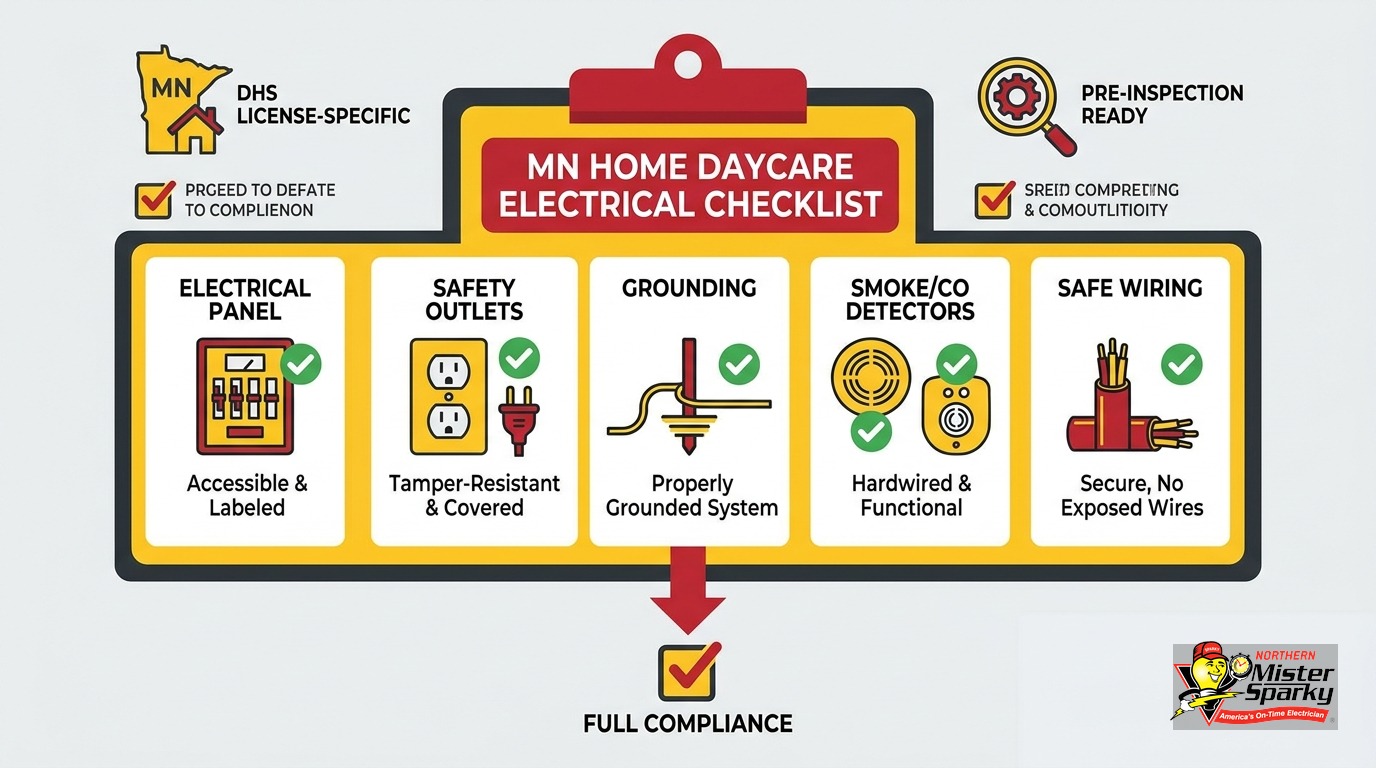
Use this checklist before you file your application, based on Rule 9502.0425 and current Minnesota code:
Outlets and wiring:
- All outlets reachable by children under first grade have tamper-resistant receptacles or approved covers
- No extension cords used as permanent wiring in any room
- All major appliances are properly grounded and in working order
- Branch circuits are sized for their loads, with no undersized wiring
- GFCI protection at all bathrooms, kitchen countertop receptacles, garages, outdoor locations, laundry areas, and unfinished basement outlets
Detection:
- UL-listed smoke alarms on every floor and inside every sleeping room used for child care
- Smoke alarms within 21 feet of all sleeping areas per Minnesota Statute 299F.662
- Carbon monoxide detectors installed per IBC 915.1.1
- All alarms functioning and replaced within the last 10 years
Basement (if used for child care):
- Fire marshal inspection complete with all findings resolved
- Egress lighting present and functioning
- All electrical work permitted, inspected, and documented
Permit documentation:
- All permit work closed with the city or county building department
- Permit documentation available to show your DCYF licensor
If you are not sure where your home stands, a pre-inspection walkthrough can answer that quickly. Call Northern Mister Sparky at 763-200-5956 or book online. We are locally owned and operated in the Twin Cities, and we understand the DCYF licensing timeline. We will assess your home against the Rule 9502.0425 checklist, identify what needs correction, and give you a straight answer about what requires a permit and what does not. No malarky. That is the Northern Mister Sparky promise: America’s On-Time Electrician(R), locally owned right here in Minnesota, backed by the UWIN(R) 100% satisfaction guarantee.
Frequently Asked Questions
Do I need a licensed electrician to fix electrical violations found during a Minnesota home daycare inspection? +
What outlets need GFCI protection in a licensed Minnesota home daycare? +
Do plastic plug covers satisfy the tamper-resistant outlet requirement for a Minnesota home daycare? +
Need an electrician now?