
Home Gym Electrical Requirements for Basement Conversions
Key Takeaways
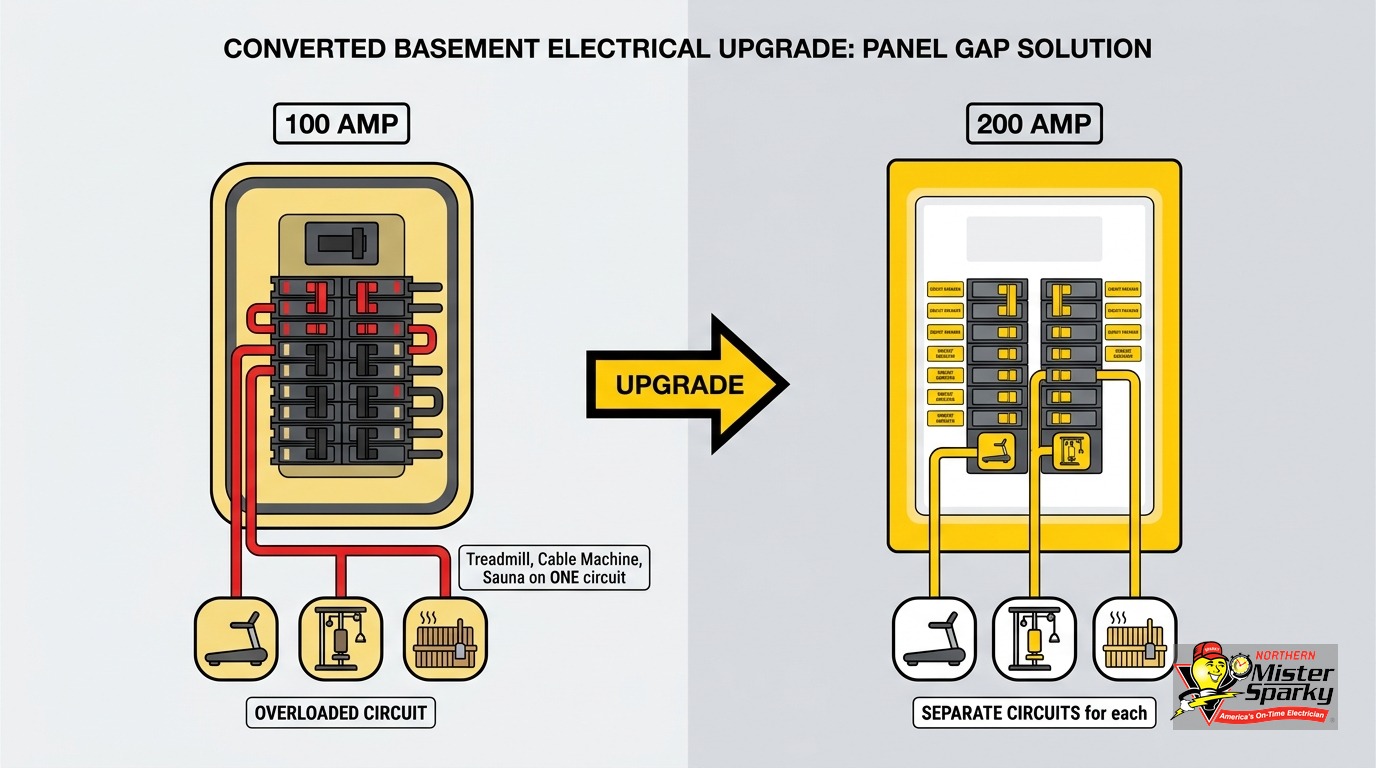
- A treadmill, cable machine, and electric sauna can together demand 65 to 95 amps of new circuit capacity. Many Twin Cities homes from the 1970s and 1980s have 100A service. After a full house load, available headroom may be well under 40 amps.
- Each piece of gym equipment needs its own dedicated circuit. Shared circuits cause nuisance tripping and code violations.
- Treadmills need a dedicated 20A, 120V circuit. Because sessions often run three or more hours, the NEC 125% continuous load rule applies, sizing conductors and the breaker at 25 amps minimum.
- Electric sauna heaters need a 240V dedicated circuit, typically 30 to 60A depending on kilowatt rating. NEC Article 422 governs them, not Article 680 (pools and spas), despite what several published guides claim.
- All 120V receptacles in a basement require GFCI protection per NEC code. Treadmill manufacturers warn against GFCI outlets on their circuits. There is a code-compliant resolution.
- Finished basement recreation rooms require AFCI protection on all 120V circuits. Budget $40 to $60 per AFCI breaker.
- Minnesota currently enforces NEC 2023. Permits filed August 17, 2026 or later must comply with NEC 2026.
- Xcel Energy customers in the Twin Cities may qualify for up to $1,500 to $2,500 toward a panel upgrade. Income-qualified customers can stack this with federal Inflation Reduction Act credits.
What Are the Home Gym Electrical Requirements for a Basement Conversion?
The short answer: A properly wired basement gym needs at least three dedicated circuits, one for each major piece of equipment. The individual circuit specs are straightforward. The part most homeowners miss is whether the main panel can supply all three circuits simultaneously without exceeding safe capacity.
Converting a basement into a home gym is one of the most common projects we wire in the Twin Cities. The formula looks simple on paper: run a circuit for the treadmill, a circuit for the sauna, one for the cable machine, and you are done. In practice, the project often reveals that the real bottleneck is the main electrical panel, not the individual circuits.
Homes built in this region between the 1960s and 1990s commonly have 100A or 150A service. That was adequate when those homes were built. Add a high-draw sauna, a treadmill running for an hour, and a cable machine in the same space, and the panel math changes fast.
Getting ahead of that question before any wire is pulled is the single most valuable thing you can do at the start of a gym build. The sections below cover each circuit requirement, the code rules that apply in Minnesota, the GFCI-treadmill conflict and its resolution, the Xcel Energy rebate, and what to do when the panel does not have room.
Does Your Panel Have Room for a Full Gym Setup?
The short answer: Many Twin Cities homes from the 1970s and 1980s have 100A service. A treadmill, cable machine, and electric sauna can together demand 65 to 95 amps of new circuit capacity. After a full house load, a 100A panel may have fewer than 40 amps of headroom available — not enough for a full gym.
Here is the circuit math for a typical basement gym:
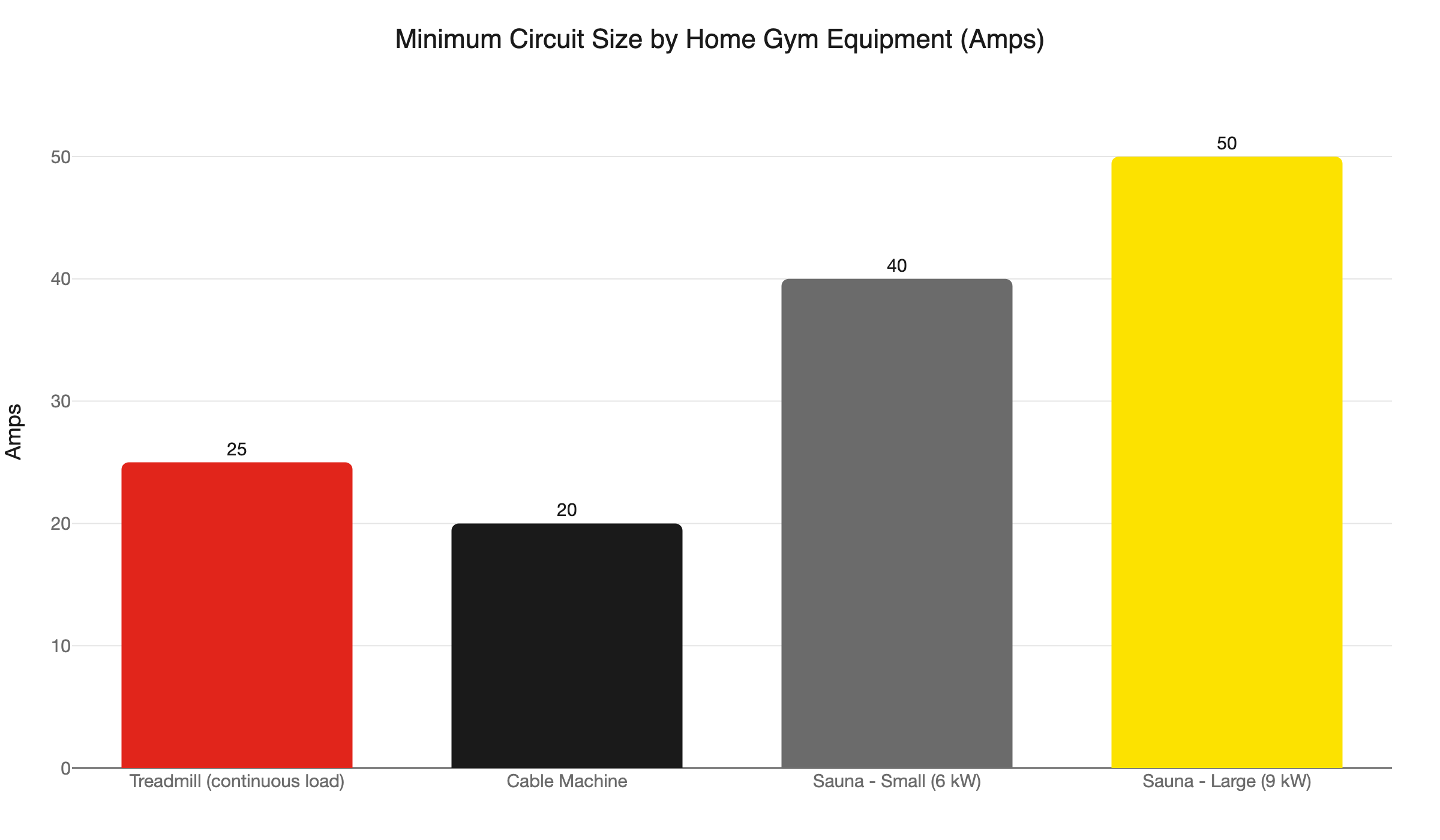
- Treadmill: 20A circuit, sized at 25A continuous under the 125% rule
- Motorized cable machine: 15 to 20A dedicated circuit
- Electric sauna, 6 kW: 240V, 25A running draw, sized to a 40A circuit
- Electric sauna, 9 kW: 240V, 37.5A running draw, sized to a 50A circuit
A mid-size setup with a treadmill, a motorized cable machine, and a 6 kW sauna adds up to roughly 85 amps of new circuit capacity. A 100A panel serving a full house has far less than 100A available at any one time. Once you factor in the air handler, water heater, refrigerator, lighting, and other loads, most 100A homes are at or near capacity before a single gym circuit is installed.
That does not automatically mean a full service upgrade. A dedicated basement subpanel fed from a spare 60A or 100A breaker slot in the main panel is often the cleaner, more affordable solution. The right answer depends on the specific load schedule of your home. Our post on 100A vs. 200A electrical service covers the tradeoffs in detail.
What Circuit Does a Treadmill Require?
The short answer: A dedicated 20A, 120V circuit with a NEMA 5-20R outlet and 12 AWG minimum conductors. Per manufacturer specifications for most treadmill brands, this is the baseline requirement across the category. Never share this circuit with another load, and never use an extension cord.
The dedicated circuit requirement is not optional. Treadmill motors draw significant startup current. Sharing a circuit with a lamp or a portable speaker means the breaker may trip the moment the motor engages. Beyond nuisance tripping, shared circuits can overheat the conductors over time as the combined load pushes them above their rated capacity.
The 125% continuous load rule from NEC 210.19(A)(1) matters here because most treadmill sessions last well over three hours. Any load running three or more hours is classified as a continuous load under the code. That classification requires the circuit conductors and the overcurrent protection device to be rated at 125% of the load. A 20A circuit designed for a treadmill drawing up to 16A running current meets this requirement. If the treadmill nameplate shows a higher amperage, re-size the circuit accordingly.
Minnesota winters are long. If your basement gym sees year-round daily use — which most do — the continuous load classification applies almost every time the equipment runs. The 125% rule gets triggered here more often than it does in warmer climates where home gym equipment may sit idle for months.
The GFCI-Treadmill Conflict: What Code Actually Says
The short answer: NEC 210.8(A)(5) requires GFCI protection on all 120V, 15A and 20A receptacles in basements. Treadmill manufacturers warn against GFCI outlets because the sensor can trip during motor startup, stopping the belt mid-run and creating a fall hazard. The code-compliant resolution in most Twin Cities jurisdictions is an AFCI-protected dedicated circuit with GFCI protection handled at the panel breaker level rather than at the outlet.
Here is what happens when a standard GFCI outlet protects a treadmill: the motor’s startup current can trigger the ground fault sensor and cut power mid-run. A treadmill belt stopping at 6 mph while you are on it is not a theoretical problem. It is a fall hazard, and manufacturers document it explicitly in their installation instructions.
The code and the safety concern pull in opposite directions. The right resolution depends on local inspector interpretation. In the Twin Cities, a GFCI breaker at the panel — rather than a GFCI outlet at the receptacle — provides the required ground fault protection while being less sensitive to the motor’s startup transient. Paired with an AFCI breaker (required for finished basement recreation rooms per NEC 210.12(A)), the circuit meets the basement code requirement without the nuisance-trip risk a standard GFCI outlet creates.
This is not a decision to improvise. A licensed electrician who has worked with local inspectors knows what combination of devices will pass inspection and what will not. An unpermitted workaround that fails inspection means re-work at your expense. Get it right the first time.
AFCI protection adds cost: typically $40 to $60 per breaker. It is not optional in a finished basement gym. Our post on AFCI breaker requirements explains where they apply and why the code requires them.
What Electrical Circuit Does an Electric Sauna Need?
The short answer: A dedicated 240V circuit, sized between 30A and 60A depending on the heater’s kilowatt rating. Wire gauge runs 8 to 10 AWG copper. A disconnect switch is required outside the sauna room, within sight of the heater. Per sauna electrical wiring guides, size the breaker per the heater nameplate, not a generic estimate.
The math for sauna circuit sizing:
- 4 kW heater: 240V, 16.7A running draw. At 125% continuous: 20.8A. Use a 30A circuit.
- 6 kW heater: 240V, 25A running draw. At 125% continuous: 31.25A. Use a 40A circuit.
- 9 kW heater: 240V, 37.5A running draw. At 125% continuous: 46.9A. Use a 50A circuit.
- 12 kW heater: 240V, 50A running draw. At 125% continuous: 62.5A. Use a 60A circuit.
Wire gauge follows the breaker size. A 40A circuit requires 8 AWG copper conductors. A 30A circuit requires 10 AWG. Undersizing conductors is a fire risk. Read the heater nameplate, confirm the kilowatt rating, and pull the correct wire gauge for the circuit you are installing.
Infrared saunas are a different product category. Many run on 120V at 15 to 20A. Check the heater specification sheet before assuming 240V. If it is a traditional Finnish-style electric sauna heater, it is almost certainly 240V.
Why NEC Article 422 Governs Sauna Heaters, Not Article 680
This distinction is worth explaining because the wrong article produces unnecessary work and unnecessary cost.
NEC Article 422 applies to fixed electrical appliances, which is the correct classification for a sauna heater. Article 680 applies to swimming pools, hot tubs, spas, and permanently installed pools. The two articles are not interchangeable, and several national electrical guides — and at least a few competitors — cite the wrong one for saunas.
Article 680 mandates an equipotential bonding grid: a network of copper bonding conductors tied to every metal surface within a defined perimeter. This requirement exists because water conducts electricity and a voltage gradient in water can cause electrocution. Saunas are high-heat, low-humidity environments. That specific hazard does not apply, and NEC does not require the bonding grid.
Under Article 422, the key requirements for a sauna heater are these: a dedicated circuit sized for the nameplate amperage (plus the 125% continuous load factor), a disconnect switch within sight of the heater and outside the sauna room, and compliance with the heater manufacturer’s installation instructions. That is the full list.
If a contractor quotes you a full equipotential bonding grid for a sauna, ask them to cite the specific NEC article. If they cite Article 680, they are applying the wrong standard. Wrong standards mean extra materials and extra labor you should not be paying for.
Does a Cable Machine or Weight Stack Need Its Own Circuit?
The short answer: Non-motorized cable stacks, plate-loaded machines, and power racks draw no electricity and need no dedicated circuit. Motorized cable systems typically draw 15 to 20A on 120V and need a dedicated 20A circuit. Check the manufacturer specification sheet.
If you are installing a commercial-grade functional trainer with a digital resistance motor, treat it the same as any other motorized appliance: a dedicated 20A, 120V circuit, 12 AWG minimum conductors, and no load sharing. If the spec sheet calls for a dedicated circuit, that requirement is not a recommendation.
If your cable setup is fully non-motorized, the electrical priority shifts to general-purpose outlets for phones, speakers, fans, and accessories. Plan those outlets before the drywall contractor arrives. Four to six duplex outlets distributed around the gym perimeter is a reasonable baseline. Adding outlets after the walls close requires cutting and patching — an avoidable expense if you plan ahead.
What Are the AFCI Requirements for a Finished Basement Gym?
The short answer: NEC 210.12(A) requires AFCI protection on all 120V, 15A and 20A branch circuits supplying recreation rooms and similar spaces in a dwelling unit. A finished basement gym qualifies as a recreation room. Every 120V circuit in that space needs an AFCI breaker.
AFCI breakers detect the electrical signature of an arc fault: a loose connection or damaged wire that generates heat and can ignite insulation or framing. Standard breakers trip on overcurrent. They do not detect arc faults. In a finished basement where the wiring is inside walls and ceilings, an arc fault that does not reach the overcurrent threshold can smolder undetected for hours.
Budget $40 to $60 per AFCI breaker. A gym with four or five 120V circuits adds $160 to $300 in breaker cost compared to a non-protected installation. That cost is not avoidable under NEC 2023 or NEC 2026. Plan for it at the estimate stage so it does not become a surprise line item at rough-in.
What Permits and Inspections Does Minnesota Require?
The short answer: Minnesota DLI requires a permit and final inspection for any new circuit installation. Owner-occupied single-family homeowners can pull their own permit. Licensed electricians pull permits on your behalf when they do the work. Per DLI guidance, the homeowner permit applies only to the home you live in, not to rentals or homes you are selling.
Minnesota currently enforces NEC 2023. Per the Minnesota DLI, permits filed on or after August 17, 2026 must comply with NEC 2026. For most residential gym builds, the practical difference between the two editions is modest. The most notable NEC 2026 change affecting this type of project is an update to dwelling-unit load calculations, which reduces the lighting load factor from 3 VA per square foot to 2 VA per square foot. That revision can free up modest calculated capacity on panel load assessments and is worth discussing with your electrician if your project straddles the transition date.
St. Paul homeowners should check both DLI permit requirements and the city’s own basement finish checklist. Minneapolis and most suburban municipalities in the metro follow DLI directly. When in doubt, ask your electrician before assuming one permit covers the full scope.
No malarky: skipping the permit to save a few hundred dollars is not worth it. An unpermitted electrical installation can void your homeowner’s insurance claim in the event of a fire, and it will surface as a defect during a home sale inspection. The remediation cost almost always exceeds what the permit would have cost. Our post on electrical permits in Minnesota walks through the process in full.
Can You Use the Xcel Energy Rebate to Offset a Panel Upgrade?
The short answer: Yes. Xcel Energy’s panel upgrade rebate offers up to $1,500 to $2,500 for qualifying panel upgrades in the Twin Cities service area. A licensed electrician, permit documentation, and completed work are required before submitting the rebate application.
If the load math for your basement gym points to a service upgrade from 100A to 200A, the Xcel rebate is the first financial lever to pull. It is a direct rebate, not a tax credit, so you do not need to wait for a tax filing cycle.
Income-qualified Xcel Energy customers can stack the panel upgrade rebate with federal Inflation Reduction Act home electrification credits. That combination can offset a substantial portion of a service upgrade cost. Program terms and income thresholds change periodically. Ask about current availability when you call for an estimate. We track what is active in the Twin Cities market and flag it when it applies to your project.
For a closer look at the signals that indicate a panel upgrade is overdue, see our post on signs you need an electrical panel upgrade.
Should You Add a Subpanel or Upgrade the Main Service?
The short answer: A basement subpanel is the right choice when the main service has spare capacity and the gym is the only new load cluster being added. A full 200A service upgrade makes more sense when the main panel is genuinely at capacity, or when other high-draw projects are planned in the same window.
A basement subpanel works well when the main panel has a spare 60A or 100A two-pole breaker slot available and the main service amperage is adequate — typically 200A. The subpanel sits in or near the gym space and gives the gym its own breaker box, clean circuit labeling, and room for future circuits without touching the main panel again. Cost is typically lower than a full service upgrade, and the project scope is smaller.
A 200A service upgrade is the right path when the main panel has no available slots, when the home still has original 100A service, or when other projects are planned for the same renovation cycle: an EV charger, a whole-home generator, a mini-split system, or a future home addition. Bundling those loads into one service upgrade is almost always more cost-effective than doing them one at a time. See our post on dedicated circuits for appliances for guidance on how to group loads when planning multiple projects.
How to Plan Before the Walls Go Up
Rough-in electrical work happens before insulation and drywall. That is the window when an electrician can run conduit, pull wire, and position outlet boxes and disconnect switches without cutting into finished surfaces. If you schedule the electrician after the drywall contractor, every circuit you add later requires wall cuts, patches, and repainting.
Start the planning conversation before you finalize the gym layout. Know the kilowatt rating of the sauna heater you want. Know whether the cable machine is motorized. Know if you want a mini-split for year-round temperature control (another 240V circuit). Know whether a utility sink or wet bar is part of the plan (that triggers additional GFCI requirements and may need its own circuit). The more specific you can be before the first tool hits the framing, the more accurate the estimate and the fewer surprises on inspection day.
Then call an electrician to walk the basement and assess the main panel before a single stud goes up. That conversation takes 30 to 60 minutes on-site. It is the investment that prevents a $2,000 surprise when the inspector flags a service upgrade after the sauna room is already framed and drywalled.
Our team is locally owned and operated, serving Minneapolis, St. Paul, Bloomington, Brooklyn Park, Woodbury, Blaine, Maple Grove, Plymouth, and the surrounding Twin Cities metro. As America’s On-Time Electrician(R), we show up when we say we will and give you a straight answer on what the panel can handle. The UWIN(R) 100% satisfaction guarantee backs every job.
Call 763-200-5956 or book online to schedule a basement gym electrical assessment.
Frequently Asked Questions
Do I need a permit to add gym circuits in Minnesota? +
Can a treadmill be on a GFCI-protected outlet? +
What is the Xcel Energy panel upgrade rebate? +
Need an electrician now?