
Irrigation System Electrical Wiring: MN Homeowner Guide
Key Takeaways
- The outlet your irrigation controller plugs into is an outdoor 120V receptacle. NEC 210.8(A)(3) requires it to be GFCI-protected, weather-resistant, and covered with an in-use bubble cover.
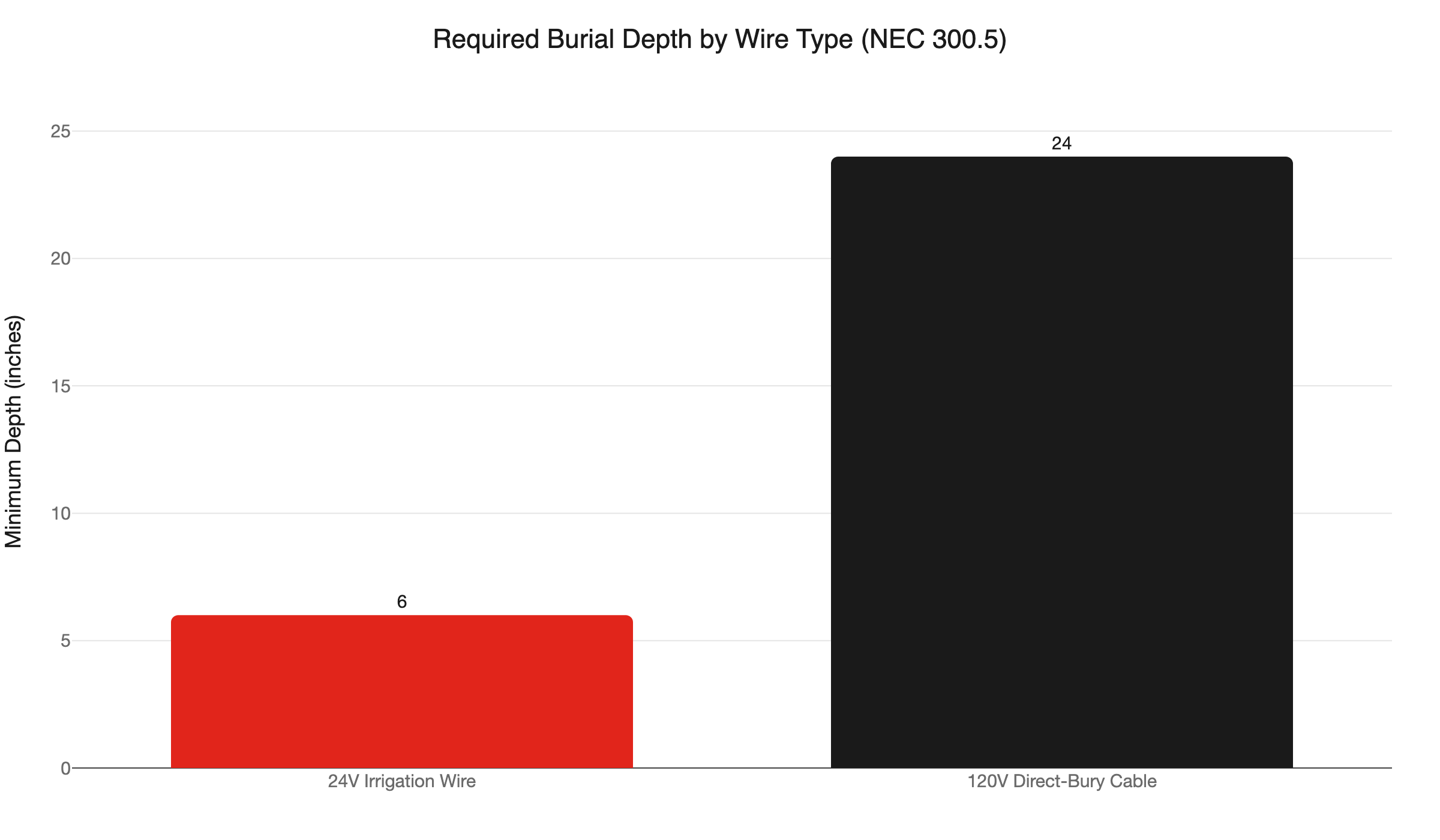
- The 24V field wire running to zone valves must be buried at least 6 inches deep. Standard direct-bury 120V cable requires 24 inches. The two cannot share a conduit.
- Every underground splice at a valve box must use listed waterproof connectors. A standard wire nut buried underground fails code and corrodes within a season or two.
- The transformer feeding your system must be Class 2 listed. Sizing it too small trips the thermal breaker and kills zones mid-cycle.
- Adding or modifying the 120V outlet for the controller requires a Minnesota electrical permit. Homeowners can pull one online for as little as $55.
- Minnesota adopted the 2026 NEC on August 17, 2026. Permits filed on or after that date are governed by the new code.
- Twin Cities homeowners have a hard electrical deadline: irrigation systems should be powered down and the outlet and cover inspected before sustained freezing temperatures arrive in late October.
What Is Irrigation System Electrical Wiring, Exactly?
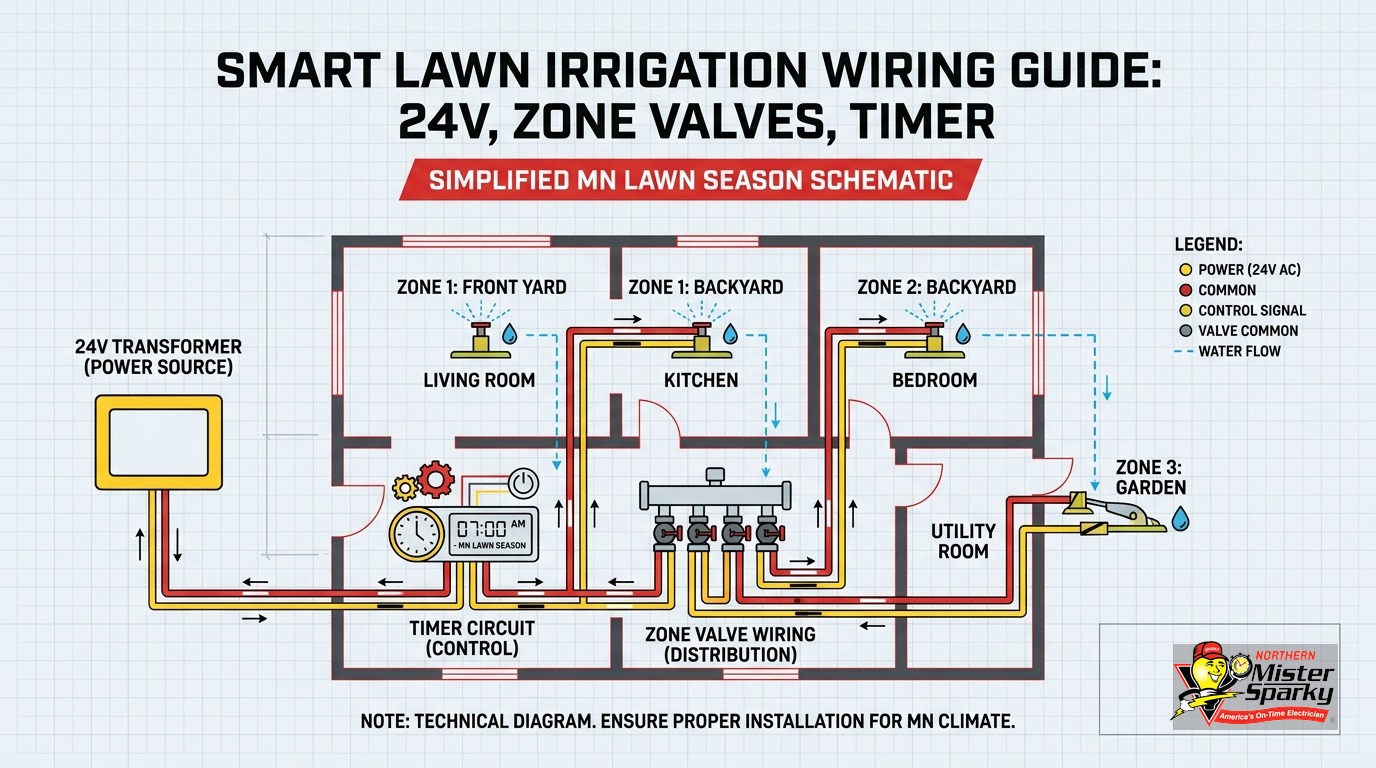
Most irrigation guides treat this as a low-voltage plumbing job. It is not. An irrigation system has two electrical layers. The first is the 120V supply circuit that powers the controller. The second is the 24V AC network that runs from the controller to each zone valve solenoid. Both carry separate code requirements.
The 24V field layer is what every DIY wiring guide covers. Zone terminals, common wire, rain sensor port, pump start relay - those connect to the controller’s terminal strip using thin 18 AWG multi-strand wire. This work is within reach of a careful homeowner.
The 120V supply layer is the piece that falls under the National Electrical Code. The outdoor receptacle your transformer plugs into must be GFCI-protected, weather-rated, and installed with a permit if it is new or modified. That is the layer the guides skip. And that is where things go wrong.
Understanding both layers tells you what is a DIY task and what needs a licensed electrician.
The Part Every DIY Guide Skips: The 120V Supply Side
Every zone valve solenoid, every rain sensor, and the controller’s own logic circuit runs off the 24V AC side of the transformer. But the transformer’s primary - the plug in the wall - is a standard 120V connection governed by the same code as any other circuit in your home.
Minnesota Rules Part 1315.0200 requires all new electrical wiring and equipment to comply with the currently adopted edition of the NEC. The Minnesota Board of Electricity adopted the 2026 NEC with an effective date of August 17, 2026. Any permit filed on or after that date falls under 2026 code requirements.
That matters for late-summer irrigation installs. If you are putting in a new controller this week or adding an outdoor outlet for the first time, your installation is subject to the 2026 NEC.
The outdoor outlet where you plug in the transformer cannot be any convenient receptacle near the garage door. It must meet specific outdoor installation standards. If a compliant outlet does not exist - or if the existing one was never properly installed - adding or correcting it is an electrical project, not an irrigation project.
Does the Outlet Feeding My Irrigation Controller Need GFCI Protection?
Yes. NEC 210.8(A)(3) requires GFCI protection on all outdoor outlets at dwelling units. The outlet your irrigation transformer plugs into qualifies as an outdoor outlet. It must be weather-resistant (WR-rated) and covered with an in-use bubble cover rated for wet locations. A standard indoor GFCI device in a weatherproof box is not sufficient on its own.
The device itself must carry the WR rating - it appears on the face of the outlet. The cover must be the bubble or hood style, not a flat cover, so it closes around a plug while it is still inserted and keeps water out during rain.
This is one of the most commonly skipped steps when irrigation systems are installed by landscaping crews rather than electricians. The sprinkler heads work. The controller cycles correctly. Nobody checks the outlet. Then a GFCI trip kills the system mid-July and the homeowner traces it to an unprotected indoor receptacle that has been sitting outdoors for five years.
If your current irrigation outlet has a flat cover, or if you cannot find a GFCI test-and-reset button anywhere on the circuit, it likely does not meet code. Our outdoor GFCI outlet installation page covers what a compliant installation looks like. For a full breakdown of where GFCI protection is required throughout your home, see our GFCI outlet requirements guide.
How Deep Does Irrigation Wire Need to Be Buried?
The 18 AWG multi-strand irrigation field wire runs at less than 30V. NEC 300.5(A) sets the minimum burial depth at 6 inches for wires in this voltage range. Standard 120/240V direct-bury cable requires 24 inches. The two cannot share a conduit, though they may share a trench if each runs in its own separate conduit.
Six inches is the floor, not the target. In Minnesota, frost heave and lawn aeration are real factors. Core aerators typically reach 3 to 4 inches into the soil. Running irrigation field wire at 8 to 10 inches keeps it clear of routine aeration passes and reduces the chance of a shovel strike during spring planting or fall bulb work.
The shared-trench rule matters if you are running a 120V circuit to an outdoor-mounted controller or to a landscape lighting transformer in the same trench run. Each circuit must travel in its own conduit. Bundling them in a single conduit violates code regardless of burial depth.
Before any trenching, call 811. Gopher State One Call maps buried utility infrastructure across Minnesota, and the Twin Cities metro has dense gas, fiber, and water lines running through residential yards. Minnesota law and the NEC both require the call before digging. A shovel through a buried gas line costs far more than the irrigation system itself.
For a complete breakdown of burial rules by wire type and conduit configuration in the Twin Cities, see our underground electrical wire depth guide for Minnesota.
How Do You Size a Transformer for Your Zone Valves?
Divide the transformer’s VA rating by 24 - the secondary voltage - to get available current in amps. A 40VA unit delivers 1.67 amps at 24V. Most solenoid valves draw 0.2 to 0.5 amps on activation. If your total zone load exceeds the transformer’s current limit, the thermal breaker trips and zones go dark mid-cycle.
The math is straightforward. A six-zone system with solenoids drawing 0.35 amps each pulls 2.1 amps at peak. A 40VA transformer tops out at 1.67 amps. That transformer will trip under that load. A 60VA unit delivers 2.5 amps - enough for the same system with room for a master valve or rain sensor draw.
The right approach: check the solenoid data sheet for each valve. Add the activation current across all zones. Add 10 to 15 percent as a safety margin. Choose a transformer with a VA rating that covers that total.
Many entry-level controllers ship with 24VA transformers rated for three or four zones. Homeowners add zones over time and never check whether the transformer kept up. The result is intermittent zone failures, breaker trips on hot days when solenoid draw increases, and diagnostics that point everywhere except at the undersized transformer.
All irrigation transformers must also be Class 2 listed under NEC 680.22(A)(6) and NEC 725. Outdoor low-voltage transformers must be placed at least 5 feet from any pool or standing water. An indoor-rated transformer mounted on an exterior wall without an appropriate enclosure is a code violation, regardless of whether it delivers the right voltage.
What Waterproof Connectors Are Required at Underground Splice Points?
NEC 300.5(C) requires all underground splices to use listed waterproof methods. A standard twist-on wire nut is not a listed waterproof method. Valve box splices must use gel-filled or heat-shrink waterproof connectors rated for direct burial. Water in a splice is the most common cause of zone failures and intermittent fault codes.
Every zone valve junction is a splice. The solenoid pigtails connect to the field wire there. That splice lives in a valve box that fills with water every spring and after heavy rain. A wire nut - even wrapped in electrical tape - lets water in. The tape fails within a season or two underground.
Gel-filled waterproof connectors (the blue direct-burial style found at any home center) displace moisture and maintain a sealed connection. Heat-shrink splice connectors with interior adhesive are also acceptable. Either satisfies NEC 300.5(C).
A wet splice does not always fail immediately. Corrosion builds slowly. You may see one zone run sluggishly, a smart controller report intermittent valve faults, or normal operation for a full season before the connection fails completely. If your system has mystery zone issues, start at the valve box splices.
Does Irrigation System Electrical Wiring Require a Permit in Minnesota?
The 120V supply side does. Running a new outdoor GFCI outlet for an irrigation controller is a permitted electrical project under Minnesota law. The 18 AWG low-voltage field wire typically does not require a permit on its own. Minnesota homeowners can pull their own electrical permit online for as little as $55.
The common misconception is that because the visible irrigation wiring is low voltage, no permit is needed. The 24V field wire generally falls below the permit threshold. But the moment you modify or add the 120V outlet feeding the transformer, you are doing permitted electrical work.
This is where many DIY irrigation projects create liability problems. A landscaping crew wires the controller and valves correctly. The outlet feeding the whole system is an unprotected receptacle that was never inspected. Or a homeowner adds a new outdoor outlet without a permit, skipping the inspection that would have caught a missing GFCI device or an incorrect burial.
The permit is not bureaucratic friction. It puts an inspector’s eyes on the installation before it is buried or buttoned up. The minimum $55 inspection fee is a small cost against an unpermitted outdoor circuit that surfaces during a home inspection when you sell.
Minnesota adopted the 2026 NEC effective August 17, 2026. If you are pulling a permit this week or later in the season, your installation is subject to 2026 code requirements - not the 2023 edition.
Our Minnesota electrical permit guide walks through the homeowner permit process step by step.
The Twin Cities Seasonal Deadline: What to Do Before October
Irrigation systems in the Twin Cities operate under a hard annual clock. Twin Cities irrigation professionals begin compressed-air blowouts in late September, and the window closes by late October before sustained sub-32-degree temperatures set in.
Most homeowners focus on the blowout itself - clearing water from the lines so pipes do not freeze and crack. The electrical side gets less attention, and it is worth a few minutes before the season closes.
After the blowout, power down the controller at the outlet or at the breaker. The 120V outlet stays live all winter whether the controller is running or not. Before temperatures drop consistently below freezing, verify the in-use bubble cover closes fully and latches. A damaged cover lets moisture into the outlet box, causing a GFCI trip in the spring or, worse, a corroded connection that is not visible from the outside.
A fall electrical close-out checklist:
- Power down the controller at the outlet or at the dedicated breaker.
- Test the GFCI button while the weather is still mild enough for a reliable test. Reset and confirm it holds.
- Verify the in-use cover closes and latches without forcing it.
- Walk the field wire runs and look for exposed sections where soil has shifted or settled through the season.
- Note any zone that ran erratically or faulted during the season. Investigate the splice or solenoid before the ground freezes.
- Check the transformer housing for cracking or moisture intrusion, especially if it is wall-mounted.
Spring startup has its own electrical step. Before the first cycle, restore power and run a manual test of every zone. Confirm each valve opens and closes cleanly. If a zone fails on the first spring test, the fault is usually a bad splice that let water in over winter. It is far easier to find and fix in dry soil before the season is in full swing.
If the outlet or controller circuit has not been inspected since installation - or if you are not certain it was ever permitted - fall is the right time to schedule a review before the ground freezes and access gets harder.
When to Call a Licensed Electrician for Irrigation System Electrical Wiring
The 24V field work is within reach of a careful homeowner: connecting zone wires to the terminal strip, swapping a solenoid, splicing a broken field wire with waterproof connectors. The 120V supply side is not.
Call us when:
- You need a new outdoor outlet for a controller being installed for the first time.
- The existing outlet has no GFCI protection or no in-use cover.
- You cannot locate the breaker controlling the irrigation outlet, or the circuit is shared with other loads it should not carry.
- Zones are failing and no bad splice explains it - the fault may be upstream in the transformer circuit or in the 120V supply.
- A system expansion adds zones beyond what the current transformer can handle.
- The installation was never permitted and you want to correct the record before selling the home.
As locally owned and operated Northern Mister Sparky, we know Twin Cities homes and Minnesota code - including the shift to the 2026 NEC that took effect this month. Our team arrives when we say we will. That is the promise behind “America’s On-Time Electrician(R).” And we back every job with the UWIN(R) 100% satisfaction guarantee.
Call 763-200-5956 or book online. We will get your irrigation circuit inspected, corrected, and ready well before the October deadline.
Frequently Asked Questions
Does installing an outdoor outlet for an irrigation controller require a permit in Minnesota? +
Does the outlet for an irrigation controller need GFCI protection? +
How deep does irrigation wire need to be buried in Minnesota? +
Need an electrician now?