
LED Dimmer Switch Compatibility: Why LEDs Flicker
Key Takeaways
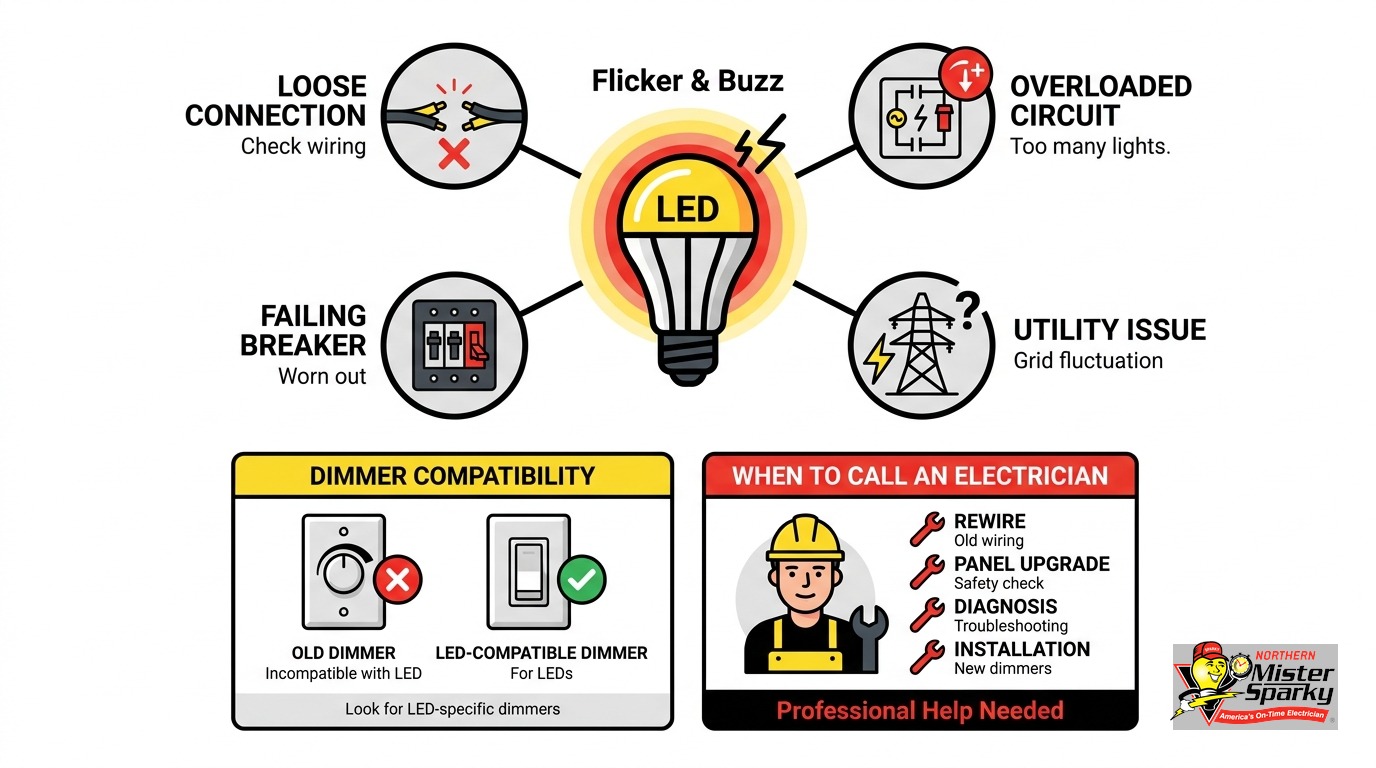
- LED dimmer switch compatibility breaks down because old dimmers were designed for incandescent loads, not LED drivers. The mismatch causes flicker, buzz, and dropout.
- An LED-rated trailing-edge dimmer paired with confirmed-dimmable bulbs fixes the problem in most post-1960 homes.
- Pre-1960 homes in the Twin Cities often have no neutral wire at the switch box. Many LED and smart dimmers require one to function. Without a neutral, the dimmer either fails or back-feeds ghost voltages into the circuit.
- Knob-and-tube wiring - common in South Minneapolis, Mac-Groveland, Northeast Minneapolis, and St. Paul’s Summit Hill bungalows - eliminates the dimmer question entirely. Those circuits need to be rewired first.
- In Minnesota, replacing a dimmer switch is a permitted electrical alteration. A permit is required even when a homeowner does their own work.
- Xcel Energy offers LED rebates for Minnesota customers. Call 800-895-4999 to confirm current amounts before purchasing - the program can close early when funding runs out.
- When you need professional help, call Northern Mister Sparky at 763-200-5956 or book online.
LED dimmer switch compatibility is one of the most common lighting questions we hear from Twin Cities homeowners. You switch to LED bulbs, flip the dimmer, and suddenly the lights buzz, flicker, or die at the low end of the range. Here is what is happening inside the wall, and where the fix stops being a product swap.
Why Do LED Lights Flicker or Buzz on a Dimmer Switch?
The short answer: Old dimmers were built for incandescent bulbs. They fire 120 pulses of electricity per second - a method LED drivers were never designed to handle. The result is flicker, buzz, or dropout, especially at low dim settings.
Start with what a dimmer is actually doing. Incandescent bulbs are resistive loads. They behave like simple heating elements. The way power arrives does not affect the filament - it just glows brighter or dimmer based on how much current flows. Old leading-edge TRIAC dimmers were designed around that behavior: they chop the front of each AC half-cycle - a technique called forward-phase cutting - to reduce average power to the bulb. No exotic components, low cost, and it worked for generations of incandescent fixtures.
LED drivers operate on a different principle. They are capacitive loads. They convert incoming AC to low-voltage DC before the LED chip receives it. When a TRIAC dimmer fires an inrush spike at the front of each cycle, the LED driver reads it as corrupted or unstable power. The DOE/EERE Gateway program confirmed in 2013 that phase-cut mismatch is the root cause of most LED dimming complaints in residential installations.
The flicker is not a defective bulb. It is a physics incompatibility that no amount of bulb-swapping resolves on its own. The fix starts with the dimmer.
What Is the Minimum Load Problem?
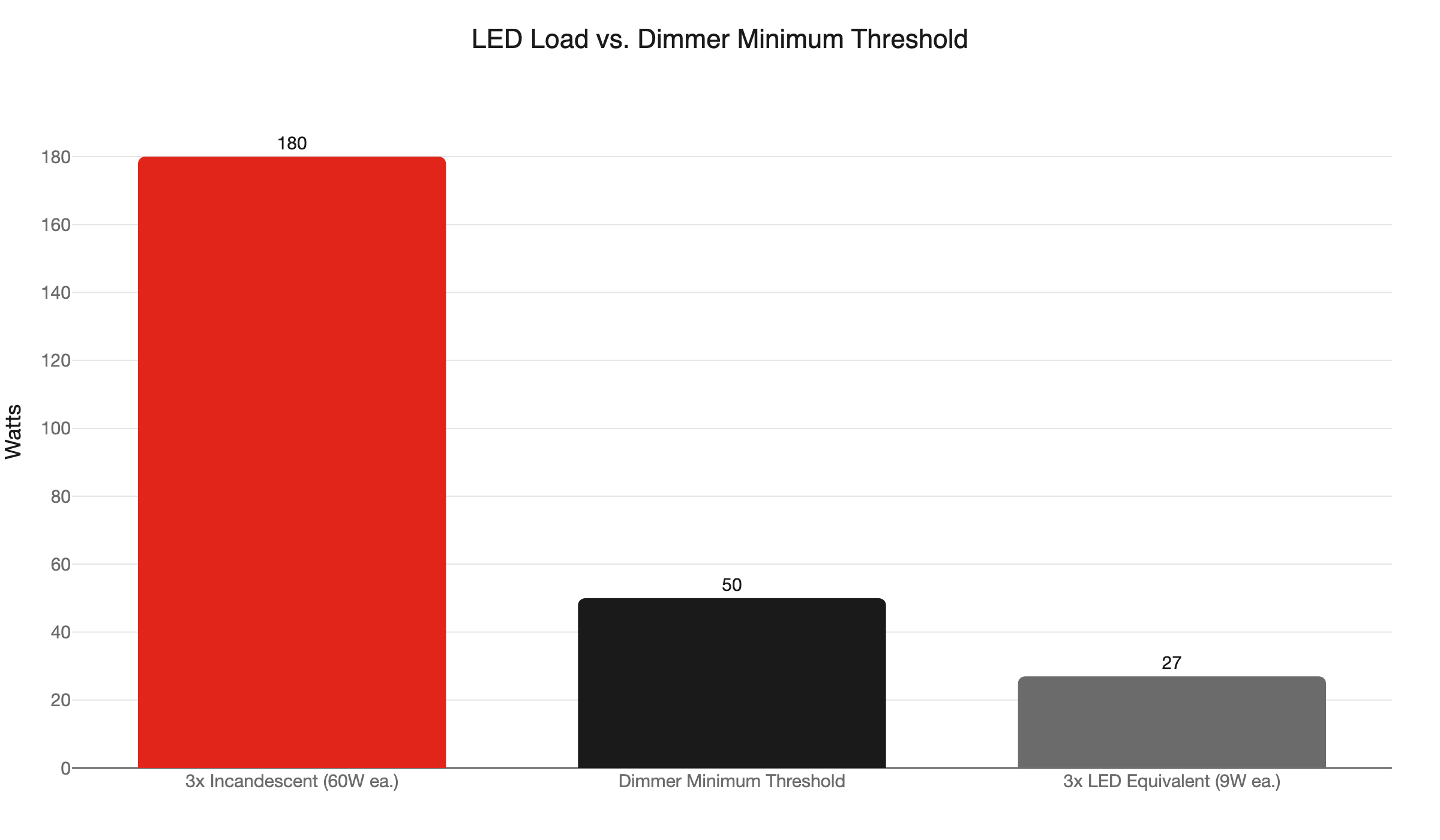
The short answer: TRIAC dimmers require at least 40-60 watts to fire and hold steady. Three LED “60W equivalent” bulbs draw about 27 watts combined - far below that floor. The dimmer chatters because it cannot reach a stable firing point.
Standard TRIAC dimmers need a minimum load of 40-60 watts to operate reliably. In the incandescent era, this threshold was invisible. A single 60-watt bulb cleared it. A six-socket chandelier loaded to 360 watts sat three to four times above it. There was always enough load.
A modern LED “60W equivalent” draws only 8-10 watts. Three of them on a single circuit total roughly 24-30 watts. A six-socket fixture loaded with LED equivalents might draw 54-60 watts total - at the edge of the threshold, or below it on newer, more efficient bulbs. The dimmer tries to fire, cannot reach a stable cut point, and the chatter produces the flicker and buzz you hear.
This is also why the dimmer may seem normal at full brightness but stutter the moment you reduce it. At full power, the phase-cut control is fully open and the circuit runs near full load. Reduce the dial and the instability immediately appears.
Modern LED-rated dimmers are designed with minimum loads of 5-10 watts - built for the real wattages in today’s LED-equipped homes. That engineering gap is the fix.
How Do You Fix LED Dimmer Switch Compatibility?
The short answer: Replace the old dimmer with an LED-rated trailing-edge model, confirm your bulbs are marked “dimmable,” and adjust the low-trim pot until the light shuts off cleanly at the bottom of the range.
Trailing-edge dimmers - also called reverse-phase or ELV dimmers - cut the tail of the waveform rather than the front. The result is a smoother, more gradual transition that LED drivers were engineered to handle. Most flicker, buzz, and dropout disappears with the right replacement.
Before you buy, confirm all four of the following:
- Dimmer type: The packaging says “LED compatible,” “trailing edge,” or “ELV.” Avoid any unit labeled for incandescent loads only.
- Manufacturer compatibility list: Most dimmer makers publish a list of tested bulbs. Match your specific bulb brand and model number to the list before ordering.
- Dimmable bulbs: Your bulbs must be marked “dimmable” on the packaging. Non-dimmable LEDs flicker or burn out prematurely on any dimmer, including a trailing-edge model.
- Load spec: Confirm the dimmer’s minimum-load rating is below your total LED wattage. Most modern LED dimmers handle loads as low as 5-10 watts.
Once the new dimmer is installed, find the low-trim adjustment - typically a small potentiometer accessed through a hole on the side or back of the unit. Turn it until the light extinguishes cleanly at the low end of the range without any flash or linger. That is the step most YouTube install guides skip, and it is what eliminates ghosting.
What is ghosting? Ghosting is the faint glow some dimmers produce even when the control is fully off. The dimmer leaks a small current through the load circuit, which trickle-charges the LED driver’s capacitors and keeps the chip barely lit. A properly adjusted low-trim setting cuts that off.
If the dimmer swap is part of a broader relight - new fixtures, added recessed cans, or a whole-room update - see our indoor lighting installation services for what the full scope involves.
What Is the Neutral Wire, and Why Does It Matter for LED Dimmer Compatibility?
The short answer: The neutral wire completes the circuit and powers a smart dimmer’s standby electronics. Pre-1960 switch boxes often contain only two wires and no neutral. A smart dimmer that requires one simply will not work there.
Classic passive dimmers were purely resistive devices with no electronics of their own. A two-wire switch box - one line, one load - was sufficient.
Modern LED dimmers, particularly smart and wireless models, are microprocessor-based. They maintain wireless connections, respond to app or voice commands in standby, and sometimes log usage data. All of that requires continuous power. They draw it through the neutral wire.
When no neutral is present, a smart dimmer either refuses to operate or back-feeds current through the load leg of the circuit. Back-feeding creates ghost voltages - voltages that register on a meter even when the switch is off. Ghost voltages are both a code issue and a shock hazard.
NEC 2023 Article 404.2(C) requires a neutral conductor at switch locations controlling lighting in habitable rooms, hallways, bathrooms, and stairways. There is one practical exception: if bringing a neutral to the switch box would require removing finished wall surfaces, a no-neutral-required device may be used, capped at five such devices per circuit.
Minnesota adopted the 2023 NEC effective July 1, 2023, per the Minnesota Department of Labor and Industry. All permitted work filed after that date must comply.
When Does LED Dimmer Compatibility Become a Wiring Problem?
The short answer: When there is no neutral at the switch box, or when the circuit runs knob-and-tube wiring. At that point, swapping the dimmer is not the fix - the wiring is the problem.
Every retailer article stops at “buy a different dimmer.” Here is where the conversation actually needs to go.
Two-wire switch boxes
Most pre-1960 switch boxes contain only a line (hot) wire and a load wire running up to the fixture. The neutral lives back at the panel or at the ceiling junction box - not at the switch. If you open the box and see only two wires, your options narrow:
Option one is a no-neutral-required LED dimmer. These are code-compliant under the NEC 2023 exception. They perform inconsistently with some LED driver designs and carry the five-device-per-circuit limit.
Option two is having an electrician run a neutral conductor to the switch box. This usually requires opening the wall or pulling wire through a finished ceiling. That is a wiring job, not a product swap.
Knob-and-tube wiring
The Twin Cities has one of the highest concentrations of pre-1940 housing stock in the region. Bungalows and foursquares in South Minneapolis, Mac-Groveland, Northeast Minneapolis, and St. Paul’s Summit Hill were built between roughly 1890 and 1940. Knob-and-tube wiring is two-wire by design: no ground, no neutral at the switch box, cloth-insulated conductors that may be brittle after 80-plus years of use. LED dimmer compatibility is irrelevant on a knob-and-tube circuit until that circuit is replaced.
There is also a financial dimension. Many Minnesota homeowners’ insurance carriers flag knob-and-tube wiring and require replacement or add surcharges to policies. The dimmer question and the insurance question often arrive in the same conversation. Resolving the wiring addresses both.
Our page on knob-and-tube wiring replacement in the Twin Cities covers what the replacement process typically involves on a pre-1940 home, including what to expect on a bungalow or foursquare.
When Should You Stop the DIY and Call an Electrician?
The short answer: Stop when you find only two wires at the switch box, knob-and-tube conductors, a smart dimmer that back-feeds after installation, or any configuration you cannot identify with confidence.
Use this checklist before continuing. Call a licensed electrician if any of the following applies:
- The switch box contains only two wires. No white neutral conductor is present.
- Wire insulation is cloth-wrapped, crumbling, or attached to ceramic knob insulators. That is knob-and-tube.
- You want a smart dimmer that requires a neutral and your box does not have one.
- After installation, the new dimmer ghost-glows when fully off, flickers across all dim settings, or does not respond at all.
- The wiring in the box is aluminum - aluminum wiring requires specific device ratings and handling that differ from copper.
- You are uncertain about what you are looking at.
If flickering is showing up throughout the house - at multiple fixtures, not just one dimmer location - the cause may be upstream at the panel rather than at any individual switch. Our guide on why lights flicker and when it signals a bigger problem covers panel-level causes and when the circuit breaker becomes part of the conversation.
Northern Mister Sparky is locally owned and operated. We serve Minneapolis, St. Paul, Bloomington, Brooklyn Park, Woodbury, Blaine, Maple Grove, Plymouth, and the broader Twin Cities metro. Our team handles dimmer upgrades, neutral wire extensions, and full circuit rewires. Call 763-200-5956 or book online. America’s On-Time Electrician(R) means we show up when we say we will.
Do You Need a Permit to Replace a Dimmer Switch in Minnesota?
The short answer: Yes. Minnesota treats dimmer replacement as a permitted electrical alteration. A permit and inspection are required - for licensed contractor work and for homeowner self-installation in a homesteaded single-family property.
Not one competitor article mentions this. They sell dimmers. Permit compliance is your responsibility, not theirs.
The Minnesota Department of Labor and Industry is direct: replacing a dimmer switch is an electrical alteration that requires a permit and inspection. A licensed electrician handles this process automatically. A homeowner doing their own work must pull the permit personally, perform every step of the installation, and file the required affidavit. The homeowner exemption applies only in a homesteaded single-family property the owner occupies as their primary residence.
What happens when you skip the permit:
- Work done by an unlicensed handyman is unpermitted regardless of how competent the work appears.
- An unpermitted alteration can surface on an inspection report during a home sale and complicate or delay closing.
- If an electrical fire or injury follows unpermitted work, your homeowner’s insurer may dispute or deny coverage.
The permit requirement covers a basic dimmer swap. It definitely covers any wiring work needed to bring a neutral to the switch box. Our post on electrical permits in Minnesota walks through the full process if you plan to pull one yourself.
When you book Northern Mister Sparky, permit coordination is part of the job. No malarky, no loose ends.
Can You Get an Xcel Energy Rebate for LED Lighting in Minnesota?
The short answer: Yes. Xcel Energy offers residential LED rebates for Minnesota customers. Call 800-895-4999 to confirm current amounts before buying - the program can close early when funding runs out.
Xcel Energy’s residential home rebates page lists LED lighting as an eligible rebate category for Minnesota customers. The program is subject to 60 days’ notice of changes and has closed before year-end in prior cycles when funding was exhausted.
Before you purchase bulbs or fixtures for a broader lighting project, call Xcel at 800-895-4999 and ask specifically about current residential LED lighting rebate amounts. The portal is dynamically rendered and the figures change. That call takes a few minutes and can save you real money - especially if you are relighting multiple rooms or replacing fixtures throughout the house.
If the dimmer project is the start of a more comprehensive upgrade, bring the rebate question into the planning conversation from the beginning. Knowing what qualifies before you buy simplifies everything downstream.
Ready to Solve This?
If your switch box has a neutral wire and your home has post-1960 wiring, a trailing-edge LED dimmer paired with dimmable bulbs will almost certainly fix the problem. Follow the steps above, pull your Minnesota permit, and adjust the low-trim after installation.
If there is no neutral, knob-and-tube wiring, or anything you cannot confidently identify, call Northern Mister Sparky at 763-200-5956 or book online. Our licensed electricians assess the wiring, pull the permit, and back every job with the UWIN(R) 100% satisfaction guarantee. We serve the Twin Cities and the surrounding metro - on time, every time.
Frequently Asked Questions
Why do LED lights flicker on a dimmer switch? +
Do I need a permit to replace a dimmer switch in Minnesota? +
What happens if my switch box has no neutral wire? +
Need an electrician now?