Lights Dim When an Appliance Turns On: Normal or a Warning?
Key Takeaways
- A brief half-second dim when the AC compressor or washing machine starts is normal physics. Motor-driven appliances draw 6 to 8 times their running current at startup.
- A dim that lingers, hits lights throughout the house, or is getting worse month over month is a warning sign - not a quirk to live with.
- Two serious causes: undersized electrical service and a failing panel connection. Both require a licensed electrician.
- Many Twin Cities homes built before 1970 still run on 100A services that were sized for a world without central AC, electric dryers, or EV chargers.
- Any panel upgrade or service change in Minnesota requires an electrical permit, a state inspection under the 2023 NEC, and Xcel Energy meter coordination.
Is It Normal for Lights to Dim When an Appliance Turns On?
Yes - briefly, for about half a second. Motor-driven appliances pull 6 to 8 times their normal running current the instant the motor spins up to speed. That inrush drops voltage on the circuit for a fraction of a second. Lights respond with a visible sag, and then they recover. If the dip lasts half a second and the behavior has been consistent for years, you are watching normal physics - not a wiring problem.
The qualifier that matters is the recovery. A dim that bounces back in half a second on a single circuit is expected. A dim that takes two or three seconds to recover, or one that pulls down lights in rooms nowhere near the appliance, is a different symptom entirely - and it deserves a different answer.
Dimming vs. Flickering: Why the Difference Matters
Most search results treat dimming and flickering as interchangeable. They are not, and they point to different root causes with different fixes.
Dimming is a held-down voltage sag. The light drops and recovers. It tracks directly with large appliances starting up: you run the washing machine and the kitchen fixture dips. The pattern is repeatable and tied to a specific load event.
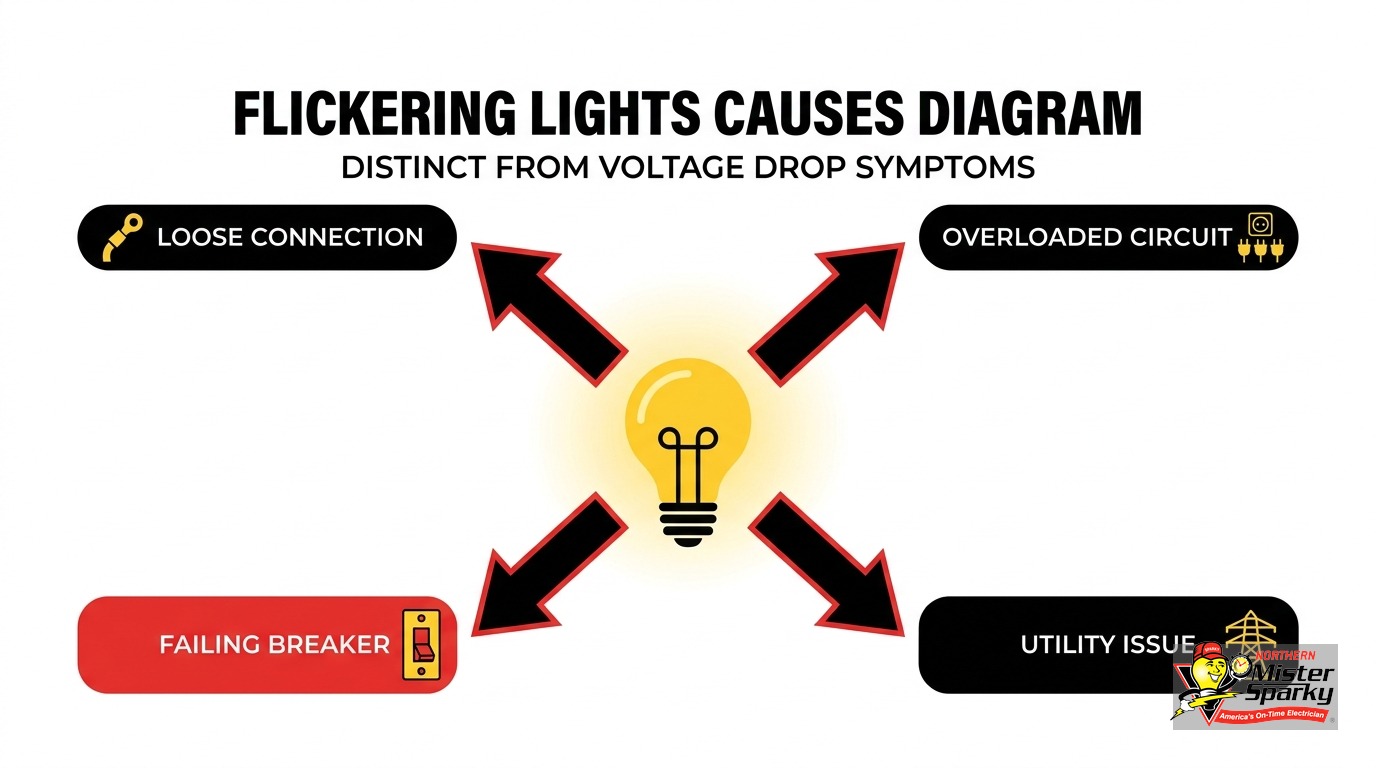
Flickering is rapid oscillation - fast, sometimes strobe-like variation that may or may not be tied to appliance startup. Flickering is more often a loose neutral connection, a failing LED driver, or a loose wire at the fixture or switch. It also shows up when dimmer switches are incompatible with modern LED bulbs.
If your lights drop noticeably when a motor-driven appliance starts and then recover, you are dealing with a dimming symptom. Our post on why lights flicker covers the flickering diagnostic path. These are two different problems. Treating one as the other can send you down the wrong fix and cost you time and money.
What Causes Lights to Dim When an Appliance Turns On?
There are four causes, ranging from completely normal to a safety emergency that needs attention today. They all share the same outward symptom - lights dim when appliance turns on - but each one requires a different response.
1. Normal inrush current - no action needed
NEC Article 430 accounts for motor startup loads in load calculations because inrush current is a well-understood, expected event on any circuit feeding a motor. The dim is real, it is brief, and a properly wired home absorbs it without incident. If the recovery is fast, the symptom is consistent, and nothing else has changed, no action is needed.
2. Overloaded branch circuit - a circuit fix
When the appliance shares a circuit with the lights and that circuit is already carrying load, the voltage drop on startup is amplified. The NEC recommends a maximum 3% voltage drop on branch circuits. A loaded shared circuit can exceed that threshold the moment a large motor starts. Adding a dedicated circuit for the appliance moves the motor load off the shared circuit and eliminates the sag for the lights on that run. This is one of the more straightforward fixes available.
3. Undersized electrical service - a service or panel conversation
When lights drop throughout the house - not just on the circuit closest to the appliance - the problem is upstream. The service feeding the house may be too small for the total simultaneous load your home is drawing. NEC 230.79(C) sets 100A as the minimum service size for a single-family dwelling, but the code minimum is not the same as “adequate for your home as it exists today.” This is where the Twin Cities housing stock creates a specific, common problem. More on this below.
4. Failing panel connection - call today
A corroded main lug, a loose bus connection, or degraded hardware inside the panel can produce voltage sag under load that is functionally identical to an undersized service - from the outside. The inside story is very different: a failing connection means heat and resistance at the point that carries your entire electrical load. That combination can progress to arcing and panel fire. This one does not go on a someday list.
When Should You Be Worried About Lights Dimming?
Worry when the dim takes more than a second to recover, when it hits lights in multiple rooms, or when it is noticeably worse than it was six months ago. Any burning smell near the panel or service entrance is an emergency - not a “schedule it for next week” situation.
Here is a direct read on where you stand:
Normal - watch and wait:
- Dim lasts half a second or less
- Only lights on the same circuit as the appliance are affected
- Behavior has been consistent for years, not getting worse
- No smell, no heat near the panel
Call an electrician:
- Dim lasts longer than one second
- Lights in multiple rooms or throughout the house drop at once
- The symptom is worse than it was six months ago
- You notice it on lighter loads now than you used to
- Any burning smell near the panel or service entrance
- The circuit breaker for the appliance trips occasionally
- Your home was built before 1970 and still carries a 100A service
Two or more items from that second list - call 763-200-5956 before you finish reading.
What Is Inrush Current and Why Does It Dim Your Lights?
Inrush current is the burst of power a motor needs to overcome inertia and spin up to operating speed. For motor-driven appliances, that burst can be 6 to 8 times the appliance’s normal running draw, lasting a fraction of a second. The spike pulls voltage down on the circuit long enough for lights to visibly sag, and then the motor settles into its cruise current and voltage recovers.
Think of a car merging onto a highway. The engine works hard to reach traffic speed, then settles. The inrush is the acceleration. Once the motor reaches operating speed, current drops back to normal and lights come back up.
For most properly sized homes, inrush causes a barely perceptible blink. When it causes a visible, house-wide dim, the wiring or the service is not keeping pace with the momentary demand.
The whole-house piece matters because of cumulative load. If your AC compressor, your electric dryer, your dishwasher, and your EV charger are running at the same time, your service may already be operating at 80% or more of its rated capacity. The NEC’s informal guidance is to keep continuous loads under 80% of service capacity. At that utilization level, the AC compressor’s inrush creates a voltage sag across every circuit in the house simultaneously - not because the compressor failed, but because the service has no headroom left.
Could Undersized Electrical Service Be the Cause?
Yes - and for a lot of Twin Cities homes, it is the most likely explanation for a whole-house dim. When a 100A service is feeding central AC, an electric dryer, a dishwasher, and an EV charger concurrently, the service is near its ceiling. The AC compressor’s inrush on top of that simultaneous load is enough to drag voltage down across every circuit in the house.
This is a specific and identifiable problem in the inner-ring Twin Cities suburbs. St. Louis Park, Columbia Heights, Richfield, South Minneapolis neighborhoods, Brooklyn Center - these areas are dense with 1940s and 1960s housing. A large share of those homes carry 100A services. Some started as 60A, were upgraded to 100A decades ago, and have never been revisited. The original service was sized for a 1955 load profile: a refrigerator, some lighting, and maybe a window air conditioner.
That service was not designed for central AC. It was not designed for a heat pump water heater, an electric range, or a Level 2 EV charger. When you layer a modern appliance profile onto a service designed for a different era, the service is undersized - and the lights are where you see it first.
If your home has a 100A service and you have added major loads in recent years, the symptom is not random. It is the electrical system accurately reporting that it is out of headroom. Our post on 100A vs. 200A electrical service walks through the load math and what a service upgrade involves. If you are in a pre-1970 Twin Cities home and lights dim when the AC runs, that conversation is worth having before the next appliance you add makes it worse.
What Is a Failing Panel Connection, and Is It Dangerous?
A failing panel connection is dangerous, and it is not a situation to monitor over time. A corroded or loose connection at the main lug, neutral bar, or bus inside the panel carries your entire house load through a degraded contact. When resistance goes up at that connection, two things happen: heat is generated, and voltage drops under load. Under a motor startup spike, both effects are amplified.
What makes this particularly difficult to catch is that the outward symptom looks exactly like an undersized service. You see lights dim when the AC starts. You notice it is getting worse. You assume it is just an old house doing what old houses do - while the connection inside the panel is progressively failing.
The clues that point toward a failing connection rather than service size alone:
- The dimming has worsened quickly - over weeks, not years
- A faint burning or electrical smell near the panel that comes and goes
- The panel exterior feels warm when you hold your hand close to the door, not inside it
- Lights dim even under moderate loads, not just the AC compressor starting
Underground service laterals in the Twin Cities face an additional stressor that rarely gets mentioned. Decades of Minnesota freeze-thaw cycles produce frost heave - ground movement that stresses service entrance connections year after year. A home that has been through 50 winters of that ground movement may have service entrance hardware that is mechanically fatigued even if it looks intact from the outside. It is a real local cause of the failing connection scenario, and it is worth adding to the diagnostic picture.
If any of those clues match what you are seeing, do not schedule a future appointment. Call 763-200-5956 and describe what you have.
What Minnesota Requires for Panel and Service Work
Short answer: A permit, a state inspection, and Xcel Energy coordination - every time, without exception.
Minnesota adopted the 2023 NEC effective July 1, 2023, and all panel and service work is inspected against that code. Homeowners may pull their own electrical permit for their owner-occupied single-family home, but service entrance and meter work requires a licensed contractor. The utility piece - pulling and restoring the meter - requires Xcel Energy to schedule a service disconnect and reconnect.
That coordination step is a dependency most homeowners do not anticipate until they are standing in a house with no power waiting for a utility truck. A licensed electrician handles all of it. When you work with Northern Mister Sparky, we manage the permit application, coordinate the state inspection, and schedule the Xcel disconnect and reconnect. You do not juggle those pieces separately.
Our post on electrical permits in Minnesota explains what the permit process looks like from a homeowner’s perspective, including what the inspector checks and how long the process typically takes.
The permit and inspection requirement is worth naming plainly: it exists because panel and service work is the highest-consequence electrical task in a home. The inspection is a verification that the work was done to code by someone licensed to do it. For work that touches your main lug and service entrance, that verification is not a formality.
How Do You Know When the Dimming Is a Problem?
Run through this list. Two or more items from it puts you past the normal inrush explanation.
- Dim lasts longer than one second
- Lights in multiple rooms or throughout the house drop when one large appliance starts
- The symptom is worse now than it was six months ago
- You notice dimming on lighter appliance loads than you used to
- Any burning smell near the panel or service entrance
- The breaker for the appliance trips occasionally
- Your home was built before 1970 and still carries a 100A service
One item warrants a professional look. Two or more - call today.
What To Do When Lights Dim When an Appliance Turns On
Step 1: Identify the pattern. Note which lights dim, which appliance triggers it, how long the recovery takes, and whether the symptom is changing over time. A dim only in one room when the kitchen microwave runs points to a shared circuit. A dim throughout the house every time the AC compressor starts points upstream - to the panel or the service size.
Step 2: Check whether large appliances are on dedicated circuits. Washers, dryers, dishwashers, refrigerators, AC units, over-the-range microwaves, and EV chargers each belong on a dedicated circuit. Putting a large motor-driven load on a shared circuit amplifies the voltage drop on every startup. If you are not sure what is dedicated and what is not, a panel inspection will tell you quickly.
Step 3: Note any warning signs and act on them. A burning smell, heat near the panel, or a symptom that has worsened over the past few months are not things to file away. They mean stop the diagnostic and call a licensed electrician today.
Step 4: Call Northern Mister Sparky. We run a load calculation, inspect the panel and service entrance connections, and give you a direct answer about what you have and what it will take to fix it. If it is a service upgrade, we handle the permit, the inspection, and the Xcel coordination. If it is a connection repair or a dedicated circuit addition, same process.
Locally owned and operated in the Twin Cities, we know this housing stock. A large share of the homes we work in were built in the same decades with the same 100A services and the same wiring conventions. We have seen these symptoms hundreds of times and we know exactly what they mean.
As America’s On-Time Electrician(R), we show up when we say we will and give you the facts without the runaround. The UWIN(R) 100% satisfaction guarantee backs every job. Call 763-200-5956 or book online today.
Frequently Asked Questions
Why do my lights dim when the AC turns on? +
Is it dangerous if lights dim every time an appliance starts? +
Do I need a permit to upgrade my electrical panel in Minnesota? +
Need an electrician now?