
Nursery Electrical Outlets: What Minnesota Code Requires
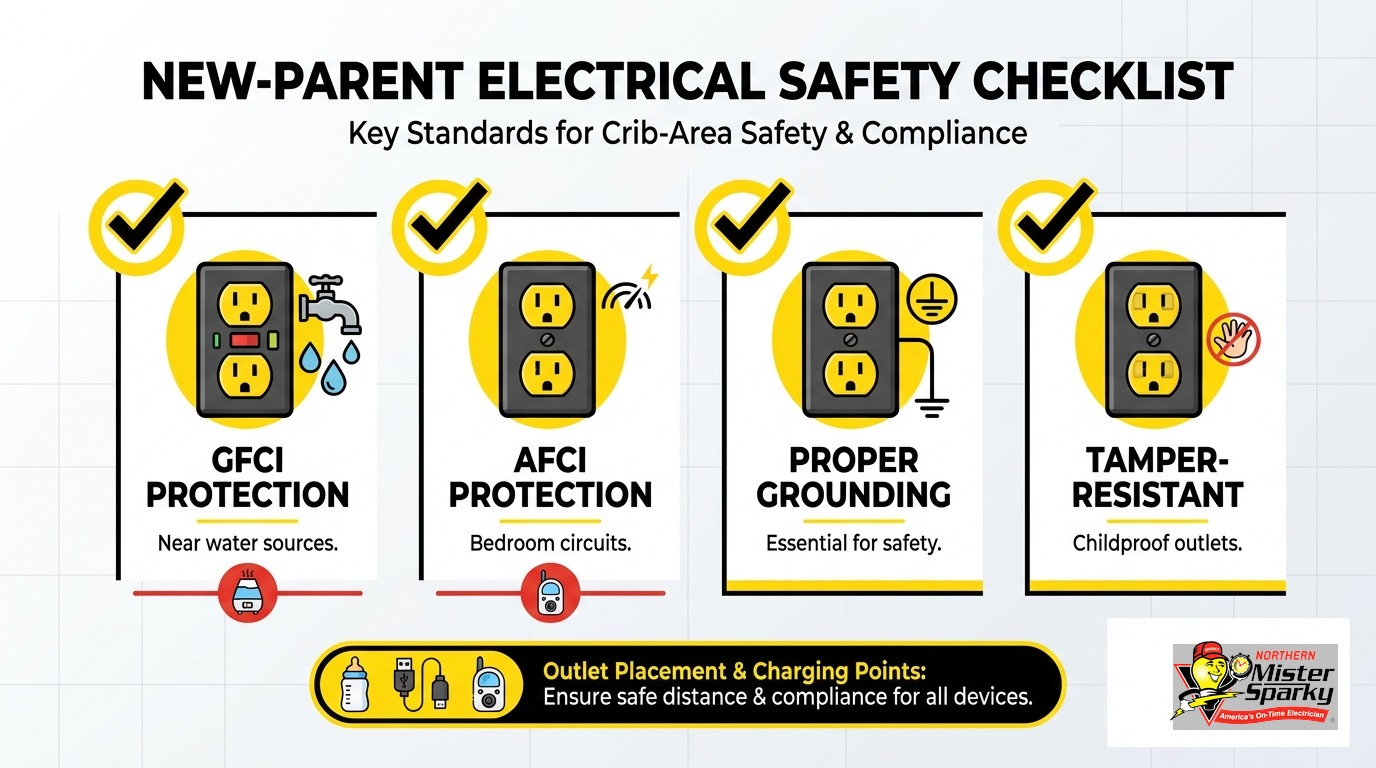
Key Takeaways
- NEC 210.52 requires outlets spaced so no wall point is more than 6 feet from a receptacle. In practice, outlets go no more than 12 feet apart along every wall.
- NEC 406.12 requires tamper-resistant receptacles on every standard 15A and 20A outlet in the home. Plastic plug covers are not a code-compliant substitute.
- NEC 210.12 requires AFCI protection on the bedroom circuit. A nursery is a sleeping room and falls under this requirement. Any permitted work in the room triggers the upgrade if it is not already in place.
- USB charging outlets must comply with NEC 406.3(F). The USB circuitry must be integral to the listed receptacle, not added via a face-plate splice.
- As of August 17, 2026, Minnesota adopted the 2026 NEC. AFCI protection now applies to all 120V branch circuits in a home, not just bedrooms.
- In Minnesota, any new outlet, circuit extension over 6 feet, or new circuit requires a permit pulled by a licensed electrician.
The Problem with One Outlet in the Corner
Most nurseries start as spare bedrooms. A spare bedroom typically has two outlets: one on each wall, positioned wherever the builder left them.
Then the baby gear arrives.
A humidifier. A baby monitor. A white noise machine. A night light. Maybe a small lamp for the 2 a.m. feeding. Suddenly everything is crowded into one corner near the crib. It all runs through a power strip plugged into the single nearest outlet, with cords routed along the baseboard or tucked behind the crib frame.
That exact setup is what the electrical code is designed to prevent. The outlet spacing rule exists to eliminate the need for extension cords and power strips. The arc fault protection requirement exists because families sleep through the early stages of an electrical fire. The tamper-resistant outlet requirement exists because a 9-month-old can pull a standard plastic plug cover off the wall.
If you are converting a bedroom before the baby arrives, you have a clean window to get the wiring right. This post walks through what Minnesota code actually requires for nursery electrical outlets, why each rule exists, and what the work looks like when we come out.
How Many Nursery Electrical Outlets Does Code Actually Require?
The short answer: NEC 210.52 requires that no point along any wall is more than 6 feet from a receptacle. Outlets go no more than 12 feet apart along any wall, and any continuous wall section 2 feet or wider needs at least one receptacle. The rule exists specifically to eliminate extension cords.
If the spacing is right, you can reach every plug-in location in the room with a standard 6-foot appliance cord. No power strip needed, no cord stretched across the floor.
In a typical 10-by-10 nursery, that usually means four outlets: two on the longer walls, one on each shorter wall. Most existing bedrooms have two outlets, sometimes three. That gap is where the power strip shows up.
The NEC 210.52 spacing formula is documented in full here. One nuance worth knowing: floor outlets count toward the spacing requirement only if they are within 18 inches of the wall. A floor outlet installed in the center of the room does not satisfy the 6-foot rule for the surrounding walls.
When we add outlets to bring a nursery into compliance, the new receptacles go on the existing bedroom circuit or a new dedicated circuit, depending on what the panel can support. We evaluate the existing load and run the calculation before we recommend anything. The work requires a permit. Minnesota requires a licensed electrician to pull it.
For the full code framework on outlet placement, our post on electrical receptacle spacing requirements walks through NEC 210.52 room by room.
Are Tamper-Resistant Outlets Required Everywhere, or Just in the Nursery?
The short answer: Everywhere. NEC 406.12 requires tamper-resistant receptacles on all standard 15A and 20A, 125V and 250V outlets in dwelling units. The Minnesota DLI 2023 NEC inspection checklist carries this requirement without local modification. It covers every room, not just the nursery.
The narrow exceptions are outlets more than 5.5 feet above the floor and single dedicated outlets serving permanently installed, non-movable appliances.
Tamper-resistant receptacles work through a spring-loaded shutter inside the outlet body. The shutters open only when equal pressure hits both slots simultaneously. That is exactly what happens when you insert a plug. A child pressing a single finger, key, or hairpin into one slot cannot force the shutter open.
The devices carry a small “TR” marking embossed between the slots. From across the room they look identical to standard outlets. The protection is built into the device, not an accessory you add later.
If your home was built before 2008, when TR requirements became widespread in the NEC, your existing outlets are almost certainly not tamper-resistant. Replacing them is straightforward work: remove the old device, install the listed TR receptacle in the same box, confirm the wire connections, and move on. Our post on tamper-resistant outlets and child safety explains what to look for and what the installation involves.
Do Plastic Outlet Covers Actually Protect Your Child?
The short answer: Not reliably. Children as young as 9 months old have been documented removing standard plastic plug covers. The CPSC pulled approximately 900,000 Safety 1st Push ‘N Snap outlet covers for exactly this hazard. A cover a toddler can pull out is not real protection.
Plug covers introduce a second problem: when a child removes one, it becomes a small plastic piece in an environment where everything goes in the mouth.
Tamper-resistant receptacles eliminate both issues. There is nothing to remove, nothing to choke on, and no per-outlet item to remember at every socket in the house. The protection is in the wall.
If you are replacing outlets in the nursery anyway, specify TR-rated receptacles for the whole room. Code requires it everywhere, and the cost difference per device is small.
What Is AFCI Protection and Does the Nursery Need It?
The short answer: Yes. NEC 210.12 requires AFCI protection on all 120V, single-phase, 15A and 20A branch circuits supplying outlets in bedrooms and similar rooms. A nursery is a sleeping room. If the circuit feeding the nursery does not have an AFCI breaker, any permitted electrical work in that room triggers the upgrade.
AFCI stands for arc fault circuit interrupter. An arc fault happens when electricity jumps across a gap in damaged wire insulation or at a loose connection. An arc is not an overload. A standard breaker trips when current exceeds its rating. An arc can generate damaging heat at current levels well below that threshold, which means a standard breaker provides no protection against it.
Bedrooms were the first room category added to AFCI requirements in NEC history. The reasoning is direct: people sleep through the early stages of an electrical fire. A fire that starts inside a wall at 2 a.m. may not produce enough smoke to wake a sleeping family before it is well established.
AFCI and GFCI protect against different hazards and are not interchangeable. GFCI (NEC 210.8) detects current imbalance to prevent shock. AFCI (NEC 210.12) detects arcing signatures to prevent fire. A bedroom circuit needs AFCI. A bathroom circuit needs GFCI. Combination AFCI/GFCI breakers exist for locations where both requirements apply.
Adding an AFCI breaker to an existing panel is typically 30 to 45 minutes of work. If the panel is full or is one of the known problematic brands, we address that as part of the conversation. Our post on AFCI breaker requirements covers what to expect at the panel and how to identify whether your current breakers are AFCI-rated.
Why Baby Monitors and Humidifiers Near the Crib Are a Hidden Fire Risk
This is the piece that every parent-facing outlet guide misses completely.
A humidifier running 8 hours a night draws continuous power through its cord. That cord typically runs from the nearest outlet to the device by whatever path is available: along the baseboard, under the crib frame, behind a crib leg. Over weeks and months, the cord can develop a kink at a corner, get pinched under the crib foot, or rub against a rough edge on the baseboard.
A baby monitor’s cord does the same thing on a smaller scale.
Neither device draws enough current to trip a standard breaker when its cord is kinked or partially damaged. But a cord with compromised insulation can arc at the damage point. The arc occurs at the wire, which may be behind furniture, inside the gap between the crib and wall, or pressed against the baseboard. There is no visible flame, no burning smell in the early stage, and no obvious sign that anything is wrong. The arc generates heat until the surrounding material ignites.
That failure mode is exactly what AFCI protection catches. The breaker monitors the circuit’s waveform continuously and recognizes the electrical signature of an arcing fault, even at low current. When it detects the arc signature, it trips before the heat can build to a dangerous level.
Running those same devices on an extension cord makes the risk worse. Extension cords are not rated for continuous overnight use. They are a short-term convenience, not a wiring solution. If the nursery does not have enough outlets to reach every device with the appliance’s own cord, the answer is more outlets rather than a longer cord. Our post on extension cord dangers and when to add an outlet covers this directly.
The AFCI risk is also why NEC 210.12 covers “similar rooms” alongside bedrooms. Any room used as a sleeping space falls under the same standard.
Should You Add USB Outlets to the Nursery?
The short answer: Yes, with the right device. NEC 406.3(F) requires that receptacles with built-in USB chargers be listed units with the Class 2 USB circuitry integral to the receptacle body. Face-plate-only add-ons that require splicing into the 120V wiring inside the box do not qualify under this standard.
The practical difference: the USB receptacle must be manufactured and tested as a single listed unit, not a standard outlet with a USB module attached to the faceplate after the fact.
NEC 406.3(F), added in 2017 and carried into the 2023 code, was written in direct response to early USB add-on products that placed low-voltage electronics in proximity to 120V wiring without proper listing or testing. The integral requirement exists because of documented failure incidents with those earlier products.
In practice, listed USB-A/C combination receptacles are widely available and install in a standard single-gang box. They provide two USB charging ports alongside both 120V slots. A baby monitor with a USB charging block no longer occupies a full 120V outlet.
If you are adding outlets to the nursery anyway, specifying USB combination receptacles at the crib-adjacent and changing-table locations adds minimal cost per device. We carry listed units and install them in the same pass as the outlet additions.
What Does Minnesota Code Require Right Now?
The short answer: Minnesota adopted the 2026 NEC effective August 17, 2026. AFCI protection now applies to all 120V branch circuits in the home, not just bedrooms. Any permitted electrical work in any room of a Minnesota home triggers this requirement under current code.
Before August 17, 2026, Minnesota operated under the 2023 NEC. That version required AFCI for bedrooms, living rooms, dining rooms, and several other listed spaces, but not universally for every circuit. The Minnesota DLI inspection framework and the Minnesota Electricity Board tracked the room-by-room scope of the 2023 requirement.
Under the 2026 NEC, the analysis is simpler: any new 120V circuit or circuit extension in any room of a Minnesota home needs AFCI protection on that circuit. If the bedroom circuit feeding the nursery already has an AFCI breaker, you are in compliance. If it does not, any permitted work in that room triggers the upgrade at the panel.
Tamper-resistant outlet requirements have not changed. NEC 406.12 has required TR receptacles in all dwelling unit outlets since 2008. If your home was built or substantially rewired after that point, you may already have them. We verify the embossed “TR” marking during any outlet work.
Minnesota permit requirements: the following work requires a permit and a licensed electrician:
- Any new electrical circuit
- Any circuit extension longer than 6 feet
- Any outlet replacement that triggers AFCI review under current code
- Any service or panel work
Pulling a permit means your work is inspected. The city or county inspector confirms the AFCI breaker is correctly installed, the TR receptacles are in place, and the outlet spacing meets NEC 210.52. That documentation travels with the home when you sell it.
What to Expect When We Come Out
A nursery electrical project is typically a half-day job. Here is the usual scope.
Outlet assessment. We measure the existing outlet placement against NEC 210.52 and identify where additional receptacles are needed. We note which walls are short of the 6-foot maximum and plan the cleanest wire routing: through the wall cavity, through the attic or basement, or along the baseboard in conduit if that is the most practical path. We patch any drywall we open.
Tamper-resistant receptacles. We replace any standard outlets in the room with listed TR-rated receptacles. If the room already has TR outlets, we verify the “TR” marking between the slots and keep moving.
AFCI breaker. We check the panel for an existing AFCI breaker on the bedroom circuit. If one is not present, we replace the standard breaker with a listed AFCI unit. That portion of the job takes about 30 to 45 minutes at the panel. If the panel has no open slots or is one of the known problematic brands, we raise that with you before we start work.
USB combination receptacles. If you want USB-A/C outlets at specific locations, such as the crib corner or changing table, we specify the correct listed units and install them in the same pass.
Permit and inspection. We pull the permit before any work begins. After the job is done, the city or county inspector verifies the AFCI installation, the TR receptacles, the outlet spacing, and the work quality. You receive a record of the inspection.
We are locally owned and operated, serving Minneapolis, St. Paul, Bloomington, Brooklyn Park, Woodbury, Blaine, Maple Grove, and Plymouth. As Northern Mister Sparky, America’s On-Time Electrician(R), we back every job with the UWIN(R) 100% satisfaction guarantee. If you are not satisfied, we make it right.
Call us at 763-200-5956 or book online to schedule a nursery electrical assessment. We look at the outlets, the circuit, and the panel, then tell you exactly what the job requires before we start. No guesswork, no surprises partway through. For larger projects that include panel work or multiple new circuits, ask about financing when you call.
Frequently Asked Questions
Are tamper-resistant outlets required in a nursery? +
Does a nursery circuit need AFCI protection? +
How many outlets does a nursery actually need? +
Need an electrician now?