
Extension Cord Safety: Why Permanent Use Is a Code Violation
Key Takeaways
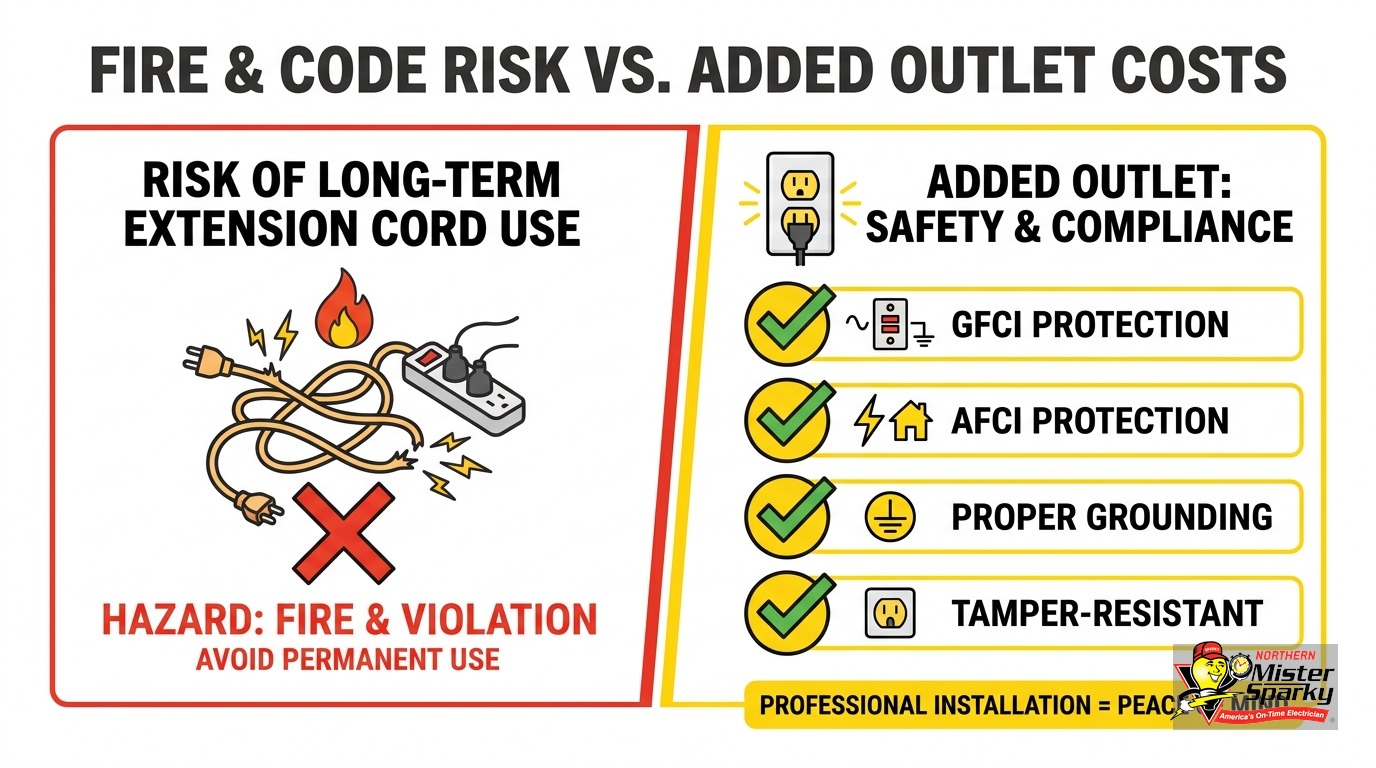
- Around 3,300 home fires ignite in extension cords each year, killing roughly 50 people and injuring 270 more. An additional 4,000 people are treated in emergency rooms for extension cord injuries annually.
- NEC Article 400.8 prohibits flexible cords as a substitute for fixed wiring. Any cord in place longer than 90 days is a code violation by definition.
- Extension cord insulation is rated 60-75°C. The Romex in your walls is rated 90°C. That gap widens in significance every month a cord stays in place.
- Covering a cord under a rug or behind furniture traps heat, softens insulation, and creates an arc fault risk that can ignite carpet or dust.
- A heavier cord gauge increases load capacity. It does not fix insulation fatigue or arc fault risk.
- A simple outlet tap in the Twin Cities runs $200-$370. For most lamp and device situations, that is the entire cost of the fix.
- Minnesota adopted the 2026 NEC on August 3, 2026. New permit work now triggers updated AFCI and GFCI requirements.
That extension cord behind the entertainment center has been there since you moved in. The one in the corner bedroom, too - powering the lamp that has been on since your daughter was in middle school. Both cords look fine. Both work fine. But extension cord safety and permanent use intersect in a way the hardware store packaging never mentions. The insulation is degrading. The clock on a code violation started ticking around 90 days after you plugged it in. And somewhere in this country today, a home fire started because of the exact same setup.
Is Permanent Extension Cord Use Actually Dangerous?
Short answer: Yes. Around 3,300 home fires start in extension cords each year, killing roughly 50 people and injuring 270 more. An additional 4,000 emergency room visits involve extension cord injuries annually. The danger is not abstract. It is statistical and predictable.
The source of that danger is not a dramatic event. It is time. An extension cord is engineered for temporary, intermittent loads: a power tool used on weekends, a holiday light string up for six weeks, a lamp repositioned during a renovation. The thermoplastic jacket protecting the conductors inside is rated for continuous temperatures of 60-75°C. Every hour under load generates heat. Every hour of heat degrades the jacket a little more.
Industry material data puts the design lifespan of an extension cord at 1-2 years of intermittent use. Permanent use - continuous load, the same circuit, day after day - accelerates that timeline. The jacket hardens. Small cracks form. The insulation separating the conductors becomes less effective at its primary job.
At that point, the hazard is not a tripping risk. It is a conductor that can arc.
What Does Electrical Code Say About Extension Cord Safety and Permanent Use?
Short answer: NEC Article 400.8 is explicit: flexible cords cannot substitute for fixed branch circuit wiring. The NEC defines temporary as 90 days or less. A cord in place longer is a code violation. There is no minimum amperage or minimum length below which the rule does not apply.
The National Electrical Code treats flexible cords as a defined category with specific permitted uses. Those uses include connecting portable appliances, powering tools that need to move, and serving pendant fixtures. They do not include running a lamp in the corner of a living room for three years.
The 90-day definition surprises most homeowners. Temporary does not mean “until I get around to it.” It has a specific code meaning. Most long-running cords crossed that line years ago.
Minnesota adds a current-events layer here. The state adopted the 2026 NEC effective August 3, 2026. Permits filed on or after that date must comply with the updated code, which refines GFCI and AFCI requirements for residential circuits. Selling a home or filing a permit for a renovation brings code compliance into the conversation immediately. An electrical inspector who finds a permanently run extension cord will flag it. That flag does not expire because the cord is old.
Why Does Cord Insulation Fail Over Time?
Short answer: Extension cord insulation is rated for 60-75°C. Permanent home wiring handles 90°C. Months of repeated thermal cycling - current on, cord heats, current off, cord cools - fatigue the jacket in ways visual inspection cannot detect. When insulation cracks internally, conductors can arc.
Think of it like a plastic bag opened and closed hundreds of times. The material weakens at the fold. Extension cord insulation weakens wherever heat, bending, or compression concentrates. You cannot see this from the outside. The fatigue is structural and cumulative, and once the jacket is compromised enough, the conductors inside can contact each other through the degraded material.
That contact produces an arc. An arc produces heat far more intense than the cord’s normal operating temperature. In a fraction of a second, that heat can ignite surrounding material.
This failure mode is distinct from simple overloading. Cord failure from insulation fatigue can happen at normal loads, on a correctly sized circuit, in a cord that feels cool to the touch. The degradation is happening inside the jacket. There is nothing to see until there is.
Why Is Running a Cord Under a Rug So Risky?
Short answer: A covered cord cannot release heat. The jacket temperature rises past its rated threshold. Insulation softens or melts. An arc fault ignites carpet fibers and the dust packed tight beneath the cord. Fire investigators look for this sequence specifically because it is predictable and common.
Insurance and safety research consistently identifies covered cords as a primary ignition point. The cord does not need to be old or visibly damaged. A heavy rug over a healthy cord under a continuous load is enough to start the thermal sequence.
The same risk applies to cords run behind furniture pressed against a wall, through a doorway where the door repeatedly pinches the jacket, or under carpet runners in hallways. Any setup that restricts airflow around a cord that is under load creates a thermal trap.
The practical test is direct: if you cannot see the full length of a cord that is carrying current, it is a fire risk. Move it or replace it with a permanent circuit.
Running a cord through a wall is an additional violation on its own. Any cord passing through a wall, floor, or ceiling breaks code regardless of load or gauge. The fix is the same in every case: a permanent outlet on a properly installed branch circuit.
Does a Heavier-Duty Cord Solve the Problem?
Short answer: No. A 10-gauge cord carries more current before the breaker trips. It does not carry that current at a lower temperature, and the thermoplastic jacket has the same rated ceiling as a standard cord. Gauge addresses load capacity. It does not address insulation fatigue.
This is the most common misconception we see when assessing a permanent-cord situation. A homeowner swaps a 16-gauge cord for a 10-gauge heavy-duty model and considers the problem handled. The gauge increase reduces voltage drop and lowers the probability of overloading the cord at the breaker level. It does not make the cord safer for permanent installation.
The arc fault risk from insulation fatigue exists whether the cord is 16-gauge or 10-gauge. Understanding how arc faults differ from ground faults helps explain why AFCI protection on branch circuits matters - and why an extension cord on an older unprotected circuit carries risk that a heavier gauge alone cannot address.
The solution is always the same regardless of gauge: a permanent outlet on a branch circuit with wiring rated for continuous, fixed installation.
What Does Fixing This Actually Cost in the Twin Cities?
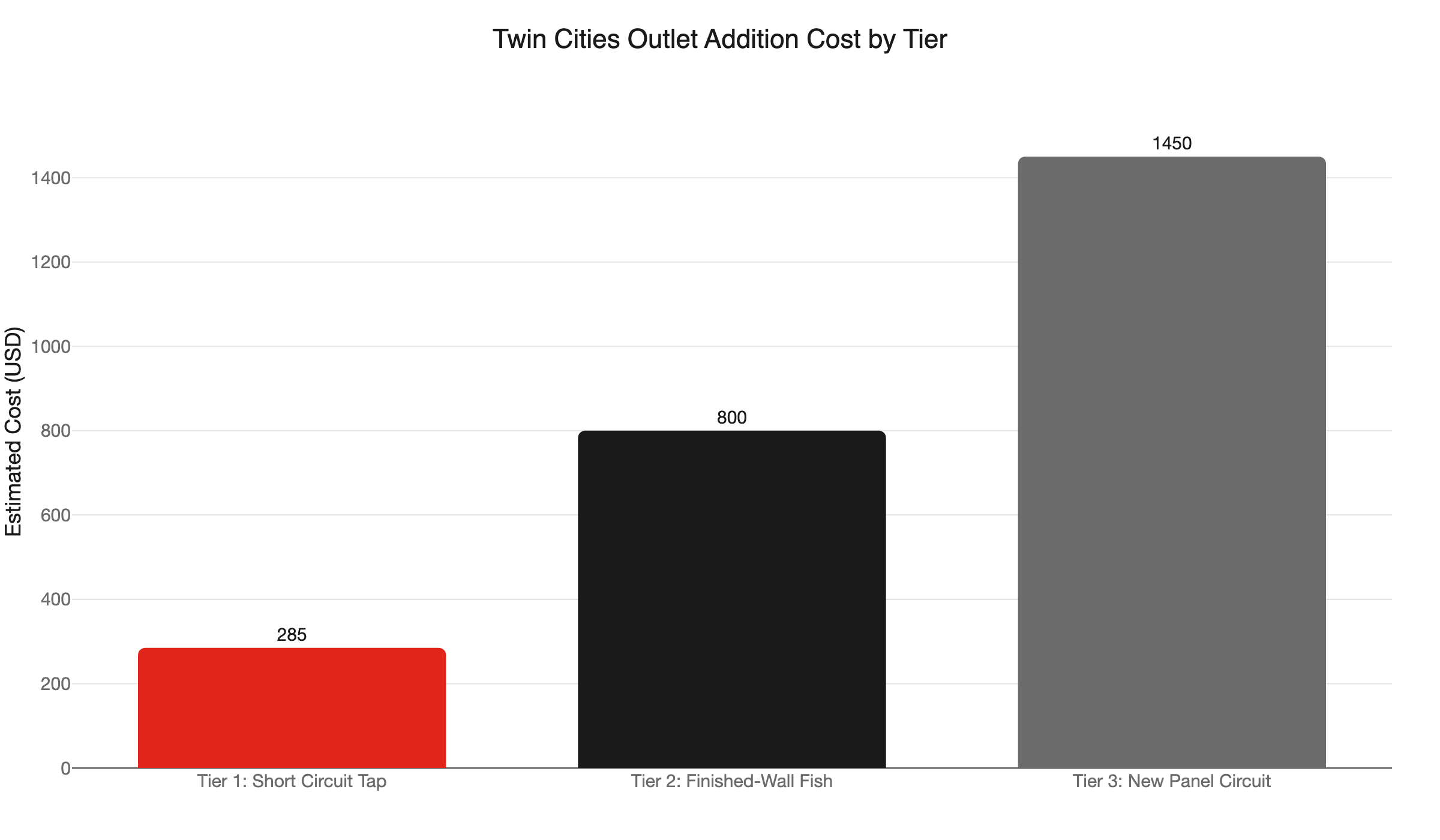
Short answer: A simple outlet tap on an existing circuit runs $200-$370 all in. Fishing wire through a finished wall costs $700-$900 or more. A new circuit from the panel runs $900-$2,000. The right tier depends on your wall type, circuit availability, and the room’s code requirements.
Our full breakdown of what it costs to add an electrical outlet in the Twin Cities covers the variables in depth. The short version: Minneapolis averages $371 per outlet against a national average of $229. Twin Cities labor rates, older housing stock, and the complexity of finished-wall work all drive the difference.
Three tiers cover most situations:
Tier 1: Short circuit tap ($200-$370 all in). An existing outlet is nearby, the circuit has capacity, and the electrician extends the run with minimal wall disruption. Most outlet additions in newer construction or rooms with accessible walls land here.
Tier 2: Finished-wall fish ($700-$900 or more). This is the common scenario in older Twin Cities neighborhoods. The nearest circuit may be across the room. The walls are plaster or closed drywall with blocked cavities. Getting wire from point A to point B requires fishing through finished surfaces. Wall patching may be a separate line item.
Tier 3: New circuit from the panel ($900-$2,000). This is the path when existing circuits are full, when the room’s code requires a new AFCI-protected circuit, or when existing wiring cannot accept new loads. Panel work adds labor and, in many cases, a new breaker.
For most situations where an extension cord has been running a lamp or device for years, the actual fix is Tier 1 or low Tier 2. The figure that stops people from picking up the phone is usually the worst-case number. Your electrician can tell you exactly which tier applies before work starts.
Why Do Twin Cities Homes Cost More to Wire Than the National Average?
Short answer: Plaster-over-lath walls, knob-and-tube circuits, aluminum wiring, and updated AFCI requirements under the 2026 NEC all affect the scope of adding an outlet in Minneapolis or St. Paul. National pricing guides miss every one of these factors.
Plaster-over-lath walls. Homes built before 1960 in Minneapolis and St. Paul were built with plaster applied over wood lath - not drywall. Plaster cracks unpredictably under a drill bit. Patching it cleanly requires a different technique than patching drywall. An electrician who works regularly in older Twin Cities homes knows the drill approach and the patching method that preserves the wall surface. One who does not will leave a visible patch.
Knob-and-tube wiring. Pre-1950 homes frequently have knob-and-tube circuits still in service. Minnesota prohibits adding new loads to knob-and-tube circuits. If the circuit serving your proposed outlet location is knob-and-tube, a simple tap is not a legal option. The job becomes a Tier 3 circuit replacement: new wire from the panel, all the way to the new outlet.
Aluminum wiring. Homes built between roughly 1965 and 1973 may have aluminum branch circuit wiring. Aluminum requires CO/ALR-rated devices and specific connection techniques at every termination point. The electrician needs to identify aluminum wiring before quoting and before pulling any permits. It does not make the job impossible. It makes it more precise.
The 2026 NEC and AFCI. Minnesota adopted the 2026 NEC on August 3, 2026. Living rooms, bedrooms, and other dry living spaces - the exact rooms where extension cords typically live - require AFCI protection on branch circuits. Any new outlet circuit in those spaces requires an AFCI breaker at the panel. That adds to the material cost of Tier 3 work. It also means the new circuit is protected against exactly the arc fault scenario that makes permanent cord use dangerous in the first place. The upgrade eliminates the risk it costs.
None of these are reasons to avoid fixing the problem. They are reasons to call a local electrician who knows these houses, rather than estimating from a national pricing calculator built for tract construction.
When Should You Call an Electrician?
Short answer: Call now if any extension cord in your home has been in place longer than 90 days, runs under a rug or behind furniture, powers a device you use daily, or sits in a room where every outlet is already full. These are the conditions that precede fires and code violations.
You do not need to wait for something to go wrong. The situations that warrant a call:
- A cord that has been in the same position for more than three months
- Any cord running under carpet, a rug, or a floor runner
- A cord powering a TV, monitor, lamp, or kitchen appliance used regularly
- A power strip plugged into another power strip
- A room where every outlet is full and extension cords fill the gap
- A cord that feels warm after a device has been running for an hour
- Visible cracking, discoloration, or kinking anywhere on the cord jacket
- A burning smell near an outlet, cord, or adjacent wall
Our outlet installation service covers what the process looks like from estimate to finished outlet. A straight assessment, a clear number, and no surprises about what you are getting.
The Bottom Line
No malarky: an extension cord is a temporary tool, and the code is clear about what temporary means. Ninety days. That is the line. A cord in place longer is a documented violation with a fire pattern an electrician recognizes on sight.
The fix costs less than most homeowners expect. A simple outlet tap in the Twin Cities runs $200-$370. For the lamp in the corner or the device behind the desk, that is usually the entire scope of the job.
As locally owned and operated Northern Mister Sparky, we are the team that shows up when you call us - not after the damage is done. We assess the situation honestly, tell you which tier applies to your specific home and walls, and give you a clear number before any work begins. That is the UWIN(R) 100% satisfaction guarantee backed by a local crew, from America’s On-Time Electrician(R).
Call 763-200-5956 or book online to get on the schedule.
Frequently Asked Questions
Can I use an extension cord as a permanent power source? +
How much does it cost to add an outlet in Minneapolis? +
What happens if I run an extension cord under a rug? +
Does a heavy-duty extension cord make permanent use safe? +
Need an electrician now?