
Outdoor Water Feature Pond Pump Electrical Requirements
Key Takeaways
- GFCI protection is required on every outdoor outlet serving a pond pump under NEC 210.8(A). There is no exception for small or decorative ponds.
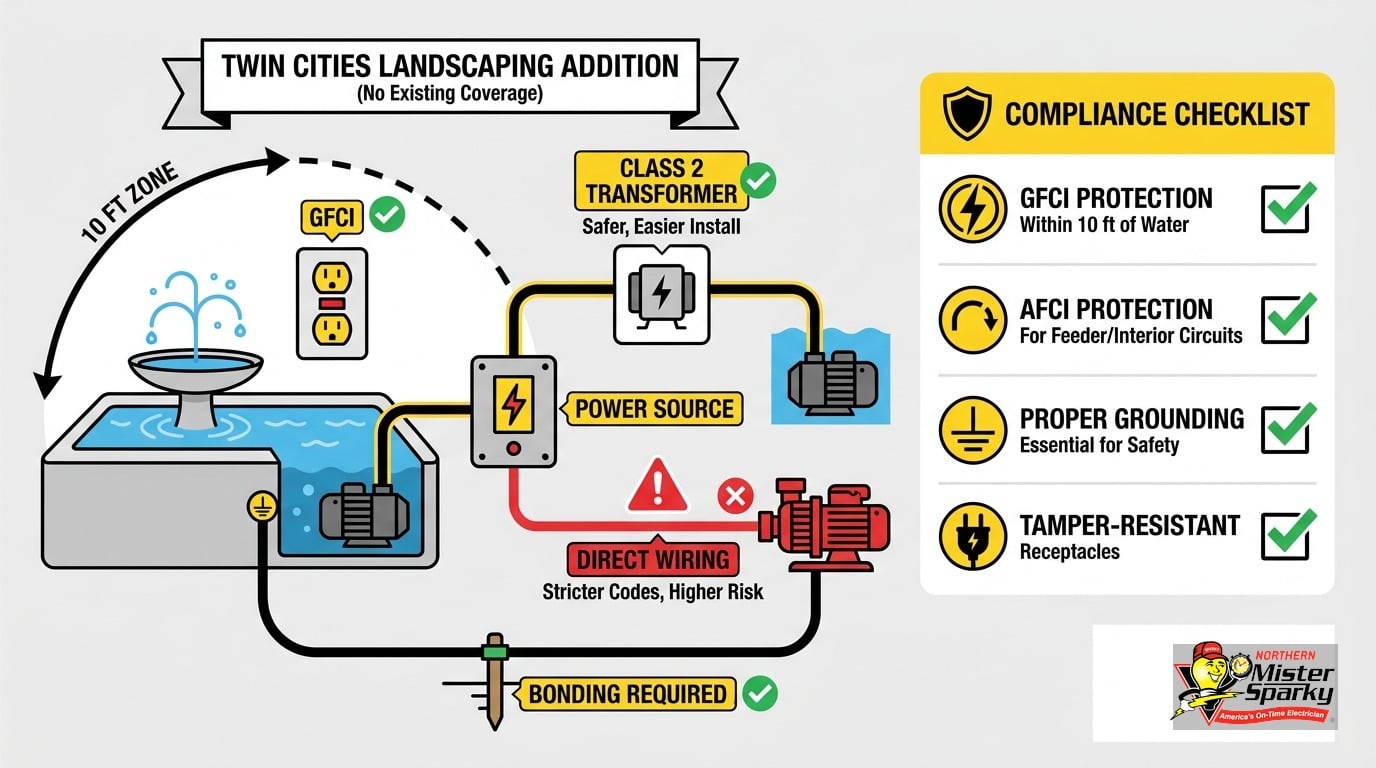
- The 10-foot placement rule requires receptacles to sit at least 10 feet from the inside walls of a fountain or ornamental pool, on top of GFCI protection.
- A Class 2 transformer relaxes wiring requirements on the low-voltage side of the system, but the 120V outlet feeding the transformer still requires GFCI protection.
- NEC 682.33 bonding can apply to decorative backyard ponds with pumps. Most pond installation guides skip this requirement entirely.
- Electric shock drowning (ESD) is not a marina-only hazard. NFPA confirms it can occur at residential ponds.
- Minnesota is on the 2026 NEC as of August 17, 2026. Any permit filed now is governed by the 2026 code.
- A permit is required for new outdoor pond electrical work in Minnesota. Our team handles the permit and inspection process.
Outdoor Water Feature Pond Pump Electrical Requirements: The Three Code Layers
Backyard koi ponds and water features are one of the most popular Twin Cities landscaping additions. Most homeowners buying a pond kit know one rule: use a GFCI outlet. That is a start. The full picture of outdoor water feature pond pump electrical requirements covers three code layers. Most articles only address one.
This post covers all three: the GFCI rule and a placement requirement most installers get wrong, the Class 2 transformer distinction that changes what wiring is required, and NEC 682.33 bonding, which almost no residential pond guide mentions. It also covers Minnesota’s current code cycle and what a permit actually requires. If you are planning a pond install or evaluating an existing one, these are the questions your electrician should be able to answer.
Does Every Outdoor Outlet Near a Water Feature Require GFCI Protection?
Yes. NEC 210.8(A) requires GFCI protection on all 125V-250V receptacles installed outdoors. There are no distance exceptions for low-power pumps or ornamental features. Any outdoor outlet serving a pond pump must be GFCI-protected.
The rule has no carve-out based on pump size or pond type. A small recirculating fountain pump triggers the same requirement as a high-flow koi pond unit. NEC 680.21(C) adds a second layer for pump motors specifically. Outlets supplying pool pump motors at 125V or 240V must also be GFCI-protected. Minnesota’s 2026 NEC inspection checklist confirms this requirement applies to replacement pump motors, not just new installations. Swapping an old pump for a new one does not exempt you from the GFCI requirement.
The 10-foot placement rule. GFCI protection is only part of what NEC 680 requires. Receptacles serving outdoor fountain and ornamental pool equipment must also be located at least 10 feet from the inside walls of the fountain. That is a placement rule, not just a protection rule. You cannot mount an outdoor GFCI outlet on the edge of a raised pond bed and call the job done. The outlet must be set back.
In many residential landscaping layouts, that means running conduit farther than most homeowners expect. For a small decorative pond near a back patio, the nearest GFCI outlet on the house wall may already be within 10 feet of the water. Relocating the outlet, or running a new circuit to a correctly positioned location, is part of a code-compliant installation.
If your current pond outlet is within 10 feet of the water and was installed without a permit, that is a code violation worth correcting. Our team can evaluate the existing setup and relocate the outlet to the correct distance. For more on what this type of work involves, see our post on outdoor GFCI outlet installation.
Class 2 Transformer vs. Direct 120V Wiring: Why the Choice Matters
Most pond kits include a Class 2 transformer. Most landscaping guides say “just use a low-voltage pump kit.” Neither explanation tells you what is actually happening from a code standpoint.
What a Class 2 transformer does. A listed Class 2 transformer steps 120V down to 15V or less. The output voltage is below the threshold that causes dangerous shock. So the NEC treats the low-voltage secondary side under relaxed wiring requirements. NEC 680.54 covers lighting systems running at 15V or less through a listed Class 2 transformer. These systems do not require the same conduit protection as direct 120V line-voltage wiring. Low-voltage cable running to submersible lights can be installed with less conduit in most cases.
What the transformer does not change. The transformer is still a 120V device on its input side. The outlet feeding it must still be GFCI-protected under NEC 210.8(A). The transformer itself must be listed for the application. Any submersible lighting must be listed for submersible use. Low voltage does not mean unregulated.
The direct 120V path. If you run line-voltage power directly to a submersible pump without a transformer, the wiring requirements are significantly stricter. All conductors, conduit, and connections fall under NEC 680 requirements for wet locations. Pump motors at 240V require GFCI protection under NEC 680.21(C). Junction boxes near water must be rated for the environment. Splice locations and penetrations must be sealed for wet or damp conditions.
The Class 2 transformer is not just a convenience choice. It is a code-path choice that affects what your electrician must install and what it costs. When your landscaper says “use a low-voltage kit,” they are pointing you toward a simpler code path. But the entry point, the 120V outlet feeding the transformer, still requires a licensed electrician to install correctly.
For more on GFCI requirements and when a GFCI breaker makes more sense than a GFCI outlet at the circuit level, see our GFCI outlet requirements explained post.
What Is NEC 682.33 Bonding, and Does My Backyard Pond Need It?
NEC 682.33 requires equipotential bonding for electrical equipment installed outdoors adjacent to artificially made bodies of water. A pond with a submersible pump can trigger this requirement. Most homeowners and most pond installation guides are unaware it exists.
Most homeowners have heard of the NEC 680.26 bonding requirement for pools, spas, and hot tubs. What they do not know is that NEC 682.33 extends a bonding obligation beyond pools. It applies to “electrical equipment installed outdoors adjacent to natural and artificially made bodies of water.” A backyard koi pond is an artificially made body of water. A pump is electrical equipment adjacent to it. That combination is the trigger.
What bonding does. Bonding connects metallic equipment, plumbing, and structural components near the water to a common bonding conductor. The goal is to eliminate voltage differences between objects a person could touch at the same time. A pump fault can create a voltage difference between the water and a nearby metal fence post, hand rail, or structural component. A person who contacts both simultaneously becomes the current path.
Bonding and GFCI protection work together. GFCI detects a ground fault and cuts power in milliseconds. Bonding reduces the voltage difference that makes a fault dangerous in the first place. Both are required for a safe, code-compliant installation. One does not replace the other.
Does your specific pond need bonding? That depends on the pump voltage, the presence of metal components near the water, the conductors used, and how the pond is constructed. A licensed electrician evaluating the site can tell you what applies to your installation. If a landscaper built the pond and plugged a pump into an extension cord, the honest answer is: almost certainly not up to code on bonding or anything else.
For a deeper explanation of how bonding and grounding work in residential electrical systems, see our electrical bonding and grounding explained post.
What Is Electric Shock Drowning, and Can It Happen in a Residential Pond?
NFPA explicitly confirms that electric shock drowning is not limited to marinas. It can occur anywhere electricity contacts water, including residential ponds and decorative water features. This is a safety-of-life issue, not a remote or theoretical concern.
ESD occurs when faulty wiring introduces AC current into fresh water. Fresh water is less conductive than salt water. That sounds safer. It is not. In less-conductive water, the voltage gradient across the water is larger. That larger gradient creates stronger current flow through a person’s body, which can cause muscular paralysis before the person can exit the water.
The warning signs are not always obvious before it is too late. A tingling sensation in the water is one indicator. Unusual or distressed behavior from animals near the water is another. Aging outdoor wiring, extension cords running to pumps, and overhead power lines within range are all risk factors that increase the likelihood of a fault reaching the water.
Why a backyard pond is a real ESD risk. Most decorative pond setups have a pump that has been running for several years. The wiring was often never permitted or inspected. Extension cords that were meant to be temporary are now permanent fixtures. Pump housings crack after a hard Minnesota winter. Wiring insulation degrades over time and develops small faults that let current leak.
Any of those failure modes can introduce current into the water. A wiring fault when a child or pet is in or near that water can be fatal. GFCI protection and NEC 682.33 bonding are the two code-required safeguards that stand between a wiring fault and an ESD event. That is the non-obvious reason these requirements exist.
Did Minnesota Adopt a New Electrical Code? How It Affects Your Pond Permit
Yes. Minnesota adopted the 2026 NEC effective August 17, 2026. Any permit filed on or after that date must comply with the 2026 NEC. Permits filed before August 17 were governed by the 2023 NEC.
This matters for pond pump work because the NEC updates on a three-year cycle and requirements change between cycles. A neighbor who installed a pond two years ago and tells you what code required then may be describing the previous cycle. The code your project is held to is the one in effect when your permit is filed.
If you are planning a pond electrical installation for spring 2027, your electrician will work from the 2026 NEC. The current Minnesota code authority is the Department of Labor and Industry. The code lives in Chapter 1315 of the Minnesota State Building Code. Any installer who quotes you based on 2023 NEC requirements may price a job that does not pass inspection under the current code. That is worth asking about before work begins.
Do Outdoor Water Feature Pond Pump Electrical Requirements Include a Permit?
Yes. Any new electrical circuit, outlet, or wiring that requires inspection needs a permit in Minnesota before the work starts. Outdoor and landscape electrical work is not exempt.
Homeowners can self-permit for work on their own occupied residence. The homeowner must sign an affidavit, personally perform the work, and schedule a rough-in inspection before any wiring is concealed. All wiring must pass that inspection before it is covered. The permit and inspection authority is the Minnesota Department of Labor and Industry, or a local electrical inspection authority for some municipalities.
Minnesota’s 2026 NEC inspection checklist covers permit requirements at items 001-007. If you pull a permit as a homeowner and fail inspection, you are responsible for correcting the work and scheduling a re-inspection. Errors in GFCI placement, bonding, or wiring methods are common causes of failed inspections on outdoor water feature circuits.
What this means in practice. If a landscaper built your pond and plugged a pump into an extension cord, no permit was pulled and no inspection happened. The GFCI protection, 10-foot placement, bonding, and wiring method requirements were almost certainly not addressed. That is not just a citation risk at resale. It is a safety risk every time someone is near that water.
When our team does this work, we pull the permit, complete the installation to code, and schedule the inspection. You receive documentation that the work passed. That matters both for safety and for home sale disclosures. Our electrical permit Minnesota post walks through the permit process in full detail.
Should You Inspect Your Pond Pump Wiring Before Every Spring Startup?
Yes, especially in Minnesota. The freeze-thaw cycle does real damage to outdoor electrical installations over time, and pond pump wiring is particularly exposed to it.
Submersible pump housings crack when water inside them freezes. Conduit seals fail when frost heaves the ground around buried conduit. Junction boxes that were weatherproof at installation can fill with water after a winter of freeze-thaw movement. Wiring insulation becomes brittle under sustained cold and can develop hairline cracks when the ground shifts in spring.
These failure modes accumulate gradually and are not visible from the outside. A pump that ran without issue last summer may have a compromised housing seal by spring. A junction box that passed inspection four years ago may have water infiltration today.
A licensed electrician running a pre-season check will test continuity on the submersible pump wiring, verify the GFCI outlets are still functioning correctly, inspect the pump housing for cracks, and look for water intrusion in any conduit runs or junction boxes. If the system has been running more than five years without an inspection, assume the inspection will turn up something worth fixing.
A pre-season check is a short job. It costs far less than a service call to diagnose a fault that a failed GFCI test uncovers. And it is far less costly than everything that follows an ESD event.
Ready to get your pond electrical up to code? Call us at 763-200-5956 or book online. We are locally owned and operated in the Twin Cities, and we handle outdoor electrical work across the metro, from Minneapolis and St. Paul to Bloomington, Maple Grove, Woodbury, Blaine, and Brooklyn Park.
Whether you are planning a new pond installation, evaluating an existing setup that was never permitted, or coming out of winter and want a pre-startup check, our team will give you a straight answer on what the work requires. No malarky, no oversell. That is what America’s On-Time Electrician(R) looks like locally.
Frequently Asked Questions
Do I need a permit for pond pump electrical work in Minnesota? +
Does a decorative backyard pond require electrical bonding? +
What is the 10-foot rule for water feature outlets? +
What is electric shock drowning, and can it happen in a backyard pond? +
Need an electrician now?