
Over the Range Microwave Dedicated Circuit Requirements
Key Takeaways
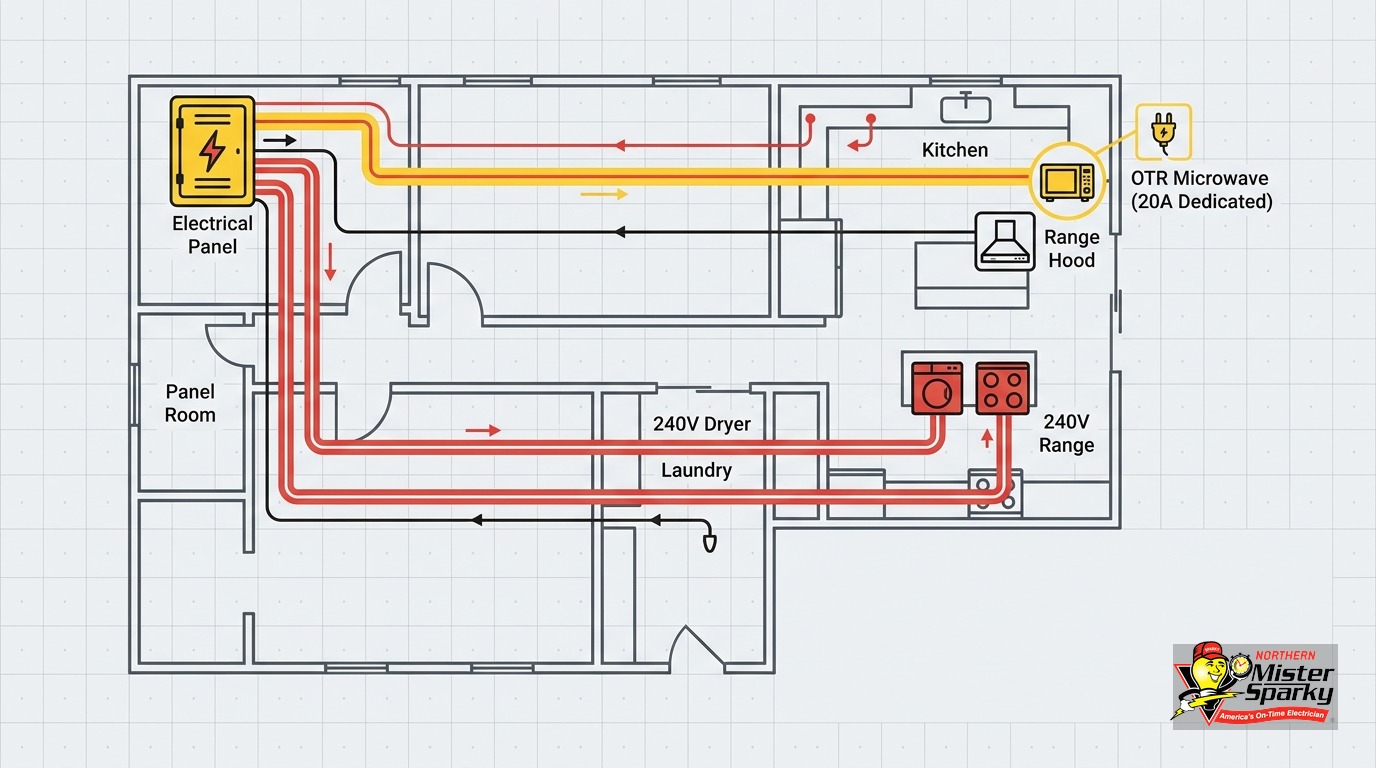
- Every over the range microwave dedicated circuit must be an individual branch circuit under NEC 422.16(B)(4). No shared outlets. No shared appliances.
- A plain exhaust-only range hood is a legally distinct appliance. It can share a hardwired branch circuit under NEC 210.23. An OTR microwave-hood combination cannot.
- The circuit must be 120V, 20 amps, and run on 12-gauge wire.
- Under Minnesota’s 2023 NEC, the circuit requires both GFCI protection (NEC 210.8(D)) and AFCI protection (NEC 210.12(B)).
- A permit and post-installation inspection are required in Minnesota. Homeowners can pull their own permit for a home they own and occupy. An unlicensed handyman cannot.
- Minnesota switches to the 2026 NEC on August 17, 2026. Permits filed before that date are governed by 2023 NEC rules.
Why Didn’t Your Old Range Hood Need Its Own Circuit?
A plain exhaust-only range hood is a motor load. Under NEC 210.23, it can share a hardwired branch circuit as long as its draw stays under 50% of circuit ampacity. An OTR microwave-hood combination is a cooking appliance. NEC 422.16(B)(4) puts it in a different category entirely and requires an individual branch circuit.
This question comes up on nearly every OTR microwave installation we do. The old hood ran off the kitchen light circuit for years. Nothing tripped. No inspector flagged it. Then the homeowner swaps in an OTR microwave and the electrician says: you need a dedicated circuit. What changed?
The appliance category changed.
A standard exhaust-only hood does one thing: it moves air. The motor in a typical range hood draws 100 to 200 watts. On a 15-amp branch circuit with 1,800 watts of capacity, a 200-watt motor stays well inside the 50% limit set by NEC 210.23. Sharing the kitchen light circuit is code-legal.
An over-the-range microwave is a different machine. It heats food with a magnetron, exhausts air with a fan motor, and runs a turntable and interior light simultaneously. A typical OTR unit draws between 1,200 and 1,800 watts at full cooking power. That is not a ventilation load. It is a cooking appliance load, and the code treats it accordingly.
The Mike Holt Professional Forum discussion of NEC 422.16(B)(4) and (5) draws this line precisely. A plain range hood hardwired to a lighting branch is permissible under NEC 210.23, provided it stays within the load limit. A microwave-hood combination is a distinct appliance category. It triggers the individual branch circuit requirement under 422.16(B)(4) regardless of available load.
Most homeowners treat range hoods and OTR microwaves as the same product. The NEC does not. That is the real answer to why the old wiring worked and the new appliance needs its own circuit.
Does an Over the Range Microwave Need a Dedicated Circuit?
Yes. NEC 422.16(B)(4) requires an OTR microwave-hood combination to be on an individual branch circuit. “Individual” means no other outlet, fixture, or appliance shares that circuit. If the unit is cord-and-plug, the receptacle it plugs into must be on that circuit alone. Sharing is not permitted, even when the available load appears to allow it.
GE Appliances states directly in its installation guidance for OTR models: the unit “should always be on a dedicated circuit” with “a 120 volt, individual, properly grounded branch circuit with a 3-prong grounding type receptacle protected by a 15 or 20 amp circuit breaker or time-delay fuse.”
When the appliance manufacturer and the NEC say the same thing, there is no room for interpretation.
Your kitchen already has two required small-appliance branch circuits at counter height. These serve the toaster, coffee maker, blender, and other countertop appliances. They are not available for the OTR microwave, even when the load math appears to work. The OTR circuit is a completely separate run from the panel to the upper cabinet space above the range.
Cord-and-plug installations have strict limits of their own. NEC 422.16(B)(4) restricts the supply cord to between 18 inches and 4 feet in length. It requires the receptacle to be accessible without moving the microwave. It mandates proper grounding throughout. The circuit behind that receptacle must still be individual.
For a full list of which kitchen appliances require their own circuits, our post on dedicated circuits for appliances covers each one.
What Are the Over the Range Microwave Dedicated Circuit Requirements in Minnesota?
Minnesota operates under the 2023 NEC. A new OTR circuit must be: 120V, 20 amps, 12-gauge wire, individually routed from the panel, GFCI-protected under NEC 210.8(D), and AFCI-protected under NEC 210.12(B). A combination AFCI/GFCI 20-amp breaker at the panel satisfies both protection requirements in a single device.
Here is what each requirement means in practice.
Individual branch circuit. The cable runs from the panel to one destination: the receptacle or hardwired connection for the OTR microwave. Nothing else is on that circuit. No lights. No other outlets. No additional appliances.
120V, 20A, 12-gauge wire. Standard residential voltage is 120V. A 20-amp circuit requires 12-gauge wire throughout the entire run. Using 14-gauge wire on a 20-amp breaker is a code violation and a fire risk. Do not let anyone suggest it.
GFCI protection. NEC 210.8(D) now extends GFCI protection to microwave ovens, both cord-and-plug and permanently-connected models. This requirement is confirmed on Minnesota’s 2023 NEC residential inspection checklist. A GFCI breaker at the panel covers a hardwired OTR unit. A GFCI receptacle inside the upper cabinet covers a cord-and-plug installation.
AFCI protection. NEC 210.12(B) requires AFCI protection on 120V, 15- and 20-amp circuits serving kitchen areas. Minnesota adopted this requirement when it transitioned to the 2023 NEC. A new OTR microwave circuit needs an AFCI breaker at the panel. A combination AFCI/GFCI breaker handles both requirements in one device.
Combination AFCI/GFCI breakers cost more than a standard breaker. They are required. A plain 20-amp breaker on a new kitchen circuit in Minnesota does not pass a 2023 NEC inspection. This is the protection requirement that most online content about microwave circuits skips entirely.
For more on why AFCI protection is now standard on kitchen circuit work in Minnesota, our post on AFCI breaker requirements explains the arc-fault concept in plain language.
What Size Breaker Does an OTR Microwave Circuit Need?
A 20-amp breaker on 12-gauge wire is the industry standard for OTR installations. GE’s installation guidance lists “15 or 20 amp” as acceptable, but 20 amps is the right choice. It provides load headroom above the microwave’s rated draw and prevents nuisance tripping during extended cooking cycles.
The math is simple. A typical OTR microwave draws between 1,200 and 1,800 watts at full cooking power. On a 120V circuit, 1,800 watts equals 15 amps of draw. The 80% continuous-load rule means a 15-amp circuit can sustain only 12 amps before approaching its design limit. A microwave running a long defrost cycle will push that circuit into nuisance-trip territory.
A 20-amp circuit can sustain 16 amps continuously. That is the headroom an OTR microwave needs.
The material cost difference between 12-gauge and 14-gauge wire is small on a new installation. The performance difference is not. Running 14-gauge wire to save a few dollars and then dealing with tripped breakers every time you run the microwave at full power is a false economy. We size OTR circuits at 20 amps on every installation.
One more variable: your panel. Adding a 20-amp breaker requires an open slot. If your panel is full, the options are a tandem breaker (if your panel model supports them) or a panel upgrade before the new circuit can be added. Our post on signs you need an electrical panel upgrade outlines what to watch for before scheduling any new circuit work.
Do You Need a Permit to Add This Circuit in Minnesota?
Yes. Adding a new circuit in Minnesota requires an electrical permit and a post-installation inspection. No “minor work” exemption applies when the job involves running a new circuit from the main panel.
Minnesota homeowner permit rules allow a homeowner to pull their own electrical permit for a single-family home they own and occupy. This is a real right worth knowing. You can legally file the permit and perform the electrical work yourself on your own property.
An unlicensed handyman, general contractor, or well-meaning friend who “does electrical” cannot pull a Minnesota electrical permit. They are not licensed electricians. Work they perform without a permit is unpermitted work, regardless of how well it is done.
The inspection exists to protect you. An inspector verifies wire gauge, breaker sizing, AFCI and GFCI protection, and correct receptacle placement or hardwiring method. If anything is wrong, you fix it and call for re-inspection. That process creates a paper record that matters at resale, after a kitchen incident, and when an insurance claim involves your electrical system.
Skipping the permit is not a savings. It is a deferred liability. The permit is part of the job, and it is not expensive relative to the work being done.
When Northern Mister Sparky installs your circuit, we file the permit and coordinate the inspection. You do not have to track any of that.
What About Minnesota’s August 2026 NEC Code Switch?
Minnesota transitions from the 2023 NEC to the 2026 NEC on August 17, 2026. Permits filed before that date are governed by 2023 NEC rules. Permits filed on or after August 17 are governed by 2026 NEC rules. Both code cycles require a dedicated 20-amp circuit with AFCI and GFCI protection for an OTR microwave.
As of today, that transition is 19 days away. If your OTR microwave installation is scheduled for late July or early August, your permit uses 2023 NEC. If the project is in mid-August or later, your electrician applies 2026 NEC requirements at the panel and throughout the circuit.
The Minnesota Department of Labor and Industry maintains the official adoption timeline. Electrician licensing exam requirements shift to the 2026 NEC on September 8, 2026.
This is a genuinely local detail. Generic national content talks about what “the NEC” requires. Your permit is filed and inspected in Minnesota. Your inspector enforces the code cycle that was active on your permit filing date. Knowing which cycle applies to your project date is not optional information.
We track Minnesota’s NEC adoption schedule closely. When you contact us about an OTR circuit installation, we will confirm which code applies to your permit date and spec the work accordingly. You do not need to navigate this yourself.
What Does an OTR Microwave Circuit Installation Actually Involve?
A dedicated OTR microwave circuit is a half-day electrical job. It starts with a panel assessment, moves through permit filing, wire routing inside walls, breaker installation, and ends with a post-installation inspection. The exact timeline depends on your panel’s condition and your home’s construction.
Here is what the work looks like from start to finish.
Panel assessment. Before any wire is pulled, we inspect your main panel. We verify there is an open 20-amp breaker slot. We note the panel brand, age, and capacity. Some panel brands common in older Minnesota homes carry a safety record worth discussing before new circuits are added.
Permit filing. We file the electrical permit before work begins. Electrical work that starts before a permit is issued is unpermitted work. This step is not optional, and it does not slow the job down.
Wire routing. A 12/2 cable runs from the panel to the upper cabinet space above the range. In a typical Twin Cities rambler or two-story home with the panel in the basement, this means fishing wire through finished walls and ceilings. Older Minneapolis and St. Paul homes with plaster walls, dense insulation, and fire blocking at floor levels take more time and care than newer construction with accessible framing. Every home has its own routing challenges.
Rough-in and terminations. We run the cable, secure it at the required intervals, and terminate both ends. For a cord-and-plug OTR unit, a grounded receptacle installs inside the upper cabinet, accessible without removing the microwave. For a hardwired unit, we terminate at a junction box with a proper cover.
Breaker installation. A combination AFCI/GFCI 20-amp breaker installs in the panel. We label the circuit on the panel directory. Clear labeling is code-required and basic electrical hygiene.
Inspection. The inspector reviews the installation against 2023 NEC (or 2026 NEC if your permit is filed after August 17) and closes the permit. We schedule the inspection and are on site when the inspector arrives.
Most OTR circuit installs wrap in a half day for the electrical labor. Permit processing timelines vary by municipality. Maple Grove, Plymouth, Brooklyn Park, and Minneapolis each move on slightly different schedules. We track that for your specific permit.
If you are also planning circuits for a new dishwasher, garbage disposal, or dedicated refrigerator circuit during the same kitchen project, bundling those into one visit saves time and mobilization cost. Our post on kitchen electrical circuit code requirements covers what a fully code-compliant modern kitchen needs at every position.
Why This Is Not a DIY Project
Homeowners in Minnesota can legally pull their own electrical permit and perform their own electrical work. The question is whether this specific project is the right one for that.
Two things concentrate the risk on an OTR microwave circuit installation.
Your panel is live. Installing a new breaker requires working inside the main panel enclosure. The main service lugs at the top of the panel are energized at all times. The utility feeds them. Turning off the main breaker does not de-energize those lugs. One wrong contact near the service entrance causes a serious arc flash. This is not a theoretical risk. It is the reason panel work requires training, proper PPE, and the right tools. Panel work is the wrong project to develop confidence on.
Finished walls in a Minnesota kitchen. Fishing 12-gauge wire through a completed kitchen involves plaster walls or drywall, fire blocking at floor plate levels, insulation batts, and existing wiring and plumbing runs inside the wall cavity. Drilling into a live circuit or a copper water line inside a finished wall creates an emergency. The tools and technique required to avoid those problems come from doing this work repeatedly, not from watching a video.
If you perform the work yourself and it fails inspection, you pay to fix it before re-inspection. The rework cost often exceeds the original electrician quote for the full job. The economics of DIY on panel and wall work rarely hold up on this type of project.
For homeowners who want to understand the full picture of where DIY electrical work carries hidden costs, that risk calculation is worth thinking through before picking up a drill.
Ready to Add Your OTR Microwave Circuit?
We are locally owned and operated in the Twin Cities. Our team serves Minneapolis, St. Paul, Bloomington, Brooklyn Park, Woodbury, Blaine, Maple Grove, Plymouth, and the communities around them.
We pull the permit, show up on schedule as America’s On-Time Electrician(R), and back every job with the UWIN(R) 100% satisfaction guarantee. If your OTR microwave is already installed and running on a shared circuit, that is worth correcting now.
No malarky. Call 763-200-5956 or book online. We will assess your panel, quote the dedicated circuit, file the permit, and see the inspection through to a close.
Frequently Asked Questions
Does an over the range microwave need its own dedicated circuit? +
What size breaker does an over the range microwave circuit need? +
Do I need a permit to add a microwave circuit in Minnesota? +
Does an OTR microwave circuit need GFCI and AFCI protection? +
Need an electrician now?